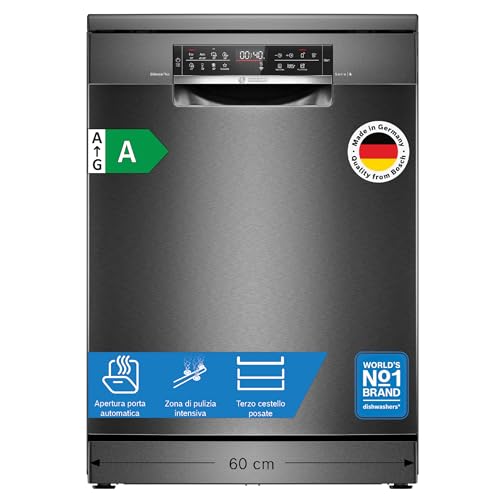

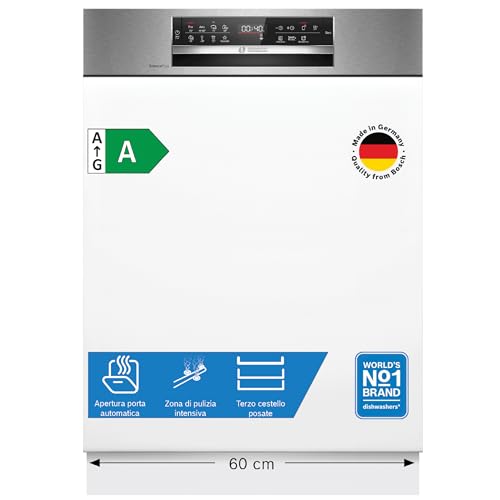
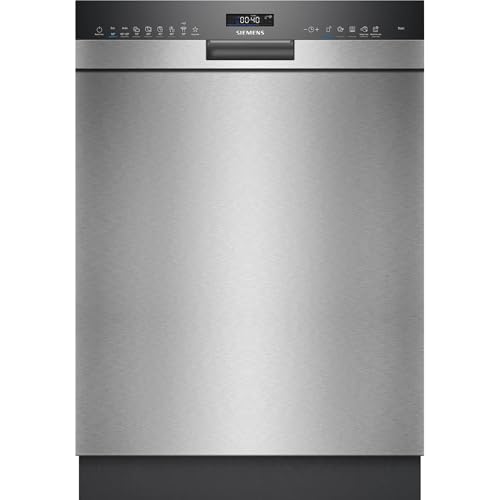
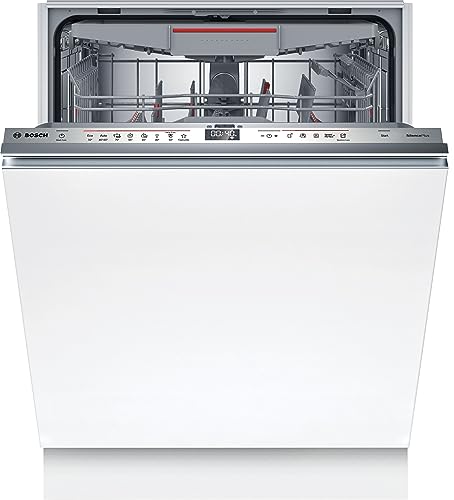
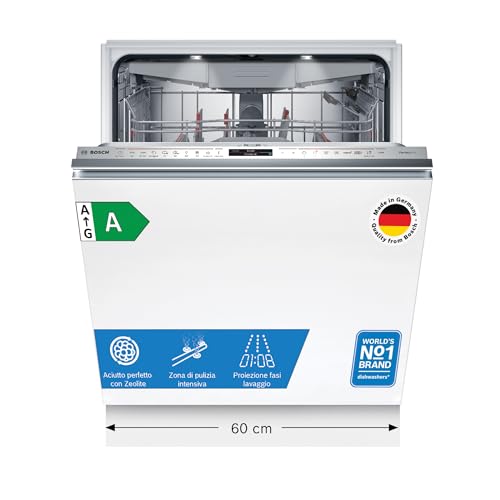
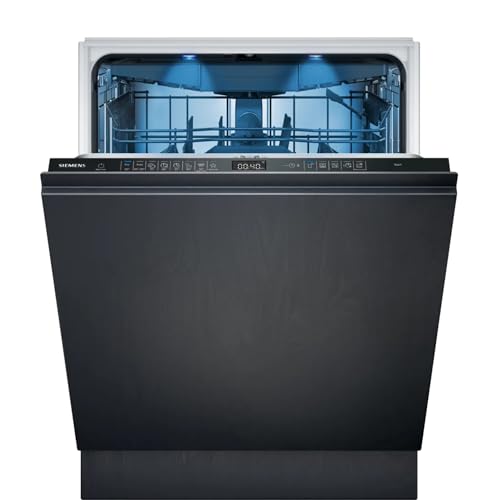
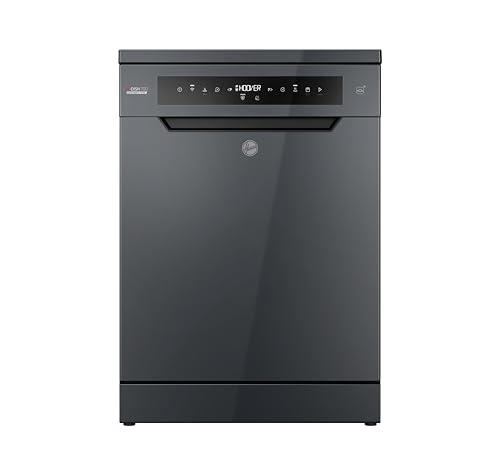
What are the best dishwasher brands of 2026?
The best dishwasher brands of 2026 are ranked below:
- Bosch (Average overall score: 9)
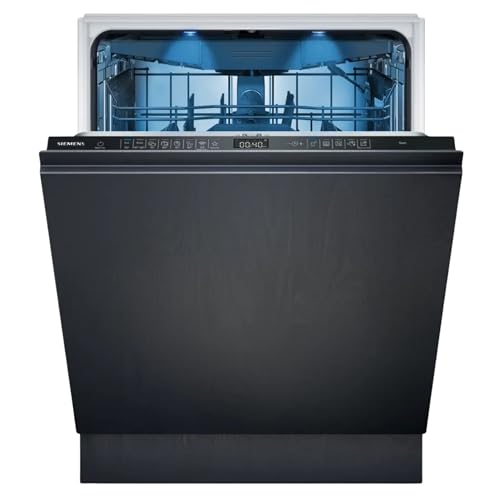
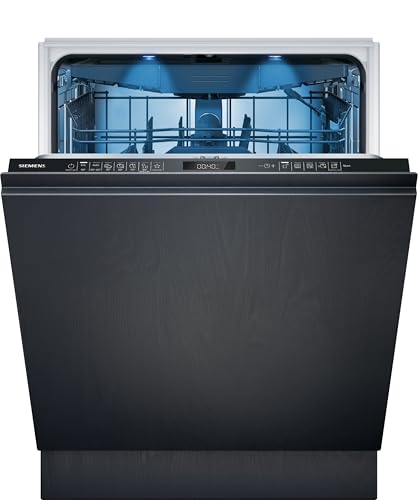
- Siemens (Average overall score: 8.9)
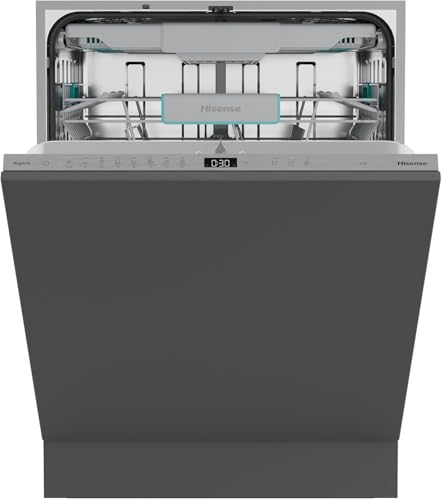
- Hisense (Average overall score: 8.7)
The chart below ranks dishwasher brands by average overall score.
[horizontal-chart-05146734171668731297071529236993497072053739813640]
Which dishwasher brands have the highest user ratings?
The best-rated dishwasher brands according to users are ranked below:
- Bosch (Average user rating: 9.2)
- NEFF (Average user rating: 9.1)
- Siemens (Average user rating: 9.1)
The chart below compares dishwasher brands by average user rating.
[horizontal-chart-06456323325671609400182949171240983806383818286046]
Which dishwasher brands offer the best value for money?
The best dishwasher brands for value for money are ranked below:
- Hisense (Average value-for-money score: 8.6)
- Midea (Average value-for-money score: 8.5)
- Bauknecht (Average value-for-money score: 8.5)
The following chart compares dishwasher brands by average value-for-money score.
[horizontal-chart-16061147246020410925164615276906182911081802039498]

How much do the best dishwashers cost?
The best dishwashers generally cost about £300-£700, although premium models can exceed this range. Price depends on size, installation type, efficiency, noise, rack design, drying technology, and brand support.
Below £340, expect straightforward programs, simpler baskets, basic condensation drying, and often higher noise or consumption. From £300-£600, models more commonly add adjustable racks, automatic programs, stronger leak protection, quieter operation, and more dependable drying.
Above £600, the emphasis shifts to very low noise, advanced drying, flexible third racks, better interior lighting, premium hinges or finishes, and stronger connectivity or service packages. These upgrades can improve convenience, but a higher price does not replace checking cleaning performance and rack suitability.
The chart below shows the price distribution of dishwashers.
[vertical-chart-13013288282940916310170603137035922034661157208393]
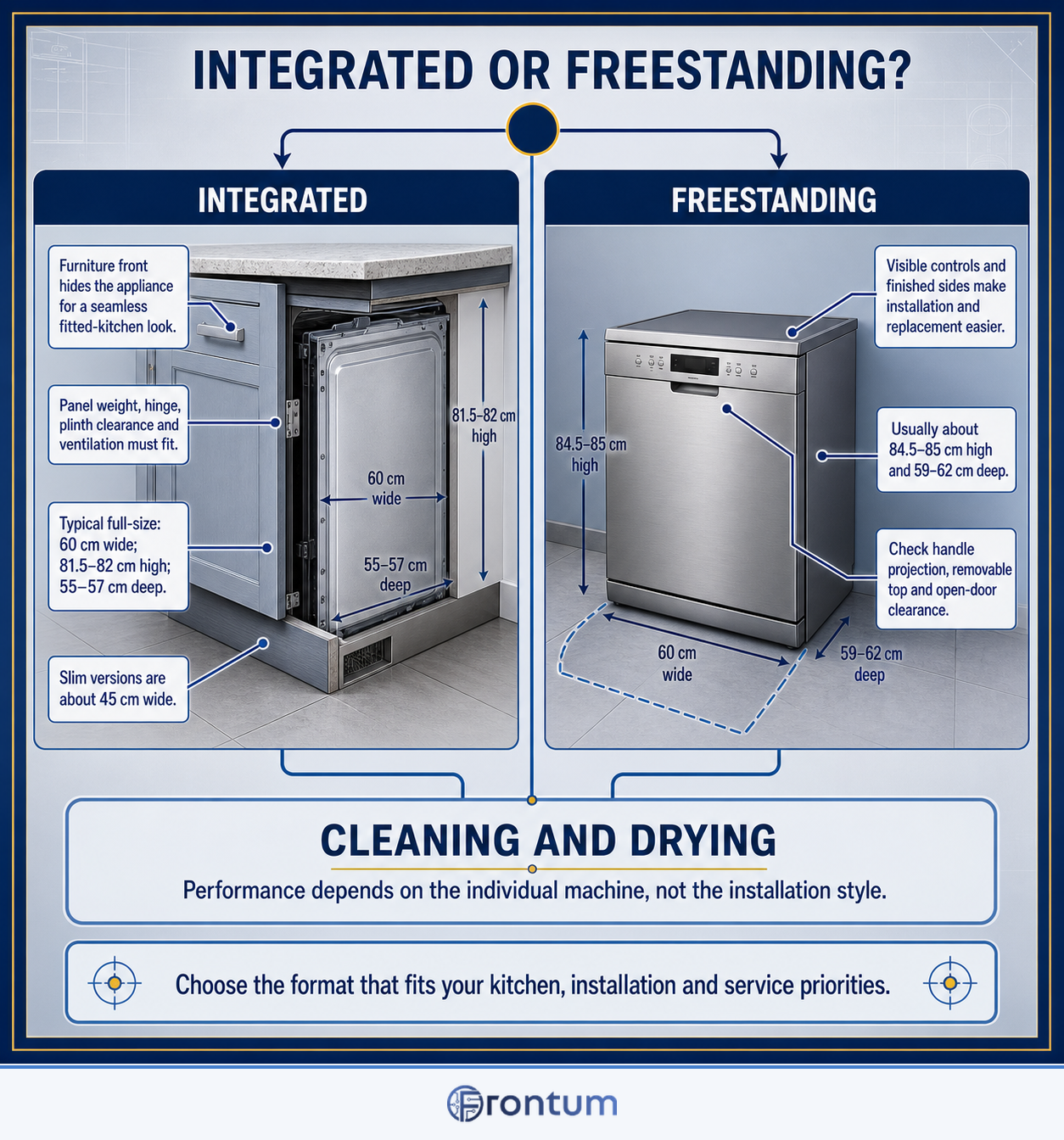
Are integrated dishwashers better than freestanding models?
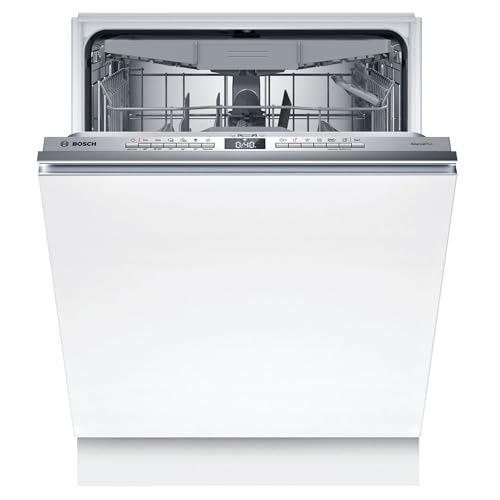
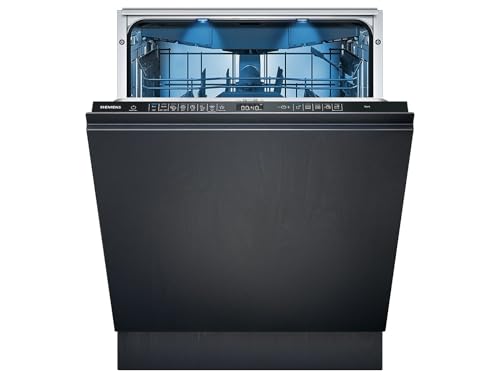
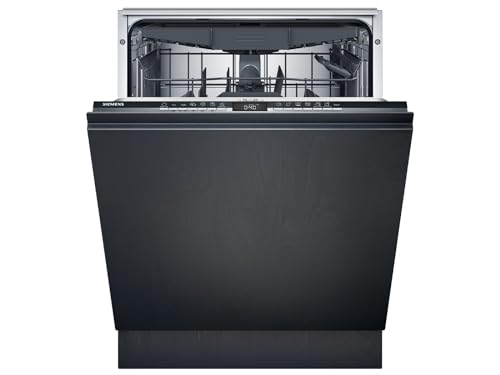
Integrated dishwashers are better when a seamless fitted-kitchen appearance matters most, while freestanding models are better when easier installation, visible controls, and replacement flexibility are priorities. Cleaning and drying performance depend on the individual machine rather than the installation style.
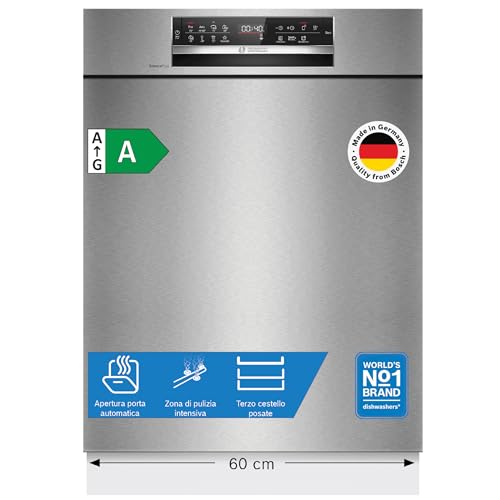
A standard integrated model is commonly about 60 cm wide, 81.5–82 cm high, and 55–57 cm deep before allowing for hoses and the furniture panel; slim versions are about 45 cm wide. A freestanding full-size machine is usually about 84.5–85 cm high and 59–62 cm deep, so replacing one format with the other is not automatically a like-for-like fit.
Integrated installation also requires the correct panel weight, fixed or sliding hinge, plinth clearance, ventilation, and status indication such as InfoLight or time projection. Freestanding machines avoid the furniture-door work and are easier to remove for service, but their finished sides, handle projection, removable top, and open-door clearance still need checking.

How many place settings do the best dishwashers hold?
The best dishwashers usually hold 13–15 place settings in full-size 60 cm models, and 14 place settings is the most common all-round capacity. A place setting represents a standardized group of tableware, so bulky pans, serving dishes, tall glasses, and large plates can reduce the practical load.
Ten to twelve place settings can suit a smaller household or a narrow machine, while 13–14 works well for many three- to five-person homes. Capacities of 15–16 are useful for larger households or fewer, fuller cycles, but rack geometry matters as much as the headline number: adjustable tines, a height-adjustable upper rack, and a third cutlery tray can make the same rated capacity much easier to use.
The chart below shows how dishwasher place-setting capacities are distributed.
[vertical-chart-02450317174712548265115923140661616343303191907458]
What energy efficiency do the best dishwashers have?
The best dishwashers usually have class A or B efficiency on the current A–G scale, while a well-sized class C model can still be a sensible value choice. Typical median Eco consumption is roughly 0.54 kWh for class A, 0.65 kWh for B, 0.75 kWh for C, and 0.84 kWh for D.
At 280 cycles per year, those figures correspond to about 151, 181, 209, and 235 kWh respectively. Using an illustrative electricity price of £0 per kWh, the difference between a 0.54 kWh A-rated machine and a 0.75 kWh C-rated machine is about £10 per year.
Water use is not determined by the letter alone: many A-to-C full-size models cluster around 9–10 L per Eco cycle. Compare energy per 100 cycles, water per cycle, capacity, Eco duration, and noise together rather than treating the class as a complete performance score.
Actual efficiency depends on loading and program choice. A 14-setting machine run sensibly full can use fewer resources per item than a smaller dishwasher that needs two cycles, while quick, intensive, hygiene, and extra-dry modes can consume more than Eco.
How much energy and water do the best dishwashers use per cycle?
The best dishwashers commonly use about 0.5–0.9 kWh and 9–11 L of water per Eco cycle in full-size models. The most efficient examples can use less, while older, larger, or performance-focused models may exceed those ranges.
Use per-cycle figures only for like-for-like comparisons. Eco results reflect the standardized Eco program, whereas intensive washing, hotter hygiene cycles, partial loads, and extra drying can change consumption. A compact dishwasher may use fewer litres per cycle but also wash far fewer place settings, so capacity-adjusted efficiency and how often the machine must run are equally important.
How quiet are the best dishwashers?
The best dishwashers generally operate at roughly 42–46 dB, with models at 44 dB or below particularly well suited to open-plan kitchens and overnight use. Machines around 47–50 dB remain acceptable in a separate kitchen, while levels above 50 dB are more noticeable during water intake, spraying, and draining.
The headline figure is measured under a defined program and does not describe every sound. Motor design, insulation, pump control, cabinet installation, and whether dishes are loaded securely all affect perceived noise. A quiet or night program can help, but it may extend cycle time; prioritize a low rated noise level if silence matters regularly rather than relying only on a special mode.
Which wash programs do the best dishwashers offer?
The best dishwashers offer the following useful wash programs:
- Eco: The normal comparison cycle minimizes energy and water use, but it often takes three to five hours. It is the best default for a full load of normally soiled dishes when speed is unimportant.
- Automatic or sensor: Sensors adjust time, temperature, and water use according to the load and soil level. This is a practical everyday option when loads vary and you do not want to choose settings manually.
- Intensive: Higher temperatures and stronger spray action target baked-on food, pans, and robust cookware. Check that delicate glassware, plastics, and decorated items are excluded from the same load.
- Quick: Current machines offer quick cycles ranging from about 15 to 60 minutes. These programs suit fresh, light soil but may provide weaker drying and are not a substitute for an intensive cycle.
- Delicate or glass: Lower temperatures and gentler pressure protect glassware and fragile items. Good rack support and correct detergent dosing remain important because movement and clouding are separate risks.
- Hygiene or sanitizing: A hotter final stage is useful for baby items, chopping boards, or illness-related cleaning when the manufacturer specifies a hygiene cycle. It usually consumes more energy and may not suit heat-sensitive plastics.
Which convenience features do the best dishwashers have?
The best dishwashers include the following convenience features:
- Flexible racks and cutlery storage: A height-adjustable upper rack, folding tines, and a third tray make room for tall glasses, pans, and awkward utensils. Check whether adjustments can be made while the rack is loaded and whether a tray reduces upper-rack clearance.
- Automatic door opening: Opening the door near the end of the cycle releases steam and improves drying without a prolonged heated phase. Confirm that the feature can be disabled where worktops, children, pets, or narrow walkways make an opening door inconvenient.
- Load and soil sensors: Sensors can adjust water, temperature, and cycle duration for mixed or partial loads. They are most useful when they control a strong automatic program rather than simply adding another marketing label.
- Leak and overflow protection: A protected inlet hose, base tray sensor, and automatic shut-off reduce the damage caused by hose or internal leaks. For an integrated machine, full-time protection is especially valuable because water can remain hidden behind cabinetry.
- Clear controls and indicators: A time-remaining display, floor-projected status light, salt and rinse-aid warnings, delay start, and end signal make long cycles easier to manage. Fully integrated controls should still provide a visible or audible indication that the machine is running.
- Connected controls: Wi-Fi can provide completion alerts, remote diagnostics, program downloads, and maintenance reminders. Treat app control as a secondary benefit because loading, detergent, and door closure still require physical interaction.