
What household size is an eight-place-setting dishwasher suitable for?
An eight-place-setting dishwasher is usually suitable for one or two people who cook regularly, or up to three people when loads contain mostly plates, cups, and cutlery rather than large pans. It can also suit a holiday home, office kitchen, studio, or household that runs the dishwasher daily.
It is less suitable for a family of four, frequent entertaining, or cooking that generates several pots, trays, and preparation bowls. Place-setting standards use a defined set of tableware and do not represent bulky cookware, so an eight-setting rack may fill after one dinner even when fewer than eight people ate. Choose by peak daily load rather than average household size: if the machine would regularly require two cycles, a 9–10-setting slim or 13–14-setting full-size dishwasher may use less time and fewer resources per item.
How many dishes fit in an eight-place-setting dishwasher?
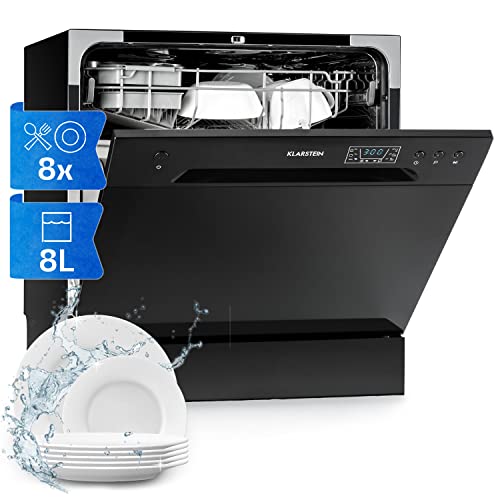
An eight-place-setting dishwasher nominally fits eight dinner plates, eight dessert plates, eight soup bowls, eight cups and saucers, eight glasses, and the associated cutlery and serving pieces defined by the test standard. The actual rack may not accept all of those items in household sizes and shapes at once.
In practical use, expect roughly one day of tableware for one or two people, or one main meal for three people. A frying pan, saucepan, chopping bowl, tall glasses, or reusable containers can consume the space allocated to several formal place settings.
Rack design determines whether the capacity is usable. A height-adjustable upper basket can trade glass clearance for larger plates, while folding supports provide pan space; a fixed cutlery basket may occupy valuable lower-rack area.
Check maximum plate diameter, upper-rack height, folding supports, cup shelves, cutlery storage, spray-arm clearance, and whether a pan blocks detergent release. Loading dimensions or an in-person test are more useful than photographs of an empty basket.

What dimensions does an eight-place-setting dishwasher have?
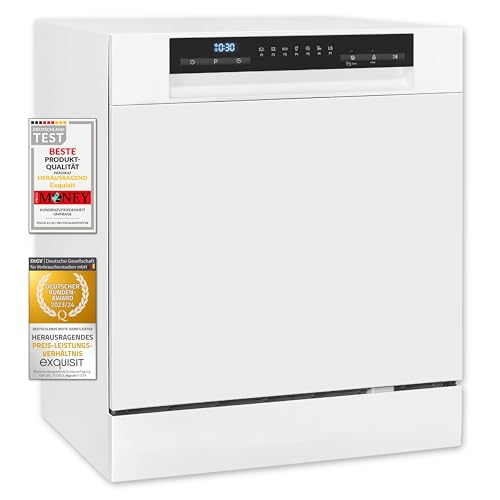
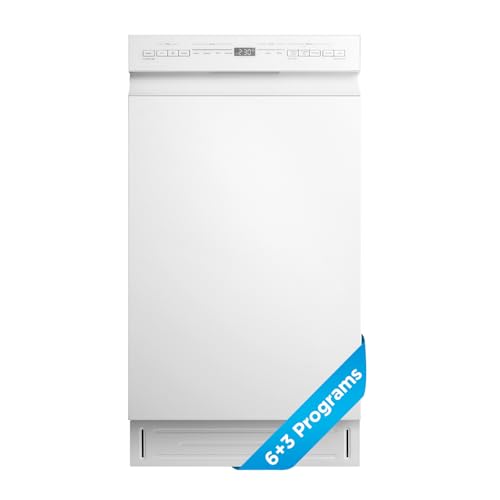
An eight-place-setting dishwasher has no single standard size because the capacity appears in several formats. Countertop or compact models are often around 55 cm wide, 50 cm deep, and 44–60 cm high; slim under-counter models can be about 45 cm wide, 55–58 cm deep, and 82 cm high; compact built-in designs may be close to 60 cm wide but shorter than a standard dishwasher.
Measure the opening at the front, middle, and rear, then allow space for hoses, cable, ventilation, door projection, and the water and drain connections. Countertop models also need a stable surface and enough height beneath wall cabinets, while built-in units require correct furniture support and trim.
Do not assume eight settings means smaller external dimensions than a 9–10-setting model. A similarly sized alternative may provide more usable capacity, better racks, quieter operation, and wider parts availability.
How much energy and water does an eight-place-setting dishwasher use?
An eight-place-setting dishwasher typically uses about 0.7–0.8 kWh and 9–10 L per Eco cycle, but compact design does not automatically make it more efficient per dish than a larger machine. Compare the label’s energy per 100 cycles, water per cycle, Eco duration, and declared capacity.
At 280 cycles per year, 0.72 kWh per cycle equals about 202 kWh. At £0 per kWh, that is roughly £50 per year for electricity before water, detergent, salt, and rinse aid. Loading efficiency is decisive: one full eight-setting cycle can be economical, but two cycles use much more than one sensibly loaded 14-setting cycle, and quick, intensive, hygiene, or extra-dry programs can exceed the Eco figures.
How much do eight-place-setting dishwashers cost?
Eight-place-setting dishwashers generally cost about £300-£600. Format, dimensions, installation, noise, energy class, rack design, drying, and brand availability explain most of the range.
Around £300-£300, expect basic countertop or freestanding products, simpler racks, conventional drying, and approximately 49–52 dB. From £340-£470, better controls, adjustable racks, lower consumption, and more flexible compact or built-in formats may appear.
Above about £470, require a concrete benefit such as quieter 45 dB operation, automatic drying, stronger efficiency, premium construction, or a specialized compact built-in size. With so few exact eight-setting models, compare 6-, 9-, and 10-setting alternatives before accepting a scarcity premium.
What should you consider when choosing an eight-place-setting dishwasher?
Before buying an eight-place-setting dishwasher, consider the following factors:
- Real household capacity: Eight place settings normally suit one or two people, or a compact household that runs the machine frequently, rather than eight complete daily diners. Test the actual combination of plates, bowls, mugs, pans, food containers, and cutlery because cookware consumes far more space than the standardized place-setting load.
- External size and installation: Measurements should cover width, height, body depth, door swing, hose route, ventilation gap, and the clearance needed to connect water and waste. Compact machines may be narrower or shorter than full-size units but can still project beyond shallow cabinets once hoses and plugs are included.
- Rack geometry: Check plate-diameter limits, upper-rack adjustment, folding tines, cutlery basket position, stemware supports, and whether a frying pan can stand without blocking the spray arm. In a small tub, one poorly positioned basket component can remove a significant fraction of usable capacity.
- Programs and temperatures: The essential program set includes a dependable Eco cycle, an Auto or normal program, a 65–70 °C intensive option for cookware, and a short cycle with clearly stated load limits. Half-load functions are less important in an eight-place machine unless they genuinely alter water and energy use.
- Drying system: The specification should state whether the machine relies on residual-heat condensation, fan assistance, or automatic door opening. Small tubs retain moisture around plastics, so compare declared drying results, end-of-cycle ventilation, and whether steam could affect a worktop or nearby cabinet edge.
- Noise and consumption: For open living areas, target approximately 42–44 dB; values near 47–49 dB are much more noticeable during evening cycles. For an eight-place machine, roughly 0.55–0.75 kWh and 7–9 L per Eco cycle is good; above 0.85 kWh or 10 L is relatively high unless the cycle washes unusually bulky loads.
- Long-term practicality: Consider whether an eight-place machine will remain adequate after changes in household size, cooking habits, or entertaining. Verify leak protection, filter access, rack-part availability, warranty terms, and the price difference to a slim nine- or ten-place model before committing.