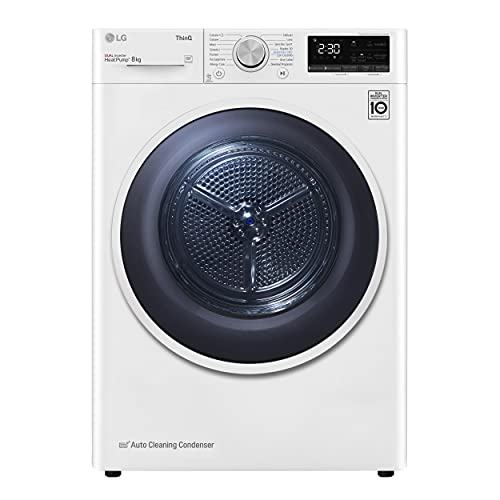
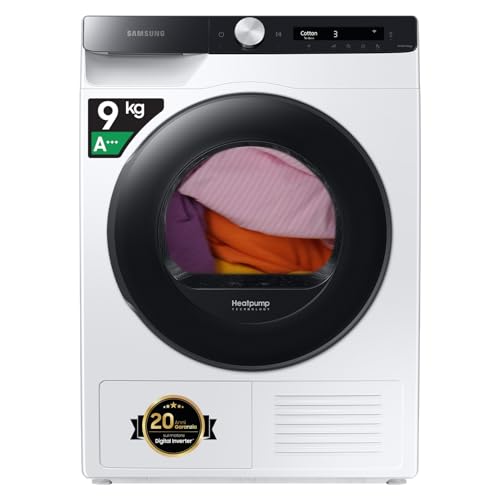
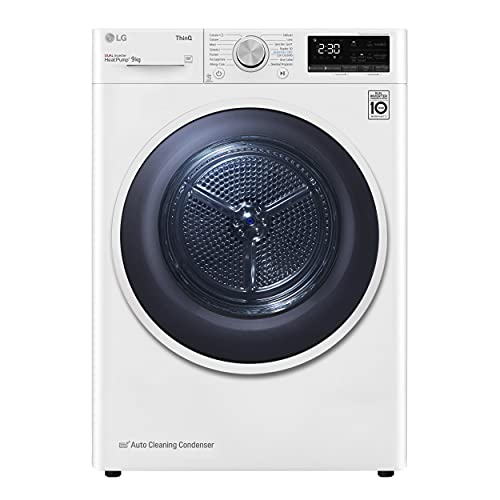
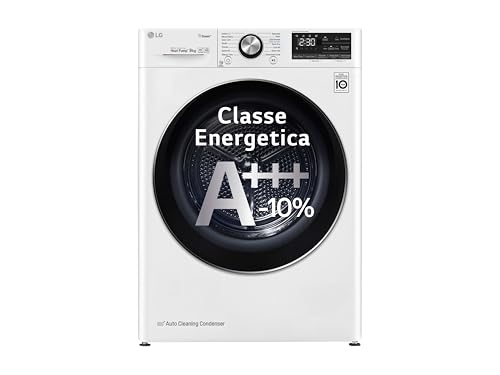
Low energy consumption for partial load (0.89 kWh)
Extended motor warranty (20 year/s)
Supports Wi-Fi
Advanced drying technology (heat pump)
Why avoid?
Wide width (60 cm)
Higher price
Heavy design (50 kg)
Does not support gentle drying
Long ECO cycle duration (220 min)
Tall height (85 cm)
Non-adjustable temperature
Does not have a jeans program
Avg. price:~£800|
Capacity:9 kg|
Energy efficiency class:A+++|
Drying technology:heat pump
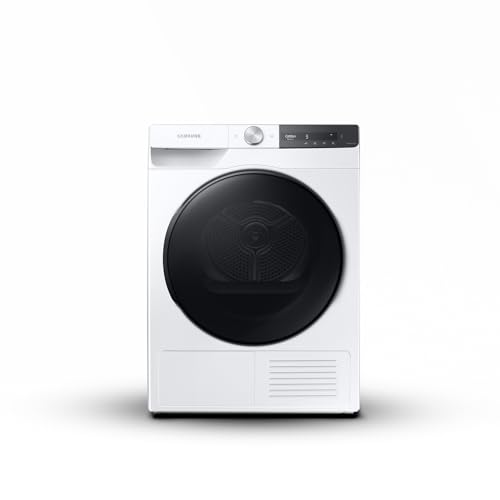
Samsung DV90T6240LH Series 6 uses heat pump technology to deliver efficient drying with a low energy use of just 1.54 kWh per full load and a quiet operation at 63 dB. Its 9 kg cap...Read more
Low energy consumption for partial load (0.89 kWh)
Extended motor warranty (20 year/s)
Supports Wi-Fi
Advanced drying technology (heat pump)
Why avoid?
Wide width (60 cm)
Higher price
Heavy design (50 kg)
Does not support gentle drying
Long ECO cycle duration (220 min)
Tall height (85 cm)
Non-adjustable temperature
Does not have a jeans program
Avg. price:~£800|
Capacity:9 kg|
Energy efficiency class:A+++|
Drying technology:heat pump
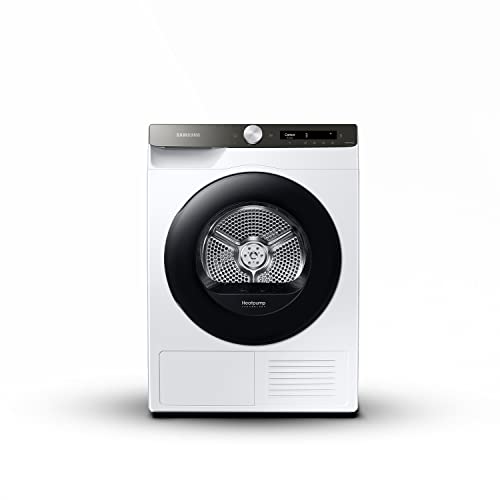
Samsung DV90T5240AN Series 5+ combines advanced heat pump technology with AI Control that learns user habits and suggests optimal programs from its 14 options. Its OptimalDry syste...Read more
Low energy consumption for partial load (0.89 kWh)
Extended motor warranty (20 year/s)
Supports Wi-Fi
Advanced drying technology (heat pump)
Why avoid?
Wide width (60 cm)
Heavy design (50 kg)
Does not support gentle drying
Long ECO cycle duration (220 min)
Tall height (85 cm)
Non-adjustable temperature
Higher price
Does not have a jeans program
Avg. price:~£600|
Capacity:9 kg|
Energy efficiency class:A+++|
Drying technology:heat pump
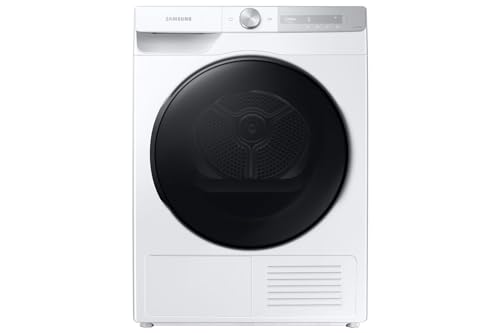
Samsung DV90T5240AW/S1 DV5000T has a 9 kg capacity, operates quietly at 63 dB, and consumes only 1.54 kWh per full load. It includes AI Control, humidity sensors, smart diagnostics...Read more
Samsung DV80T7220BT DV7000T is a heat pump dryer with an 8 kg capacity and advanced features like AI Control, OptimalDry sensors, and a quiet Digital Inverter Motor backed by a 20-...Read more
Low energy consumption for partial load (0.89 kWh)
Extended motor warranty (20 year/s)
Supports Wi-Fi
Advanced drying technology (heat pump)
Why avoid?
Wide width (60 cm)
Heavy design (50 kg)
Does not support gentle drying
Long ECO cycle duration (220 min)
Tall height (85 cm)
Non-adjustable temperature
Higher price
Does not have a jeans program
Avg. price:~£620|
Capacity:9 kg|
Energy efficiency class:A+++|
Drying technology:heat pump
Samsung DV90T5240AT DV5000T is a heat pump dryer with a 9 kg capacity, low energy use at just 1.54 kWh per full load, and quiet 63 dB operation. AI Control, humidity sensors, and t...Read more
Low energy consumption for partial load (0.89 kWh)
Extended motor warranty (20 year/s)
Supports Wi-Fi
Advanced drying technology (heat pump)
Why avoid?
Wide width (60 cm)
Higher price
Heavy design (50 kg)
Does not support gentle drying
Poor ratio quality/price
Long ECO cycle duration (220 min)
Tall height (85 cm)
Non-adjustable temperature
Avg. price:~£1,140|
Capacity:9 kg|
Energy efficiency class:A+++|
Drying technology:heat pump
Samsung DV90T7240BH DV7000T integrates a 9 kg capacity with heat pump technology, delivering high efficiency at just 1.54 kWh per full load. Its 17 drying programs, AI Control, hum...Read more
Low energy consumption for partial load (0.85 kWh)
Has an inverter motor
Extended motor warranty (20 year/s)
Supports Wi-Fi
Advanced drying technology (heat pump)
Why avoid?
Wide width (60 cm)
Higher price
Heavy design (50 kg)
Does not support gentle drying
Tall height (85 cm)
Non-adjustable temperature
Long ECO cycle duration (215 min)
Does not have a jeans program
Avg. price:~£740|
Capacity:9 kg|
Energy efficiency class:A+++|
Drying technology:heat pump
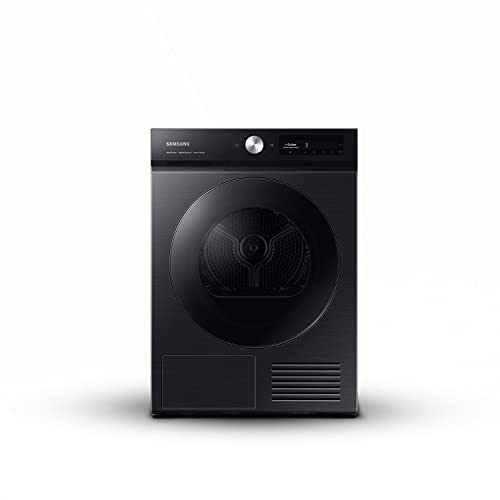
Samsung DV90BB7445GBS3 Bespoke AI Quickdry pioneers intelligent drying with comprehensive AI integration, consuming 1.46 kWh per full load while reducing energy use by up to 20% th...Read more
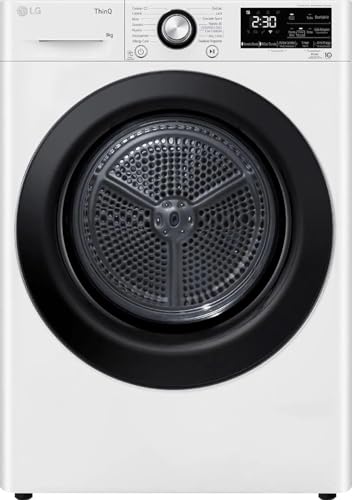
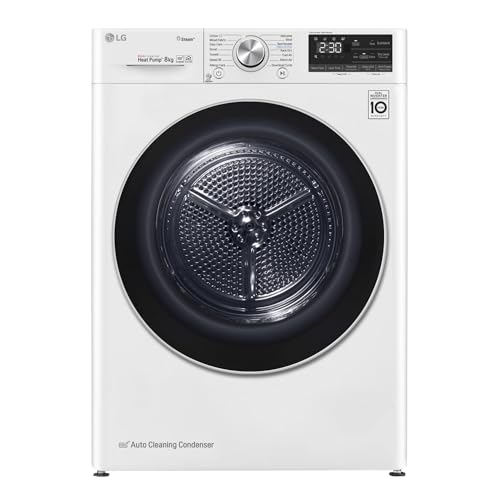
LG RH80V9AVHN is a heat pump dryer with 8 kg capacity, low energy use at just 1.47 kWh per full load, and a strong A+++ efficiency rating. It includes 14 programs, guided drying, h...Read more
Low energy consumption for partial load (0.89 kWh)
Extended motor warranty (20 year/s)
Supports Wi-Fi
Advanced drying technology (heat pump)
Why avoid?
Wide width (60 cm)
Higher price
Heavy design (50 kg)
Does not support gentle drying
Long ECO cycle duration (220 min)
Tall height (85 cm)
Non-adjustable temperature
Poor ratio quality/price
Avg. price:~£930|
Capacity:9 kg|
Energy efficiency class:A+++|
Drying technology:heat pump
Samsung DV90T5240AE DV5000T showcases heat pump technology with 9kg capacity, consuming 1.54 kWh per full load while running at 63 dB noise level. The dryer includes 16 advanced fe...Read more
Low energy consumption for partial load (0.86 kWh)
High n. of drying programs (14)
Has an inverter motor
Low energy consumption for full load (1.66 kWh)
Extended motor warranty (10 year/s)
Supports Wi-Fi
Advanced drying technology (heat pump)
Why avoid?
Bulky (351,900 cm³)
Large depth (69 cm)
Wide width (60 cm)
Heavy design (57 kg)
No bidirectional motion for even drying
Lacks a laundry detection system
Does not have a refresh program
Higher price
Avg. price:~£910|
Capacity:9 kg|
Energy efficiency class:A+++|
Drying technology:heat pump
LG RH90V9AVHN is a heat pump dryer with a 9 kg capacity, designed for quiet operation at just 62 dB and strong energy efficiency rated A+++, consuming only 1.66 kWh per full load. ...Read more
Low energy consumption for partial load (0.77 kWh)
Low energy consumption for full load (1.46 kWh)
High n. of drying programs (14)
Has an inverter motor
Extended motor warranty (10 year/s)
Supports Wi-Fi
Advanced drying technology (heat pump)
Why avoid?
Bulky (351,900 cm³)
Large depth (69 cm)
Wide width (60 cm)
Heavy design (57 kg)
No bidirectional motion for even drying
Lacks a laundry detection system
Long ECO cycle duration (239 min)
Does not have a refresh program
Avg. price:~£1,040|
Capacity:9 kg|
Energy efficiency class:A+++|
Drying technology:heat pump
LG RC90V9AV2W is a 9 kg heat pump dryer with excellent energy efficiency at just 1.46 kWh per cycle and a quiet 62 dB operation. It includes 14 programs, Wi-Fi connectivity, smart ...Read more
Low energy consumption for partial load (0.89 kWh)
Quiet during operation (61 dB)
Supports Wi-Fi
Advanced drying technology (heat pump)
Why avoid?
Heavy design (55.9 kg)
Lower drum volume (112 L)
Limited motor warranty (2 year/s)
Lacks a laundry detection system
Wide width (59.8 cm)
Does not have a refresh program
Higher price
Slow fast cycle duration (40 min)
Avg. price:~£970|
Capacity:9 kg|
Energy efficiency class:A+++|
Drying technology:heat pump
Bosch WQB245B40 Serie 8 achieves exceptional quietness at just 61 dB while maintaining heat pump technology with eco-friendly R290 refrigerant gas for zero environmental impact. Th...Read more
Low energy consumption for partial load (0.87 kWh)
Low energy consumption for full load (1.59 kWh)
Has an inverter motor
Extended motor warranty (10 year/s)
Supports Wi-Fi
Advanced drying technology (heat pump)
Why avoid?
Louder during operation (69 dB)
Long ECO cycle duration (235 min)
Does not support gentle drying
Tall height (85 cm)
Non-adjustable temperature
Does not have a duvet program
No built-in drum light
Lower user score
Avg. price:~£440|
Capacity:9 kg|
Energy efficiency class:A+++|
Drying technology:heat pump
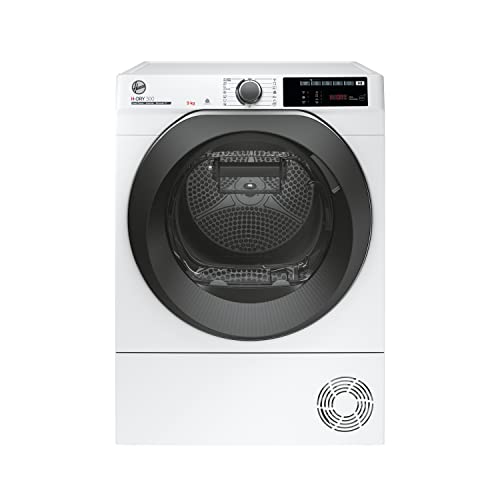
Hoover H-DRY 500 NDEH9A3TCBEXS relies on heat pump technology and an Eco-Power Motor to ensure efficient drying for loads up to 9 kg while maintaining low energy consumption at 1.5...Read more
Low energy consumption for partial load (0.81 kWh)
Has an inverter motor
Extended motor warranty (10 year/s)
Supports Wi-Fi
Advanced drying technology (heat pump)
Why avoid?
Louder during operation (69 dB)
Does not support gentle drying
Tall height (85 cm)
Non-adjustable temperature
Does not have a duvet program
Lower user score
No built-in drum light
Long ECO cycle duration (205 min)
Avg. price:~£450|
Capacity:8 kg|
Energy efficiency class:A+++|
Drying technology:heat pump
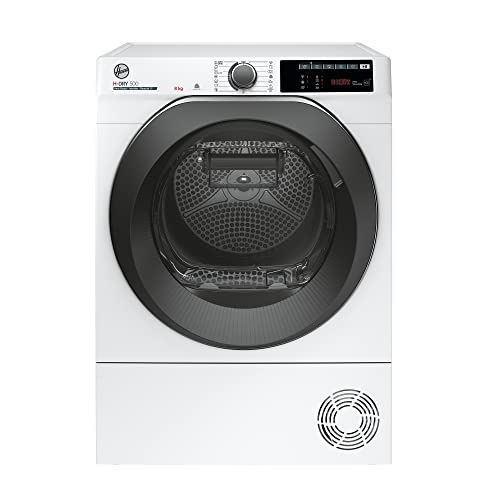
Hoover H-DRY 500 NDEH8A3TCBEXS runs on heat pump technology and consumes only 1.42 kWh per full load, placing it among the most energy-efficient dryers available. It supports 15 pr...Read more
Low energy consumption for partial load (0.91 kWh)
Large drying capacity (10 kg)
Low energy consumption for full load (1.78 kWh)
Extended motor warranty (10 year/s)
Supports Wi-Fi
Why avoid?
Bulky (351,900 cm³)
Large depth (69 cm)
Wide width (60 cm)
Heavy design (58 kg)
No bidirectional motion for even drying
Long ECO cycle duration (278 min)
Lacks a laundry detection system
Does not have a refresh program
Avg. price:~£700|
Capacity:10 kg|
Energy efficiency class:A+++|
Drying technology:heat pump
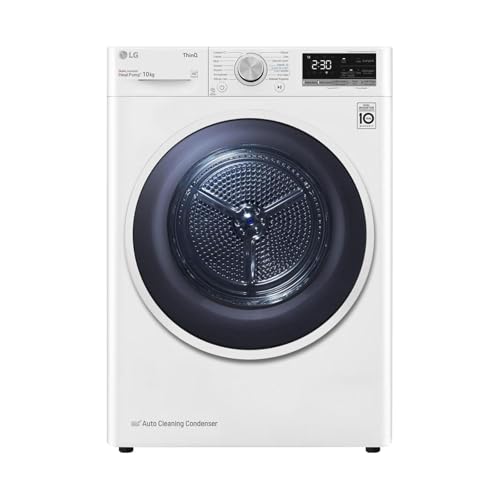
LG RH10V9AV4W relies on Dual Inverter heat pump technology to keep energy use low, with just 1.78 kWh per full load and an A+++ rating. It supports a large 10 kg capacity, offers 1...Read more
Bosch WTX87MH9IT Serie 8 runs on heat pump technology with eco-friendly R290 gas and ensures high efficiency with just 1.61 kWh per full load. It supports 14 programs, including Al...Read more
Bosch WTX87EH9IT Home Professional uses heat pump technology with eco-friendly R290 gas, ensuring high energy efficiency rated A+++, and consumes only 1.61 kWh per full load. It fe...Read more
Low energy consumption for partial load (0.84 kWh)
Low energy consumption for full load (1.55 kWh)
Has an inverter motor
Supports Wi-Fi
Advanced drying technology (heat pump)
Large drying capacity (9 kg)
Why avoid?
Lacks post-dry tumbling to prevent wrinkles
Bulky (325,743.8 cm³)
Heavy design (62 kg)
Large depth (64.3 cm)
Limited motor warranty (2 year/s)
Higher price
Poor ratio quality/price
Tall height (85 cm)
Avg. price:~£1,410|
Capacity:9 kg|
Energy efficiency class:A+++|
Drying technology:heat pump
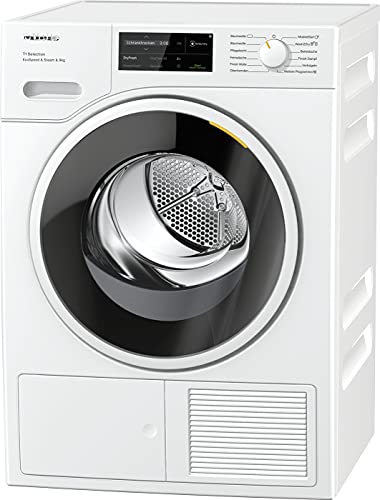
Miele TSL 783 WP T1 Selection delivers outstanding drying performance with its heat pump technology, 9 kg capacity, and 22 specialized programs like HygieneDry, Wool Finish, and Wa...Read more
Low energy consumption for partial load (0.86 kWh)
High n. of drying programs (14)
Has an inverter motor
Low energy consumption for full load (1.66 kWh)
Extended motor warranty (10 year/s)
Supports Wi-Fi
Advanced drying technology (heat pump)
Why avoid?
Bulky (336,600 cm³)
Wide width (60 cm)
Large depth (66 cm)
No bidirectional motion for even drying
Heavy design (52 kg)
Lacks a laundry detection system
Does not have a refresh program
Does not have a shirt program
Avg. price:~£610|
Capacity:9 kg|
Energy efficiency class:A+++|
Drying technology:heat pump
LG RH90V9AVBN incorporates Dual Inverter heat pump technology that reduces energy consumption by 32% through intelligent compression speed control, achieving 1.66 kWh per full load...Read more
Low energy consumption for partial load (0.71 kWh)
Low energy consumption for full load (1.32 kWh)
High n. of drying programs (14)
Has an inverter motor
Extended motor warranty (10 year/s)
Supports Wi-Fi
Advanced drying technology (heat pump)
Why avoid?
Bulky (351,900 cm³)
Large depth (69 cm)
Wide width (60 cm)
Heavy design (58 kg)
No bidirectional motion for even drying
Lacks a laundry detection system
Does not have a refresh program
Does not have a shirt program
Avg. price:~£670|
Capacity:8 kg|
Energy efficiency class:A+++|
Drying technology:heat pump
LG RC80V9AV3W runs with Dual Inverter heat pump technology and achieves excellent energy efficiency, consuming just 1.32 kWh per full load. With 14 drying programs, Wi-Fi control, ...Read more
As an Amazon Associate, we earn from qualifying purchases.
1
2
...
20
Next page
To find the best tumble dryer, we compared 388 models from 47 brands by analyzing 31816 technical data points and 96347 user reviews. Each dryer received an overall score from 1 to 10 (1 being the lowest, 10 the highest).
The overall score combines a technical score (70%) and a user ratings score (30%). The technical score evaluates performance (35%), drying programs (25%), features (30%), and design (10%). The user ratings score considers the average rating of reviews (80%) and the number of reviews (20%).
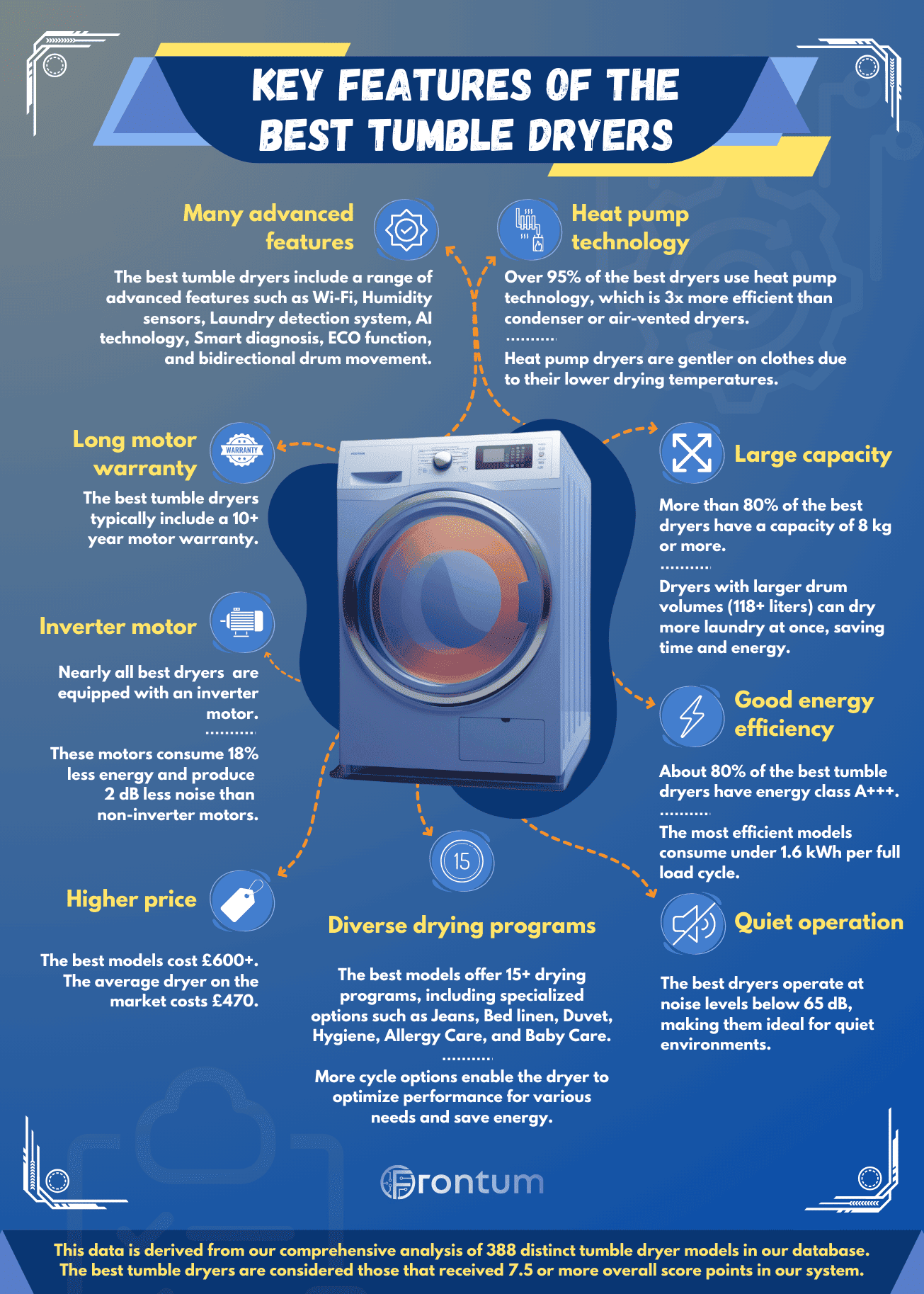
The best tumble dryers use heat pump drying technology, consume less energy (A+++ class, under 1.6 kWh per full load, under 0.8 kWh per partial load), and operate quietly (under 65 dB). These dryers have a high-efficiency inverter motor and advanced features such as a laundry detection system, humidity sensors, anti-crease functions (post-drying drum movement and bidirectional drum movement), Wi-Fi connectivity, smart pairing with a washing machine, ECO function, AI technology, special drum design, and interior light. The best models also receive high ratings from users.
The best tumble dryer is Samsung DV90T6240LH Series 6 with an overall score of 9.08 points, a technical score of 9.12, and user ratings of 8.99 points.
The best tumble dryer brands (with the highest overall score) are as follows.
Samsung (Average overall score: 9)
LG (Average overall score: 8.6)
Hoover (Average overall score: 8.4)
The chart below ranks dryer brands based on their overall scores.
[horizontal-chart-33837636474424437]
Which dryer brands have the highest user ratings?
The tumble dryers brands with the highest user ratings are as follows.
Siemens (Average user ratings: 9.3)
Bosch (Average user ratings: 9.3)
LG (Average user ratings: 9.3)
Dryer brands are ranked by user ratings in the following chart.
[horizontal-chart-33067635662423388]
Which dryer brands offer the best value for money?
The following tumble dryer brands offer the best ratio quality-price.
Hoover (Average ratio quality-price score: 8.3)
Candy (Average ratio quality-price score: 8.2)
Samsung (Average ratio quality-price score: 8.2)
The chart below compares dryer brands based on their quality-price ratio.
[horizontal-chart-39121241615425747]
Heat pump vs Condenser vs Air vented: Which type of tumble dryer is the best?
The best type of tumble dryer depends on your priorities, such as energy efficiency, cost, installation, and drying time.
Heat pump dryers are the most energy-efficient, saving money on electricity over time and are gentler on clothes due to lower drying temperatures, but tend to have a higher upfront cost.
Condenser dryers have a mid-range cost and have simpler mechanism and flexible installation.
Air vented dryers are the cheapest and have the fastest drying times but are the least energy-efficient and require installation near a wall or window for venting.
Generally speaking, heat pump technology offers the most benefits among all types. They have the highest initial price but are much more energy efficient during the drying process, so the initial higher cost will pay itself in a few years.
The following chart illustrates the distribution of drying technologies among dryers.
[pie-chart-18965018852617702]
What are the main advantages of heat pump dryers?
Heat pump tumble dryers have several advantages compared to condenser and air vented dryers:
Use much less energy as they recycle hot air and dry at lower temperatures (44% have energy class A+++ and 94% have A++, while no condenser or air vented dryer has these classes)
Consume less electricity (1.85 kWh per full load vs 4.7 kWh for condenser and 4.4 kWh for air vented; 227 kWh annual use vs 561 kWh and 510 kWh)
Recover water more efficiently (about 30% have water recovery class A vs less than 5% of the other types)
Work more quietly on average (65 dB vs 67.5 dB for condenser and 66.5 dB for air vented)
Include Duvet and Hygiene cycles more often than other types
Include more features such as silent function, ECO function, ECO indicator, Wi-Fi, smart pairing, interior light, special drum design, reversible door, and antivibration design
Dry clothes more gently due to lower temperatures, suitable for delicate fabrics
Include Inverter motor in 53% of models vs less than 10% in condenser and air vented dryers
Air vented tumble dryers have several advantages compared to heat pump and condenser models. The following series highlight the key benefits:
Affordability: Vented dryers cost much less on average than heat pump and condenser models (£240 vs £540 vs £320).
Eco cycle duration: The Eco cycle runs 65 minutes faster than in heat pump dryers and 10 minutes faster than in condenser dryers (140 min vs 205 min vs 150 min).
Weight and size: Vented dryers are much lighter than heat pump models (28 kg vs 48 kg) and weigh 7 kg less than condenser dryers (28 kg vs 35 kg).
They also take up less space on average (2.74 m³ vs 3.08 m³ for heat pump dryers and 2.96 m³ for condenser dryers).
Ease of use and maintenance: These dryers have a simpler design and require less upkeep since they do not need a water tank emptied or a condenser unit cleaned.
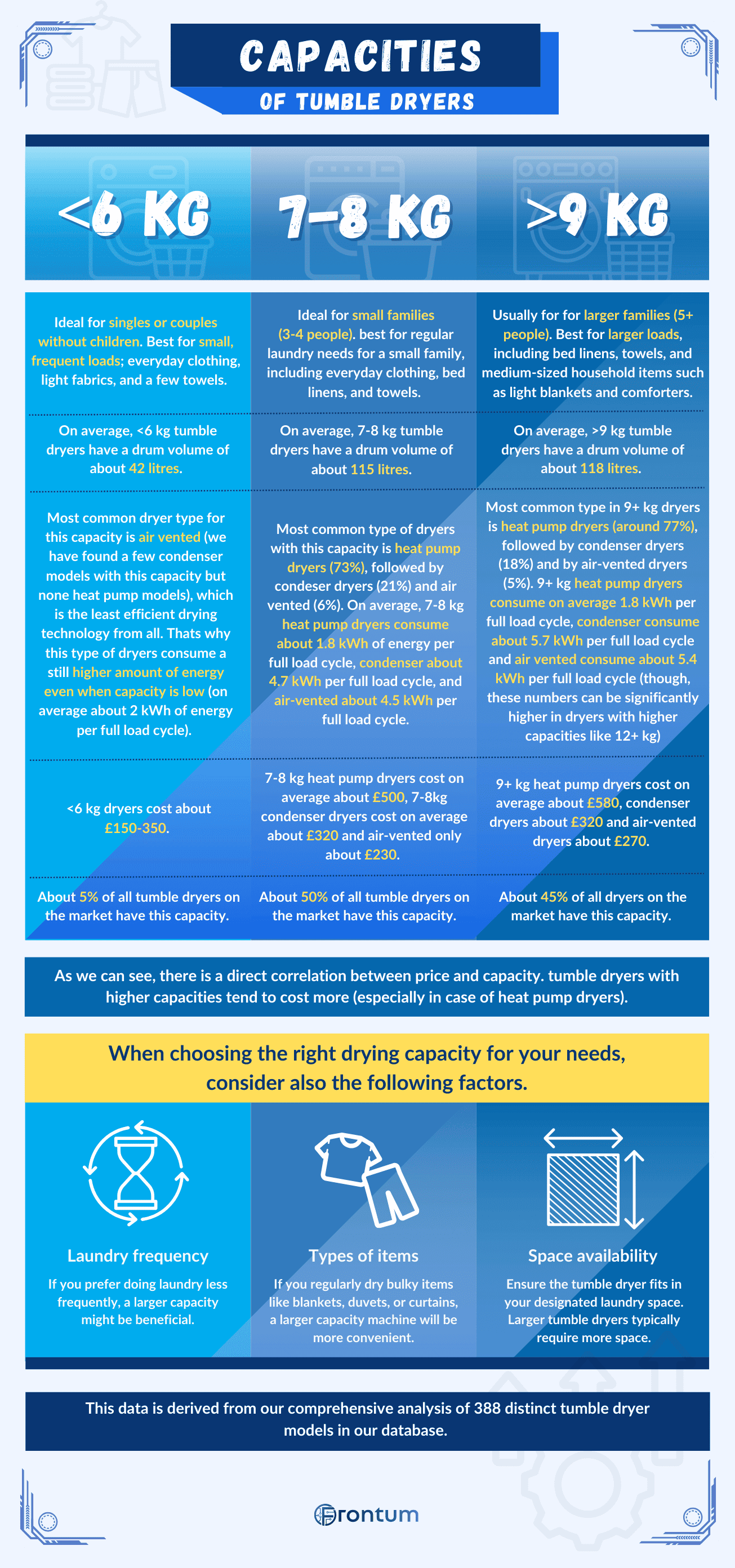
Less than 6 kg: Best for singles or couples without children. Handles small, frequent loads such as everyday clothing, light fabrics, and a few towels. Average drum volume is about 42 litres. Most models use air vented technology, which consumes about 2 kWh per full load cycle and has the highest energy use among all types. Few condenser models exist in this size, no heat pump models. Prices range from £150 to £340. Around 5% of dryers on the market have this capacity.
7–8 kg: Fits needs of small families (3–4 people). Dries everyday clothes, bed linens, and towels. Average drum volume is about 115 litres. Heat pump dryers are the most common (72%), followed by condenser (22%) and air vented (6%). Heat pump dryers use about 1.85 kWh per cycle, condenser about 4.7 kWh, and air vented about 4.5 kWh. Average prices: Heat pump £520, condenser £330, air vented £240. Around 50% of dryers on the market fall in this range.
More than 9 kg: Suits larger families (5+ people). Handles bigger loads like bed linens, towels, light blankets, and comforters. Average drum volume is about 118 litres. Heat pump models lead at (77%), followed by condenser (18%) and air vented (5%). Heat pump dryers use about 1.78 kWh per cycle, condenser about 5.7 kWh, and air vented about 5.4 kWh. Usage may rise in dryers over 12 kg. Average prices: Heat pump £600, condenser £320, air vented £280. About 45% of dryers on the market have this capacity.
Dryers with larger capacity usually cost more (especially heat pump models).
Choose dryer capacity based on how often you do laundry, what items you dry, and the space in your laundry area.
The chart below highlights how dryer capacities vary across models.
[vertical-chart-16166916989116913]
What are slim dryers and when to buy one?
Slim tumble dryers have a depth of less than 50 cm. About 7% of all tumble dryers on the market fall into this category, including small tumble dryers designed for limited spaces or lower laundry capacities. The average volume of a slim dryer is about 55% smaller than the market average (0.14 m³ vs 0.31 m³).
The following dryer types are most common among slim models:
Air-vented dryers: 65% of slim dryers belong to this category. These dryers are the most compact because they use a simpler drying mechanism where air is heated, passed through the drum, and vented outside.
Heat pump dryers: 28% of slim models use this technology.
Condenser dryers: 7% of slim dryers fall into this category.
Slim tumble dryers consume less energy than non-slim models. For example, a slim air-vented dryer uses about 1.9 kWh per full load cycle, while a non-slim air-vented dryer consumes around 5 kWh per cycle.
Which energy class do the best tumble dryers have?
The best tumble dryers have energy classes A+++ or A++.
The distribution of energy classes for tumble dryers is:
A+++: 31%
A++: 67%
A+: 5%
B: 18%
C: 9%
D: less than 1%
Brands sometimes state their dryers belong to classes like A+++-20% or A+++-10%. These classes are unofficial, so they do not appear on energy labels. They indicate dryers are 10% or 20% more efficient than standard A+++ models.
According to our data, dryers with A+++ or A++ classes are always heat pump models. Condenser and air-vented dryers never reach these high classes.
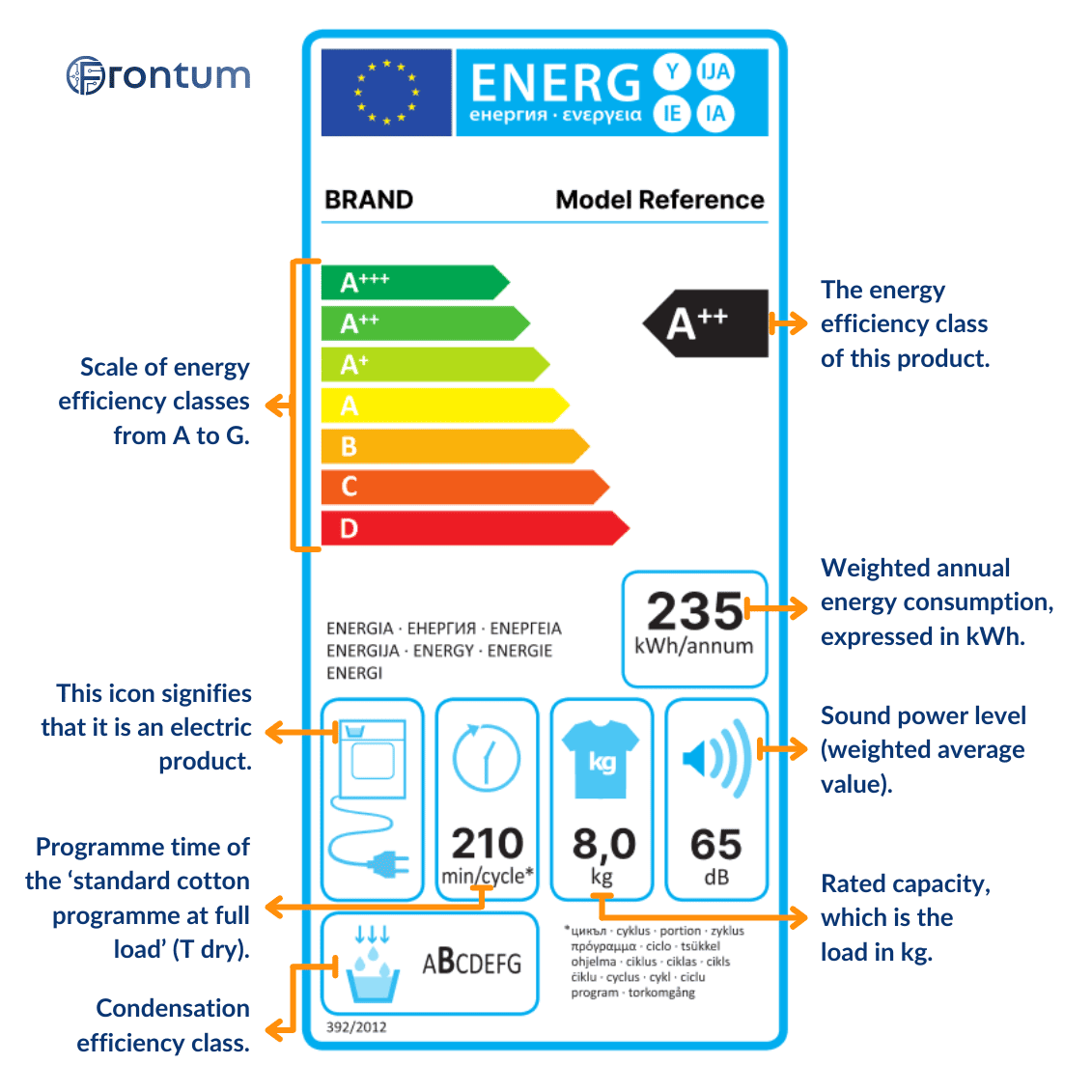
Energy efficiency for tumble dryers depends on Specific Energy Consumption (SEC). SEC is calculated as:
SEC = Total Energy Consumption (kWh) / Load capacity (kg)
To measure Total Energy Consumption, dryers undergo tests with a standard cotton load at full and partial capacities. The tests measure electricity used, initial moisture, and remaining moisture. Corrections for standby and off-mode power consumption apply, so results reflect typical use.
After SEC calculation, dryers receive an energy class based on fixed efficiency limits.
Energy efficiency classes for dryers are distributed as shown in the following chart.
[pie-chart-22520222510819767]
How much energy do the most efficient dryers consume?
The most efficient tumble dryers (energy class A+++) consume from 1.2 kWh to 2 kWh per drying cycle. The average is around 1.49 kWh. Energy consumption depends heavily on dryer capacity (larger dryers consume more). In dryers with very large capacities (16 kg), consumption can reach up to 2.6 kWh per cycle (even in class A+++).
For comparison:
Class A++ dryers consume about 1.9 kWh per cycle (30% more than A+++).
Class A+ dryers consume about 2.25 kWh per cycle (50% more than A+++).
Class B dryers consume about 4.74 kWh per cycle (220% more than A+++).
The chart below illustrates the distribution of energy consumption per full load cycle for dryers.
[vertical-chart-39869240631626732]
How quiet are the best tumble dryers?
The best tumble dryers produce less than 65 dB during operation. About 34% of all tumble dryers on the market meet this noise level.
If noise is a concern, check the decibel rating in the specifications. A dryer below 65 dB is ideal for quiet operation. For an even quieter model, look for one below 63 dB (about 11% of dryers on the market).
Heat pump dryers are the quietest type, with an average noise level of 65 dB. They operate at lower temperatures and use less energy-intensive components. In comparison:
Air-vented dryers: Average noise level of 66 dB.
Condenser dryers: Average noise level of 67 dB.
What makes some dryers more quiet than others?
Certain features reduce noise in tumble dryers, making them quieter during operation. The following factors contribute to lower noise levels:
Inverter motors: These reduce vibrations and noise compared to conventional motors. 38% of all tumble dryers use an inverter motor, and 72% of quiet dryers (<65 dB) include it.
Special drum design: A well-designed drum minimizes friction and improves laundry distribution, reducing noise. 54% of all dryers have this feature, and 73% of quiet dryers include it.
Vibration reduction: Shock absorbers, stabilizing systems, and anti-vibration pads or feet help limit operational noise.
Advanced insulation: Extra layers dampen sound, making the dryer quieter.
Quiet functions/cycles: 25% of all tumble dryers include special programs designed to reduce noise.
The distribution of noise levels for dryers is represented in the following chart.
[vertical-chart-17785418691618619]
How many drying programs do the best dryers have?
The best tumble dryers usually have 15 or more drying programs. About 39% of all tumble dryers meet this standard, while 5% include 16 or more programs. The total number of drying programs varies from 3 to 22, with 14 being the most common.
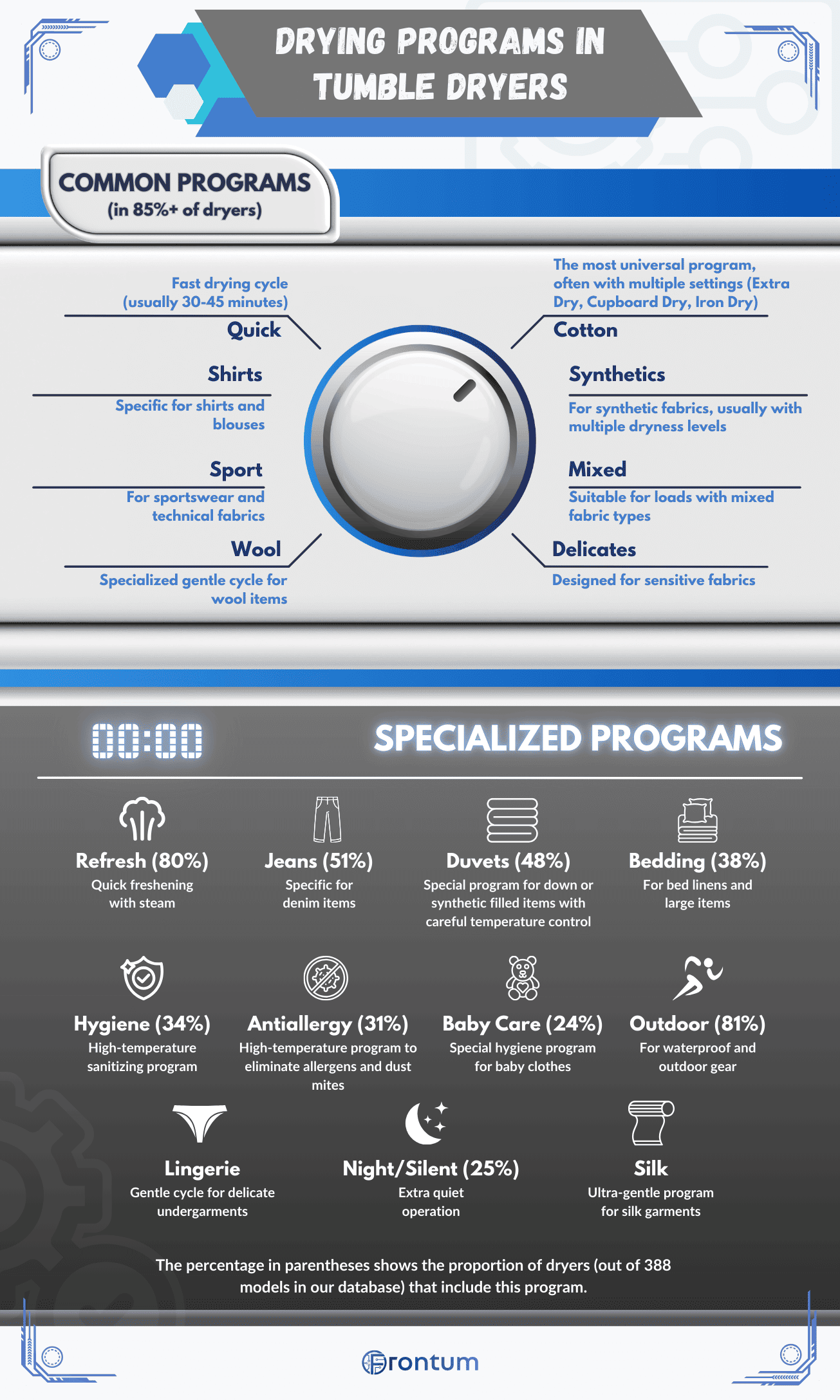
All tumble dryers include basic programs such as Cottons, Synthetics, and Mix. The difference between models comes from specialized programs, which provide greater versatility for specific fabrics and load sizes. The following specialized programs are the most common:
Wool: 89% of models
Refresh: 80%
Outdoor/Sport: 81%
Shirt: 74%
Jeans: 51%
Duvet: 48%
Hygiene: 34%
Bed linen: 38%
Allergy: 31%
Baby Care: 24%
Some brands, such as Hoover and Candy, allow you to connect the tumble dryer to your phone. Through their app, you can download and use about 40 additional drying programs.
The following chart showcases the number of drying programs available in different dryer models.
[vertical-chart-23965824747120899]
Which drying functions do the best dryers have?
The best tumble dryers have the most useful drying functions. The following drying functions are commonly included:
Gentle drying function(52% of tumble dryers): Reduces drying temperature so laundry is treated gently.
Silent function(25% of tumble dryers): Lowers noise without affecting drying quality. The appliance runs more slowly and extends cycle time.
ECO function(13% of tumble dryers): Minimizes power consumption.
Fast function(11% of tumble dryers): Reduces drying time by a percentage. It has different names depending on the brand, such as QuickDrive (Samsung), Rapid Option (Hotpoint), and Eco Hybrid (LG).
Mini/Half load function(6% of tumble dryers): Dries small loads or individual items.
These functions improve drying performance and adapt to different needs.
What are the common features of dryers?
The most common features of dryers are as follows:
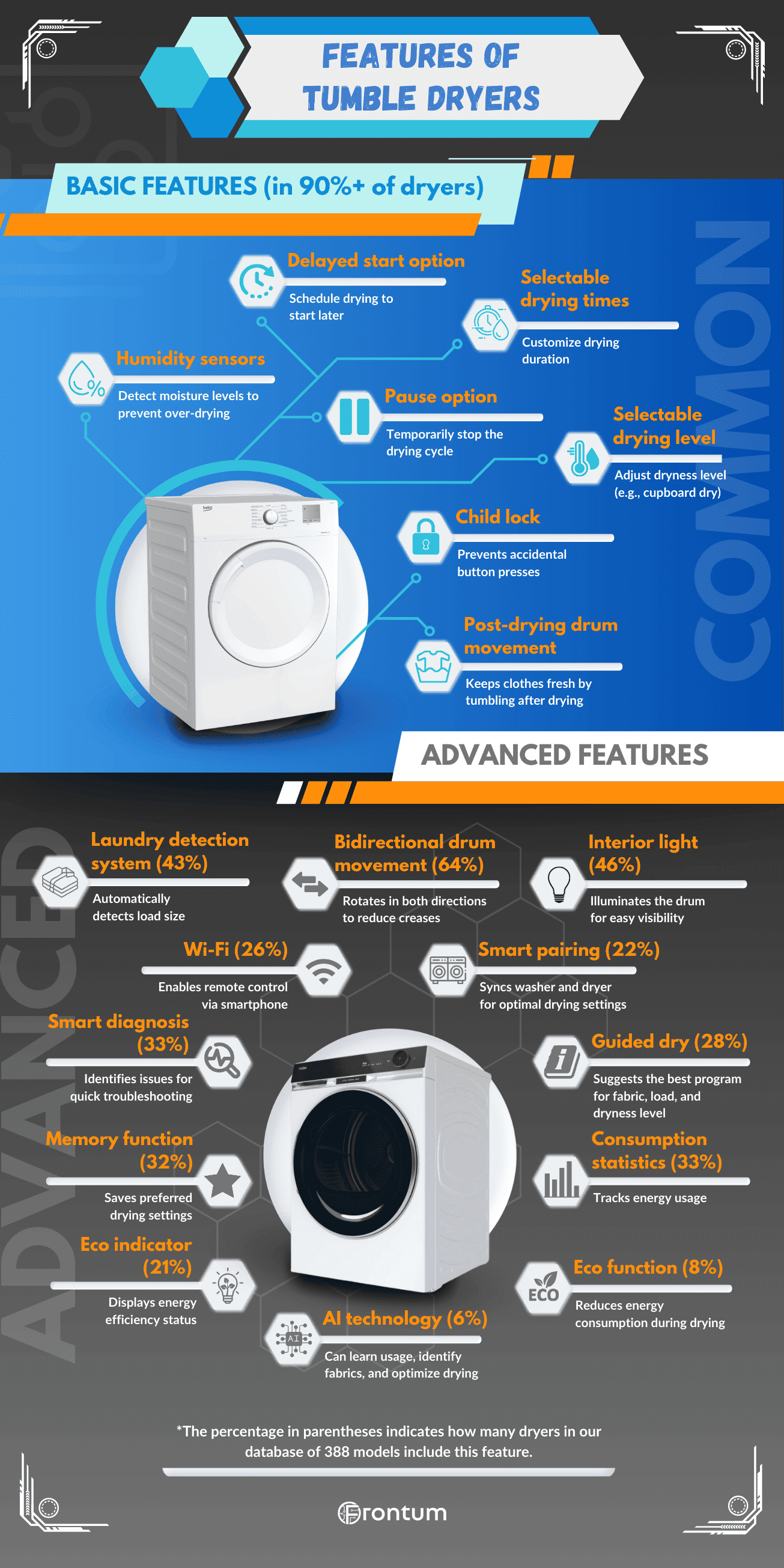
Humidity sensors(89% of tumble dryers): Detect moisture levels in clothes during drying and adjust the drying time.
Selectable drying level(94%): Lets you choose the desired dryness level, such as Iron Dry, Cupboard Dry, or Extra Dry.
Delay start option(93%): Schedules the drying cycle to begin later, often up to 24 hours, for convenience and off-peak electricity use.
Laundry detection system(43%): Measures the weight or amount of laundry in the drum and adjusts drying time and energy use.
Memory function(32%): Saves previous drying settings for frequently used cycles.
Smart diagnosis(33%): Communicates with a smartphone app or service center to identify issues or malfunctions.
Most dryers also have a post-drying movement feature (90%), which helps prevent creases if clothes are not removed immediately. Many models include bidirectional movement (64%), reducing tangling and bunching.
Nearly all dryers come with child lock, pause, and selectable drying times for added convenience.
The chart below shows the distribution of the number of features in dryers.
[vertical-chart-25178826046221379]
What features do the best dryers include?
The best tumble dryers include the following advanced features:
Wi-Fi(26% of tumble dryers): Integrates with home networks for remote control, monitoring, and firmware updates.
NFC(9%): Short-range wireless technology that enables contactless data exchange with NFC-enabled devices. It helps with program selection, machine diagnostics, and firmware updates. Dryers with NFC rarely include Wi-Fi.
Consumption statistics(33%): In-app function that provides real-time or historical data on energy usage.
Smart diagnosis(33%): Uses built-in sensors to detect issues or inefficiencies, accessible through an app.
Guided dry(28%): Suggests the best drying program based on fabric type and desired dryness level.
Smart pairing(22%): Syncs with a compatible washing machine to automatically select the ideal drying program.
ECO indicator(21%): Displays the energy efficiency of the selected drying option, considering time, temperature, and program settings.
Scan & Dry(13%): Lets you scan clothing care labels with a smartphone app to get program recommendations.
AI technology(6%): Analyzes laundry type, weight, and preferences to choose the best drying program.
Self-cleaning condenser(9%): Automatically flushes the condenser with water to remove lint and debris.
The best tumble dryers also include a special drum design (54%) to protect fabrics, a special easy-to-clean filter (100%), an anti-vibration design (100%), an interior light (46%), and a reversible door (24%) for flexibility.
Which motor type do the best dryers have?
The best tumble dryers are equipped with an inverter motor, found in 38% of all tumble dryers.
An inverter motor is a brushless direct current motor (BLDC) that uses variable frequency drive technology to precisely control rotational speed and torque. It operates through electromagnetic induction to create a rotating magnetic field, resulting in higher energy efficiency, lower noise levels, and greater durability than traditional universal motors.
Tumble dryers with an inverter motor consume about 18% less energy (1.58 kWh vs. 1.93 kWh) and operate 1 dB quieter on average (64 dB vs. 65 dB) compared to models without it. These motors typically come with a long warranty of 10-20 years.
Different brands use various names for their inverter motors: ProSmart (Beko), Eco Silence Drive (Bosch), Direct Motion (Haier), Eco Power Inverter (Hoover), Digital Inverter (Samsung), and ProfiEco (Miele). While the core inverter technology remains the same, brands focus on different aspects such as noise reduction, durability, or energy efficiency in their implementations.
How much do the best dryers cost?
The best dryers cost £600 or more.You pay this price for dryers with advanced features, better build quality, and higher user satisfaction.
The price distribution for dryers is displayed in the following chart.
[vertical-chart-14327415375316308]
To which price categories dryers could be divided?
Tumble dryers fall into the following three price categories:
Bottom range (£430 or less)
About 35% of all tumble dryers are in this category. These dryers come in various capacities, with 8 kg (36%) and 7 kg (21%) being the most common. Some models have higher capacities (9-10 kg), and compact dryers (4 kg or less) are also available.
All three dryer types appear in this price range (40% condenser, 35% heat pump, 25% air vented). Due to the higher number of vented and condenser models, these dryers are less energy-efficient (4.18 kWh per full load cycle, 60% in class B or worse) but lighter (36.5 kg vs. 45.5 kg average) and faster (174 min Eco cycle vs. 195 min average).
Specialized drying cycles are less common, with Bed Linen (31%), Duvet (30%), and Hygiene (21%) appearing less often. Features such as gentle drying (31%), Silent mode (8%), laundry detection system (37%), ECO indicator (14%), and Wi-Fi (18%) are also limited. However, NFC (22%) appears more frequently than in higher-priced models.
Advanced features like AI technology are almost absent, and only 10% of these dryers have an inverter motor, which affects energy consumption and noise levels. Still, most include humidity sensors, delay start, pause function, bidirectional drum movement, and post-drying movement to reduce creases.
Mid range (£430-£600)
Around 35% of all dryers belong to this category. These models generally have higher capacities, with 9 kg (43%) and 8 kg (38%) being the most common, while 11 kg models make up 11%. Almost all dryers in this range are heat pump models (92%), with a few condenser dryers (8%).
This category is already very energy efficient, consuming about 1.87 kWh per full load cycle and 1.1 kWh per partial load. Most models have good energy ratings (34% A+++ and 51% A++).
Specialized drying programs are more frequent, with Duvet (54%), Hygiene (48%), and Outdoor/Sport (90%) being common. Additional features include Laundry detection (52%), Wi-Fi (33%), Bluetooth (23%), and AI technology (9%).
45% of mid-range dryers have an inverter motor, and most include post-drying movement and bidirectional drum movement to reduce creases.
Top range (£600+)
Around 30% of all dryers belong to this category. Most have 8 kg (47%) or 9 kg (43%) capacities, and 98% use heat pump technology.
These models are the most energy-efficient, consuming 1.55 kWh per full load cycle and 0.9 kWh per partial load, despite their larger capacities. They also tend to be quieter (64 dB or less).
Advanced features are more common, with Outdoor/Sport, Bed Linen, Duvet cycles, gentle drying, fast function, and Silent mode appearing frequently. Most models have Wi-Fi (37%), ECO function, ECO indicator (26%), smart pairing (30%), and AI technology (11%).
Other premium features include Interior light (78%), Special drum design (79%), an easy-to-clean filter (67%), and a self-cleaning condenser (20%). 75% of high-end dryers come with an inverter motor, making them even more efficient and quieter than lower-priced models.
What are the cheapest dryer brands?
The cheapest tumble dryer brands are as follows.
Candy (Average overall score: 6.8 points; Average price: £390)
Hoover (Average overall score: 7.1 points; Average price: £405)
Beko (Average overall score: 7.5 points; Average price: £430)
The chart below compares dryer brands based on their price, sorted in ascending order.