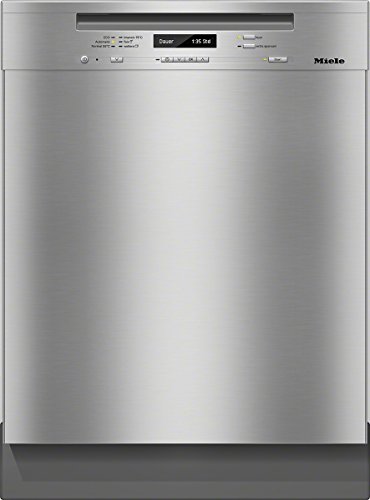

Are Miele dishwashers good?
Miele dishwashers have an average overall score of 7.4, ranking #23 among comparable dishwasher brands
Miele dishwashers target premium buyers with refined baskets, low noise, and controlled drying. Selected series add AutoDos with PowerDisk, AutoOpen, 3D MultiFlex cutlery storage, QuickPowerWash, and Knock2open for handleless integrated kitchens.
Miele dishwashers cost more to buy and can add proprietary detergent and higher out-of-warranty repair costs. Buyers should pay the premium only when AutoDos, advanced racks, very quiet operation, or specialized installation features will provide regular practical value.
The chart below compares Miele with other dishwasher brands by average overall score.
[horizontal-chart-12846332776424105731103630839095905880383845576063]
What are the main advantages of Miele dishwashers?
The main advantages of Miele dishwashers are as follows:
- Rack engineering: 3D MultiFlex trays, adjustable baskets, stable runners, and detailed glass and pan supports improve mixed-load flexibility.
- Automated dosing: AutoDos meters PowerDisk detergent during compatible programs, reducing manual dosing but creating a consumable cost.
- Drying: AutoOpen releases moisture at cycle end and can improve plastics while limiting extra heat.
- Fast washing: QuickPowerWash is designed for strong cleaning in roughly one hour with suitable detergent and loading.
- Premium ownership support: Miele emphasizes long design life, parts, service, and model documentation, although actual repair economics vary.
What are the main disadvantages of Miele dishwashers?
The main disadvantages of Miele dishwashers are as follows:
- A high initial price: Miele dishwashers commonly list around £700-£1,100, with a midpoint close to £790, before installation or extended cover. That is roughly £300-£500 above many well-equipped mainstream machines, so AutoDos, 3D MultiFlex racks, low noise, or handleless installation must deliver recurring value.
- Proprietary detergent cost: AutoDos is designed around PowerDisk cartridges, adding a recurring consumable and reducing the freedom to buy inexpensive tablets in bulk. Conventional detergent remains possible on relevant models, but buyers paying for AutoDos should calculate cost per wash and local cartridge availability.
- Eco cycles remain long despite the premium: Available models run about 190–234 minutes, or 3 h 10 min to 3 h 54 min. QuickPowerWash is useful for faster turnaround, but its permitted load, detergent, temperature, and consumption differ from the standardized Eco cycle.
- Premium does not mean silent or class A automatically: Noise sits around 44–46 dB and Eco consumption roughly 0.84–0.95 kWh in the relevant range. Buyers expecting 38–40 dB operation or approximately 0.55 kWh should verify the exact label rather than infer performance from price.
- Repair and mechanism complexity: AutoDos, Knock2open, AutoOpen, advanced racks, and electronic controls add motors, linkages, sensors, and proprietary parts. Out-of-warranty repair or basket replacement can be expensive, making local Miele service coverage and extended-warranty pricing important parts of the purchase.

Who makes Miele dishwashers?
Miele dishwashers are made for Miele & Cie. KG, the German family-owned appliance manufacturer headquartered in Gütersloh. Miele designs and manufactures under its own brand, while the precise factory and component origin depend on the model.
Check the rating plate, full G-number, index suffix, warranty, and local product sheet. Similar family names can hide differences in AutoDos, AutoOpen, racks, lighting, connectivity, hinge design, and installation height.
What are the main Miele dishwasher series?
The main Miele dishwasher series are as follows:
- G 5000: The core premium range offers strong rack flexibility, AutoOpen on selected models, QuickPowerWash, and practical integrated or freestanding formats.
- G 7000: The upper range can add AutoDos with PowerDisk, more advanced 3D MultiFlex trays, BrilliantLight, Miele@home, and premium controls.
- SC and SCi variants: Freestanding or semi-integrated controls remain visible and are easier to monitor directly.
- SCVi variants: Fully integrated models hide controls and may add floor status indication or Knock2open on handleless versions.
- XXL variants: Taller integrated tubs increase vertical loading space but require a compatible niche and furniture panel.
How much do Miele dishwashers cost?
Miele dishwashers generally cost about £700-£1,700, with highly equipped or specialized configurations sometimes exceeding that range. Series, installation, racks, AutoDos, lighting, noise, energy class, and hinge hardware explain most differences.
Around £700-£900, expect core G 5000 equipment, approximately 14 settings, good rack adjustment, and selected AutoOpen or QuickPowerWash functions.
From £900-£1,300, stronger racks, quieter operation, AutoDos, connectivity, better displays, and premium integrated formats become more common. Calculate the recurring PowerDisk cost if automated dosing is a key reason for upgrading.
Above about £1,300, require clear daily value from AutoDos, BrilliantLight, Knock2open, XXL capacity, exceptionally quiet operation, or specialized furniture integration. A £430 premium cannot normally be recovered through energy savings alone.
What should you consider when choosing a Miele dishwasher?
Before buying a Miele dishwasher, consider the following factors:
- Series and installation: Identify the exact G-series model, standard or XXL tub height, 60 cm format, and freestanding, integrated, or handleless configuration. Check niche dimensions, panel weight, plinth, AutoOpen or Knock2open clearance, hose routing, and whether the controls suit the planned cabinet design.
- Basket generation: A practical test should cover the 3D MultiFlex drawer, FlexLine baskets, upper-rack adjustment, glass supports, folding rows, rail movement, and plate diameter with real items. Most 13–14-setting Miele models suit 3–5 people, while 14–16 settings better accommodate 4–6 people or frequent entertaining. Miele’s rack engineering is a major reason to pay more, so confirm that the selected model includes useful components rather than only the brand badge.
- Detergent dosing: AutoDos with PowerDisk can meter detergent automatically and simplify repeated cycles, but it creates a proprietary consumable cost. Compare dose control, PowerDisk price per wash, conventional tablet compatibility, refill frequency, and whether the household actually needs automatic dosing.
- Cleaning and programs: Look for an automatic sensor cycle, Pots & Pans or intensive washing, QuickPowerWash, glass care, hygiene options, and machine cleaning. Verify temperature and load restrictions; a fast program is valuable only when it cleans the household’s normal soil without requiring pre-rinsing.
- Drying and noise: AutoOpen assists efficient drying, while selected premium models add enhanced ventilation or mineral-supported systems. Compare plastics, deep containers, Eco duration, and dB values around 38–44, and ensure automatic opening is suitable beneath the worktop.
- Efficiency calculation: For a premium full-size dishwasher, approximately 0.55–0.75 kWh and 8.5–10 L per Eco cycle is a strong target; Miele examples around 0.84–0.95 kWh and 8.9–11.3 L should justify that higher use through racks, dosing, or service value. A 0.20 kWh saving is only about 56 kWh over 280 cycles, so a premium of several hundred euros may take many years to recover through electricity alone.
- Lifetime ownership: Review full-appliance warranty, extended-service pricing, local technician coverage, electronic-module cost, rack spares, and proprietary consumables. Miele is most rational when its loading, low noise, dosing, and installation features are used regularly, not when basic cleaning alone is the objective.