Which brands make the best vacuums for parquet floors in 2026?
The best parquet-floor-vacuum brands in 2026 are ranked below:
- Dreame (Average overall score: 8.6)
- Samsung (Average overall score: 8.3)
- Rowenta (Average overall score: 7.5)
- Dyson (Average overall score: 7.5)
- Bosch (Average overall score: 7.2)
The chart below ranks parquet-floor-vacuum brands by average overall score.
[horizontal-chart-12886841353470291110047000082573079303731114635170]
What makes a vacuum cleaner suitable for parquet floors?
A vacuum cleaner is suitable for parquet floors when every part touching the surface is soft, clean and free to move without dragging grit. A dedicated parquet brush uses soft bristles or a cushioned roller, while suction control prevents the head from clamping to boards and stressing joints or loose sections.
The safest design also keeps hard plastic edges, exposed screws and stiff carpet bristles away from the finish. Large rubberised wheels should rotate freely, the swivel joint should not scrape when the head tilts, and the roller should open easily so trapped sand can be removed before it marks the next room.
Floor finish still determines the cleaning method. Dry vacuuming is appropriate for most parquet, but mopping or wet pickup should be used only when the flooring manufacturer approves the moisture level for that sealed, oiled or lacquered surface.
Which floorheads are safest for parquet?
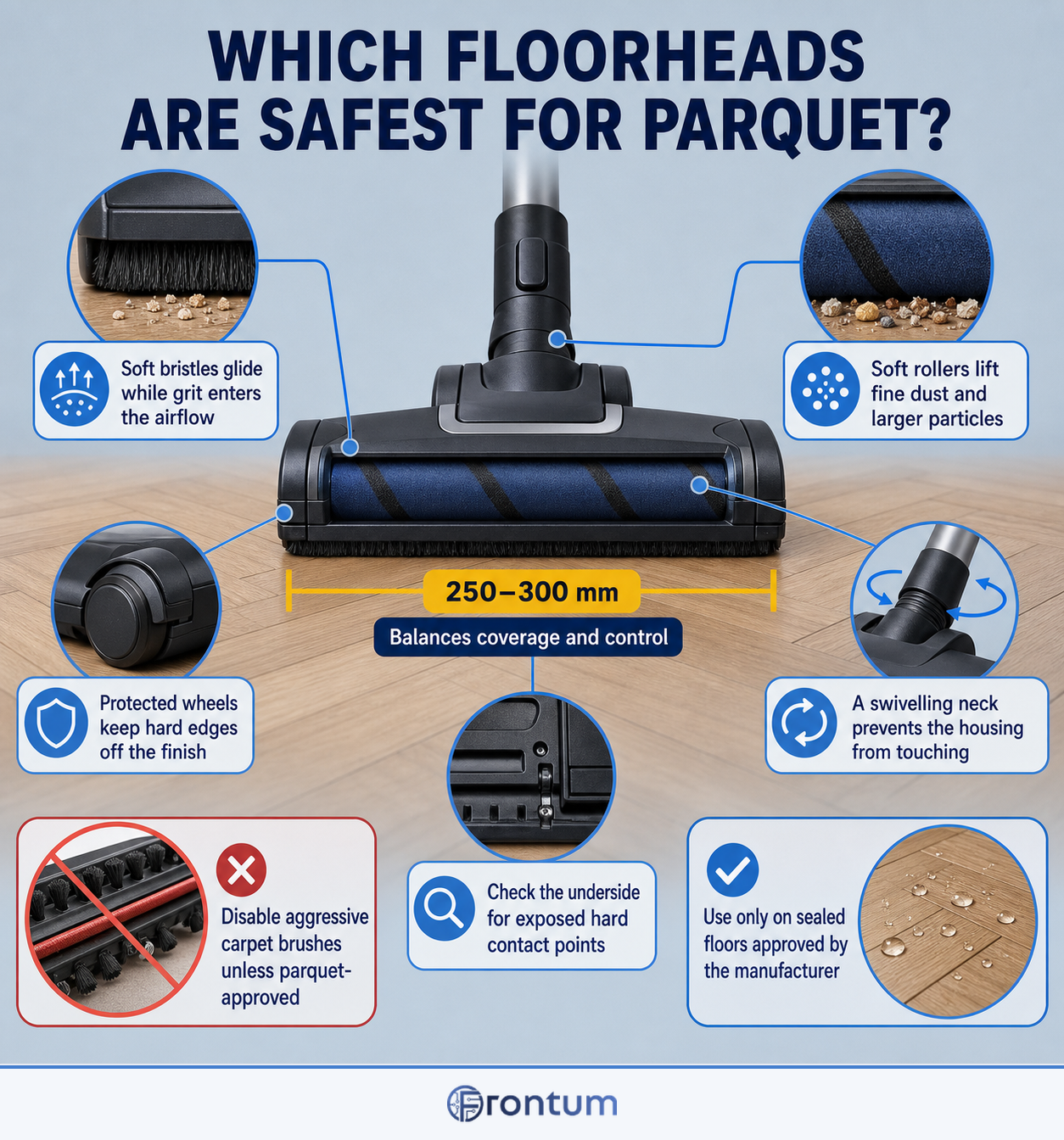
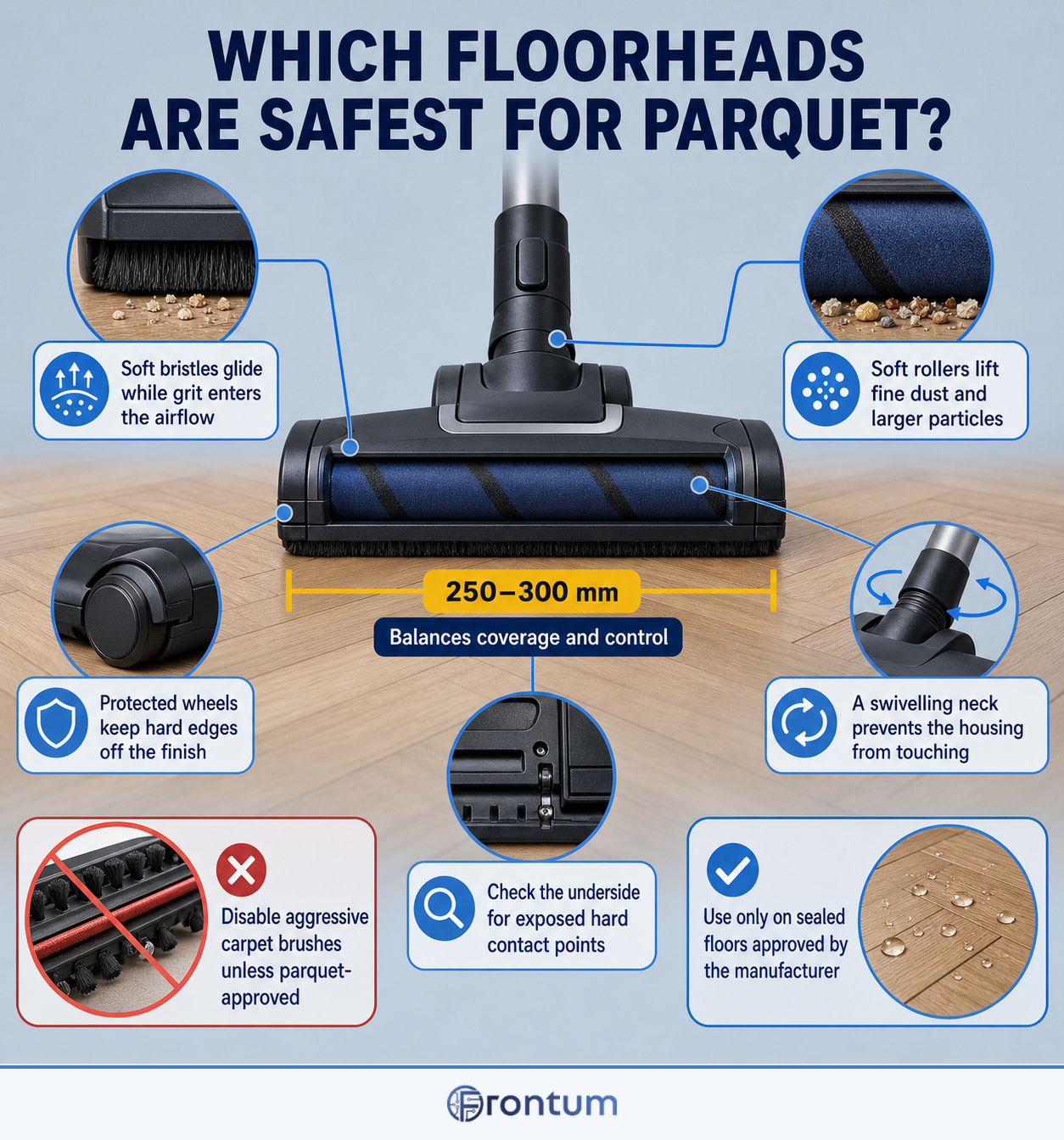
The safest floorheads for parquet are dedicated soft-bristle parquet brushes and soft rollers designed for sealed hard floors. A parquet brush glides on dense bristles and leaves space for grit to enter the airflow, while a soft roller lifts fine dust and larger particles without relying on a stiff beater bar.
A cleaning width around 250–300 mm covers open floors efficiently without becoming awkward around furniture. Check the underside for hard contact points, make sure the neck swivels without the housing touching the floor, and disable or remove an aggressive carpet brush when the manufacturer does not approve it for parquet.
The chart below shows the distribution of main brush types among vacuum cleaners suitable for parquet floors.
[pie-chart-13660551647156552010158098082754342224660667300383]
How do wheels and suction control protect parquet?
Soft rubberised wheels and controllable suction protect parquet by preventing grit from being dragged and by keeping the floorhead easy to move. Wheels should rotate rather than slide, and their tread should be inspected regularly because a small stone embedded in soft material can still scratch a finish.
Around 100–200 AW is usually ample for loose dust and crumbs on hard floors when the head seals correctly. Models we reviewed average around 200 AW, but an adjustable setting or bypass vent is more useful than maximum pressure because excessive suction can make a broad head difficult to push and can pull at loose joints.
Keep the front caster, rear wheels and floorhead neck free of hair so the body remains stable and does not tip onto the floor. On canister vacuums, a flexible hose and smoothly turning wheels also prevent sudden sideways loads when the body follows through a doorway.
How much do vacuums for parquet floors cost?
Vacuums for parquet floors generally cost about £100-£400, with the broader range extending from roughly £40 to £950. Around £170 is a practical midpoint, and models around £90-£130 can already include a dedicated parquet brush, automatic cord rewind or a useful hard-floor roller.
From about £200-£300, better sealing, quieter operation, adjustable controls and more refined floorheads become common. Premium cordless packages and specialist canisters should justify prices above £430 with replaceable batteries, excellent edge pickup, durable wheels or a genuinely better filtration system rather than only a larger accessory bundle.
The chart below shows the price distribution of vacuums for parquet floors.
[vertical-chart-13035989618880404216103439309766526835080673005763]
What should you check before buying a vacuum for parquet floors?
You should check the following factors before buying a vacuum for parquet floors:
- Floor compatibility: Confirm that the head is explicitly approved for parquet or the exact sealed hard-floor finish in your home. A mopping function is not automatically safe for unsealed, moisture-sensitive, oiled or damaged boards.
- Contact materials: Choose dense soft bristles, a cushioned soft roller and an underside without exposed hard edges or screws. The roller or brush should be removable so trapped sand and grit can be cleared before they scratch another section.
- Suction control: Around 100–200 AW is sufficient for most loose hard-floor debris when the head seals well. Adjustable suction, automatic control or a bypass vent keeps a broad head movable and protects lightweight mats and loose floor joints.
- Wheels and steering: Large rubberised wheels should rotate smoothly, the neck should swivel without scraping and the body should remain stable when pulled sideways. Inspect the wheel tread regularly because embedded grit can damage parquet even when the wheel material is soft.
- Cleaning width and edge pickup: A head around 250–300 mm balances coverage with access around furniture, close to the 280 mm typical width among models we reviewed. Check front and side pickup so crumbs do not require repeated passes along skirting boards.
- Power source and handling: Parquet-ready models in our research weigh around 5 kg because canisters dominate, while sticks place more of their mass near the hand. Cordless designs generally advertise 60 minutes in a lower mode and about four hours to charge; corded models avoid that limit but require enough cable and hose reach.
- Noise, filtration and parts: Maximum noise averages about 75 dB, so quieter models near 70 dB are preferable for long sessions. Look for a sealed exhaust path and verify local availability of parquet heads, soft rollers, filters, wheels, batteries and seals.