Which brands make the best bagged vacuums in 2026?
The best bagged-vacuum brands in 2026 are ranked below:
- Rowenta (Average overall score: 7.2)
- Henry (Average overall score: 7.1)
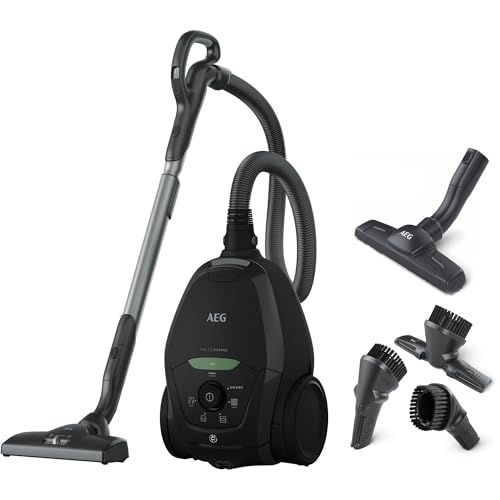
- AEG (Average overall score: 7)
- Siemens (Average overall score: 7)
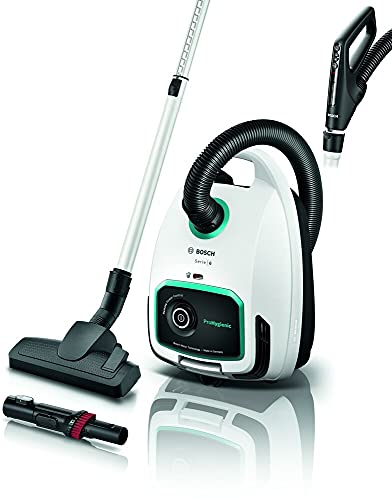
- Bosch (Average overall score: 7)
The chart below ranks bagged-vacuum brands by average overall score.
[horizontal-chart-11290645386297343166096689874179864958590590023078]
When should you consider buying a bagged vacuum?
You should consider a bagged vacuum if you want cleaner dust disposal, stable filtration and less frequent contact with the collected debris. A self-closing bag is especially useful for allergy-sensitive households because the dust remains enclosed when the vacuum is emptied.
Bagged canisters also suit larger homes and pet owners when a 3–5 L bag reduces emptying interruptions. As the bag expands, a good internal airflow path should use most of its capacity without a severe loss of pickup, while a bag-full indicator prevents the user from waiting until the motor sounds strained.
The trade-off is an ongoing supply of compatible bags and less visibility of accidentally collected objects. Choose this format when hygienic disposal and lower filter-cleaning effort matter more than avoiding consumables.
Are bagged vacuums better than bagless models?
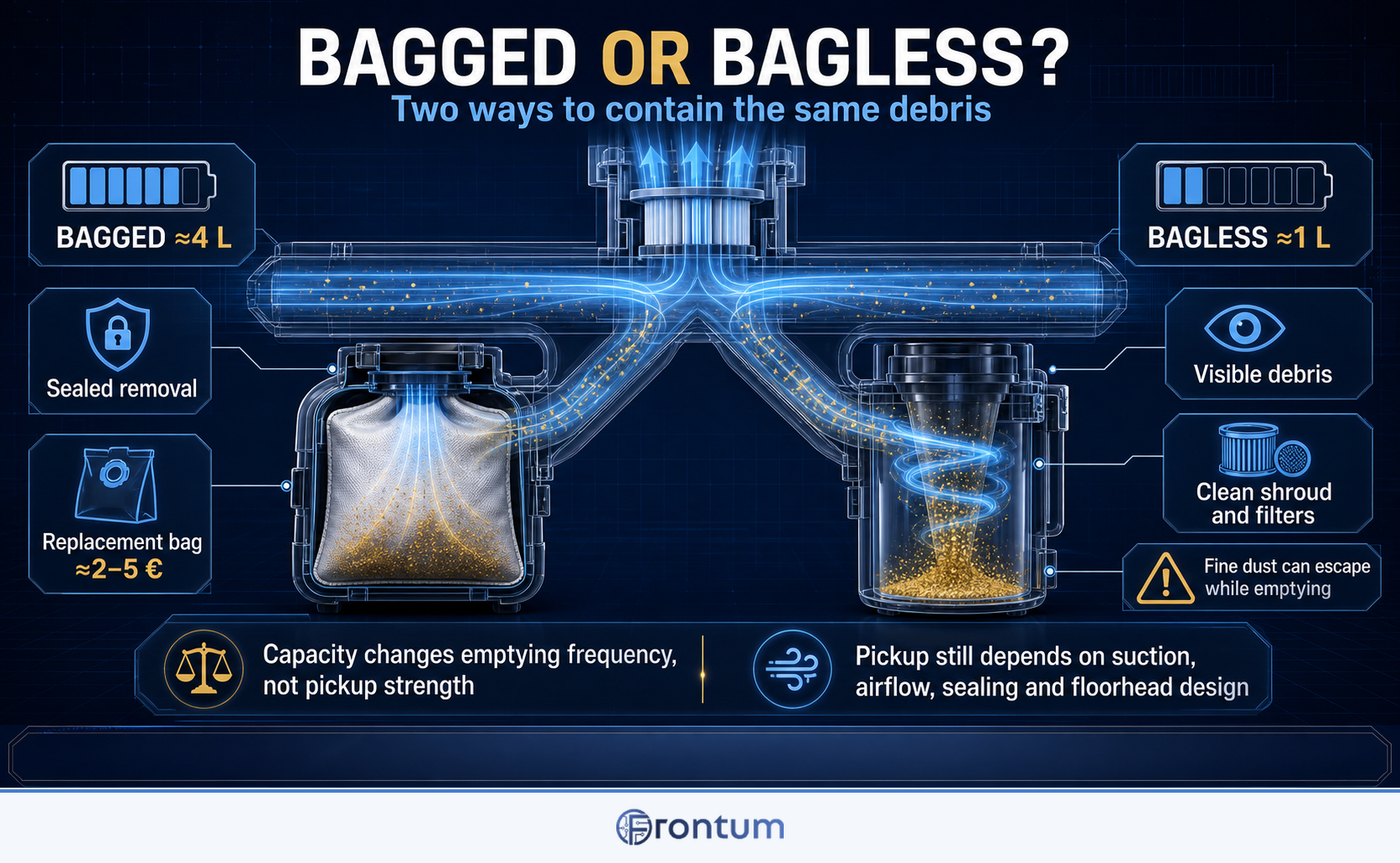
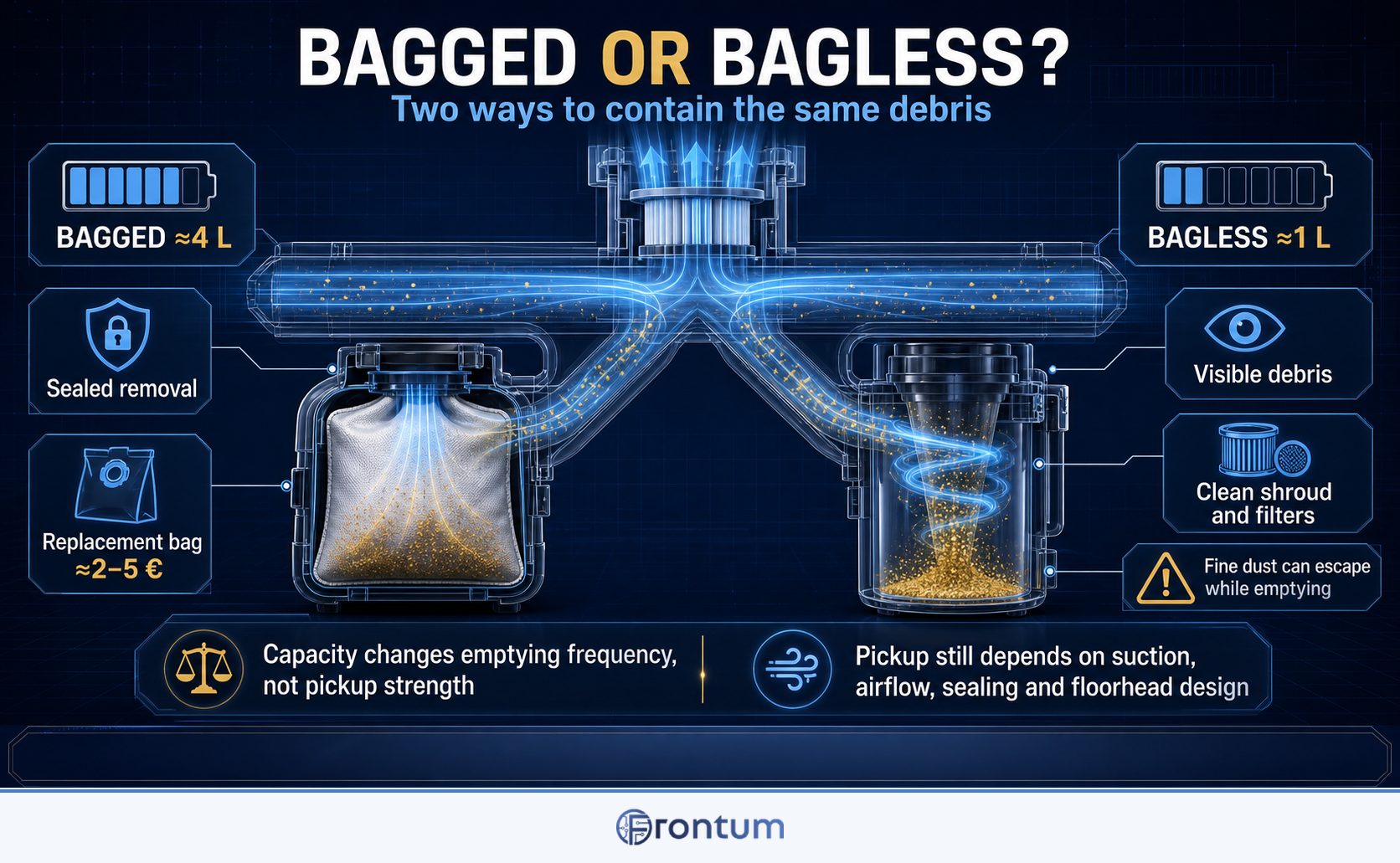
Bagged vacuums are better than bagless models for hygienic emptying and capacity, while bagless models are better for avoiding replacement bags and seeing collected debris. Bagged models average about 4 L of capacity, compared with roughly 1 L for bagless vacuums, so they usually go longer between changes.
Replacement bags commonly cost about £0-£5 each, whereas bagless models need regular shroud and filter cleaning and can release dust during emptying. Cleaning performance still depends more on suction, airflow, sealing and floorhead design than on the container type, so the larger bag does not automatically mean stronger pickup.
What bag capacity should a good bagged vacuum have?
A good bagged vacuum should usually have about 3–4 L of usable bag capacity for normal household cleaning. Compact models around 2–3 L are easier to store but need more frequent changes, while 4–5 L is useful in larger homes or where pet hair fills a smaller bag quickly.
Nominal capacity does not show how completely the bag can expand before airflow falls. A well-designed chamber supports the bag on all sides, keeps the inlet clear and uses a reliable bag-full indicator; changing the bag early may be necessary when fine plaster dust or powder blocks its pores.
Professional and wet/dry-style machines can offer 6–15 L, but the larger body is heavier and harder to store. Choose that size for genuinely high debris volume rather than assuming that the biggest bag is automatically best for routine rooms.
The chart below compares bag capacities across bagged vacuums.
[vertical-chart-09879716150041167803105585226291061954353815380882]
How much do replacement vacuum bags cost?
Replacement vacuum bags commonly cost about £10-£20 per pack, with many packs containing four to eight bags. That usually works out to roughly £0-£5 per bag, although large multipacks and compatible third-party bags can cost less, while premium allergen-sealing bags or packs bundled with filters cost more.
Annual cost depends on bag size, household dust and how early airflow begins to fall rather than on pack price alone. Confirm the exact bag code before buying the vacuum, check whether motor and exhaust filters are included in the pack, and avoid forcing a nearly compatible bag onto the inlet because a poor seal can leak dust into the motor compartment.
How much do bagged vacuums cost?
Bagged vacuums generally cost about £100-£300, with a broad market range starting near £40. Entry-level machines around £40-£130 usually have simpler floorheads, shorter operating radii and fewer suction controls.
The practical middle sits around £130-£220, where 3–4 L bags, automatic cord rewind, better sealing and more complete hard-floor and carpet tools become common.
Premium domestic and specialist models can cost £300-£500, while a small number of professional machines reach roughly £600-£900. Include the price of the correct bags and filters in the comparison, but do not assume a higher motor-input wattage justifies a higher purchase price.
The chart below shows the price distribution of bagged vacuums.
[vertical-chart-01979540366794005119139604627044742898892623307354]
What should you check before buying a bagged vacuum?
You should check the following factors before buying a bagged vacuum:
- Suction and airflow: Around 180–220 AW or 15–25 kPa can indicate strong household output when compared using the same measurement method, while airflow near 25–40 L/s helps carry debris through the hose. Motor input around 600–900 W measures electricity use and cannot replace a suction comparison.
- Bag capacity and fill indicator: About 3–4 L suits most homes, while 4–5 L reduces changes with pet hair and 6 L or more is mainly useful for unusually high debris volume. Check that the bag can expand fully, the inlet stays clear and the indicator reacts to real restriction rather than only a completely full chamber.
- Cord length and operating radius: A 7–8 m cable is a useful baseline and 9–12 m suits larger floors. Include the hose and telescopic wand when comparing reach, and check that automatic rewind is strong enough to store the full cable without repeated feeding.
- Bag seal and filtration: Prefer a self-closing bag, sealed housing and HEPA, HEPA 13 or S-Class exhaust filtration for fine dust. Verify whether the bag pack includes motor or exhaust filters and whether the vacuum remains sealed when those filters are replaced.
- Floorhead and cleaning width: A 250–300 mm head suits most rooms, while powered or turbine brushes improve carpet agitation and a soft parquet head protects delicate floors. Adjustable suction or a bypass vent prevents a well-sealed head from clamping to thick carpet or lightweight rugs.
- Weight and manoeuvrability: Around 5–6 kg is typical for a full-size bagged canister, and models above 8 kg require more effort on stairs. Check wheel rotation, hose flexibility, carrying-handle position and whether the body follows without overturning at doorways.
- Noise and consumable support: Around 68–75 dB is comparatively restrained, while 80 dB or more is loud during long cleaning sessions. Confirm the exact bag code, local pack price and availability of filters, hoses, rollers and seals before choosing a discontinued model.