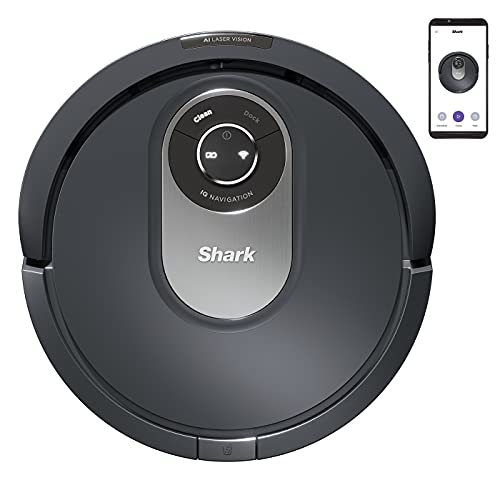
Are Shark robot vacuums good?
Shark robot vacuums have an average overall score of 7.2, ranking #11 among comparable robot vacuum brands.
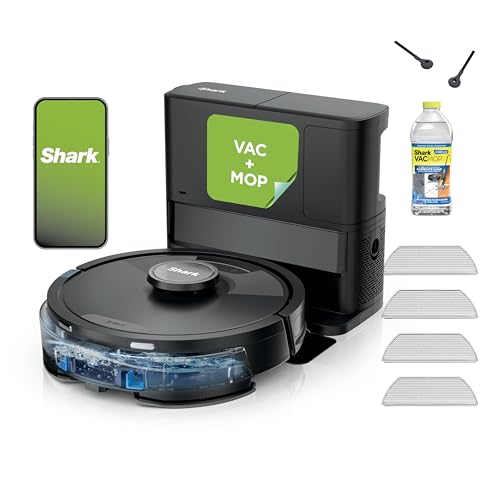
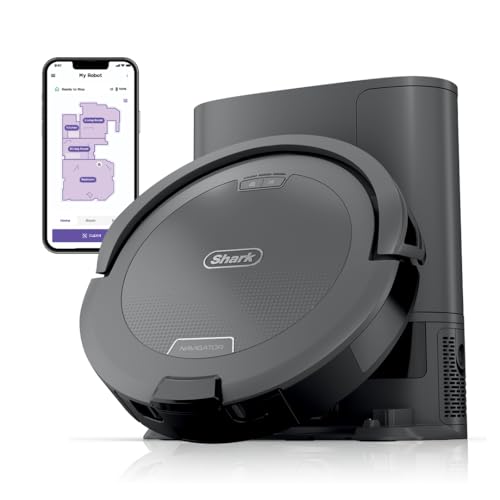
Shark robot vacuums are strong for pet hair and mixed floors because most current families combine mapping with a self-cleaning brushroll, targeted repeat-pass cleaning and bagless dock options. Matrix and PowerDetect models add increasingly deliberate edge, dirt and floor detection without forcing every buyer into mopping.
Shark robot vacuums are less consistent in navigation, mop hardware and dock automation across generations. Older ION, IQ and AI labels overlap with newer Matrix names, while NeverTouch describes a base package rather than the robot alone; the full RV or AV model code is essential for comparing features and parts.
The chart below compares robot vacuum brands by average overall score.
[horizontal-chart-15406096130061009453140888914513010987580044587466]
What are the main advantages of Shark robot vacuums?
The main advantages of Shark robot vacuums are as follows:
- Pet-hair-focused brush design: Most current Shark robots use a self-cleaning or anti-tangle brushroll that works directly on hard floors and agitates carpet. This reduces the need to cut wrapped hair from the roller and pairs well with the brand’s strong upright-vacuum experience.
- Deliberate repeat-pass cleaning: Matrix Clean follows a precision grid and approaches debris from multiple directions instead of relying on one pass. Detect Pro and PowerDetect add dirt, floor and edge reactions that increase suction, redirect airflow or repeat an area when conditions demand it.
- Bagless self-empty options: Shark bases typically collect debris in a reusable bin rather than a disposable bag, with published capacities around 45 or 60 days depending on the package. That lowers bag costs and makes the dust level visible, while HEPA-sealed versions add better containment for fine dust and pet allergens.
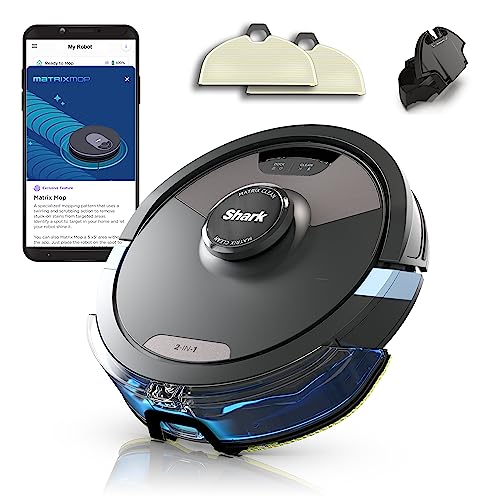
- Useful vacuum-and-mop choices: Matrix Plus 2-in-1 models use Sonic Mopping for active vibrating-pad scrubbing, while PowerDetect can extend the wet pad to an edge and lift it over carpet. Vacuum-only Matrix and Detect Pro variants remain available for buyers who would rather avoid mop tanks and pad care.
- Strong mapping and app control: LiDAR-equipped IQ, AI, Matrix, Detect and PowerDetect robots build room maps for schedules, targeted cleaning and no-go zones in the SharkClean app. Mapping works in darkness and supports methodical coverage, while the newer detection systems add more responsive cleaning around edges and changing floor types.
What are the main disadvantages of Shark robot vacuums?
The main disadvantages of Shark robot vacuums are as follows:
- Confusing family and regional names: ION, IQ, AI, Matrix, Detect Pro and PowerDetect labels overlap with RV and AV model codes, retailer suffixes and dock bundles. Two products with similar marketing names can therefore differ in mopping, obstacle sensing, filtration or the included base.
- Modest runtime on many generations: A large part of the range is rated around 90–120 minutes, with selected premium versions extending toward 180 minutes. That is adequate for many homes with recharge-and-resume, but maximum figures use lighter modes and can fall when suction or repeated Matrix passes increase.
- Uneven small-object avoidance: LiDAR provides accurate room mapping but does not guarantee reliable recognition of cables, socks or pet toys. Older IQ, AI and Matrix machines may still need floors prepared, while the stronger threshold and object reactions are concentrated in Detect Pro and PowerDetect models.
- Mopping and dock automation vary sharply: Matrix Plus generally uses a vibrating pad that still needs hands-on filling and pad care unless paired with a suitable station. NeverTouch Pro adds refilling, washing and drying, but that does not mean every NeverTouch, ZE, WD or self-empty package includes the same functions.
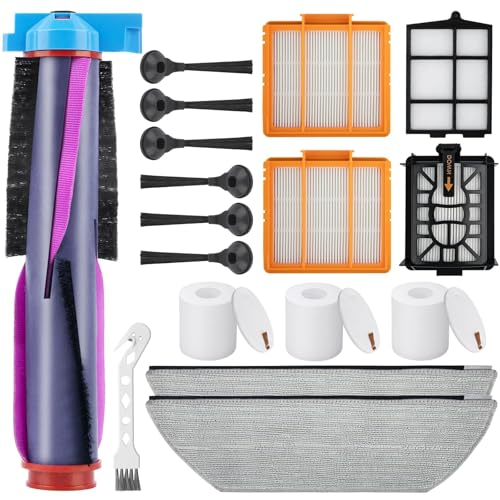
- Bagless bases still require upkeep: Avoiding disposable dust bags saves money, but the reusable base bin and filters need emptying and cleaning without releasing dust back into the room. HEPA filters, odor cartridges, mop pads, side brushes and brushroll parts remain model-specific consumables.
Who makes Shark robot vacuums?
Shark robot vacuums are made by SharkNinja, Inc., the company behind the Shark and Ninja appliance brands. SharkNinja is headquartered in Needham, Massachusetts; it identifies Mark Rosenzweig as founder and Mark Barrocas as chief executive.
The business began in Montreal in 1994 as Euro-Pro Operating LLC, initially focused on small cleaning appliances. Shark became a vacuum-cleaner trademark in Canada in 2000, the company established roots near Boston in 2003, and the combined SharkNinja identity was adopted in 2015.
SharkNinja describes itself as a product design and technology company rather than a single-factory manufacturer. It develops and tests products through teams and innovation centers across several regions, while official corporate reporting says production is handled by long-standing third-party suppliers in China and Southeast Asia.
SharkNinja separated from JS Global Lifestyle in July 2023 and now trades independently on the New York Stock Exchange under the symbol SN. Within its cleaning portfolio, Shark robot vacuums extend the brand’s brushroll, filtration and bagless-dust expertise into LiDAR mapping, the SharkClean app and increasingly automated bases.
What are the main Shark robot vacuum series?
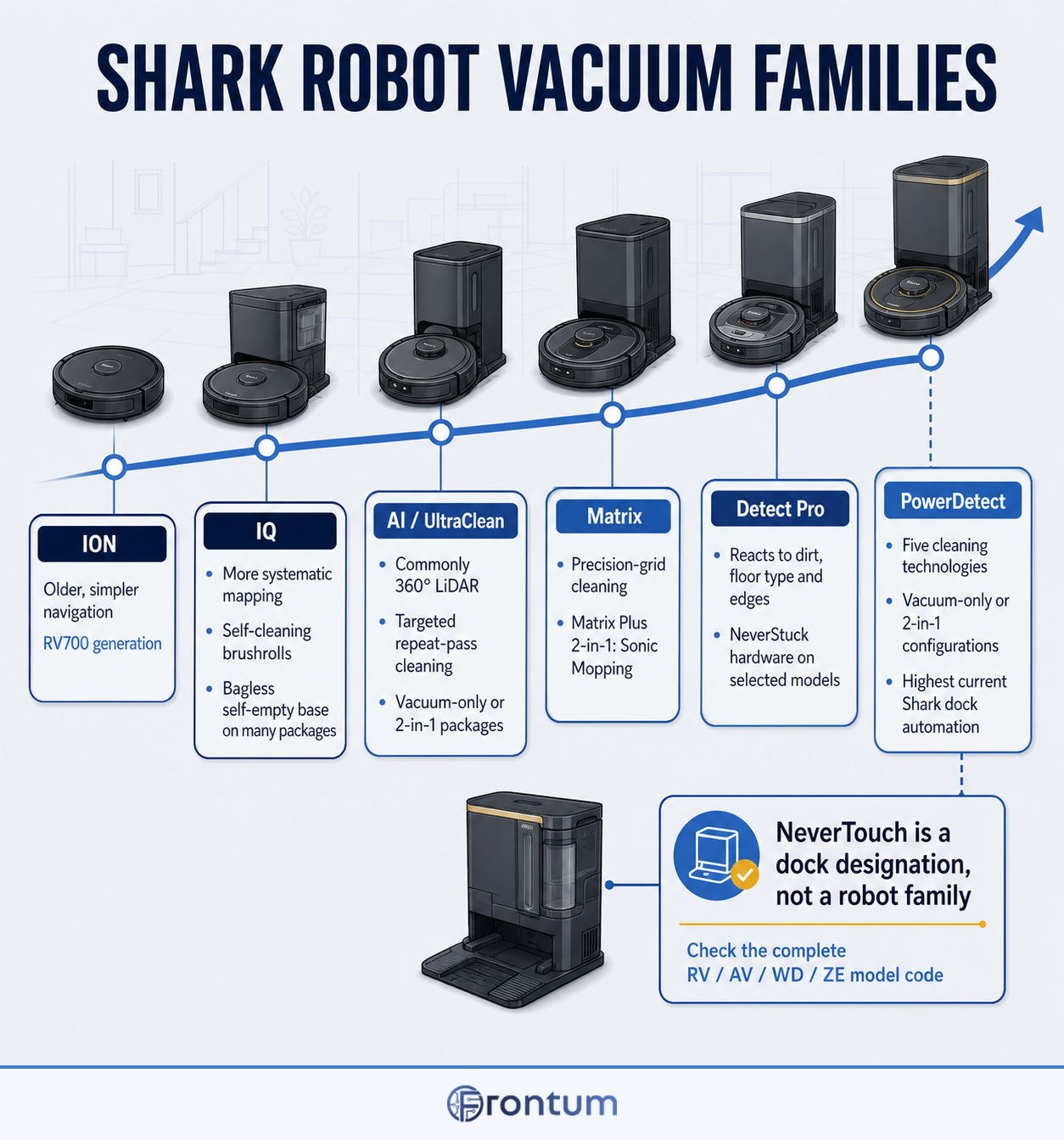
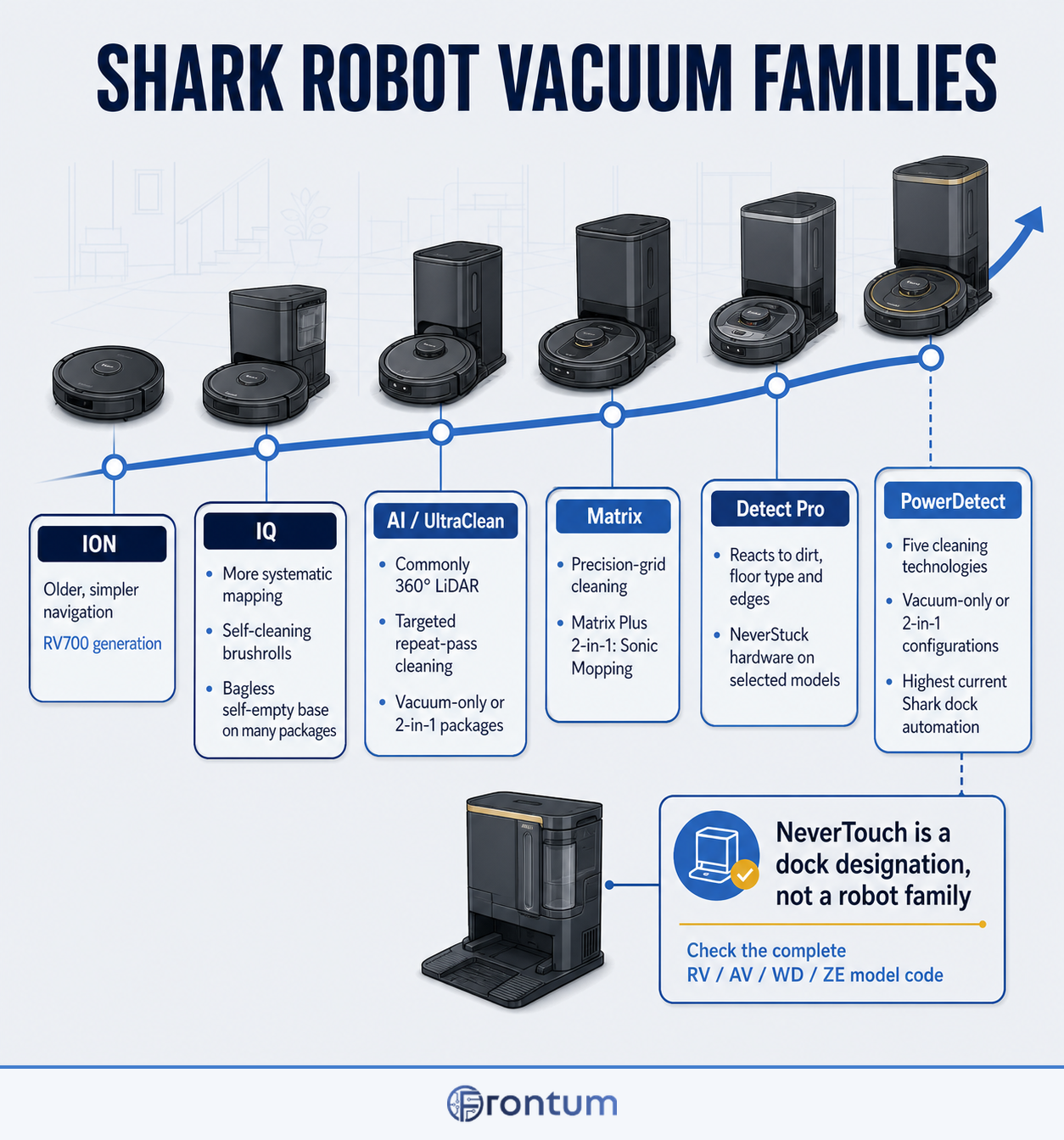
The main Shark robot vacuum families and package names are as follows:
- ION family: ION models such as the RV700 generation are the oldest and simplest Shark robots, using basic sensor or bounce-style navigation rather than a persistent LiDAR map. They suit small, uncluttered floors when price matters more than room selection, methodical coverage or self-emptying.
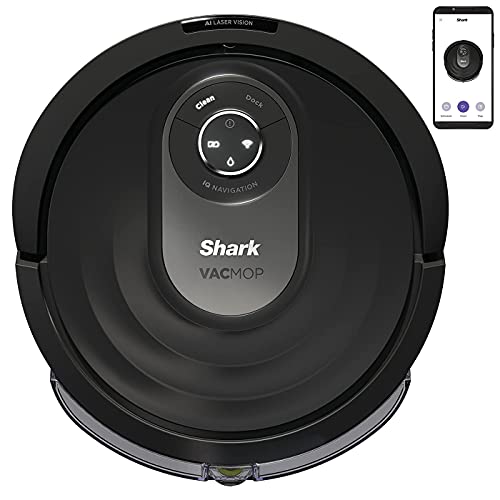
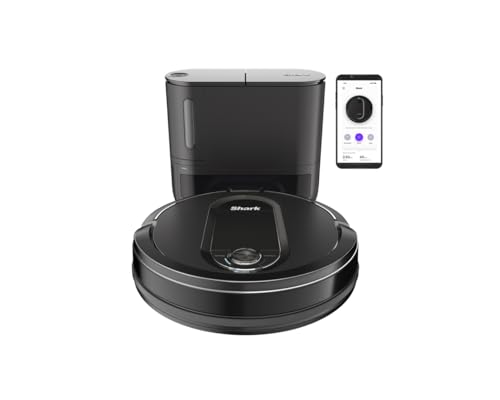
- IQ family: IQ robots introduced more systematic mapping, self-cleaning brushrolls and widely available bagless self-empty bases, with RV1000 and AV2500 codes appearing in different markets. IQ does not identify one fixed specification, so navigation generation, base capacity and mopping still need to be checked separately.
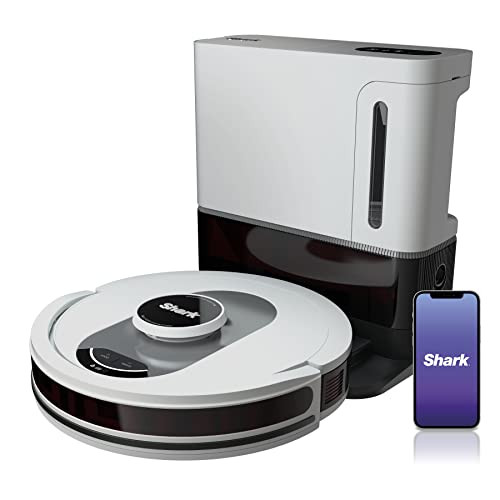
- AI and UltraClean family: AI-branded RV2000 and RV2500 generations commonly use 360-degree LiDAR and Shark’s targeted UltraClean or similar repeat-pass modes. Some are vacuum-only, while WD or 2-in-1 packages add vibrating-pad mopping, making the suffix as important as the AI label.
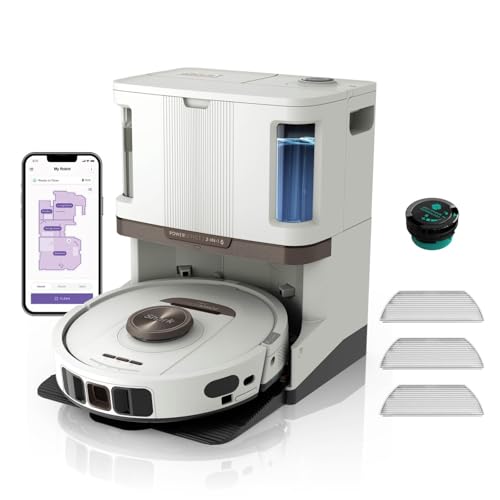
- Matrix family: Matrix names the precision-grid cleaning pattern used by RV2300- and RV2600-era products rather than one identical chassis. Matrix vacuum models focus on repeat-pass pickup and self-emptying, while Matrix Plus 2-in-1 adds Sonic Mopping, edge cleaning and different base choices.
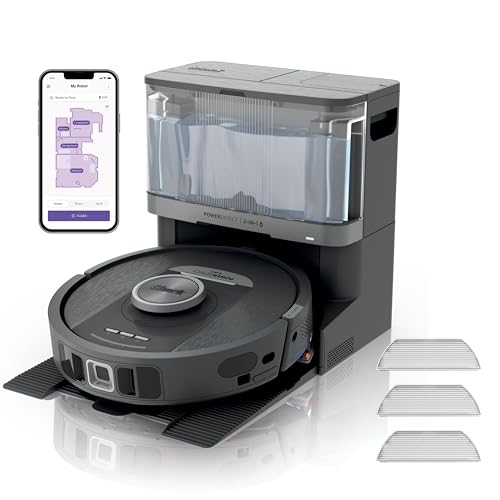
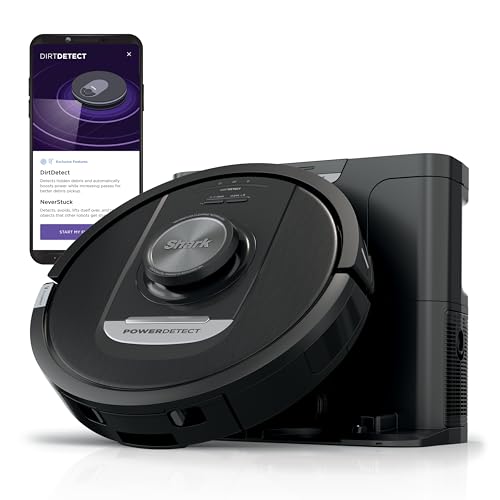
- Detect Pro family: Detect Pro focuses on reacting to hidden dirt, floor type and edges, with NeverStuck hardware helping selected models cross obstacles or thicker carpet. It is commonly sold as a vacuum-only robot with a bagless, HEPA-sealed self-empty base rather than as a full mop-washing system.
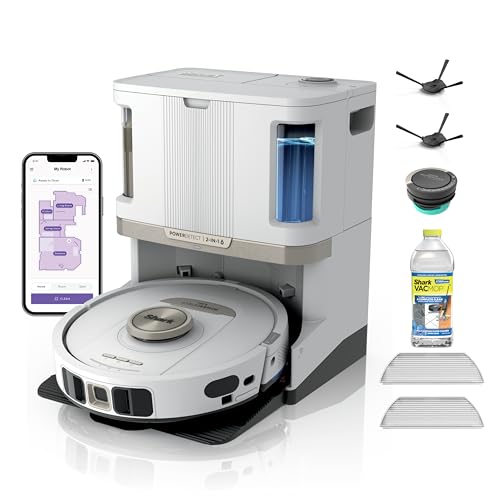
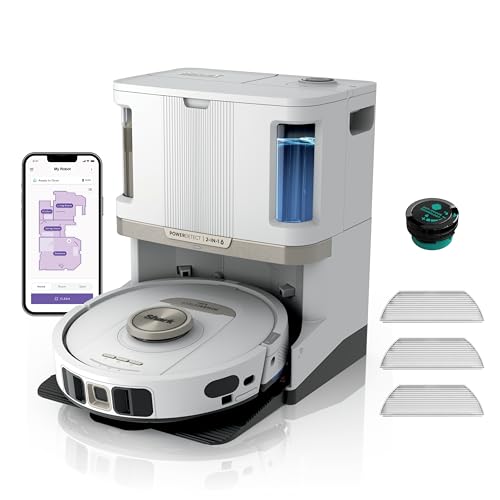
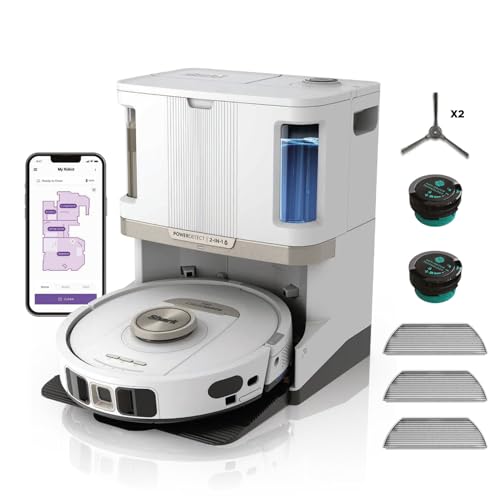
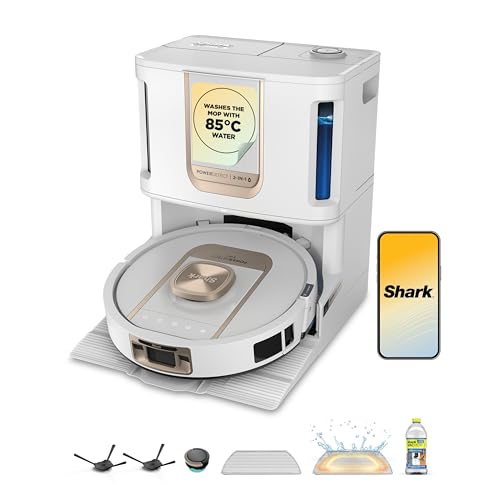
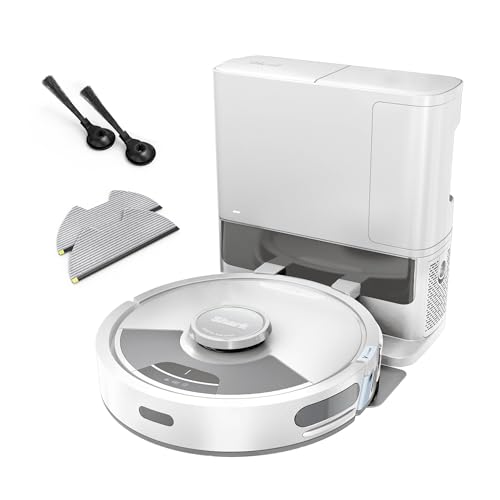
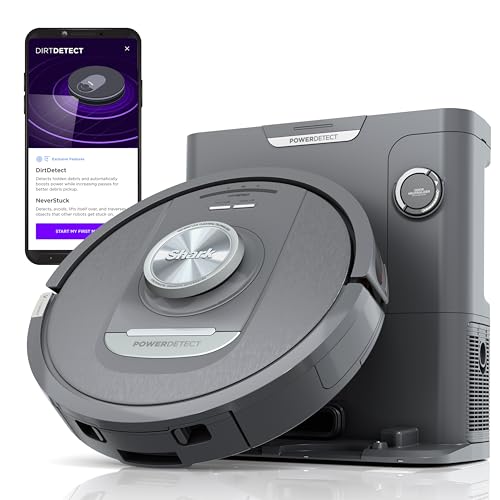
- PowerDetect family: PowerDetect expands the detect-and-react approach to five cleaning technologies and offers vacuum-only or 2-in-1 configurations. Premium versions add active lift-and-lower movement, carpet-safe mop handling, wet-edge extension and the highest level of dock automation in Shark’s current range.
- NeverTouch bases and regional codes: NeverTouch is a dock designation, not a separate robot family; the Pro base can empty debris, refill water, wash the pad and dry it, while simpler packages omit some functions. RV and AV prefixes, AE self-empty, WD wet-and-dry and ZE NeverTouch-style suffixes vary by market, so the complete code should drive comparisons.
How much do Shark robot vacuums cost?
Shark robot vacuums generally cost about £130-£950, with older ION, IQ and AI models plus basic Matrix units commonly around £130-£260. This tier can provide app control, anti-tangle brushing and even LiDAR mapping, but mopping, object avoidance and the dock package vary enough that the complete RV or AV code matters.
Matrix self-empty and 2-in-1 models broadly occupy £260-£470, while Detect Pro and PowerDetect packages range from roughly £340 to £950. Higher prices buy dirt and edge detection, better threshold handling, mop lifting and NeverTouch automation; the most expensive regional bundles add self-refilling, pad washing, drying, HEPA containment or extra accessories rather than only stronger pickup.
The chart below shows the price distribution of Shark robot vacuums.
[vertical-chart-05275332531612983180005526825217941075640214879276]
What should you consider when choosing a Shark robot vacuum?
Use the following checks to choose the right Shark robot and base:
- Series: ION models are the older, simpler Shark robots, while Matrix adds more systematic multi-pass cleaning and Detect Pro improves navigation and floor sensing. PowerDetect is the more advanced mixed-floor platform, and NeverTouch packages add fuller dock care; the RV or AV code identifies the exact regional hardware.
- Navigation: Choose LiDAR for saved rooms, targeted cleaning and reliable mapping in the dark, but do not expect it to recognise every cable or toy. Detect Pro and PowerDetect are better fits for clutter or difficult transitions; many Sharks handle about 20–25 mm, while selected active-lift models claim roughly 38 mm under stated conditions.
- Pet hair: Older ION models use simpler rollers, while IQ, Matrix and Detect Pro families introduced self-cleaning brushrolls that are easier to manage with pet hair. PowerDetect packages add the strongest carpet response and edge behaviour in the current range, making them the better comparison for shedding pets on mixed floors.
- Mopping: Choose a vacuum-only Matrix or Detect Pro for simpler carpet care, or a WD or 2-in-1 model with Sonic Mopping for hard-floor stains. In a mixed-floor home, prefer PowerDetect-style automatic mop lifting; otherwise you may need carpet zones or manual pad removal.
- Base: A Shark bagless self-empty base can hold roughly 45 or 60 days of debris, but it does not necessarily handle water or clean the pad. NeverTouch Pro can refill, wash and dry on compatible PowerDetect packages, so confirm those functions and measure the larger dock before paying extra.
- Runtime: ION and many IQ models sit nearer the shorter end of Shark's roughly 90–120-minute norm, while Detect Pro and selected PowerDetect packages provide more headroom and some premium models extend toward 180 minutes. Matrix repeat passes and stronger PowerDetect modes reduce those maxima, so the mapped families benefit more from recharge-and-resume.
- App and parts: ION models provide little or no persistent-map control, IQ and Matrix generations add more SharkClean room functions, and Detect Pro or PowerDetect exposes the fullest floor and base settings. RV and AV codes also determine compatible rollers, mop pads, odour cartridges and dock parts, even when the retail family name looks identical.