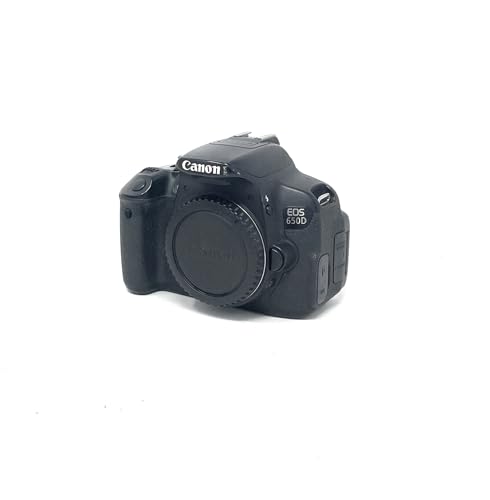
Canon EOS 650D review. Compare 108 technical specifications and user reviews to see how it ranks among cameras and if it is worth buying.
Overall score
What it is: An overall evaluation of the camera's quality, based on technical analyses and user reviews.
When it matters: When you need a quick reference to identify the best cameras on the market.
Score components:
90.0%
Technical Score
10.0%
User score
Technical Score
What it is: An assessment of the camera's technical performance, covering eight key areas: image quality, autofocus, video features, stabilization, lens compatibility, connectivity, battery, and design.
When it matters: When you want to compare cameras based on technical performance and available features.
Score components:
28.0%
Sensor & Image
25.0%
Photo Features
18.0%
Video & Audio
14.0%
Display & Design
8.0%
Battery & Power
7.0%
Connectivity & Storage
User score
What it is: A rating that combines user reviews and the total number of reviews received by the camera.
When it matters: When real-world owner satisfaction and review volume matter to your decision.
Score components:
70.0%
User reviews
30.0%
Popularity
Score components:
25.0%
Sensor size
20.0%
Main camera megapixels
20.0%
Dual card slots
15.0%
N. of focus points
10.0%
RAW photo capture
10.0%
Phase-detection autofocus (photos)
Score components:
35.0%
Weight
30.0%
Battery life (CIPA)
20.0%
Sensor-shift stabilization
15.0%
GPS
Score components:
30.0%
Price
20.0%
Weight
20.0%
AF tracking
20.0%
Battery life (CIPA)
10.0%
Touchscreen
Score components:
30.0%
Main camera megapixels
25.0%
Sensor size
20.0%
Main camera pixel size
15.0%
Sensor-shift stabilization
10.0%
RAW photo capture
Score components:
30.0%
Weight
25.0%
Thickness
20.0%
AF low-light sensitivity
15.0%
Sensor-shift stabilization
10.0%
Eye detection AF (human)
Score components:
30.0%
Sensor size
25.0%
Main camera pixel size
20.0%
Eye detection AF (human)
15.0%
Main camera megapixels
10.0%
Sensor-shift stabilization
Score components:
30.0%
Weight
25.0%
Battery life (CIPA)
20.0%
Min operating temperature
15.0%
Sensor-shift stabilization
10.0%
GPS
Available: ranking among products currently available (including other versions of this product).
All: ranking among all products in the database.
#2 in Best Cheap Cameras
#4 in Best Cheap DSLR Cameras
#5 in Best Cameras under £1000
#10 in Best DSLRs for Beginners
#13 in Best Canon DSLR Cameras
#21 in Best Cameras under £500
#22 in Best Canon Vlogging Cameras
#33 in Best Canon EOS Cameras
#34 in Best Canon Digital Cameras
#35 in Best DSLR Cameras
#35 in Best SLR Cameras
#43 in Best Cameras under £200
#46 in Best Cameras for Beginners
#59 in Best Vlogging Cameras
What it is: An assessment of the camera's technical performance, covering eight key areas: image quality, autofocus, video features, stabilization, lens compatibility, connectivity, battery, and design.
When it matters: When you want to compare cameras based on technical performance and available features.
Score components:
28.0%
Sensor & Image
25.0%
Photo Features
18.0%
Video & Audio
14.0%
Display & Design
8.0%
Battery & Power
7.0%
Connectivity & Storage
What it is: A rating that combines user reviews and the total number of reviews received by the camera.
When it matters: When real-world owner satisfaction and review volume matter to your decision.
Score components:
70.0%
User reviews
30.0%
Popularity
What it is: An indicator that combines the camera's overall rating with its cost.
When it matters: When you want to know how much overall quality you get for the price.
Score components:
60.0%
Overall score
40.0%
Price
Importance: HIGH
Good value: Full frame or larger
Importance: HIGH
Good value: At least 20 MP
Importance: HIGH
Good value: At least 3.5 µm
Importance: LOW
Importance: MEDIUM
Good value: At least ISO 25,600
Importance: MEDIUM
Importance: MEDIUM
Good value: At least 14-bit
Importance: LOW
Importance: LOW
Importance: LOW
Importance: LOW
Importance: LOW
Importance: LOW
Importance: LOW
Importance: LOW
Importance: MEDIUM
Importance: LOW
Importance: LOW
Importance: LOW
Importance: LOW
Importance: LOW
Importance: HIGH
Good value: At least 200 points
Importance: HIGH
Importance: MEDIUM
Importance: LOW
Importance: LOW
Importance: MEDIUM
Importance: MEDIUM
Importance: HIGH
Good value: At least 5 stops
Importance: LOW
Importance: MEDIUM
Good value: At least 10 fps
Importance: LOW
Importance: LOW
Importance: LOW
Importance: LOW
Importance: LOW
Importance: LOW
Importance: LOW
Importance: LOW
Importance: LOW
Importance: LOW
Importance: LOW
Importance: LOW
Importance: LOW
Importance: LOW
Importance: LOW
Importance: LOW
Good value: At least 200,000 actuations
Importance: LOW
Good value: At least 10x
Importance: HIGH
Good value: At least 3840 px
Importance: MEDIUM
Good value: At least 200 Mbps
Importance: MEDIUM
Good value: At least 10-bit
Importance: LOW
Importance: LOW
Importance: LOW
Importance: LOW
Importance: LOW
Importance: LOW
Importance: LOW
Good value: At least 30 min
Importance: LOW
Importance: LOW
Importance: LOW
Importance: LOW
Importance: LOW
Good value: At least 2 microphones
Importance: LOW
Importance: LOW
Importance: LOW
Importance: LOW
Importance: MEDIUM
Good value: 500 g or less
Importance: LOW
Importance: LOW
Importance: LOW
Importance: MEDIUM
Importance: MEDIUM
Good value: At least 2.36 million dots
Importance: LOW
Good value: 100%
Importance: LOW
Importance: LOW
Good value: At least 120 Hz
Importance: MEDIUM
Good value: At least 3 in
Importance: LOW
Importance: LOW
Importance: LOW
Importance: LOW
Importance: LOW
Importance: LOW
Importance: LOW
Good value: At least 10 m
Importance: LOW
Importance: LOW
Importance: LOW
Importance: LOW
Importance: MEDIUM
Good value: At least 400 shots
Importance: LOW
Good value: At least 1,500 mAh
Importance: LOW
Importance: LOW
Importance: LOW
Importance: LOW
Importance: LOW
Importance: LOW
Importance: LOW
Importance: LOW
Importance: LOW
Importance: LOW
Importance: LOW
Importance: LOW
Importance: LOW
Importance: LOW
Importance: LOW
Importance: LOW
Importance: LOW
Importance: LOW
Importance: HIGH
Importance: LOW
Importance: LOW
Importance: LOW
Importance: LOW
Importance: LOW
Importance: HIGH
Good value: At least 3.5 µm
Importance: MEDIUM
Importance: MEDIUM
Importance: LOW
Good value: 100%
Importance: LOW
Importance: MEDIUM
Good value: 500 g or less
Importance: LOW
Importance: LOW
Importance: HIGH
Good value: At least 200 points
Importance: LOW
(Reviews last updated: July 2026)
The DPReview in-depth review identifies the Canon EOS 650D (Rebel T4i) as a capable, user-friendly entry-level DSLR featuring an improved 5 fps burst rate and a responsive, smartphone-like capacitive touchscreen interface. Key advantages include its 9-point cross-type autofocus system for consistent subject tracking, excellent color reproduction in JPEG, and valuable additions like an external microphone jack and built-in stereo audio. Conversely, the review notes that the Hybrid AF system for live view and video is sluggish compared to competitors, often hunting to find focus. Other cons include slightly higher high-ISO noise levels compared to the older 600D, limited dynamic range, and a specific issue where Auto ISO forces ISO 400 in daylight when a flash is enabled.
The Canon EOS Rebel T4i (also known as the EOS 650D) is an upper entry-level DSLR that introduces major modern functionality to its popular predecessor's physical blueprint. While maintaining an 18-megapixel resolution and a familiar 9-point autofocus frame, it introduces a highly responsive 3-inch capacitive touchscreen that supports phone-style multi-touch gestures. Performance is significantly upgraded via the Digic 5 processor, which bumps continuous shooting to 5fps, unlocks a maximum sensitivity of 25600 ISO, and adds helpful in-camera features like Multi-shot noise reduction and Chromatic Aberration correction. Photographers will benefit heavily from its completely overhauled autofocus system, which now utilizes cross-type sensors for all nine positions to deliver superior precision. A standout pro is the "Hybrid CMOS AF" system that embeds phase-detect pixels into the main sensor, allowing for silent, quick, and accurate tracking during video recording when paired with Canon’s new STM stepper-motor lenses. Video shooters will also enjoy the integration of built-in stereo microphones, a dedicated 3.5mm external mic input, and intuitive touchscreen control over exposure settings. However, a notable con is that the Hybrid AF performance slows down...
The Canon EOS 650D (known as the Rebel T4i in the US) is an 18-megapixel DSLR aimed at beginner and enthusiast photographers, distinguished as Canon's first DSLR to feature a touch-sensitive, vari-angle LCD screen. Powered by a Digic 5 processor that is six times faster than its predecessor, the camera delivers a boosted continuous shooting speed of 5fps, making it highly capable for action and wildlife photography. A major technical highlight is its new Hybrid AF system, which combines phase and contrast detection to enable automatic focusing during video recording—a first for the Canon EOS lineup. Additionally, the review praises the camera's high ISO performance (expandable up to 25,600), its user-friendly interface, and built-in creative tools like the integrated Speedlite transmitter and new multi-shot shooting modes for nighttime and backlit scenes. Despite these strong features, the review highlights several limitations that buyers should consider. On the downside, the camera is restricted to an 18MP resolution, which falls short of competitors like the 24MP Nikon D3200. Furthermore, its raw burst-depth is limited to just six files before slowing down, and the...
The Canon EOS 650D delivers a "status quo" performance in image quality, failing to show meaningful sensor improvements over its predecessors and falling significantly behind its competition. Testing reveals a DxOMark sensor score of 62, which is actually a slight three-point drop from the older EOS 600D. When compared to rival cameras, the 650D's sensor limitations become even more pronounced. The Nikon D3200 outclasses it by 19 points overall, offering 2EV more dynamic range, 2.4 bits greater color depth, and a 0.5EV lead in low-light sensitivity despite having a higher 24-megapixel resolution. Similarly, the Sony SLT-A65 beats the 650D by 12 points overall, outperforming it by 1.4EV in dynamic range and one stop in color depth. While the stagnant 18-megapixel sensor serves as the primary con, the camera compensates with major design and usability pros. Canon focused its efforts on ergonomics, introducing a highly responsive, articulated capacitive touchscreen display and a compact, lightweight body. Another major pro is the innovative hybridized autofocus system, which utilizes specialized photosites on the sensor to provide continuous, quick, and quiet autofocus tracking in video...
The Canon EOS 650D is a mid-range DSLR that offers a solid entry point into photography, building on its predecessor with key internal updates while maintaining a familiar 18-megapixel sensor, 9-point autofocus system, and 3-inch articulated screen. A major upgrade is the DIGIC 5 processor, which increases continuous shooting speed to 5fps and introduces helpful in-camera chromatic aberration (CA) correction to eliminate color halos. It stands out as the first SLR to feature an exceptionally well-implemented touchscreen, which vastly accelerates menu navigation and makes adjusting exposure settings completely silent during video recording. For videographers, it introduces integrated phase-detect autofocus points on the sensor for continuous video tracking, stereo audio recording, and the ability to bypass the old 4GB file restriction to record clips up to 30 minutes long.
The Canon EOS 650D user review highlights the DSLR as a capable upgrade for consumers, offering excellent image quality in diverse shooting scenarios ranging from close-ups to mid-distance. It balances user-friendly operation with advanced features suitable for those entering photography, with strengths including its performance across varied focal lengths. However, the analysis suggests that existing owners of the 550D or 600D might not find the incremental upgrades necessary, noting that earlier models remain highly capable alternatives. While a strong contender in the high-end consumer market, the 650D faces competition from its own, slightly older, and often more cost-effective predecessors.
The ePHOTOzine review of the Canon EOS 650D highlights the DSLR as a solid consumer-level upgrade, praising its excellent image quality, accurate colour reproduction, and solid build quality. A major standout feature is the responsive capacitive touchscreen, alongside excellent noise performance up to ISO 3200 and a comfortable, ergonomic design. YouTube · Despite these strengths, the review notes that the live view autofocus remains slow when paired with standard lenses, failing to match the speed of competing mirrorless systems. Additionally, high ISO image quality does not quite match the older EOS 600D, and the touch menu layout may feel unfamiliar to traditional users.
The Amateur Photographer review of the Canon EOS 650D highlights a feature-rich DSLR boasting a responsive, intuitive capacitive touchscreen and a faster DIGIC 5 processor for improved performance. Key strengths include a 9-point all-cross-type autofocus system for enhanced low-light performance and a 5fps continuous burst rate. Conversely, limitations identified include a maximum shutter speed of only 1/4000sec and restricted continuous raw shooting, limited to a six-file buffer. Additionally, the review notes that while live view autofocus is improved, it can remain sluggish with standard kit lenses.
The Canon EOS 650D (known as the Rebel T4i in North America) is an innovative entry-level DSLR designed for beginner-enthusiasts, standing out as the first-ever DSLR to feature a responsive, multi-touch 3-inch Vari-angle LCD screen. Driven by an 18-megapixel Hybrid CMOS sensor and a powerful Digic 5 processor, the camera shoots full-resolution images at a fast 5 frames per second (fps) and introduces continuous autofocus tracking during Full HD video recording and Live View mode. Image quality proves excellent straight out of the camera, delivering rich contrast and realistic colors, while the expanded ISO range up to 25,600—bolstered by a highly effective Multi-Shot Noise Reduction setting—allows for usable, detailed handheld shooting in low light. Several notable strengths and weaknesses define the camera's overall performance. On the positive side, its primary pros include the intuitive touch-screen controls with Touch Shutter mode, the impressive 5fps burst rate, great image quality, and excellent high ISO performance with four-shot blending technology. Conversely, the camera's cons center on its high launch price (£699 body only), a mixed-material body construction, and the constant need to keep...
The Canon EOS 650D (also known as the Rebel T4i) is an 18-megapixel DSLR designed with entry-level and enthusiast photographers in mind, blending an evolutionary step up in performance with a highly user-friendly interface. Built from a lightweight mix of stainless steel and polycarbonate resin, it balances portability with power by offering 5 frames per second continuous shooting, a dual cross-point autofocus system for precision, and 1080p Full HD video recording. Key operational highlights include a fully articulating, lateral-swing 175-degree touchscreen LCD that simplifies high-angle and waist-level shooting, alongside excellent ISO performance that maintains impressive image sharpness up to ISO 6400 before noticeable noise deteriorates the shot. The review underscores several key advantages and drawbacks regarding its performance and handling. On the positive side, the camera delivers top-tier image quality with accurate colors, effortless usability due to an intuitive mode dial, an accessible price point, and reliable subject-tracking autofocus when paired with quiet STM lenses. However, the reviewer notes distinct cons: the camera lacks the ability to capture still photos while recording video, and its physical balance becomes significantly front-heavy...
Canon 650D Review Summary The Canon 650D stands out as a highly beginner-friendly digital SLR camera that introduces a vari-angle touchscreen interface and a newly developed 18-megapixel hybrid CMOS sensor, allowing for continuous autofocus during Full-HD video recording. It provides solid resolution improvements in JPEG files compared to earlier EOS models and features a robust 9-point cross-type autofocus system,. Operating at a continuous shooting speed of 5 frames per second, it offers adequate performance for casual action, sports, or nature photography. In terms of image quality, its daytime color accuracy matches higher-tier models like the Canon 7D. However, because of its limited buffer capacity, it is not recommended for dedicated action photographers who need to shoot long bursts of sequential images. Key Pros and Cons Pro: Responsive vari-angle touchscreen interface. Pro: Full-HD video with manual controls and continuous AF. Pro: Higher resolution JPEG files than previous EOS cameras. Con: Limited low-ISO dynamic range that requires Highlight Tone Priority to mitigate washed-out highlights. Con: Weak white balance in artificial light, producing an unnatural orange cast in both RAW and JPEG formats....
In this review, freelancer Dylan Garton evaluates the Canon EOS 650D as a portable, all-in-one solution for capturing holiday photos and videos, aiming to replace his bulky combination of a Canon EOS 350D and a Canon HV30 camcorder. A major pro highlighted in the review is the camera's ability to successfully consolidate high-quality stills and cinematic video into a single device, significantly reducing the burden of carrying multiple sets of batteries and cables while travelling. However, a prominent con identified during testing was the EFS 18-55mm kit lens, which generated a loud, distracting "whizzing sound" on video recordings due to its noisy autofocus motor. To resolve the noise issue, Garton upgraded to the Canon EF-S 18-135mm f/3.5-5.6 IS STM lens for £269, which introduces additional specific performance insights. The key pro of this STM (stepping auto-focus motor) lens upgrade is that it operates almost silently, completely eliminating autofocus noise from the video track while delivering good overall focusing speed. Conversely, a remaining con is that the autofocus system still struggled to maintain focus on fashion models walking directly toward the...
However, the review highlights several notable drawbacks, particularly regarding its heavily marketed Hybrid CMOS autofocus system. While designed to enable continuous autofocus during live view and video capture using new STM stepper-motor lenses, the Movie Servo AF system proves slow, stubborn, and prone to focusing on backgrounds rather than subjects. Additionally, the camera tends to overexpose images frequently—especially when utilizing Auto ISO—forcing users to manually dial down exposure compensation. Other cons include below-average battery life, a shallow buffer that limits long bursts when shooting in RAW format, and the lack of a dedicated AF illuminator lamp. Ultimately, the reviewer concludes that while it underperforms as a seamless video camcorder replacement, it remains an excellent, reliable choice for family still photography.
Ken Rockwell’s review highlights the Canon Rebel T4i as a feature-packed, consumer-oriented DSLR, specifically praising it as the first with built-in stereo microphones and a highly responsive vari-angle touchscreen. A major advantage is its smooth, silent autofocus when paired with STM lenses, which enables effective video tracking without motor noise, marking it as a significant step forward in hybrid video/still performance. Despite these advancements, the review notes the hybrid autofocus is quite slow to achieve initial focus and still lags behind dedicated camcorder performance. Furthermore, for photographers, the 18MP image quality is rated as no better than less expensive, older models, making it a better option for family videographers than for pure still shooters looking for value. Ken Rockwell
The Canon EOS 650D, as tested by Digitalkamera.de, is a highly capable entry-to-mid-level DSLR featuring an 18-megapixel APS-C sensor, a responsive 3-inch capacitive touchscreen, and an improved Hybrid Autofocus system for video. Key pros include enhanced touchscreen operability and better live-view focusing, though the camera still faces challenges with screen visibility in direct sunlight and limited, lens-dependent autofocus performance. Digitalkamera.de
The CHIP review highlights the Canon EOS 650D as an innovative mid-range DSLR priced around 740 Euros (body only) that successfully integrates a 3-inch articulating touchscreen with smartphone-like multi-touch gestures. Built with a premium, lightweight fiberglass and plastic chassis, its prominent strengths include an upgraded 9-point cross-type autofocus system and an entirely redesigned 18-megapixel APS-C sensor. The camera delivers outstanding image quality with highly accurate color reproduction, maintaining sharp detail resolution up to ISO 1600 and producing clean A3-size prints up to ISO 3200. Performance-wise, it provides a fast burst rate of 5 frames per second, a swift viewfinder shutter delay of 0.31 seconds in daylight, an extended battery runtime of up to 1,140 photos, and rich Full-HD video capabilities complemented by an external 3.5mm microphone jack and 64-step manual audio tracking. Conversely, the review exposes several drawbacks, particularly a severely compromised Live View autofocus speed that requires a sluggish 1.67 seconds to lock focus. While the new Stepper Motor (STM) lens technology allows for noise-free, smooth focus adjustments during video capture, it fails to accelerate this slow screen-based photo...
The COMPUTER BILD review highly praises the Canon EOS 650D as an excellent and affordable entry-level DSLR for ambitious hobby photographers, awarding it a "very good" score of 1.4. A major standout feature of the camera is its high-resolution (1,040,000 pixels) 3-inch vari-angle touchscreen monitor, which provides excellent detail and supports smartphone-like multi-touch gestures for zooming and tracking faces. Equipped with an 18-megapixel APS-C sensor, the camera delivers sharp, high-contrast images with minimal noise. Performance-wise, the camera features an exceptionally fast 9-point autofocus system that locks onto subjects in just 0.35 seconds, combined with a quick 5 frames-per-second continuous shooting mode. It also introduces helpful automatic exposure modes like Handheld Night Scene and an integrated HDR mode. However, the review details several negative aspects, particularly regarding audio performance and stabilization. While the camera supports Full HD video recording, the autofocus of the bundled kit lens (Canon EF-S 18-55mm IS II) is loud and erratic. The integrated stereo microphones pick up these operational noises, rendering the recorded video audio practically useless and making manual focusing a necessity. Performance limitations are also...
Overview The Canon EOS 650D is a solid entry-level DSLR camera that delivers impressive performance inherited from mid-range models, making it a compelling upgrade for users transitioning from older cameras like the EOS 550D or 600D. Equipped with an 18.0-megapixel APS-C CMOS sensor, it produces excellent image quality with minimal noise at low ISO values (100–200) and remains highly capable up to ISO 1,600, although heavier noise reduction smoothing becomes apparent at ISO 3,200 and higher. Key strengths include its accurate 9-point cross-type phase-detection autofocus system for viewfinder shooting, a highly responsive 3.0-inch vari-angle touchscreen display supporting multi-touch gestures, a built-in Speedlite transmitter, and full HD video capabilities with manual control. Additionally, it achieves a class-leading continuous shooting speed of 5.0 frames per second, which outperforms most budget competitors. Performance and Lens Compatibility Despite its strong foundation, the camera’s performance is heavily influenced by the chosen kit lens, resulting in a few notable limitations. When paired with the specialized Canon EF-S 18-135mm STM lens, the camera’s Hybrid AF excels, providing quiet and fast focusing suitable for video recording. However, using...
The Canon EOS 650D (sold as the Rebel T4i in America) is a 18-megapixel APS-C DSLR that serves as a minor, iterative upgrade over the 600D, sharing its exact 9-point phase-detection autofocus module and 95% coverage pentamirror viewfinder. A major highlight of this model is its fully articulating, 3-inch high-resolution touchscreen, which supports multi-touch navigation for easy menu control and image playback. On the downside, the camera relies on a plasticky body built around a metal chassis, and its internal flash lacks wireless master control functionality, requiring users to purchase additional system flashes for off-camera setups. Additionally, activating the "Highlight Tone Priority" (C.Fn II-3) setting restricts the ISO range to 200–12,800, removing the option for ISO 100 or 25,600. In terms of performance, the camera delivers good image quality up to ISO 800 or 1,600, and its sensor features embedded dual-pixels to improve live-view and video autofocusing when paired with STM lenses. However, the sensor struggles with a low dynamic range that frequently causes highlights to blow out, requiring manual exposure compensation. Furthermore, low-light image quality degrades rapidly above ISO...
The Canon EOS 650D introduces a 3-inch, vari-angle touchscreen and a new 18-megapixel APS-C Hybrid CMOS sensor featuring a dual autofocus system designed to accelerate performance during live-view and video recording. Key advantages include its highly flexible, clear touchscreen display, which enables rapid menu navigation and swift "Touch AF" shutter release, alongside a robust and comfortable plastic grip. Additionally, it expands on exposure options by introducing a built-in HDR mode and a "Handheld Night Scene" feature, while offering advanced video functions like an external microphone jack with manual audio level adjustments. However, the camera falls short in several key performance and quality metrics compared to its cheaper predecessor, the EOS 600D. Despite the dual AF upgrade, live-view focusing remains slow at 1.67 seconds and suffers from choppy adjustments when filming with the new STM lenses. Crucially, the image quality is inferior at lower and mid-range ISO sensitivities due to aggressive internal contrast boosting and lower kurtosis values, meaning it processes fine details less gently than the 600D. Furthermore, entering the video mode requires navigating a somewhat clunky and inconvenient sliding...
The Canon EOS 650D (also known as the Rebel T4i) is a mid-range DSLR reviewed by CHIP that marked an impressive "triple premiere" for Canon. Priced around €740 for the body alone at launch, this camera introduced a highly intuitive, multi-touch capacitive touchscreen that brought smartphone-like swiping and pinch-to-zoom convenience to the lineup. Alongside this display, it debuted a revamped 18-megapixel Hybrid CMOS sensor and an upgraded 9-point all-cross-type autofocus system. When coupled with Canon's Stepping Motor (STM) lens technology, this combination delivered superb overall image sharpness, top-tier color accuracy, and full-time, exceptionally quiet autofocus tracking during Full HD video recording. YouTube · Reviewers from CHIP highlighted several major advantages, including the incredible ergonomics of the 270-degree vari-angle flip screen and the ease of making swift exposure adjustments with a simple tap. Users could even capture photos using a "touch-snap" shutter option. The updated DIGIC 5 processor also gave a notable speed boost, allowing for a continuous burst rate of 5 frames per second and advanced in-camera processing features like HDR Backlight Control. However, the review noted minor drawbacks, such...
The Kurier review highlights the Canon EOS 650D as a high-performance entry-level DSLR, featuring an intuitive 3-inch vari-angle touchscreen and capable continuous tracking autofocus. While praised for bridging the gap to higher-tier cameras, the 650D requires compatible STM lenses for optimal video autofocus, as tracking speed drops significantly with older lenses. While offering excellent features for beginners, the review notes that the continuous autofocus can be frustratingly slow to re-establish focus with non-STM lenses. The analysis concludes that users who do not intend to utilize the touchscreen functionality might find better value in the older EOS 600D model. Kurier
The Speicherkarten.guru review highlights the Canon EOS 650D as a significant milestone in Canon’s EOS series, notably being the manufacturer's first DSLR to integrate the modern, faster UHS-I memory card interface. A major pro identified in the text is its standard compatibility with cost-effective SDHC and SDXC cards, specifically requiring a standard speed class of 10/U1 or higher to achieve optimal performance. Furthermore, the camera serves as a viable option for advanced videographers utilising Magic Lantern firmware, as it supports specialized SD configurations optimized for RAW video recording. However, the review outlines clear technical restrictions that act as cons for users seeking top-tier speeds. The main downside is that the camera cannot exploit the extra bandwidth of premium media; purchasing expensive UHS-II cards or ultra-fast UHS-I variants yields no performance increase in write speeds or functionality. Ultimately, while the inclusion of the UHS-I interface was a breakthrough at launch, the hardware caps performance at basic U1 thresholds, meaning users looking for enhanced burst-rate clearing will find premium storage investments wasted.
The Canon EOS 650D marks a significant milestone as the brand's first DSLR to feature continuous autofocus during video recording and an intuitive multi-touch LCD screen. The camera delivers exceptional image quality up to ISO 3200, highly responsive operation with a fast 5 frames-per-second burst mode, and a fully articulating screen that boasts stellar color rendering. Additionally, it features a complete video mode with stereo sound, an integrated wireless flash commander, and a user-friendly interface that accommodates both beginners using physical controls and smartphone-accustomed users through its responsive touch display. Despite these advancements, the camera's hybrid autofocus system—which combines phase and contrast detection—ultimately lacks responsiveness and can stutter in low-light conditions. Its physical performance is also held back by a loud shutter mechanism and an unpolished auto white balance. Furthermore, users looking for modern connectivity will miss built-in Wi-Fi, GPS, and USB 3.0 support. Finally, while the newly introduced step-motor (STM) lenses ensure quiet, fluid focus adjustments during video recording, the overall STM lens ecosystem remains severely limited at launch.
The Canon EOS 650D (also known as the Rebel T4i) is a highly capable entry-level DSLR that stands out as the first reflex camera to feature a responsive, capacitive vari-angle touchscreen interface. Powered by an 18-megapixel APS-C CMOS sensor and the Digic 5 processor, it delivers vibrant, warm JPEG images with standard multi-shot features like a 5 fps burst rate and a built-in HDR mode. For videographers, the camera captures full HD video and utilizes a hybrid autofocus system that leverages phase-detection pixels directly on the sensor for continuous, fast, and smooth tracking without back-and-forth hunting. When combined with the silent, quick-focusing 40mm f/2.8 pancake STM lens used in the review, the lightweight 800g setup becomes an incredibly quiet and portable choice for everyday shooting. A major advantage highlighted in the review is the camera's highly functional, intuitive, and lag-free touch interface, which allows users to effortlessly change complex menu options, pick autofocus points, and navigate playback via smartphone-like gestures. Additionally, the camera features an integrated stereo microphone and handles high ISO noise remarkably well up to ISO 1600 without...
The Les Numériques review highlights the Canon EOS 650D (also known as the Rebel T4i) as a ground-breaking entry-level DSLR for its time, introducing key advancements in physical interface and video performance. Pros center heavily on its pioneering smartphone-like capacitive touchscreen, which integrates flawlessly with the fully articulating display to make menu navigation and Live View focus selection highly intuitive. The camera features a competent 18-megapixel APS-C sensor powered by a DIGIC 5 processor, delivering rich colors, excellent sharpness, and solid noise preservation up to ISO 800/1600. Additionally, videographers benefit from a dedicated hardware video switch, a built-in stereo microphone, and a newly implemented continuous autofocus in video mode—a major leap forward for reflex cameras. However, the review details several cons that hold the camera back from perfection. While the new continuous autofocus performs efficiently under standard conditions, its Live View autofocus speed remains noticeably slower than competing mirrorless (hybrid) cameras of the era. The physical ergonomics and overall button layout show minimal aesthetic changes compared to its predecessor, maintaining a familiar but somewhat uninspired plastic finish. Furthermore, the continuous...
The review of the Canon EOS 650D by Les Numériques focuses heavily on the camera’s groundbreaking video mode improvements, specifically highlighting the introduction of continuous autofocus. The review explains that Canon achieved this by implementing a hybrid autofocus system on the main sensor, which combines phase-detection and contrast-detection technologies. This allows the camera to maintain focus continuously during live view on the screen and while recording video. To fully utilize this system, the camera is designed to be paired with Canon's STM (Stepping Motor) lenses, which are specifically engineered for videography. The primary pro highlighted in the review is the inclusion of this continuous autofocus system during video capture and live view, which represents a major technical evolution for Canon DSLRs. Additionally, when paired with the new STM lenses, the camera delivers smooth and silent focusing movements, eliminating harsh adjustments and distracting lens noise from the video track. On the downside, the main con implies that to actually achieve these silent and seamless autofocus results, users are required to invest in these specific, newly developed STM lenses; standard older lenses...
The Canon EOS 650D marks a notable step forward for Canon’s amateur DSLR line by introducing an 18-megapixel hybridized APS-C CMOS sensor paired with a powerful DIGIC 5 image processor. A major pro of this camera is its upgraded autofocus system, which utilizes focus-dedicated photodiodes to enable permanent, full-time autofocus tracking during video recording and LiveView mode. It features a high-resolution, articulated 3-inch touchscreen that supports smartphone-like gestures and touch-to-shoot capabilities. Performance is also improved, boasting a faster burst shooting rate of 5 frames per second (up from 3.7 fps on the 600D), along with the addition of creative features like HDR and Handheld Night Shot modes. However, the camera still carries a few cons and limitations that keep it closer to its entry-level roots. It retains the same basic 18-megapixel resolution and overall sensor architecture that Canon has used since 2008, meaning it offers little surprise or massive technological leaps in raw sensor capabilities. The autofocus system is also constrained by "only" nine cross-type AF points, which lags behind higher-tier models despite its enhanced speed. Additionally, the viewfinder coverage...
The Camerarace review of the Canon EOS 650D rates the DSLR with a 56/100 score, highlighting strong performance in everyday and street photography. Key advantages include a capable autofocus system for tracking subjects, a lightweight design (575g), and a fully articulated touchscreen for versatile framing. Conversely, the assessment notes limited suitability for portrait and landscape photography, along with a lack of weather-sealing protection. Significant drawbacks include low battery autonomy of 440 shots per charge and a total absence of wireless connectivity options.
The Saggiamente review highlights the Canon EOS 650D as a versatile entry-level DSLR featuring an 18-megapixel sensor and a responsive 3-inch vari-angle touchscreen that enhances usability. Key upgrades include a Hybrid CMOS AF system for smoother video recording and improved continuous shooting speeds. YouTube · Pros include an intuitive touchscreen interface, an integrated Speedlite transmitter, and flexible, articulated shooting angles. Conversely, cons focus on sluggish live-view contrast-detection in certain scenarios and a physical design very similar to its predecessor. YouTube
The Canon EOS 650D is a versatile consumer DSLR featuring an 18-megapixel APS-C CMOS sensor, an upgraded DIGIC 5 image processor, and an innovative Hybrid CMOS AF system designed to boost autofocus performance during Live View and video recording. The camera stands out for its high-quality construction featuring a stainless steel and polycarbonate chassis that keeps the total weight under 600 grams. Notably, it is celebrated as one of the first entry-level DSLRs to successfully integrate an intelligent, fully articulating 3-inch touchscreen LCD, which vastly improves menu navigation, image playback, and touch-to-focus shooting. Photographic performance delivers highly accurate colors and clear JPEG results up to ISO 400, while RAW files retain strong integrity and details up to ISO 1600. Despite these upgrades, the review highlights several distinct limitations, particularly concerning high-ISO performance and speed. Its primary pros include a highly functional touchscreen interface, enhanced 9 cross-type autofocus accuracy in standard lighting, and dependable baseline image quality. Conversely, its prominent cons are a restricted overall feature set and noticeably poorer image quality at higher ISO ranges compared to its predecessor, the...
The Tom's Hardware Italy review highlights the Canon EOS 650D as a premium entry-level DSLR featuring an 18-megapixel hybrid CMOS sensor and DIGIC 5 processor for improved image quality and 5 fps burst shooting. Key strengths include a highly responsive 3-inch vari-angle capacitive touchscreen that simplifies navigation, alongside a robust build suitable for both photography and video. However, the analysis notes that the full-time hybrid autofocus for video is reliant on STM lenses, with non-STM lenses causing distracting noise in the internal microphone. Additionally, while ergonomic, the APS-C sensor's dynamic range showed limited improvement over previous models, marking a drawback in its competitive landscape.
The Canon 650D is an 18-megapixel APS-C DSLR camera produced between 2012 and 2013, which users highly praise for its excellent ergonomics, lightweight design, and intuitive 3-inch articulated touchscreen interface. Reviewers consistently highlight its strong image quality at lower ISO settings, 5 frames-per-second continuous burst rate, and a versatile 9-point cross-type autofocus system that serves as a massive improvement over older entry-level models. Additionally, the camera is noted for outputting vibrant, ready-to-share JPEGs directly out of the camera and performing reliably in challenging environments, ranging from mountain temperatures of -15°C to sandy desert terrains. Conversely, the camera suffers from significantly slow autofocus performance when using the live view feature on the LCD screen, making it frustrating for certain shooting styles. Multiple reviews point out that the high-ISO low-light performance is lacking, as visible digital noise begins to degrade image detail around ISO 800 and 1600. Other notable complaints include a cheap, "plastic-y" build quality, an overly cluttered and unnecessary mode selection dial, an unreliable automatic white balance under artificial lighting, and the lack of fine 1/3-stop adjustments when manually selecting...
Review Overview The Canon EOS 650D updates the xxxD entry-level line, retaining a lightweight poly-carbonate and glass fiber body (575 grams) while significantly upgrading core internal components. It features an 18-megapixel Hybrid CMOS sensor and a faster DIGIC 5 processor, which expand the native sensitivity range up to ISO 12,800. Performance-wise, the camera captures 5 frames per second in continuous bursts, utilizes an upgraded 9-point all cross-type autofocus system borrowed from the EOS 60D, and introduces a dedicated power switch position for movie mode. Its most notable innovation is the sharp, multi-touch capacitive vari-angle LCD screen, which pairs with Hybrid phase-detection pixels on the sensor to deliver remarkably fast, responsive continuous tracking and finger-tap shooting during Live View and video recording. Pros and Cons Pros: Excellent automated exposure handling under challenging lighting, vibrant color reproduction, and significantly improved JPEG image processing directly inside the camera. The multi-touch screen behaves seamlessly like a modern smartphone, making high-angle and low-angle framing incredibly easy. Additionally, it includes built-in wireless control for external Canon Speedlite flashes and the ability to embed copyright metadata straight...
The GadgetGear.nl review of the Canon 650D Body highlights the camera as a significant leap forward in Canon's XXXD line, incorporating advanced technologies like the DIGIC 5 image processor and a 3-inch capacitive touchscreen. The reviewer strongly praises the smartphone-like multi-touch experience, which allows for intuitive pinch-to-zoom verification and an automated "touch-to-focus-and-shoot" object-tracking mechanism. Photographers also benefit from a greatly improved 9-point cross-type autofocus system and helpful software-based lens corrections. For videographers, the integration of a built-in stereo microphone with 64-step volume control and creative "Snapshot" film options provide high artistic versatility. However, the reviewer points out notable performance limitations, specifically criticizing the slow processing speeds when shooting high-dynamic-range (HDR) photos and during in-camera image editing. A major drawback of the HDR mode is its restriction to JPG-only files, meaning RAW format shooting is entirely unavailable in this setting. Additionally, the capacitive screen does not respond to gloved hands in cold weather, though users can thankfully bypass this with the physical buttons. The lens correction software is restricted solely to official Canon lenses, rendering it useless for third-party glass like...
Canon EOS 650D Review Summary The Canon EOS 650D serves as a major upgrade to the EOS 600D, integrating notable hardware enhancements despite keeping a familiar 18-megapixel resolution. A standout feature is the introduction of a high-utility, highly responsive capacitive touchscreen that supports smartphone-like multitouch gestures such as pinching to zoom. It is also the first Canon DSLR to adopt a Hybrid Autofocus system, which embeds phase-detection pixels directly onto the image sensor to improve live view and movie autofocusing. Furthermore, the camera inherits the robust phase-detection system of the prosumer EOS 60D, upgrading all nine optical viewfinder autofocus points to cross-type sensors for vastly superior trefzeker accuracy over its predecessor. Under the hood, the processing capabilities of the new Digic 5 chip boost the burst shooting rate up to 5 frames per second and lift the native sensitivity scale to ISO 12,800. While the hardware enhancements provide undeniable utility, the system reveals several practical limitations. The Hybrid Autofocus framework proves too slow for effective continuous autofocus during live view photography, taking around two seconds to acquire focus and operating...
Compare