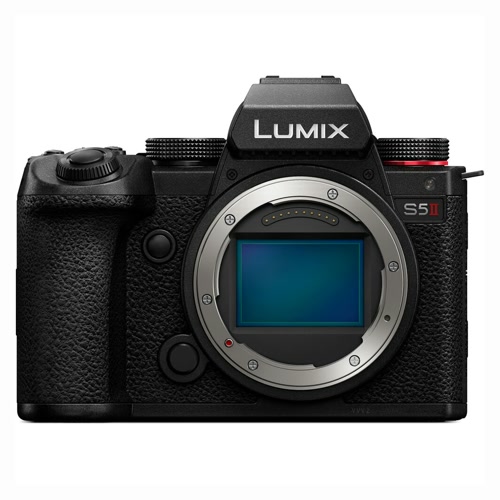
Panasonic LUMIX DC S5 II review. Compare 108 technical specifications and user reviews to see how it ranks among cameras and if it is worth buying.
Overall score
What it is: An overall evaluation of the camera's quality, based on technical analyses and user reviews.
When it matters: When you need a quick reference to identify the best cameras on the market.
Score components:
90.0%
Technical Score
10.0%
User score
Technical Score
What it is: An assessment of the camera's technical performance, covering eight key areas: image quality, autofocus, video features, stabilization, lens compatibility, connectivity, battery, and design.
When it matters: When you want to compare cameras based on technical performance and available features.
Score components:
28.0%
Sensor & Image
25.0%
Photo Features
18.0%
Video & Audio
14.0%
Display & Design
8.0%
Battery & Power
7.0%
Connectivity & Storage
User score
What it is: A rating that combines user reviews and the total number of reviews received by the camera.
When it matters: When real-world owner satisfaction and review volume matter to your decision.
Score components:
70.0%
User reviews
30.0%
Popularity
Score components:
25.0%
Sensor size
20.0%
Main camera megapixels
20.0%
Dual card slots
15.0%
N. of focus points
10.0%
RAW photo capture
10.0%
Phase-detection autofocus (photos)
Score components:
35.0%
Weight
30.0%
Battery life (CIPA)
20.0%
Sensor-shift stabilization
15.0%
GPS
Score components:
30.0%
Price
20.0%
Weight
20.0%
AF tracking
20.0%
Battery life (CIPA)
10.0%
Touchscreen
Score components:
30.0%
Main camera megapixels
25.0%
Sensor size
20.0%
Main camera pixel size
15.0%
Sensor-shift stabilization
10.0%
RAW photo capture
Score components:
30.0%
Weight
25.0%
Thickness
20.0%
AF low-light sensitivity
15.0%
Sensor-shift stabilization
10.0%
Eye detection AF (human)
Score components:
30.0%
Sensor size
25.0%
Main camera pixel size
20.0%
Eye detection AF (human)
15.0%
Main camera megapixels
10.0%
Sensor-shift stabilization
Score components:
30.0%
Weight
25.0%
Battery life (CIPA)
20.0%
Min operating temperature
15.0%
Sensor-shift stabilization
10.0%
GPS
Available: ranking among products currently available (including other versions of this product).
All: ranking among all products in the database.
#10 in Best Vlogging Cameras
#10 in Best Cameras for YouTube
#12 in Best Low Light Cameras
#13 in Best Cameras
#13 in Best Digital Cameras
#13 in Best Mirrorless Cameras
#13 in Best 4K Cameras
#13 in Best Cameras for Portraits
What it is: An assessment of the camera's technical performance, covering eight key areas: image quality, autofocus, video features, stabilization, lens compatibility, connectivity, battery, and design.
When it matters: When you want to compare cameras based on technical performance and available features.
Score components:
28.0%
Sensor & Image
25.0%
Photo Features
18.0%
Video & Audio
14.0%
Display & Design
8.0%
Battery & Power
7.0%
Connectivity & Storage
What it is: A rating that combines user reviews and the total number of reviews received by the camera.
When it matters: When real-world owner satisfaction and review volume matter to your decision.
Score components:
70.0%
User reviews
30.0%
Popularity
What it is: An indicator that combines the camera's overall rating with its cost.
When it matters: When you want to know how much overall quality you get for the price.
Score components:
60.0%
Overall score
40.0%
Price
Importance: HIGH
Good value: Full frame or larger
Importance: HIGH
Good value: At least 20 MP
Importance: HIGH
Good value: At least 3.5 µm
Importance: LOW
Importance: MEDIUM
Good value: At least ISO 25,600
Importance: MEDIUM
Importance: MEDIUM
Good value: At least 14-bit
Importance: LOW
Importance: LOW
Importance: LOW
Importance: LOW
Importance: LOW
Importance: LOW
Importance: LOW
Importance: LOW
Importance: MEDIUM
Importance: LOW
Importance: LOW
Importance: LOW
Importance: LOW
Importance: LOW
Importance: HIGH
Good value: At least 200 points
Importance: HIGH
Importance: MEDIUM
Importance: LOW
Importance: LOW
Importance: MEDIUM
Importance: MEDIUM
Importance: HIGH
Good value: At least 5 stops
Importance: LOW
Importance: MEDIUM
Good value: At least 10 fps
Importance: LOW
Importance: LOW
Importance: LOW
Importance: LOW
Importance: LOW
Importance: LOW
Importance: LOW
Importance: LOW
Importance: LOW
Importance: LOW
Importance: LOW
Importance: LOW
Importance: LOW
Importance: LOW
Importance: LOW
Importance: LOW
Good value: At least 200,000 actuations
Importance: LOW
Good value: At least 10x
Importance: HIGH
Good value: At least 3840 px
Importance: MEDIUM
Good value: At least 200 Mbps
Importance: MEDIUM
Good value: At least 10-bit
Importance: LOW
Importance: LOW
Importance: LOW
Importance: LOW
Importance: LOW
Importance: LOW
Importance: LOW
Good value: At least 30 min
Importance: LOW
Importance: LOW
Importance: LOW
Importance: LOW
Importance: LOW
Good value: At least 2 microphones
Importance: LOW
Importance: LOW
Importance: LOW
Importance: LOW
Importance: MEDIUM
Good value: 500 g or less
Importance: LOW
Importance: LOW
Importance: LOW
Importance: MEDIUM
Importance: MEDIUM
Good value: At least 2.36 million dots
Importance: LOW
Good value: 100%
Importance: LOW
Importance: LOW
Good value: At least 120 Hz
Importance: MEDIUM
Good value: At least 3 in
Importance: LOW
Importance: LOW
Importance: LOW
Importance: LOW
Importance: LOW
Importance: LOW
Importance: LOW
Good value: At least 10 m
Importance: LOW
Importance: LOW
Importance: LOW
Importance: LOW
Importance: MEDIUM
Good value: At least 400 shots
Importance: LOW
Good value: At least 1,500 mAh
Importance: LOW
Importance: LOW
Importance: LOW
Importance: LOW
Importance: LOW
Importance: LOW
Importance: LOW
Importance: LOW
Importance: LOW
Importance: LOW
Importance: LOW
Importance: LOW
Importance: LOW
Importance: LOW
Importance: LOW
Importance: LOW
Importance: LOW
Importance: LOW
Importance: HIGH
Good value: At least 200 points
Importance: MEDIUM
Importance: HIGH
Importance: MEDIUM
Good value: At least ISO 25,600
Importance: HIGH
Good value: At least 3840 px
Importance: MEDIUM
Good value: At least 200 Mbps
Importance: HIGH
Good value: At least 3.5 µm
Importance: HIGH
Good value: At least 5 stops
Importance: MEDIUM
Good value: 500 g or less
Importance: LOW
Importance: LOW
Importance: LOW
Importance: LOW
The Panasonic Lumix DC-S5II is a mid-range, 24-megapixel full-frame camera featuring significant upgrades, including phase-detection autofocus (PDAF) for reliable subject tracking and an integrated cooling fan for unrestricted 6K video recording. It is praised for excellent image quality, effective in-body image stabilization (IBIS), and extensive video capabilities, such as full-sized HDMI and Frame.io integration. Despite the improvements, the autofocus system falls short of competitors like Sony and Canon for fast-paced action, and the mechanical shutter is limited to a slow 7 frames per second. Additionally, high-speed electronic shooting suffers from significant rolling shutter distortion, and the camera relies on average-resolution screens.
The Panasonic Lumix S5 II represents a landmark shift for the brand by introducing a 779-point phase hybrid autofocus system, addressing a long-standing criticism of its older contrast-based setups. Housed in a tough, weather-sealed magnesium alloy frame, this full-frame mirrorless camera features a 24.2MP CMOS sensor and a Leica-co-developed image processor. It is highly optimized for video creators, offering unconstrained 4K/60p 10-bit internal recording, up to 6K full-sensor "Open Gate" capture, and an advanced "Active I.S." stabilization algorithm that dynamically counters unwanted camera motion. Additionally, it features "Real-Time LUT" capabilities to bake color profiles directly into image and video files, saving valuable post-processing time.
The Panasonic Lumix DC-S5 II ($1,999.99, body only) is a highly capable full-frame mirrorless camera that shines primarily as a video powerhouse but falls short for action photography. Built with a durable, weather-sealed magnesium alloy chassis, it inherits the compact handling of its predecessor while introducing a larger handgrip and a vastly improved 3.7-million-dot EVF. On the video front, the camera is practically peerless for its price, offering unlimited 4K recording thanks to an active cooling fan, and capturing up to 6K30 video with 10-bit color using an open-gate 3:2 aspect ratio. Furthermore, its 24MP full-frame BSI CMOS sensor delivers excellent high-ISO still image quality up to ISO 6400 and includes a 5-axis in-body image stabilization (IBIS) system that aids both handheld shooting and high-resolution 96MP tripod-mounted captures. Despite these significant strengths, the camera's notable drawbacks limit its appeal as a true hybrid device. The most critical con is its new hybrid phase-detection autofocus system; while it performs well for static subjects and vlogging, it struggles significantly with continuous tracking (AF-C) for fast-moving wildlife or sports, often driving telephoto lenses...
The Panasonic Lumix S5 II is a highly capable full-frame mirrorless camera that stands out for introducing distance-aware phase detection autofocus and AI-trained subject recognition to the Lumix lineup. Priced at $1,997.99 for the body only, it features a 24.2MP CMOS sensor, 5-axis image stabilization, dual UHS-II SD card slots, and an improved 3.68 m-dot OLED electronic viewfinder. Tested extensively for travel and street photography in Vancouver using both native and adapted manual-focus lenses, the camera delivers impressive image quality, natural color rendering, and an intuitive menu system that allows for quick and seamless setup. Pros and Cons of the Lumix S5 II The review highlights several key strengths, particularly its superior EVF compared to competitors like the Sony A7 IV, excellent ergonomic grip, and highly functional automated features like an in-camera processed 96MP Pixel Shift mode and Focus Stacking. It is also highly praised as an affordable, lightweight alternative to luxury options like the Leica SL2-S, making it an excellent platform for adapting vintage glass. On the downside, the 24-megapixel resolution may feel limiting to dedicated still photographers who...
The Panasonic Lumix S5 II, featured in DPReview’s studio test scene, stands out as a highly competitive, mid-range full-frame hybrid camera, primarily due to the introduction of phase-detection autofocus. Key strengths include excellent JPEG processing, a 96MP high-resolution mode, and a robust video toolkit, such as 6K open-gate recording with a built-in cooling fan. However, the analysis reveals limitations, including notable rolling shutter distortion due to a slow sensor readout, and a forced APS-C/Super 35 crop when shooting 4K/60p video. Additionally, the new phase-detect pixels introduce slight high-ISO noise, with autofocus performance, while vastly improved, still trailing top competitors in fast-action scenarios.
The Panasonic Lumix S5 II is an exceptional hybrid mirrorless camera that offers unbeatable value for content creators who balance photography and filmmaking. It introduces an upgraded 24MP full-frame sensor featuring a 779-point hybrid phase-detection autofocus system, marking a critical and long-awaited shift away from Panasonic’s traditional contrast-only autofocus. This system delivers creamy-smooth, customizable focus transitions during video capture. Filmmakers will particularly appreciate its uncropped 6K "open gate" video recording at a 3:2 aspect ratio, which provides massive flexibility for cropping vertical social media formats like 9:16 without losing resolution. Additionally, the camera boasts excellent 5-axis in-body image stabilization—further enhanced by Active IS for smooth handheld run-and-gun vlogging—alongside built-in cooling vents that provide unlimited recording times, dual UHS-II SD card slots, and a full-size HDMI port. Despite its strengths, the camera has some operational limitations. Slow-motion shooters will face a restrictive 1.5x Super 35 crop when recording video in 4K at 60p, which can hamper wide-angle handheld shots. Physically, its boxy, DSLR-style chassis prioritizes rugged build quality over aesthetics. It lacks a tally light to indicate recording status, and its...
The Trusted Reviews evaluation of the Panasonic Lumix S5II highlights the camera as a highly capable and affordable mid-range full-frame option, praised for its beautiful image quality and exceptional video production tools. Key advantages include competitive pricing, robust image stabilization, and a new Phase Hybrid autofocus system, although the autofocus is not quite as polished as top Sony and Canon rivals. Specific drawbacks noted in the review include the absence of front and back tally lamps to indicate recording status and a somewhat angular casing. Despite these limitations, the S5II is deemed an incredibly complete hybrid model.
The Panasonic Lumix S5 Mark II is a highly recommended 24-megapixel full-frame mirrorless camera that offers exceptional value, comfortably undercutting rivals like the Sony A7 IV and Canon R6 II by around $500 while serving as an excellent hybrid option for both photos and video. Its biggest upgrade is the long-awaited inclusion of a phase-detect hybrid autofocus system, which eliminates the distracting background pulsing that plagued earlier contrast-based Lumix models. Key advantages of the S5 II include a high-resolution pixel shift mode that processes 96MP images directly in-camera, open-gate 6k video capabilities, built-in active cooling via an inaudible fan to prevent overheating, dual UHS-II SD card slots, a full-size HDMI port, and access to affordable third-party Sigma L-mount lenses. Additionally, its 5-axis sensor stabilisation provides an outstanding six stops of compensation, vastly outperforming the competition in hand-held testing. Despite these strengths, the camera has notable limitations when stacked against its higher-priced competitors. Its subject-recognition tracking is less confident than Canon's system, struggles to maintain eye-lock on profile views, and features a confusing menu layout that separates human recognition into multiple...
The Panasonic Lumix S5II is a full-frame hybrid camera praised for its Phase Hybrid AF system, which provides excellent subject tracking and continuous autofocus. Key strengths include effective Active I.S. image stabilization, 30fps shooting, high-quality raw output, and robust 6K video capabilities supported by an integrated cooling fan. However, the camera is considered a "raw shooter's tool" due to disappointing in-camera JPEG processing that produces dull images, which affects both the electronic viewfinder display and the initial raw previews. While offering strong competition to rival models, achieving optimal results requires heavy reliance on post-processing to overcome these JPEG shortcomings.
The Panasonic Lumix S5II is a 24-megapixel full-frame mirrorless camera featuring a significant upgrade to a Phase Hybrid AF system, which resolves previous contrast-detect autofocus issues. The camera offers excellent image quality, a robust weather-sealed body, and effective in-body image stabilization (IBIS). For video, the S5II supports 6K 30p and 4K 60p recording, enhanced by an active cooling fan for unlimited recording times. However, users should note that 4K 60p recording incurs an APS-C crop and the autofocus, while greatly improved, still trails top-tier competition.
The digitalkamera.de review of the Panasonic Lumix DC-S5II highlights a major leap forward due to its new Phase Hybrid Autofocus system, excellent 24.2-megapixel image quality, and an active cooling system allowing for unlimited recording. Pros also include a robust, weather-sealed magnesium alloy casing and strong 6K/4K video capabilities. Conversely, the review notes the camera is somewhat heavy and bulky compared to competitors. Further criticisms involve an angular grip, limited 9 fps mechanical shutter speed, and tracking performance that trails top competitors.
Here is a specific summary of the camera review: Review Summary The Panasonic Lumix S5 II is a highly capable full-frame mirrorless camera that stands out for its exceptional video capabilities, earning top marks in testing for its razor-sharp 6K video resolution at 30 frames per second. Built around a newly developed 24-megapixel CMOS sensor, the camera delivers excellent photo quality with strong detail retention even at higher ISO levels. A major upgrade for this generation is the introduction of a fast and accurate phase-detection hybrid autofocus system, replacing Panasonic's older contrast-only focus. It is built for action, reaching electronic burst shooting speeds of up to 30 frames per second for both JPEG and RAW files. Additionally, it features a built-in cooling system to prevent overheating during long 4K video recording sessions, alongside helpful tools like real-time LUT support and dual UHS-II SD card slots. Pros and Cons While the camera is an excellent all-rounder, it has clear trade-offs to consider: Pros: Incredible 6K video capture and unlimited 4K/60p recording. Blazing-fast 30 fps burst shooting mode. Advanced hybrid phase autofocus...
The Panasonic Lumix S5 II is a highly capable full-frame mirrorless camera that addresses its predecessor's biggest weakness by introducing a fast and accurate phase-detection autofocus system, greatly improving subject tracking for moving objects. It features a newly developed 24-megapixel sensor paired with a Venus Engine image processor, delivering excellent image quality for both photos and videos, particularly with improved sharpness and color accuracy in low-light environments at ISO 1600 and above. For high-resolution demands, it includes a High-Resolution mode capable of stitching multiple shots into a 96-megapixel image. Video creators benefit immensely from uncropped 4K recording up to 60 frames per second, log-format profiles (V-Log), 10-bit color depth, and an integrated cooling fan inside the viewfinder housing that prevents overheating to allow unlimited recording times. Additionally, the camera updates the electronic viewfinder with a larger, more detailed 3.69-million-dot display and a comfortable 0.78x magnification. On the downside, the review highlights that its mechanical continuous shooting speed remains modest at 7.2 frames per second with continuous autofocus. While switching to the electronic shutter boosts speeds up to 30 frames per...
The Panasonic Lumix S5II is an exceptional full-frame hybrid camera that stands out primarily for its video capabilities, earning the "Video Tipp" award and a "very good" overall rating. It is the first Panasonic camera to integrate a hybrid autofocus system, combining a 315-point contrast AF with 779 phase-detection points on its 24-megapixel CMOS sensor. This update dramatically improves tracking speed up to 30 frames per second with an electronic shutter and fixes the focus "hunting" common in previous models. On the downside, the camera body is heavier and thicker than its predecessor—partially due to a newly built-in cooling fan that prevents overheating while maintaining dust and splash resistance. Additionally, continuous autofocus with the mechanical shutter is limited to 7 frames per second, its laboratory resolution efficiency at lower ISO settings is somewhat reserved compared to competitors like the Canon EOS R6 Mark II, and the standard battery life drops to 370 shots per charge. Its video performance is unmatched in this price tier, being the only tested camera capable of recording uncropped 6K video up to 30p at 10-bit...
The Panasonic Lumix S5II is highlighted as a highly competitive full-frame camera that finally resolves previous autofocus issues with a new, effective phase-detection hybrid system, offering excellent 6K video, 10-bit 4:2:0 recording, and impressive dynamic range. However, the review notes significant trade-offs, including a 1.56x APS-C crop when recording 4K/50-60p, a subpar electronic viewfinder, angular ergonomics, and a smaller native L-mount lens selection compared to competitors.
The Panasonic Lumix S5 II is a compact L-mount full-frame system camera featuring a newly developed 24.2-megapixel sensor and an upgraded image processor built with L² technology. A major highlight of this iteration is its vastly improved Phase Hybrid autofocus system, which utilizes 779 focus points to provide much faster and more reliable tracking during video recordings compared to the older contrast-based system. For videographers, it offers impressive internal 6K video resolution at 30fps with full sensor readout, alongside an integrated, discreet cooling fan built directly into the viewfinder housing. This active cooling allows for unlimited recording times without performance drops, even in high ambient temperatures. Additional notable pros include an upgraded In-Body Image Stabilization (IBIS) that corrects up to 7.5 stops, a higher-resolution 3.65-megapixel electronic viewfinder, Dual Native ISO, dual UHS-II card slots, and a full-size HDMI Type-A port. Despite its strong feature set, the camera has several prominent cons. Internally, the S5 II cannot output RAW video or utilize high-bitrate 800 Mbps All-Intra recording, and it lacks the ability to record video directly to an external SSD via...
The Panasonic Lumix S5 II is a compact, full-frame hybrid camera equipped with a newly designed 24.2-megapixel sensor and an upgraded L² technology image processor. Tested under challenging low-light conditions in a parking garage, it delivers sharp images and excellent noise control. A major standout feature is its High Resolution Mode, which captures eight consecutive shots to generate a massive 96-megapixel image directly within the camera, eliminating the need for external software merging. Additionally, video performance is highly robust, featuring an integrated cooling fan that enables unlimited recording times for high-end formats like 6K 30p and 4K 4:2:2 10-bit. The camera introduces several vital performance upgrades alongside a few minor limitations. Its biggest advantage is the transition to a fast Phase Hybrid Autofocus system, which successfully eliminates the distracting focus-hunting ("focus pumping") seen in older Lumix models while reliably tracking humans and animals. Other major pros include an enhanced Active I.S. image stabilization system for fast-moving subjects, faster burst shooting (up to 30 fps electronically with AI-driven rolling shutter suppression), dual UHS-II SD card slots, and a full-sized HDMI Type...
The Panasonic Lumix S5 Mark II serves as an excellent, budget-friendly addition to an L-mount system, particularly for multi-camera video setups like interviews and live streaming. A major advantage is its highly reliable and fast phase-detection autofocus (AF-C), which effectively fixes the video focusing issues found in older contrast-based models. Filmmakers will also appreciate the fully articulating flip screen, a full-sized HDMI port, 4K 4:2:2 30fps recording, and deep video customization options—such as setting a 216-degree shutter angle to prevent artificial light flickering. Additionally, the inclusion of a USB-C port with Power Delivery, dual affordable SD card slots, and an internal cooling fan ensures long, stable recording sessions without overheating issues. On the downside, the camera features a somewhat bulky, angular body design with external buttons that feel tacked on rather than seamlessly integrated. The user interface remains frustrating, confusingly structured, and less intuitive than rival brands, requiring extensive menu diving. In terms of video performance, the camera enforces a sensor crop when shooting in 4K at 60fps and only allows ISO adjustments in 1/3 steps rather than finer 1/6...
The Galaxus review highlights the Panasonic Lumix S5II as a competitive 24-megapixel full-frame camera, marking a significant milestone by introducing a hybrid phase-detection autofocus system. Key advantages include an intuitive menu structure, improved 8-way joystick control, a 96-megapixel High Resolution mode, and an active cooling fan for extended recording. However, the autofocus still trails behind market leaders like Sony in speed and tracking precision, and the system lacks a dedicated object tracking mode. Other limitations include a sub-optimally placed AF-ON button and the requirement of a tripod for the 96-megapixel mode.
The Panasonic Lumix S5 II is a highly capable full-frame hybrid camera that marks a major milestone for the brand by finally introducing a 779-point phase-detection autofocus system, which pairs with contrast detection to deliver smooth, efficient tracking, particularly in video. The camera retains a robust, weather-sealed body while adding user-friendly upgrades like a full-sized HDMI Type-A port and dual UHS-II SD card slots. Image quality from the 24.2-megapixel sensor is excellent, showcasing great noise management up to ISO 1600 and 3200, alongside an in-camera 96-megapixel high-resolution mode. For videographers, the camera is a true powerhouse, offering 6K open-gate recording at 30 fps, real-time LUT applications, and an elegantly hidden built-in cooling fan under the viewfinder that allows for unlimited recording times without overheating. Despite these major advancements, the review highlights several performance drawbacks, starting with a sluggish startup time exceeding one second and slower low-light autofocus tracking that falls behind competitors like Sony and Canon. While its electronic burst mode reaches an impressive 28.3 fps, users face a frustrating shutter lag of 0.5 to 0.7 seconds before the capture...
The Panasonic Lumix S5 II is a versatile 24.2-megapixel full-frame mirrorless camera that marks a major technological milestone for the brand by introducing phase-detection autofocus—a first for the Lumix line. This hybrid AF system significantly elevates continuous tracking accuracy (AF-C) and eradicates the frustrating focus-hunting "pulsing" effects common in previous contrast-detect models. Photographers can capture fleeting action via a blazing 30 frames-per-second electronic shutter backed by a deep buffer, or leverage a 96-megapixel high-resolution pixel-shift mode for static macro and landscape work. The robust, weather-sealed chassis houses an efficient 5-axis sensor stabilization mechanism and a physical cooling fan that unlocks unrestricted internal 4K and 6K video recording. Combined with a competitive launch price of €2,199, its immense hybrid capabilities deliver an unmatched performance-to-value ratio. Despite these achievements, the S5 II exhibits notable limitations linked to its non-stacked sensor design, making the electronic shutter prone to rolling shutter distortions and indoor artificial light banding. Its CIPA-rated battery life drops down to 370 shots per charge compared to its predecessor, and the physical build is slightly bulkier and heavier to accommodate the...
Overview The Panasonic Lumix S5 II is a highly capable full-frame hybrid mirrorless camera that represents a major evolutionary leap forward for the series, chiefly due to the integration of a new 779-point phase-detection and contrast hybrid autofocus system. Built with a rugged, weather-sealed magnesium alloy chassis, it features a 24.2-megapixel CMOS sensor paired with a powerful new processor that minimizes noise at high sensitivities up to ISO 8,000. The camera offers exceptional customization options, an intuitive interface, a sharp 3.68 million-dot OLED viewfinder with a 120 fps refresh rate, and a fully articulating touchscreen. Video performance is incredibly robust, boasting up to 6K resolution at 30p, an anamorphic mode, V-Log profiles, and efficient 5-axis image stabilization. Additionally, an integrated cooling fan built into the viewfinder prism permits unlimited recording times across all formats. Pros and Cons Autofocus: Effective subject tracking for eyes, faces, and animals. Speed: Fast continuous burst shooting speeds reaching up to 30 fps. Design: Highly customizable controls and clear menu systems. Value: Aggressive pricing that easily undercuts market rivals. High-Res Mode: Dedicated 96 MP mode requires...
for the Panasonic Lumix S5 II: The Labo Fnac laboratory gave the Panasonic Lumix S5 II (tested as a kit with the Lumix S 20-60mm f/3.5-5.6 lens) a moderate 3 out of 5 stars due to critical drawbacks in its optical performance. While the full-frame mirrorless camera performs highly in resolution and color management—scoring a strong 8 out of 10 for definition and 8 out of 10 for colorimetry—it fails heavily in its optical delivery, receiving a meager 1.9 out of 10 for optical quality. The laboratory penalizes the camera heavily for being plagued by severe optical defects, specifically noting prominent distortion, vignetting, and chromatic aberrations, making the €2,300 price tag difficult to justify and rendering the included kit lens merely passable. On the positive side, the camera is praised for its vibrant, accurate color reproduction and a 24-megapixel resolution that remains perfectly adequate for most standard photography scenarios. However, alongside its lens-based flaws, the camera displays a noticeable lack of sensitivity in low-light environments, leading to digital noise (scoring 4 out of 10 in low light and 6 out...
The Panasonic Lumix S5 II is a full-frame mirrorless camera launched in February 2023 for €2,199 (body only) as a highly versatile hybrid tool for both photography and video. It marks a major milestone for Panasonic by introducing an advanced phase-detection autofocus system that utilises 779 focus points to provide fast and highly reliable tracking of humans and animals. Key hardware highlights include a 24.2-megapixel CMOS sensor, a durable weather-sealed magnesium alloy chassis, 5-axis sensor stabilization offering up to 6.5 stops of compensation, and dual UHS-II SD card slots. Image quality is excellent with natural color rendering and strong dynamic range. For videographers, it offers unlimited recording times due to a built-in active cooling fan, and supports 6K30p internal capture alongside 12-bit RAW video output over a full-sized HDMI port. However, the camera does carry a few notable limitations. Its body is physically larger and heavier than its predecessor, weighing 740 grams with a battery and card installed. While it features an impressive 30 frames-per-second electronic burst rate, users have noted a slight 0.3-second shutter delay when initiating a high-speed...
The Galaxus review highlights the Panasonic Lumix S5II as a significant advancement for the brand, largely due to its new hybrid phase-detection autofocus which fixes previous limitations. Key pros include excellent 6K/30p video quality, superior dynamic range, a 96-megapixel high-resolution mode, and an intuitive, ruggedized body design featuring a full-size HDMI port. Conversely, the review notes cons such as a subpar electronic viewfinder, a bulky design, and a forced APS-C crop when shooting 4K at 48 to 60 fps. While a major improvement, the autofocus still displays occasional erratic tracking behavior compared to competitors, according to the reviewer.
The Lumix S5II is praised as a versatile, full-frame hybrid camera that marks a significant milestone for Panasonic by introducing phase-detection autofocus, making it much faster and more reliable than its predecessors. The reviewer highlights its robust, weather-sealed build—resistant to dust, moisture, and cold—which makes it an ideal companion for outdoor adventures and travel. Key performance strengths include excellent 5-axis in-body stabilization, a high-resolution 96MP handheld mode, and impressive low-light performance with usable images up to 20,000 ISO. Its video capabilities are equally strong, offering unlimited internal 6K recording and 4:2:2 10-bit color depth, supported by a unique built-in fan to prevent overheating. Pros and Cons While the review is overwhelmingly positive, it details specific trade-offs and highlights: Pros: Exceptional Autofocus: The new phase-detection system offers 779 AF points for fast tracking of humans and animals. High-Speed Bursts: Capable of 30 fps with the electronic shutter. Professional Video: Features full-sized HDMI, dual UHS-II SD slots, and specialized modes like anamorphic support. Value: Cited as having one of the best quality-to-price ratios on the market. Cons: Video Crop: Shooting in 4K...
The Camerarace review rates the Panasonic Lumix DC-S5 Mark II as an exceptional all-rounder, highlighting its precise Phase Hybrid Autofocus, robust weather-sealed construction, and effective 5-axis stabilization for various photography genres. Further, the camera boasts a fully articulated screen and a built-in cooling fan, supporting unlimited 4K recording for hybrid creators. However, the review identifies a significant limitation in the camera's battery performance, which offers a low 370 shots per charge. Despite this, the S5 Mark II is praised for its 24.2MP raw output and solid build quality.
The Panasonic Lumix S5 II review by Photolari highlights the camera's groundbreaking shift to a hybrid autofocus system with phase detection (PDAF), a feature long demanded by users to replace the brand's historically lagging contrast-based AF. Tested on the streets of Tokyo, the camera proves to be a formidable full-frame competitor in the mid-range market, priced competitively at 2,200 euros for the body. On the pros side, the review praises its incredible video features, including 6K open gate and 4K 4:2:2 10-bit recording, along with exceptional color science, a newly integrated active cooling fan, an upgraded electronic viewfinder, and a vastly improved in-body image stabilisation (IBIS) system that enables seamless handheld use on a gimbal. However, the camera also presents a few cons and areas for improvement. Although the new autofocus is infinitely superior to its predecessor and highly reliable for content creators, early tests with primitive firmware suggest it is still not quite as agile or intuitive as Sony's tracking or Canon's Dual Pixel systems. Additionally, reader and user discussions highlight community concerns about the potential risk of dust...
Based on the review by Johnnie Behiri from CineD, the Panasonic LUMIX S5II marks a major milestone for the brand by introducing a highly reliable, newly developed hybrid phase-detection autofocus system. The camera features a 24-megapixel full-frame CMOS sensor paired with a new imaging engine co-developed with Leica. Key hardware improvements over its predecessor include a built-in cooling fan that allows for unlimited video recording times, a full-size HDMI Type-A terminal, a higher-resolution electronic viewfinder (EVF), and a practical 8-way directional joystick. On the recording side, it supports up to 6K/30p (4:2:0 10-bit) and DCI 4K/60p (4:2:2 10-bit) internal recording, offering excellent value for independent content creators, vloggers, and run-and-gun filmmakers alike. The standout benefit highlights the pros of the camera, primarily its exceptionally precise and trustworthy autofocus performance that eliminates the "hit-or-miss" frustrations of older contrast-based models. Video professionals will also appreciate the enhanced Active Image Stabilization (IS) system, great low-light performance thanks to its Dual Native ISO (at ISO 640 and ISO 4000 in V-Log), and advanced software monitoring assists like Vector Scope and Synchro Scan. Conversely, the...
The Panasonic Lumix S5 II is a compact full-frame mirrorless camera that addresses the focus limitations of its predecessor by introducing a highly reliable phase-hybrid autofocus system with 779 AF points, resulting in vastly superior subject tracking during video recording. Built around a new 24.2-megapixel sensor and a processor engineered through L² Technology (a collaboration with Leica), it supports full-sensor readout 6K video at 30 fps internally and introduces active cooling via a discreet fan under the viewfinder, enabling unlimited recording times even in environments reaching 40°C. Additional physical design improvements include a transition to a full-sized HDMI Type-A port, dual UHS-II card slots, and an upgraded electronic viewfinder boasting a higher 3.65-megapixel resolution. In terms of pros, the camera features a significantly enhanced In-Body Image Stabilization (IBIS) system capable of correcting up to 7.5 f-stops, alongside professional tools like real-time LUT integration, waveform display, and shutter angle configuration. Its burst shooting speed has also leaped to 30 frames per second using the electronic shutter. However, on the con side, the camera still crops 4K video at 60p to an...
Overview of the Panasonic Lumix S5 II Review The Panasonic Lumix S5 II is evaluated as a highly versatile, midrange full-frame mirrorless camera designed for both advanced enthusiasts and professionals seeking a reliable hybrid system for travel photography and video production. Built with a premium magnesium alloy body, the camera features an integrated active cooling fan that enables unlimited video recording without compromising weather sealing against dust, splashes, and freezing temperatures. Testers paired it with the compact Lumix S 20-60mm F3.5-5.6 lens, praising the combination as a lightweight, practical, and highly responsive setup ideal for shooting in changing outdoor conditions like beaches and forests. Pros and Cons Pro: Phase-detection AF replaces the older contrast-only autofocus system for vastly superior tracking accuracy. Pro: Active I.S. system provides up to 6.5 stops of stabilization, enabling crisp hand-held shots even while walking. Pro: Dual Native ISO technology and 14 stops of dynamic range maintain clean, usable images at high sensitivities like ISO 6,400. Pro: In-camera 96MP High-Res mode stitches eight images internally without requiring external software. Pro: High-speed performance achieves a rapid 30...
The Digitec review highlights the Panasonic Lumix S5II as a game-changer that finally enables the brand to compete in autofocus performance through its new phase-detection system. Key advantages include top-tier image quality, an intuitive menu system, and robust video features like 6K resolution, a built-in cooling fan, and anamorphic support, all offered at a competitive price point. However, the reviewer notes a few drawbacks, specifically a subpar, low-resolution electronic viewfinder that complicates focusing and exposure evaluation. Other cons mentioned include the camera's angular body design, a limited native lens selection, and an APS-C crop enforced when shooting video at higher frame rates between 48 and 60 fps.
The Panasonic Lumix S5 II was tested for underwater photography by Rosario Scariati, who took the camera down to 22 meters in the waters of Procida. Historically a Canon user, Scariati paired the Panasonic body with a Canon 8-15mm fisheye lens via an L-mount adapter. The testing setup also included a Nauticam underwater housing, a wetsuit, fins, and a Super D-Pro flash. The camera features a 24.2-megapixel CMOS sensor with Dual Native ISO technology and a next-generation imaging engine. The review highlights strong pros but leaves some implied technical cons. On the positive side, the autofocus system delivers exceptional speed and stability, and the overall camera operation is highly intuitive and user-friendly. Furthermore, the color science produces vivid, brilliant hues that make post-production editing an optional step rather than a necessity. On the negative side, the article lacks critical technical objectivity, offering a purely enthusiastic review without mentioning any actual drawbacks or limitations of the body. Additionally, making full use of the system for this specific underwater scenario requires a third-party lens adapter and expensive dedicated diving gear.
The Panasonic Lumix S5 II represents a major shift for the brand, introducing a brand-new 24-megapixel full-frame CMOS sensor featuring a dual native ISO and their very first phase-detection hybrid autofocus system. This 779-point hybrid system vastly improves eye, face, and animal detection tracking, correcting a long-standing criticism of Panasonic's previous contrast-based autofocus. Geared heavily toward content creators, the camera delivers outstanding 10-bit video performance, supporting unlimited C4K/4K recording and up to 6K video, alongside 14 stops of dynamic range using V-Log profiles. Notable physical upgrades include an improved 3.69-million-dot EVF, a full HDMI port, a dual UHS-II SD card slot, and an innovative built-in silent cooling fan that prevents overheating without increasing body size. The review highlights several significant pros, led by the upgraded phase-detection autofocus, vastly improved "Active I.S." and "Boost I.S." image stabilization algorithms that eliminate the strict need for a tripod, and the ability to apply LUTs directly to flat-profile footage in-camera. It also boasts useful videographer tools like an anti-flicker mode, frame overlays, and a loop recording feature. On the downside, the cons are relatively...
Summary of Pros and Cons Pros Cons Phase Hybrid AF: 779-point system significantly improves tracking and low-light performance. Still Photo AF Bugs: Occasional false-focus confirmation resulted in completely out-of-focus shots. High-Speed Burst: Reaches up to 30 fps with the electronic shutter. No Specialized AI Tracking: Missing dedicated AI recognition for vehicles, trains, or airplanes. Active Stabilization: New stabilization mode provides smooth handheld video while walking. Small-Face Tracking Limits: The AF fails to recognize faces when they are too small or poorly lit in frame. Unlimited 4K Recording: Integrated miniature cooling fan prevents overheating over long sessions. Ergonomic Omissions: Lacks a physical exposure lock button and a modern dual-axis tilt/flip screen mechanism. Professional Video I/O: Upgraded to a full-size HDMI Type-A port and dual UHS-II slots. Bulkier Body: Physically thicker and heavier than the original Lumix S5 generation.
The TechPrincess review highlights the Panasonic Lumix S5 II as a game-changing hybrid mirrorless camera, specifically praising the new 24.2-megapixel sensor and high-performance Phase Hybrid Autofocus system that resolves previous tracking issues. Key advantages include robust weather-sealed construction, excellent 5-axis image stabilization, and a built-in active cooling fan allowing for unlimited 4K/60p recording. Conversely, the review notes the camera is heavily skewed toward video production, potentially limiting its appeal for traditional photographers. Additional drawbacks mentioned include a drop in advanced subject recognition performance when shooting in 5.9K while using an external monitor, and the absence of internal ProRes recording, which requires the higher-end S5 IIX model.
The provided Italian review by Tutto Digitale highlights the Panasonic Lumix S5 Mark II as a prominent, highly discussed hybrid mirrorless camera that serves as a modern benchmark for "all-rounder" multimedia creators. The review commends the camera's ability to balance photographic excellence with comprehensive video performance. A standout pro is its positioning as a versatile reference tool for solo creators, which is further elevated by an integrated, discreet cooling fan system that permits unlimited 4K video recording without the body layout becoming bulky. Additionally, users benefit from a deeply intuitive control layout, dual UHS-II SD card slots for seamless backup recording, and a highly stable sensor output. However, the analysis also notes a few performance cons. In fast-moving action or sports scenarios, the sensor's readout speeds show limitations, displaying rolling shutter artifacts during rapid pans. The default internal image processing tends to produce slightly dull JPEG profiles that generally require dedicated post-production color grading or the immediate implementation of custom LUTs to maximize visual appeal. Furthermore, while the camera incorporates a highly requested Phase Hybrid Autofocus system that significantly reduces...
The Panasonic Lumix S5 II is highly praised as a game-changing, hybrid full-frame mirrorless camera. The review highlights its headline feature: a brand-new Phase Hybrid Autofocus (AF) system that finally replaces the old contrast-based system, offering exceptionally fast and reliable subject tracking for both video and photography. Combined with its 24.2MP full-frame sensor, it delivers gorgeous, true-to-life color reproduction, excellent low-light performance, and superb image quality directly out of the camera. Photographers and videographers alike will appreciate its Active Image Stabilisation (I.S.), which provides incredibly smooth handheld and walking shots, alongside its robust, weather-sealed build and highly intuitive layout of dials and buttons. Furthermore, the addition of a built-in cooling fan allows for unlimited 4K video recording, resolving overheating concerns typical of compact mirrorless systems. YouTube · However, the review notes a few minor constraints depending on your shooting style. For tracking fast-moving subjects during continuous shooting, the high-speed 30 frames per second (fps) burst rate is strictly limited to the electronic shutter, as the mechanical shutter drops to a much slower 7 fps with continuous autofocus. While the tracking...
The Reiskick review highlights the Panasonic Lumix S5II as a massive, professional-grade upgrade over standard bridge cameras like their previous Panasonic DMC-FZ1000. The camera is highly praised as an exceptional, budget-friendly hybrid tool that balances top-tier performance for both travel photography and content creation (such as TikTok and Instagram Reels). Key pros include its 24.2-megapixel full-frame CMOS sensor that provides stunning image quality and sharp details even in challenging low-light conditions. It introduces a game-changing Phase Detection Autofocus system capable of seamlessly tracking moving objects during filming. For videographers, it offers versatile 4K video recording at 60 fps alongside V-log/V-Gamut support for advanced post-production color grading. Additionally, travel-friendly assets include a compact, lightweight body built from durable magnesium alloy, dust- and splash-water resistance, built-in Wi-Fi/Bluetooth for social media transfers, and a reassuring 5-year warranty.
The Panasonic Lumix S5 Mark II is a highly versatile 24.2-megapixel full-frame hybrid camera that excels in both photography and videography, winning the prestigious TIPA Award 2023 for "Best Full-Frame Expert Camera". It marks a major milestone for Panasonic as their first mirrorless camera to integrate a hybrid phase-detection autofocus (AF) system, correcting a long-standing disadvantage against competitors by providing significantly faster, more precise tracking even in low-light environments. Reviewers highly praise its exceptional video capabilities—offering 6K at 30fps and 4K at 60fps with professional features like Real Time LUTs and unlimited recording times enabled by a built-in cooling fan. Additional strengths include an outstanding Active I.S. image stabilisation system offering up to 6.5 stops of compensation, a robust and weather-sealed body, a high-resolution OLED viewfinder, a full-sized HDMI port, and a very competitive price-to-performance ratio. Despite these heavy upgrades, the review points out several notable weaknesses, particularly when compared to its closest rivals from Sony and Canon. While the new hybrid autofocus is a massive leap forward, it can still experience slowdowns and unreliability when tracking fast-moving subjects, and...
Panasonic Lumix S5II The Panasonic Lumix S5II is a highly capable full-frame hybrid mirrorless camera that addresses its predecessor's biggest flaw by introducing a fast and reliable Hybrid Phase Detection autofocus system with 779 focus points. It features a redesigned 24.2-megapixel CMOS sensor and an advanced processor co-developed with Leica, enabling impressive tracking for humans and animals alongside a 200% improvement in 5-axis image stabilization (Active I.S.). On the video front, it stands out in its price segment by offering oversampled 4K up to 60fps, 6K recording up to 30fps (including open gate 3:2), 14+ stops of V-Log dynamic range, and an innovative built-in fan cooling system under the viewfinder that allows for unlimited recording times. For photographers, it boasts a sharp 3.68-megadot OLED viewfinder and an in-camera 96-megapixel High Resolution mode. Pros and Cons Pros: The camera delivers exceptional image and video quality, featuring a massively upgraded autofocus system that rivals industry leaders. It offers unlimited video recording times due to active cooling, versatile 6K and open-gate shooting options, excellent dual-native ISO performance, and highly effective image stabilization. Cons:...
Compare