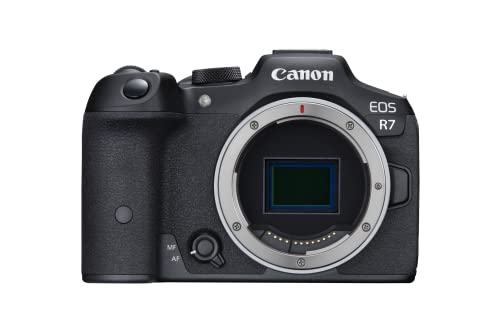
Canon EOS R7 review. Compare 108 technical specifications and user reviews to see how it ranks among cameras and if it is worth buying.
Overall score
What it is: An overall evaluation of the camera's quality, based on technical analyses and user reviews.
When it matters: When you need a quick reference to identify the best cameras on the market.
Score components:
90.0%
Technical Score
10.0%
User score
Technical Score
What it is: An assessment of the camera's technical performance, covering eight key areas: image quality, autofocus, video features, stabilization, lens compatibility, connectivity, battery, and design.
When it matters: When you want to compare cameras based on technical performance and available features.
Score components:
28.0%
Sensor & Image
25.0%
Photo Features
18.0%
Video & Audio
14.0%
Display & Design
8.0%
Battery & Power
7.0%
Connectivity & Storage
User score
What it is: A rating that combines user reviews and the total number of reviews received by the camera.
When it matters: When real-world owner satisfaction and review volume matter to your decision.
Score components:
70.0%
User reviews
30.0%
Popularity
Score components:
25.0%
Sensor size
20.0%
Main camera megapixels
20.0%
Dual card slots
15.0%
N. of focus points
10.0%
RAW photo capture
10.0%
Phase-detection autofocus (photos)
Score components:
35.0%
Weight
30.0%
Battery life (CIPA)
20.0%
Sensor-shift stabilization
15.0%
GPS
Score components:
30.0%
Price
20.0%
Weight
20.0%
AF tracking
20.0%
Battery life (CIPA)
10.0%
Touchscreen
Score components:
30.0%
Main camera megapixels
25.0%
Sensor size
20.0%
Main camera pixel size
15.0%
Sensor-shift stabilization
10.0%
RAW photo capture
Score components:
30.0%
Weight
25.0%
Thickness
20.0%
AF low-light sensitivity
15.0%
Sensor-shift stabilization
10.0%
Eye detection AF (human)
Score components:
30.0%
Sensor size
25.0%
Main camera pixel size
20.0%
Eye detection AF (human)
15.0%
Main camera megapixels
10.0%
Sensor-shift stabilization
Score components:
30.0%
Weight
25.0%
Battery life (CIPA)
20.0%
Min operating temperature
15.0%
Sensor-shift stabilization
10.0%
GPS
Available: ranking among products currently available (including other versions of this product).
All: ranking among all products in the database.
#6 in Best Canon EOS Cameras
#16 in Best Vlogging Cameras
#16 in Best Cameras for YouTube
#17 in Best Travel Cameras
#19 in Best Cameras
#19 in Best Digital Cameras
What it is: An assessment of the camera's technical performance, covering eight key areas: image quality, autofocus, video features, stabilization, lens compatibility, connectivity, battery, and design.
When it matters: When you want to compare cameras based on technical performance and available features.
Score components:
28.0%
Sensor & Image
25.0%
Photo Features
18.0%
Video & Audio
14.0%
Display & Design
8.0%
Battery & Power
7.0%
Connectivity & Storage
What it is: A rating that combines user reviews and the total number of reviews received by the camera.
When it matters: When real-world owner satisfaction and review volume matter to your decision.
Score components:
70.0%
User reviews
30.0%
Popularity
What it is: An indicator that combines the camera's overall rating with its cost.
When it matters: When you want to know how much overall quality you get for the price.
Score components:
60.0%
Overall score
40.0%
Price
Importance: HIGH
Good value: Full frame or larger
Importance: HIGH
Good value: At least 20 MP
Importance: HIGH
Good value: At least 3.5 µm
Importance: LOW
Importance: MEDIUM
Good value: At least ISO 25,600
Importance: MEDIUM
Importance: MEDIUM
Good value: At least 14-bit
Importance: LOW
Importance: LOW
Importance: LOW
Importance: LOW
Importance: LOW
Importance: LOW
Importance: LOW
Importance: LOW
Importance: MEDIUM
Importance: LOW
Importance: LOW
Importance: LOW
Importance: LOW
Importance: LOW
Importance: HIGH
Good value: At least 200 points
Importance: HIGH
Importance: MEDIUM
Importance: LOW
Importance: LOW
Importance: MEDIUM
Importance: MEDIUM
Importance: HIGH
Good value: At least 5 stops
Importance: LOW
Importance: MEDIUM
Good value: At least 10 fps
Importance: LOW
Importance: LOW
Importance: LOW
Importance: LOW
Importance: LOW
Importance: LOW
Importance: LOW
Importance: LOW
Importance: LOW
Importance: LOW
Importance: LOW
Importance: LOW
Importance: LOW
Importance: LOW
Importance: LOW
Importance: LOW
Good value: At least 200,000 actuations
Importance: LOW
Good value: At least 10x
Importance: HIGH
Good value: At least 3840 px
Importance: MEDIUM
Good value: At least 200 Mbps
Importance: MEDIUM
Good value: At least 10-bit
Importance: LOW
Importance: LOW
Importance: LOW
Importance: LOW
Importance: LOW
Importance: LOW
Importance: LOW
Good value: At least 30 min
Importance: LOW
Importance: LOW
Importance: LOW
Importance: LOW
Importance: LOW
Good value: At least 2 microphones
Importance: LOW
Importance: LOW
Importance: LOW
Importance: LOW
Importance: MEDIUM
Good value: 500 g or less
Importance: LOW
Importance: LOW
Importance: LOW
Importance: MEDIUM
Importance: MEDIUM
Good value: At least 2.36 million dots
Importance: LOW
Good value: 100%
Importance: LOW
Importance: LOW
Good value: At least 120 Hz
Importance: MEDIUM
Good value: At least 3 in
Importance: LOW
Importance: LOW
Importance: LOW
Importance: LOW
Importance: LOW
Importance: LOW
Importance: LOW
Good value: At least 10 m
Importance: LOW
Importance: LOW
Importance: LOW
Importance: LOW
Importance: MEDIUM
Good value: At least 400 shots
Importance: LOW
Good value: At least 1,500 mAh
Importance: LOW
Importance: LOW
Importance: LOW
Importance: LOW
Importance: LOW
Importance: LOW
Importance: LOW
Importance: LOW
Importance: LOW
Importance: LOW
Importance: LOW
Importance: LOW
Importance: LOW
Importance: LOW
Importance: LOW
Importance: LOW
Importance: LOW
Importance: LOW
Importance: HIGH
Good value: At least 200 points
Importance: MEDIUM
Importance: HIGH
Importance: HIGH
Good value: At least 5 stops
Importance: MEDIUM
Good value: At least ISO 25,600
Importance: MEDIUM
Good value: At least 10 fps
Importance: HIGH
Good value: At least 20 MP
Importance: MEDIUM
Good value: At least 200 Mbps
Importance: MEDIUM
Good value: 500 g or less
Importance: LOW
Importance: LOW
Importance: LOW
Importance: LOW
(Reviews last updated: July 2026)
The Canon EOS R7 is a high-value APS-C mirrorless camera, scoring 87% in the DPReview evaluation, praised for its exceptional 15 fps mechanical burst speed and advanced autofocus tracking. It delivers high-quality 10-bit video, effective IBIS, and excellent JPEGs, making it a robust hybrid tool for both stills and video enthusiasts. However, the R7 faces criticism for a slow sensor readout speed, resulting in severe rolling shutter in electronic shutter mode and oversampled video. Limitations also include a limited selection of native RF-S lenses and an EVF with lower resolution than some competitors.
The Canon EOS R7 is a high-performance, crop-sensor (APS-C) mirrorless camera that serves as a speedy, budget-friendly option for enthusiast sports and wildlife photographers. It pairs a high-resolution 32.5MP sensor with Canon's advanced Dual Pixel CMOS AF II system, offering exceptional subject tracking and eye detection for humans, animals, and vehicles. Its core strengths (pros) include blistering burst shooting speeds of up to 15fps with the mechanical shutter and 30fps with the electronic shutter, highly effective in-body image stabilization (IBIS) offering up to eight stops of compensation, and dual UHS-II SD card slots. Additionally, it provides great value for its price and handles well due to a deep, chunky grip, making it a versatile travel companion and hybrid tool capable of uncropped 4K/60p video recording. However, the camera's dense megapixel count introduces some notable weaknesses (cons), particularly in low-light environments or high-ISO settings where images exhibit noticeable noise and software smoothing. Video creators might also miss the inclusion of a 4K/120p slow-motion mode, and the 2.36m-dot electronic viewfinder is described as somewhat average and dated. The most significant drawback highlighted...
The Canon EOS R7 is positioned as a high-performance, affordable APS-C mirrorless camera, serving as a successor to the EOS 7D Mark II with features like 15-30 fps shooting, advanced subject tracking, and up to 7.0 stops of IBIS. Its dense 32.5-megapixel sensor provides significant telephoto reach, making it ideal for wildlife and sports, backed by dual card slots and robust weather sealing. Conversely, the review identifies drawbacks including increased diffraction at smaller apertures, higher noise compared to full-frame, and a smaller, un-gripped body that may feel cramped. Furthermore, the camera suffers from noticeable rolling shutter distortion with the electronic shutter, lacks a native vertical grip, and features a simplified button layout with a micro-HDMI port.
The Canon EOS R7 is a robust, highly recommended 32.5 Megapixel APS-C mirrorless camera designed for sports and wildlife photographers, offering a major resolution and autofocus leap over older DSLRs like the 7D Mark II. Key advantages include an exceptional Dual Pixel CMOS AF II system featuring sticky subject detection for humans, animals, and birds, alongside decent built-in sensor-shift image stabilisation (IBIS) that provides up to 5 stops of real-world compensation with non-stabilised lenses. It delivers impressively clean JPEGs up to ISO 6400, fast mechanical bursts at 15fps, and a highly functional RAW Burst mode with a pre-shot option to capture action half a second before the shutter button is fully pressed. Additional helpful photography features include built-in interval/Bulb timers and an automated focus bracketing mode that creates stacked, deep depth-of-field composite images directly in-camera. However, the camera has several physical and performance limitations that prevent it from being a perfect professional wildlife body. Ergonomically, it lacks a top status screen, relies on a less satisfying rear control wheel, lacks a PC Sync port, and offers no official battery grip...
The Canon EOS R7 is positioned as a powerful, portable APS-C mirrorless camera ideal for wildlife, sports, and travel, featuring impressive subject-detection autofocus and seven stops of IBIS. Its, high-quality oversampled 4K/30p video, C-Log3 support, and fast, dedicated shooting-mode switching make it a versatile tool for hybrid creators. MPB However, the APS-C sensor exhibits limited low-light performance with noise increasing beyond ISO 6400, and 4K/60p recording is restricted by a significant 1.8x crop. The handling is mixed, with the design of the video/power switch being prone to accidental, unwanted toggling. MPB
The Canon EOS R7 is a highly capable, budget-friendly cropped-sensor mirrorless camera that provides an excellent lightweight solution for wildlife photography, especially when paired with the RF100-500mm lens. Its standout features include a 32-megapixel sensor that delivers sharper cropped details than the full-frame Canon R5, and a highly flexible autofocus system derived from the premium R3 that easily tracks birds in flight. Additionally, the camera benefits from dual affordable SD card slots, an effective 1.6x lens crop factor for massive extra reach, shared battery compatibility with the R5, a handy pre-burst capture mode, and a dedicated video switch. However, the R7 has distinct ergonomic and technical drawbacks, most notably a severe rolling shutter effect that warps fast-moving subjects (like bird wings) and an inconsistent autofocus that occasionally fluctuates and drops focus on stationary subjects. Because the camera body is small and lacks a battery grip option, it can cause hand fatigue when paired with heavy prime lenses. The reviewer also notes that the EVF screen resolution is noticeably pixelated compared to premium models, the internal buffer size is restrictive unless...
Dustin Abbott describes the Canon EOS R7Go to product viewer dialogue for this item. as a high-value, pro-level APS-C mirrorless camera featuring a 32.5MP sensor, advanced R3-derived autofocus, and up to 30 fps shooting, making it a strong choice for wildlife and sports. The camera boasts impressive 5-axis IBIS, 4K video, dual UHS-II slots, and, per the review, excellent value at its $1,499 price point. However, the review notes limitations, including a shallow buffer that fills rapidly during high-speed shooting, significant rolling shutter with the electronic shutter, and a lack of native RF-S lens options. Additionally, some users may find the camera's unique control layout, featuring a rear wheel around the joystick, less intuitive than traditional designs.
The Canon EOS R7 is a highly capable $1,500 mirrorless camera featuring a newly developed 32.5-megapixel APS-C sensor, a DIGIC X processor, and dust and moisture weather sealing. Key advantages of this camera include its rich dynamic range, excellent handling of RAW data, and a mechanical closing shutter that blocks dust when powered down. It delivers impressive performance with a 15 frames-per-second (fps) mechanical shutter speed, a robust buffer that rarely locks up during action shots, and an intelligent subject-tracking autofocus system adapted from the flagship EOS R3. Additionally, it offers up to seven stops of in-body image stabilization and high-quality 10-bit oversampled 4K 60p video capabilities. However, the camera suffers from several distinct interface and performance downsides. The body layout includes a cramped grip that can cause a user's fingers to rub against certain full-frame RF lenses, and it lacks compatibility with a vertical battery grip. Control limitations are highly frustrating, featuring an awkward on/off/movie switch, restricted custom button programming, and only two control wheels to manage three exposure settings. Hardware drawbacks include a noticeably low-quality 2.36-million dot electronic...
Ken Rockwell calls the Canon EOS R7 an incredibly fast and compact APS-C powerhouse, highlighting its groundbreaking 32.5 MP sensor, 30 fps electronic shutter, and auto-leveling in-body image stabilization. Key advantages include its high linear resolution, dual SD card slots, and lightweight portability suitable for handheld shooting. Conversely, the review notes ergonomic drawbacks, specifically criticizing the small rear Quick Control Dial's awkward placement near the viewfinder and a fidgety power switch that can accidentally activate movie mode. Furthermore, the R7 lacks a built-in flash, requiring users to rely on hot-shoe accessories for lighting.
The Canon EOS R7 is a highly capable APS-C mirrorless camera optimized for action, sports, and wildlife photography, serving as the spiritual successor to the company’s 7D-series DSLRs. Built with a 32.5-megapixel CMOS sensor, it delivers superb resolution for heavy cropping, impressive low-light performance up to ISO 6400, and excellent out-of-camera JPEG color science. Its primary strength lies in its speed, offering blistering burst rates of up to 15 frames per second (fps) with the mechanical shutter and 30 fps with the electronic shutter. This rapid shooting is backed by a robust autofocus tracking system derived from the flagship R3, which effortlessly locks onto people, animals, and vehicles. Additional pros include built-in 5-axis image stabilization, weather-sealed construction, dual high-speed SD card slots, and an un-cropped 4K video capability oversampled from 7K footage. However, the R7 is not without its drawbacks, particularly regarding its physical design and sensor hardware. Unlike many modern rivals, the sensor is neither stacked nor backside-illuminated (BSI), which slightly limits its ultimate data readout potential. The layout on the back of the camera introduces a control wheel...
The Canon EOS R7 is a mid-range APS-C mirrorless camera that continues the legacy of the popular 7D Mark II, offering an affordable, weather-resistant magnesium alloy body that is highly appealing to sports and wildlife photographers due to its 1.6x crop magnification factor. It features a high-resolution 32.5MP sensor that offers excellent image quality for cropping and large printing, an advanced Dual Pixel CMOS AF II tracking system, up to 8 stops of image stabilization (IBIS), and dual UHS-II card slots. Performance is highly capable with up to 15fps mechanical and 30fps electronic shutter burst rates, alongside impressive 4K video recording capabilities that manage heat well without overheating. However, the camera has notable limitations, including a lack of a dedicated third control wheel for the exposure trinity and an unusual joystick/control dial placement on the rear. Image noise becomes visible as speckling at higher ISO settings (above ISO 2000), and shooting at the maximum 30fps with the electronic shutter produces moderate to high rolling shutter distortion and artificial light banding. Additionally, there is a current lack of fast, native native...
The Canon EOS R7 marks a highly successful debut for Canon's mirrorless R-system utilizing an APS-C sensor, offered at a competitive price point of approximately €1,500. In laboratory testing, its 32.5-megapixel sensor achieves record-breaking edge sharpness (delivering 2,464 line pairs per picture height at minimum ISO) that surpasses competing APS-C models. Tailored heavily toward action and wildlife photographers, the camera boasts a sophisticated Dual Pixel CMOS AF II system featuring deep-learning AI tracking for people, animals, and vehicles, alongside an impressive 651 automatic autofocus fields. Performance is further elevated by an integrated sensorshift image stabilization mechanism and a rapid burst shooting speed that reaches up to 30 frames per second when utilizing the electronic shutter. Despite its standout features, the camera has notable limitations that prospective buyers should consider. The primary drawback centers on image quality at elevated sensitivities, as the internal noise filter aggressively strips away very fine structures and details starting around ISO 800, leading to visible image noise when viewed at full scale from ISO 3,200 onward. From a hardware standpoint, it lacks a dedicated top-plate status...
The digitalkamera.de review highlights the Canon EOS R7 as a high-performance APS-C mirrorless flagship, featuring an excellent 32.5-megapixel sensor that delivers superb image quality and fine detail up to ISO 1,600. Its core strengths include the Dual Pixel CMOS AF II system for advanced tracking, rapid shooting speeds of up to 30 fps, and effective in-body image stabilization. However, the evaluation notes that the RF-S 18-150 mm kit lens fails to fully exploit the sensor's high resolution and reports significant image noise at higher ISO settings. Additionally, the revised ergonomic layout of the AF joystick and control wheel introduces a steep learning curve for users accustomed to traditional DSLR designs.
The Canon EOS R7 is a highly capable APS-C system camera that delivers excellent image quality, exceptionally fast continuous shooting speeds of up to 15.2 frames per second (and up to 30 fps with an electronic shutter), and high-end processing power derived from the professional EOS R3 model. It features a 32-megapixel sensor paired with a DIGIC X processor, offering detailed daytime images and impressive 4K video recording up to 60 fps using multiple modes, including a high-detail oversampled "Fine" mode and a "Crop" mode for telephoto work. Designed with an ergonomic, deep grip that makes long sessions comfortable, the camera includes a high-capacity 16 Wh battery that lasts for roughly three hours of continuous filming, dual SD card slots, and an effective built-in image stabilizer providing up to 4.3 stops of stabilization to untangle any attached lens. Its primary strengths (pros) include a top-tier autofocus system equipped with advanced subject tracking for eyes, faces, animals, and vehicles, which operates nearly on par with premium professional models. It also features robust built-in image stabilization and a high-speed mechanical shutter that...
The Canon EOS R7 is an exceptional APS-C mirrorless camera that balances a high-resolution 32.2-megapixel sensor with highly competitive performance speeds. It delivers excellent image quality with minimal noise up to ISO 1,600, remaining highly usable through ISO 3,200. For action and wildlife photography, the camera boasts blistering burst rates of up to 30 frames per second (fps) using the electronic shutter and 15 fps with the mechanical shutter. Additionally, its advanced artificial intelligence-driven autofocus system Locks onto subjects in just 0.14 seconds. Videographers benefit from uncropped 4K video recording up to 60p, 10-bit internal recording, and a highly effective 5-axis sensor-shift image stabilisation system that provides up to 7 to 8 stops of compensation when paired with compatible lenses. The robust body features weather sealing, dual SD card slots, and an articulate touchscreen display. Despite its premium features, the camera has notable design and hardware compromises. The primary drawback is its electronic viewfinder (EVF), which features a low 2.36-million subpixel resolution that looks pixelated and outdated for an upper-class camera. Ergonomically, the experimental rearrangement of the rear control dial...
The fotoMAGAZIN review praises the Canon EOS R7 as a highly successful restart of Canon's APS-C mirrorless segment, earning an impressive overall test score of 90.5% and a "Super" rating. Standout performance features include its 32.5-megapixel sensor, which maintains close to 100% resolution efficiency up to ISO 800 and delivers sharp images even at ISO 6400. It excels in speed, firing up to 30 frames per second with the electronic shutter and 15 fps with the mechanical shutter, bolstered by a clever Raw-Burst pre-recording mode. Additionally, it features an inherited Dual Pixel CMOS AF II system with advanced subject recognition for humans, animals, and vehicles, highly effective 5-axis in-body image stabilization (IBIS), dual UHS-II SD slots, uncropped oversampled 4K/60p video, and a generous battery life backed by an included external charger. However, the review details several prominent drawbacks, most notably a thin native RF-S lens ecosystem that forces users to rely heavily on full-frame RF glass or adapted EF/EF-S lenses. Ergonmically, the unusual placement of the rear control wheel wrapped around the joystick is highly divisive; testers noted that it...
The MPB review positions the Canon EOS R7 as a versatile, high-performance APS-C hybrid camera, effectively serving as a successor to the 7D DSLR series for wildlife and sports photography. Key advantages include a 32.5MP sensor with a 1.6x crop factor, exceptionally fast shooting speeds (up to 30 fps electronic), effective in-body image stabilization (IBIS), and dual SD card slots. MPB Conversely, the R7 faces limitations in low-light environments, with image noise becoming apparent at high ISO settings, and it suffers from a, at times, restrictive selection of native RF-S lenses. Ergonomic challenges include a new, non-traditional rear control dial placement, and users may experience rolling shutter distortion when shooting at maximum electronic speeds. DPReview
The Canon EOS R7 is an APS-C mirrorless camera that offers notable modern advancements but falls short of being a true, uncompromising successor to the legendary Canon EOS 7D digital SLR. On the positive side, the camera provides a high-resolution viewfinder, fast burst shooting speeds, high megapixel counts, and a highly capable autofocus system that effectively detects and tracks the eyes of both humans and animals. Additionally, its body was launched at a relatively affordable, consumer-friendly price point of €1,499, making modern mirrorless technology accessible to a wider audience. However, the reviewer highlights several significant limitations that prevent the EOS R7 from being a top choice for wildlife, sports, or action photography. A major drawback is its excessively small buffer capacity, which only sustains continuous shooting for a few short seconds before filling up. Furthermore, the camera suffers from a severe rolling-shutter effect when utilizing the electronic shutter due to using an older sensor design inherited from the EOS 90D DSLR, which creates distortion in fast-moving subjects. Users must also contend with a loud mechanical shutter and an overly complex...
The Canon EOS R7 is a highly capable and budget-friendly APS-C mirrorless camera priced around €1,400, making it an excellent tool for advanced hobbyists and professional sports or wildlife photographers. The reviewer praises its exceptional, highly accurate autofocus system inherited from the flagship EOS R3, which effortlessly tracks the eyes of humans, vehicles, and various birds even behind branches. It delivers stunning, high-resolution 32.5-megapixel images that offer immense cropping flexibility, alongside a rapid continuous shooting rate of 15 mechanical or 30 electronic frames per second. Additional major strengths include its effective in-body image stabilisation (IBIS), low-noise performance up to ISO 6400, dual UHS-II SD card slots, seamless compatibility with adapted EF lenses, and a sensor-protecting shutter mechanism when changing lenses.
Overview and Ergonomics The Canon EOS R7 marks a significant shift as one of Canon's first APS-C mirrorless cameras utilizing the RF mount, serving as the spiritual successor to the popular EOS 7D Mark II DSLR. Built with wildlife and sports photographers in mind, this weather-sealed, lightweight body weighs just 612 grams and introduces unique physical controls, such as a front-facing AF/MF switch and an unconventional top-mounted joystick surrounded by a selection wheel. It features a 32.5-megapixel stabilized sensor—a first for Canon's APS-C lineup—providing up to 8 stops of stabilization alongside dual UHS-II SD card slots, an articulated touchscreen, and stellar battery endurance reaching up to 770 shots. On the downside, the camera relies on a lower-resolution, 2.36-million-dot electronic viewfinder that falls short of its competitors, features a highly sensitive power switch that easily misfires into video mode, and displays an aggressive JPEG processing style that heavy-handedly clears details starting at ISO 1600. Performance and Video Capabilities When it comes to speed, the EOS R7 delivers blazing performance with burst shooting speeds of up to 30 frames per second using...
The Canon EOS R7 is a high-performance APS-C mirrorless camera designed to succeed the popular EOS 7D-series DSLRs, specifically targeting sports and wildlife photographers. Built with excellent ergonomics, a deep comfortable grip, and weather sealing, it is significantly lighter and more compact than its DSLR predecessors. It features a 32.5 MP stabilised sensor and a powerful Dual Pixel AF II system that delivers rapid, reliable subject tracking for humans, animals, and vehicles alike. For action photography, it achieves impressive burst rates of up to 15 fps with the mechanical shutter and 30 fps with the electronic shutter. Videographers benefit from uncropped 4K video at up to 60p, oversampled 4K from 7K at 30p, Canon Log 3 support, and excellent real-world battery life using standard LP-E6NH batteries. Despite these strengths, the review highlights several notable limitations that compromise its performance. The camera's buffer is highly restrictive, lasting only one to two seconds (about 42 to 51 uncompressed RAW files) before pausing to clear. Because the sensor is neither back-illuminated nor stacked, using the electronic shutter introduces noticeable rolling shutter distortion on...
The Canon EOS R7 is a highly capable mirrorless camera featuring a 32.4-megapixel APS-C sensor that delivers exceptional daylight performance, great color accuracy, and clean 4K video recording at 60 fps. In laboratory evaluations, it achieved a high optical quality score of 9.6 and standard-to-telephoto versatility ratings over 8.3, making it an excellent, lightweight option for everyday scenarios, action shots, and wildlife photography. Users transitioning from legacy DSLRs particularly praise its intelligent subject tracking and fast burst shooting capabilities. The camera does, however, exhibit a notable drawback in low-light environments, specifically under 90 lux, where excessive image noise drops its low-light sub-score down to a 4.5. Additionally, some users note a learning curve with the complex settings and a slightly heavier setup when using an EF adapter for older lenses. Overall, the review positions the EOS R7 as a stellar, versatile performer that offers high-tier hybrid functionality at a relatively contained price point.
This field test review evaluates the Canon EOS R7 mirrorless camera during intensive travel use in Thailand, where the photographer captured over 9,000 compressed C-RAW files. Positioned as a lightweight, weather-sealed APS-C alternative to the full-frame EOS R5 and R6, the 32-megapixel camera stands out as a high-resolution option that multiplies a telephoto lens's reach by a 1.6x crop factor. Powered by the DIGIC X processor, the camera’s standout capability is its professional-grade autofocus system, which features deep-learning subject tracking for people, vehicles, and animals. It also introduces a highly efficient 3D tracking method using the AF-ON button. Mechanically, the camera achieves shooting speeds of up to 15 frames per second. It inherits a comfortable grip and utilizes the same LP-E6NH batteries as its full-frame siblings. Pros and Cons The camera delivers remarkable image dynamic range in backlit conditions, highly effective 8-stop combined sensor stabilization, dual UHS-II SD card slots, and an highly responsive, articulable touchscreen. Ergonomic upgrades include a dedicated physical AF/MF switch on the body, the return of a top-plate ISO button, an intuitive rear control dial wrapping...
Overview and Performance The Canon EOS R7 is a premium APS-C mirrorless camera designed for passionate sports, wildlife, and video creators who need an optimal mix of high resolution and speed. It features a 32.5-megapixel CMOS sensor powered by the DIGIC X processor, delivering exceptional detail and allowing for generous image cropping. This resolution is backed by an explosive continuous shooting speed of up to 15 frames per second (fps) with the mechanical shutter, and an impressive 30 fps using the silent electronic shutter with full autofocus tracking. For video, the R7 shines by capturing oversampled 4K UHD video at up to 60p derived from a 7K readout, alongside a slow-motion Full HD mode that reaches 120p. Pros and Cons Pros: The camera's main strengths include its highly advanced Dual Pixel CMOS AF II system with deep-learning AI that flawlessly detects people, vehicles, and animals. Its 5-axis In-Body Image Stabilization (IBIS) provides up to 8 stops of compensation when coordinated with compatible stabilized lenses. Wildlife photographers also benefit heavily from the 1.6x APS-C crop factor, which effectively extends focal lengths....
The Canon EOS R7 is a high-performance APS-C mirrorless camera tailored for wildlife and sports photography, priced at around €1,600 body-only. It features a stabilized 32.5-megapixel sensor that offers excellent image detail and a 1.6x crop factor, which allows photographers to get closer to distant subjects. The camera boasts an exceptional autofocus system inherited from the high-end Canon R3, delivering fast tracking and reliable subject/eye detection. It also introduces a highly useful RAW burst pre-recording feature and shoots at a rapid 15 fps with the mechanical shutter or 30 fps electronically. Additionally, the camera performs surprisingly well against digital noise up to ISO 3,200/6,400 and features comprehensive uncropped 4K video capabilities with excellent 5-axis stabilization. Despite these strengths, the R7 has notable ergonomic and technical drawbacks. The reviewer highly criticized the physical design, noting that the small body lacks an external battery grip option, making it uncomfortable for extended use or when handling heavy telephoto lenses. The newly designed rear control wheel wrapped around the joystick is awkward to reach, and the removal of the dedicated third ISO dial frustrates...
Canon EOS R7 Review Summary The Canon EOS R7 is a versatile APS-C mirrorless camera designed for enthusiastic amateurs, positioning itself between classic DSLRs like the 7D Mark II and the 90D. Driven by the powerful Digic X processor, it inherits Canon’s advanced Dual Pixel CMOS AF II system, which delivers exceptional tracking for subjects like wildlife, sports, and vehicles. It is highly praised for its rapid burst shooting capabilities—reaching 15 fps with a mechanical shutter and up to 30 fps using the electronic shutter. Key advantages include its 32.5MP high-resolution sensor, an effective in-body image stabilisation (IBIS) system providing up to eight stops of compensation, and dual UHS-II SD card slots. Furthermore, it caters well to content creators by offering uncropped 4K/60p video capture, an articulating touchscreen, and both headphone and microphone jacks. Despite its robust features, the camera's primary drawback is the severely limited selection of native RF-S lenses, which often forces users to adopt bulkier full-frame RF lenses or legacy EF lenses via an adapter. The 32.5 megapixel sensor also suffers from noise and heavy image smoothing...
The Canon EOS R7 is a high-end APS-C mirrorless camera launched in 2022 as a spiritual successor to the EOS 7D Mark II reflex camera. It features a 32.5-megapixel sensor and uses the RF mount, which also introduced the compact RF-S lens series. Designed primarily for sports, action, and wildlife photography, the camera delivers remarkable responsiveness thanks to its DIGIC X processor and a Dual Pixel CMOS AF system inherited from the flagship Canon R3. It boasts blazing burst rates of 15 frames per second (fps) with the mechanical shutter and up to 30 fps with the electronic shutter. Additional key strengths include 5-axis in-body image stabilization (IBIS) offering up to 8 stops of compensation, weather-sealed construction, dual UHS-II SD card slots, unclipped 4K 60p video capabilities, and an impressive battery life of around 700 shots per charge.
The Photolari review highlights the Canon EOS R7 as a highly capable hybrid APS-C camera designed primarily for action, sports, and wildlife photography. Among its top advantages are its exceptional autofocus system, which rivals the performance and tracking speed of the high-end Canon EOS R3, and its outstanding battery life capable of delivering over 2,600 burst-shot images on a single charge. Additionally, it features an effective in-body image stabilization (IBIS) system, rapid burst speeds of up to 15 fps with the mechanical shutter and 30 fps with the electronic shutter, and high-quality 32 MP image output regarding detail and color, all offered at a highly competitive body price of around €1,600. However, the review details several notable weaknesses, particularly stemming from the fact that it lacks a stacked sensor. This results in a severe rolling shutter effect during fast-action video tracking and when using the electronic shutter. The camera's buffer is also heavily limited, filling up in under 4 seconds when shooting at maximum electronic burst rates. Other drawbacks include a lack of dedicated high-performance RF-S lenses available for the...
The Gadgerss review evaluates the Canon EOS R7 from the practical perspective of a tech content creator using it for event coverage and YouTube video production. The reviewer praises the mirrorless camera's ergonomics, highlighting its comfortable rounded grip and portable 530-gram body, which balances well despite nearing a kilogram when paired with the RF-S 18-150mm kit lens. Key functional strengths include an abundant layout of buttons, wheels, and a joystick, a responsive touchscreen, dual SD card slots, and versatile connectivity options like a headphone jack for audio monitoring and USB-C webcam functionality. Performance-wise, the camera stands out for its lightning-fast Dual Pixel CMOS AF II autofocus system, which excels even in low-light environments, and its robust ISO performance that keeps image noise minimal below ISO 6400. However, the review outlines specific limitations, particularly regarding its target audience and video configuration. A primary drawback is that the camera is not strictly designed as a video-first device, offering limited recording options restricted to the MP4 format and a maximum resolution of 4K at 60 fps. Additionally, the reviewer notes that the price...
The El Español review hails the Canon EOS R7 as the reigning queen of mirrorless APS-C cameras, perfectly balancing professional-grade performance with an aggressive €1,579 body-only price tag. Built to act as a robust second body for working professionals or a primary powerhouse for enthusiasts, it packs an impressive 32.5-megapixel CMOS sensor paired with the DIGIC X processor. Its core strengths lie in its high-end ergonomics that mimic premium full-frame models like the R5 and R6, an exceptional Dual Pixel CMOS AF II autofocus system capable of flawlessly tracking fast-moving wildlife and birds, and rapid continuous burst speeds of 15 fps mechanically and 30 fps electronically. Additionally, it boasts excellent 5-axis in-body image stabilization (IBIS) offering up to 7–8 stops of shake correction, a versatile vari-angle touchscreen, dual SD card slots, and an outstanding battery life that yields over 800 shots per charge using standard full-frame LP-E6NH batteries. Despite its stellar performance, the review highlights a few notable drawbacks to consider before purchasing. On the physical side, the camera body is quite robust and bulky, meaning it will not suit...
This comprehensive review characterises the Canon EOS R7 as the finest modern APS-C sensor camera produced by the manufacturer, positioning it as a highly capable tool for action, wildlife, and wedding photography. Among its standout features are an advanced 32.5-megapixel sensor that delivers competitive dynamic range and the highly accurate Dual Pixel II autofocus system with subject recognition. It is highly praised for its exceptional image stabilisation system—offering up to 8 stops of compensation with compatible RF lenses—and an impressive battery life that easily exceeds 1,000 shots on a single charge using the same battery pack found in the R5 II and R6 II. Conversely, the review notes several drawbacks, particularly for creators focused heavily on video production. The R7 is not considered an ideal video camera due to a significant 1.83x crop factor when shooting in 4K at 60fps, a lack of internal 10-bit recording, and restricted HDMI output capabilities. On the hardware side, the camera lacks the bulletproof, heavy-duty build quality of older DSLRs like the 7D, opting instead for a lighter construction. Finally, the reviewer points out...
The Canon EOS R7 is a fast, lightweight APS-C hybrid camera offering an excellent upgrade for enthusiasts with a 32.5MP sensor, 7-stop IBIS, and an advanced Dual Pixel CMOS AF II system. Key advantages include exceptional subject-tracking autofocus, detailed image quality with natural color science, and high-quality oversampled 4K/30p video. MPB Conversely, the R7 faces limitations with lower-than-expected low-light performance and dynamic range compared to full-frame alternatives, along with significant rolling shutter in 4K/30p mode. While 4K/60p is available for faster action, it imposes a heavy 1.8x crop and reduces overall image quality.
The FotografiAmo review positions the Canon EOS R7 as a powerful, compact, and highly effective mirrorless flagship for the APS-C line, successfully inheriting the sports and wildlife legacy of the older DSLR Canon EOS 7D Mark II. The reviewer notes that it leapfrogs its predecessor in speed and autofocus capabilities by integrating deep learning subject tracking (for humans, animals, and vehicles) and achieving blazing burst rates of up to 15 fps with the mechanical shutter and 30 fps with the electronic shutter. The camera boasts excellent ergonomics, dual SD card slots, up to 7 stops of coordinated image stabilization, and a 32.5 megapixel CMOS sensor that captures highly malleable RAW files with wide dynamic range and pleasing color science. However, the review highlights several distinct drawbacks and design flaws that hold the camera back. The most prominent physical complaint is the clunky, 3-position power switch that integrates the video mode; the reviewer frequently overshot the toggle when powering up in a hurry, accidentally entering video mode when trying to capture rapid action. Additionally, the small body layout sacrifices the top...
The Canon EOS R7 functions as an APS-C "mini-flagship" mirrorless camera designed for speed and wildlife photography, pairing exceptionally well with long telephoto lenses like the Canon RF 100-500mm. Its standout pros include a high-resolution 32-megapixel sensor that provides massive cropping flexibility, and a 1.6x crop factor that extends focal reach while retaining a brighter aperture compared to full-frame setups using teleconverters. The camera features an ergonomic, deep grip, an excellent fully articulating screen, robust weather sealing, and highly impressive battery life. Its autofocus excels at tracking static or predictably moving animals using eye-detection, and it handles continuous shooting smoothly at 15 frames per second (FPS) via the mechanical shutter. Furthermore, the camera features an intuitive, in-camera RAW pre-burst mode to capture action half a second before full shutter depression, alongside a strong built-in focus stacking feature. However, the review outlines several prominent cons and design flaws. The experimental layout of the buttons and dials is heavily criticized, specifically the combined joystick/scroll-wheel design which is clunky to navigate, and the power switch that prone to accidentally activating video mode. While...
Overview of the Canon EOS R7 Field Test The Canon EOS R7 is an APS-C mirrorless camera with an RF mount designed to succeed the DSLR Canon 7D Mark II for sports and wildlife photography due to its 1.6x crop factor. Built with a magnesium alloy body, the lightweight camera features a deep ergonomic grip, weather sealing, and full port connectivity, alongside a highly responsive fully articulating touchscreen and a battery life yielding 700 to 800 shots. Testing reveals excellent subject tracking, autofocus, and up to 5 stops of image stabilisation, while the sensor demonstrates complete ISO invariance when recovering dark frames by 3 to 4 stops. Key Pros and Cons Pros: Outstanding autofocus performance and subject tracking. Highly effective built-in 5-stop image stabilisation system. Excellent dynamic range recovery in underexposed shadows (up to 4 stops). Fluid, smartphone-like responsive touchscreen navigation. Cons: Visible image noise at higher ISO settings, strictly limiting night or low-light usability to ISO 3200–6400. Poor highlight recovery performance, clipping severely at just 2 stops overexposed. Cheap plastic lens mounts on the dedicated native RF-S lenses. Fragile...
The Canon EOS R7 is a versatile APS-C mirrorless camera featuring a high-speed Dual Pixel CMOS AF II system, a weather-sealed body, and a fully articulated screen. With a high handling score, this lightweight camera is designed for action and wildlife photography, offering fast operational performance and immediate image sharing via wireless connectivity. Conversely, the review notes that the smaller APS-C sensor results in lower image quality and inferior low-light performance compared to full-frame alternatives like the EOS R. While ideal for speed, the camera is limited by lower dynamic range and higher ISO noise when compared to professional, full-frame models.
The MPB review of the Canon EOS R7 highlights the camera as a versatile, budget-friendly hybrid, offering 30 fps shooting, superior tracking, and effective IBIS for photographers and videographers. Its primary strengths include excellent battery life with the LP-E6NH and a deep buffer, making it a strong choice for wildlife and travel. Conversely, the R7 features a significant 1.8x crop in 4K/60p video and a potential ergonomic issue with the combined power/video switch. While the 32.5MP APS-C sensor provides high detail, it offers less dynamic range in low-light scenarios compared to full-frame alternatives.
The review evaluates the Canon EOS R7, a 32.5-megapixel APS-C mirrorless camera that the author initially mistook for a full-frame model due to its high-quality output. Priced at €1,489, the reviewer positions it in a "sweet spot" between the more expensive 40-megapixel Fuji X-T5 (€1,249 but often noted as less value-dense in certain lineups) and the highly economical Nikon Z50 (€899). The Canon R7 balances pixel density well, featuring larger pixels than the Fuji X-T5, which improves low-light performance and dynamic range. It handles high contrast effortlessly, producing excellent straight-out-of-camera JPEGs with commendable color accuracy, predictable Kelvin white balance adjustments, and a reliable electronic viewfinder (EVF) and LCD layout. The autofocus system is praised for being fast and silent, pairing perfectly with lenses like the RF 18-150mm and offering seamless compatibility with older EF lenses via an adapter. However, the reviewer highlights specific drawbacks, particularly regarding its pricing structure and feature scaling. While the R7 boasts a monumental leap in dynamic range for Canon—making it a milestone for the brand—it still falls slightly short of Nikon's dynamic range and active...
The Canon EOS R7 is a high-performing, competitively priced APS-C mirrorless camera that shines particularly well in wildlife, sports, and macro photography. Its core strengths lie in its highly accurate and fast Dual Pixel CMOS AF tracking system (optimized for people, animals, and vehicles) and its remarkable continuous shooting speeds—reaching up to 15 frames per second (fps) with the mechanical shutter and a blazing 30 fps with the electronic shutter. Photographers will appreciate the 32.5-megapixel sensor, which offers a 1.6x crop factor that effectively extends telephoto lens reach (making a 500mm lens behave like an 800mm full-frame equivalent), as well as an impressive 7-stop In-Body Image Stabilization (IBIS) system, customizable Q menus, dual UHS-II SD card slots, and an innovative sensor-shifting auto-leveling feature. However, the reviewer points out several notable compromises to achieve its attractive price point. The compact body design is noticeably smaller than full-frame alternatives like the R5 and R6, and the lack of an official battery grip option leaves it feeling slightly off-balance when paired with heavy telephoto lenses. The redesigned layout—which uniquely relocates the rear quick-control...
The Canon EOS R7 is a compact and lightweight APS-C mirrorless camera featuring a 32.5-megapixel sensor, exceptional 5-axis in-body image stabilization (IBIS), and a dual UHS-II SD card slot. Tested during a vacation in Germany, it functions excellently as a fast-paced action camera due to its rapid continuous shooting speeds (15 fps mechanical / 30 fps electronic) and highly accurate Dual Pixel CMOS AF II tracking system for humans, animals, and vehicles. It also provides powerful, unrestricted video capabilities, including 4K 60 fps recording oversampled from 7K and C-Log3 support. Additional standout features include a dedicated physical AF/MF switch on the body and an automatic horizon-leveling tool that works surprisingly well. However, the camera falls into an awkward middle ground between a consumer hobbyist and a semi-professional body, compounded by a somewhat high retail price of €1,519. Its high-resolution APS-C sensor yields a narrower dynamic range than full-frame alternatives, creating noticeable noise when brightening dark shadows beyond three stops or shooting at higher ISO levels. Ergonomically, the combined thumb scroll wheel and joystick placement requires significant muscle memory adjustment. The...
Compare