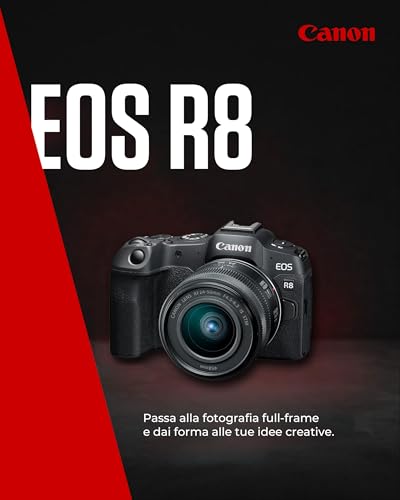
Canon EOS R8 review. Compare 108 technical specifications and user reviews to see how it ranks among cameras and if it is worth buying.
Overall score
What it is: An overall evaluation of the camera's quality, based on technical analyses and user reviews.
When it matters: When you need a quick reference to identify the best cameras on the market.
Score components:
90.0%
Technical Score
10.0%
User score
Technical Score
What it is: An assessment of the camera's technical performance, covering eight key areas: image quality, autofocus, video features, stabilization, lens compatibility, connectivity, battery, and design.
When it matters: When you want to compare cameras based on technical performance and available features.
Score components:
28.0%
Sensor & Image
25.0%
Photo Features
18.0%
Video & Audio
14.0%
Display & Design
8.0%
Battery & Power
7.0%
Connectivity & Storage
User score
What it is: A rating that combines user reviews and the total number of reviews received by the camera.
When it matters: When real-world owner satisfaction and review volume matter to your decision.
Score components:
70.0%
User reviews
30.0%
Popularity
Score components:
25.0%
Sensor size
20.0%
Main camera megapixels
20.0%
Dual card slots
15.0%
N. of focus points
10.0%
RAW photo capture
10.0%
Phase-detection autofocus (photos)
Score components:
35.0%
Weight
30.0%
Battery life (CIPA)
20.0%
Sensor-shift stabilization
15.0%
GPS
Score components:
30.0%
Price
20.0%
Weight
20.0%
AF tracking
20.0%
Battery life (CIPA)
10.0%
Touchscreen
Score components:
30.0%
Main camera megapixels
25.0%
Sensor size
20.0%
Main camera pixel size
15.0%
Sensor-shift stabilization
10.0%
RAW photo capture
Score components:
30.0%
Weight
25.0%
Thickness
20.0%
AF low-light sensitivity
15.0%
Sensor-shift stabilization
10.0%
Eye detection AF (human)
Score components:
30.0%
Sensor size
25.0%
Main camera pixel size
20.0%
Eye detection AF (human)
15.0%
Main camera megapixels
10.0%
Sensor-shift stabilization
Score components:
30.0%
Weight
25.0%
Battery life (CIPA)
20.0%
Min operating temperature
15.0%
Sensor-shift stabilization
10.0%
GPS
Available: ranking among products currently available (including other versions of this product).
All: ranking among all products in the database.
#8 in Best Canon EOS Cameras
#23 in Best Vlogging Cameras
#23 in Best Cameras for YouTube
#27 in Best Low Light Cameras
#28 in Best Full-Frame Cameras
#34 in Best Mirrorless Cameras
#36 in Best Cameras
#36 in Best Digital Cameras
#36 in Best 4K Cameras
What it is: An assessment of the camera's technical performance, covering eight key areas: image quality, autofocus, video features, stabilization, lens compatibility, connectivity, battery, and design.
When it matters: When you want to compare cameras based on technical performance and available features.
Score components:
28.0%
Sensor & Image
25.0%
Photo Features
18.0%
Video & Audio
14.0%
Display & Design
8.0%
Battery & Power
7.0%
Connectivity & Storage
What it is: A rating that combines user reviews and the total number of reviews received by the camera.
When it matters: When real-world owner satisfaction and review volume matter to your decision.
Score components:
70.0%
User reviews
30.0%
Popularity
What it is: An indicator that combines the camera's overall rating with its cost.
When it matters: When you want to know how much overall quality you get for the price.
Score components:
60.0%
Overall score
40.0%
Price
Importance: HIGH
Good value: Full frame or larger
Importance: HIGH
Good value: At least 20 MP
Importance: HIGH
Good value: At least 3.5 µm
Importance: LOW
Importance: MEDIUM
Good value: At least ISO 25,600
Importance: MEDIUM
Importance: MEDIUM
Good value: At least 14-bit
Importance: LOW
Importance: LOW
Importance: LOW
Importance: LOW
Importance: LOW
Importance: LOW
Importance: LOW
Importance: LOW
Importance: MEDIUM
Importance: LOW
Importance: LOW
Importance: LOW
Importance: LOW
Importance: LOW
Importance: HIGH
Good value: At least 200 points
Importance: HIGH
Importance: MEDIUM
Importance: LOW
Importance: LOW
Importance: MEDIUM
Importance: MEDIUM
Importance: HIGH
Good value: At least 5 stops
Importance: LOW
Importance: MEDIUM
Good value: At least 10 fps
Importance: LOW
Importance: LOW
Importance: LOW
Importance: LOW
Importance: LOW
Importance: LOW
Importance: LOW
Importance: LOW
Importance: LOW
Importance: LOW
Importance: LOW
Importance: LOW
Importance: LOW
Importance: LOW
Importance: LOW
Importance: LOW
Good value: At least 200,000 actuations
Importance: LOW
Good value: At least 10x
Importance: HIGH
Good value: At least 3840 px
Importance: MEDIUM
Good value: At least 200 Mbps
Importance: MEDIUM
Good value: At least 10-bit
Importance: LOW
Importance: LOW
Importance: LOW
Importance: LOW
Importance: LOW
Importance: LOW
Importance: LOW
Good value: At least 30 min
Importance: LOW
Importance: LOW
Importance: LOW
Importance: LOW
Importance: LOW
Good value: At least 2 microphones
Importance: LOW
Importance: LOW
Importance: LOW
Importance: LOW
Importance: MEDIUM
Good value: 500 g or less
Importance: LOW
Importance: LOW
Importance: LOW
Importance: MEDIUM
Importance: MEDIUM
Good value: At least 2.36 million dots
Importance: LOW
Good value: 100%
Importance: LOW
Importance: LOW
Good value: At least 120 Hz
Importance: MEDIUM
Good value: At least 3 in
Importance: LOW
Importance: LOW
Importance: LOW
Importance: LOW
Importance: LOW
Importance: LOW
Importance: LOW
Good value: At least 10 m
Importance: LOW
Importance: LOW
Importance: LOW
Importance: LOW
Importance: MEDIUM
Good value: At least 400 shots
Importance: LOW
Good value: At least 1,500 mAh
Importance: LOW
Importance: LOW
Importance: LOW
Importance: LOW
Importance: LOW
Importance: LOW
Importance: LOW
Importance: LOW
Importance: LOW
Importance: LOW
Importance: LOW
Importance: LOW
Importance: LOW
Importance: LOW
Importance: LOW
Importance: LOW
Importance: LOW
Importance: LOW
Importance: HIGH
Good value: At least 200 points
Importance: HIGH
Importance: MEDIUM
Good value: At least ISO 25,600
Importance: HIGH
Good value: At least 3.5 µm
Importance: MEDIUM
Good value: At least 200 Mbps
Importance: LOW
Importance: MEDIUM
Importance: MEDIUM
Importance: LOW
Importance: LOW
Importance: LOW
Importance: MEDIUM
Good value: 500 g or less
Importance: LOW
Good value: At least 1,500 mAh
Importance: LOW
Importance: LOW
(Reviews last updated: July 2026)
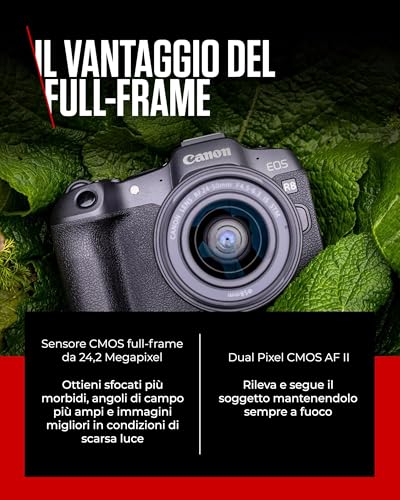
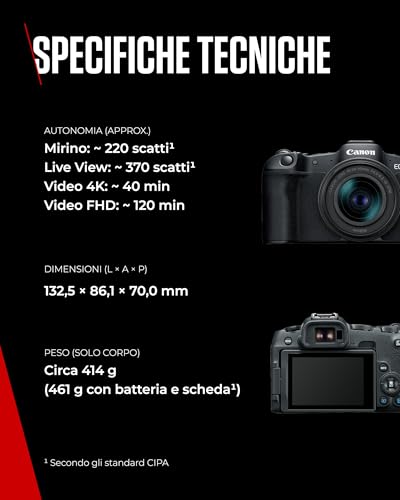
The Canon EOS R8 is a lightweight, budget-friendly, full-frame mirrorless camera that offers exceptional 24.2MP image quality and advanced Dual Pixel CMOS AF II autofocus inherited from the high-end EOS R6 Mark II. It supports uncropped 4K 60p video, 10-bit C-Log3, and 40 fps electronic shooting, making it a powerful tool for creators. However, to achieve its price point, the R8 lacks in-body image stabilization (IBIS), features a small battery with short life, and lacks a fully mechanical shutter. Additionally, the body lacks a dedicated AF joystick and uses a single UHS-II card slot, which may limit professional use cases. YouTube
The Canon EOS R8 is a highly portable, lightweight full-frame mirrorless camera offering excellent image quality, reliable subject-tracking autofocus, and advanced 4K 60fps video capabilities. It provides significant performance value, featuring a robust, uncropped video mode, 10-bit internal recording, and a fast, fully articulated screen. RTINGS.com However, the camera's entry-level design entails notable compromises, including a lack of in-body image stabilization (IBIS), no weather-sealing, and poor battery life. Additionally, the reliance on an electronic shutter can cause artifacts in action shots, and the buffer takes a long time to empty.
The Canon EOS R8 is a compact, entry-level full-frame mirrorless camera that heavily inherits the high-performing 24.2MP CMOS sensor and Dual Pixel CMOS AF II autofocus system from the pricier EOS R6 Mark II. Photographer Dustin Abbott highlights its outstanding performance capabilities for its $1,500 USD price tag, pointing out that its low-light sensitivity, dynamic range, and tracking capabilities are vastly superior to its predecessor, the EOS RP. The camera excels at capturing action with an impressive burst rate of up to 40 frames per second using the electronic shutter, backed by an intelligent "auto" tracking mode that easily locks onto human, animal, and bird eyes. For video creators, it offers robust upgrades including uncropped 4K60p video oversampled from 6K, a vari-angle touchscreen, and Canon Log 3 support. However, the reviewer details notable design trade-offs made to keep the body compact and affordable. The most critical drawback is the lack of In-Body Image Stabilization (IBIS), which restricts stable handheld shooting, especially since many of Canon's compact prime lenses lack optical stabilization. Additional physical constraints include a single SD card slot...
The Canon EOS R8 is lauded by ePHOTOzine as a highly efficient, compact, and well-made enthusiast-level hybrid camera, delivering excellent image quality via its 24.2MP full-frame sensor and DIGIC X processor. Key advantages include a top-tier autofocus system with superb subject tracking, 40fps continuous shooting, and high-quality UHD 4K 60p video, earning it a "Recommended" award. However, the review highlights compromises made to achieve a lower price point, including the absence of a full mechanical shutter, which limits high-speed shooting options. Other notable cons include a simplified control layout lacking a joystick, a single SD card slot shared with the battery, and a smaller battery capacity.
The Amateur Photographer review characterizes the Canon EOS R8 as a compact, lightweight, entry-level full-frame camera boasting a class-leading autofocus system and producing superb, high-quality images. It is noted for its portability and a growing selection of native RF lenses, making it a compelling option for photographers seeking an accessible full-frame experience. However, the review highlights that achieving this price point involved significant compromises, including a lack of in-body image stabilization (IBIS), poor battery life, and the absence of a second card slot. Furthermore, the build is described as having over-simplified controls, lacking an autofocus joystick and featuring a lower-quality build compared to higher-end models.
In this Photofocus camera review by Sean McLean, the Canon EOS R8 is highly praised as an outstanding, high-performing travel and general-purpose camera that shares the same 24.2MP full-frame sensor and DIGIC X processing as the higher-end R6 Mark II. The reviewer notes that while it looks similar to the older EOS RP, it is far superior, delivering exceptional image quality, an updated control layout, and excellent performance at high ISO levels. It is also noted for having back-button focus, a built-in level, and a histogram enabled in the viewfinder by default, making it an excellent value for enthusiasts. McLean tested it in real-world environments, including a portrait session and surf photography in Santa Cruz, where he found that the autofocus and subject tracking performed exceptionally well—even tracking a surfer’s face from 200 meters away. However, the review highlights several specific downsides, particularly regarding its physical build quality. The Canon EOS R8 features a mostly plastic construction with a noticeable structural weak spot near the bottom-left corner of the LCD screen, which makes the reviewer doubt its ability to survive...
Canon EOS R8 Review Summary The Canon EOS R8 is a highly capable full-frame mirrorless camera that punches well above its weight class, utilizing the same 24.2MP CMOS sensor and Digic X processor found in the more expensive R6 Mark II. It delivers exceptional dynamic range, a significantly improved signal-to-noise ratio at high ISOs, and flawless low-light autofocus accuracy utilizing the Dual Pixel CMOS AF II system. Tested extensively for specialized genres like long-exposure light painting, night cityscapes, and low-light portraits, the camera shines due to its lightweight 461-g body, highly customizable interface, and integrated features like a bulb timer and intervalometer. Pairings with compact prime lenses (RF 16mm f/2.8, RF 24mm f/1.8, and RF 50mm f/1.8) create a remarkably portable kit with excellent center and mid-field sharpness, highly effective flare control, and decent sunstar rendering for night photography. However, the R8's low price and small form factor require several design compromises. The body completely lacks In-Body Image Stabilization (IBIS), is limited to a single UHS-II SD card slot, has only two custom shooting modes (C1 and C2), and features...
The Pascal Basel review identifies the Canon R8 as a high-performance, entry-level full-frame camera, highlighting its exceptional 4K 60p video quality, 10-bit 4:2:2 output, and reliable autofocus as key pros. While praised for its, value, the camera is best suited for videographers seeking professional-grade image quality in a budget-friendly, portable package. Conversely, the primary con noted is the complete lack of in-body image stabilization (IBIS), which requires users to rely on stabilized lenses or gimbals for steady handheld footage. The review notes that the construction prioritizes functional performance over premium build quality, making it a capable "cinematic beast" despite this compromise.
Ken Rockwell hails the 24 MP Canon EOS R8 as the world’s lightest full-frame camera with an electronic viewfinder, highlighting its exceptional high ISO performance and rapid 40 fps electronic shutter burst rate. Pros include unmatched technical performance similar to higher-end models, a lightweight design ideal for travel, and excellent image quality. YouTube · Conversely, the compact design limits physical controls, resulting in fewer buttons and dials compared to larger models like the EOS R6 II. Additionally, the reliance on an electronic shutter for maximum speed can introduce rolling shutter distortion in fast action scenarios. YouTube
The Canon EOS R8 is a lightweight, hybrid mirrorless camera launched in April 2023 for an affordable $1,300 MSRP. Borrowing its 24.2-megapixel full-frame sensor, Digic X processor, and Dual Pixel CMOS AF II system from the higher-end EOS R6 Mark II, it excels at low-light performance by producing low-noise images, and delivers fast, reliable subject tracking even in adverse conditions like snow. Weighing just one pound, its compact form factor makes it an excellent travel companion and vlogging tool, further aided by a user-friendly menu system and an articulating 3-inch LCD touchscreen. It also shoots 4K video oversampled from 6K, though this downsampling could occasionally lead to strange visual artifacts when capturing tight patterns or lines. However, the reviewer notes several significant "pro" omissions that limit its overall utility. A major drawback is the lack of In-Body Image Stabilization (IBIS), which requires higher shutter speeds for sharp photos and results in shakier handheld videos. The camera also lacks a physical autofocus control joystick, forcing users to take their eye off the viewfinder to adjust focus points. Furthermore, the live viewfinder...
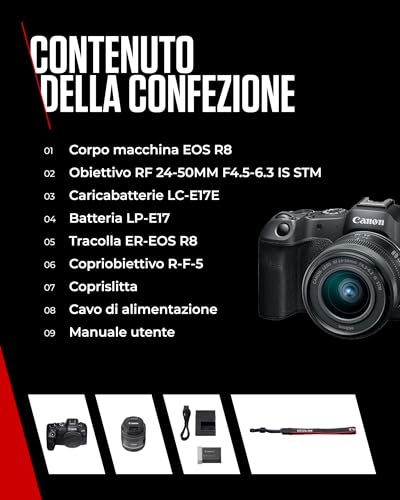
The Canon EOS R8 is a lightweight and highly portable full-frame mirrorless camera weighing just 414g, making it an excellent walkabout camera or backup body for professional photographers. Tested alongside the RF 24-50mm f/4.5-6.3 IS STM lens, the camera excels in delivering outstanding sharpness, rich color capture, and impressive dynamic range, even when handling high-contrast scenes using its HDR mode. It is packed with premium, high-end features at a highly reasonable price point of $1,499 (or $1,699 in a kit), offering exceptional low-light capabilities and a blistering continuous shooting speed of up to 40 fps, alongside a 30 fps raw burst mode with pre-recording features. Despite these stellar capabilities, the reviewer highlighted a few physical and ergonomic limitations. A major drawback for existing Canon shooters is the camera's specific battery type, which prevents cross-compatibility with heavier bodies like the R5 or R6, meaning users must carry separate spares. Additionally, there is no official dedicated battery grip available for the R8, though it does support an EG-E1 extension grip to assist users with larger hands. The placement of the memory card...
The PhotoBohemian Canon EOS R8 review highlights the camera as an affordable, lightweight full-frame mirrorless option featuring top-tier technology from the EOS R6 Mark II, including impressive autofocus and fast shooting speeds. Key pros include its 461-gram portability and high-quality, oversampled 4K 60p video capabilities. Conversely, the review notes significant compromises, particularly the lack of in-body image stabilization (IBIS), which makes optical lens stabilization crucial. Other cons highlighted to keep costs low include a small electronic viewfinder (EVF), a single card slot, and poor battery life.
The Canon EOS R8 features a 24.2 MP front-side-illuminated CMOS sensor paired with a Digic X processor, delivering exceptional image quality that rivals more expensive back-side-illuminated (BSI) systems. In testing, it achieved an impressive overall DXOMARK score of 93, highlighted by a peak dynamic range of 14.7 EV at base ISO and excellent color depth of 24.5 bits. Pros include its highly competitive low-light performance (ISO 3295), powerful video capabilities featuring full-width oversampled 4K 60p, and a blazing fast 40 fps fully electronic shutter. Additionally, it remains competitively priced at $1499, making it a strong entry-to-mid-level full-frame mirrorless option. However, to achieve its aggressive price point and lightweight 461g design, Canon introduced several hardware limitations. Notable cons include the total lack of in-body image stabilization (IBIS) and a single SD UHS-II card slot. Its continuous shooting mode is heavily restricted to just 6 fps when utilizing the pared-down mechanical shutter. Furthermore, the compact physical footprint forces the use of a smaller LP-E17 battery, which restricts overall battery life compared to premium models.
The Canon EOS R8 is a highly recommended, lightweight full-frame mirrorless camera designed as an affordable upgrade for DSLR or APS-C shooters. It inherits the high-end 24-megapixel sensor, DIGIC X processor, and exceptional autofocus capabilities of the pricier EOS R6 Mark II. Key advantages include uncropped, oversampled 4K video recording up to 60p, 10-bit C-Log 3 support, and advanced subject recognition tracking (including an efficient "Auto" mode). Stills photographers benefit from blazing-fast 40fps electronic burst shooting and a useful RAW burst pre-capture feature. To achieve its lower price point, the camera makes several physical compromises and loses premium features. The most significant drawback is the complete omission of in-body image stabilization (IBIS), making it reliant on optically stabilized lenses or a heavily cropped digital movie stabilization mode. Furthermore, it downgrades to a single SD card slot, a smaller LP-E17 battery that yields just 65 minutes of 4K recording, and a lower-resolution 2.36M-dot viewfinder. The body also lacks physical controls like an autofocus joystick or a rear selection wheel, and the mechanical shutter is limited to a modest 6fps.
The Canon EOS R8 is a highly capable, remarkably compact, and lightweight full-frame mirrorless camera that offers roughly 90% of the features found in the more expensive EOS R6 Mark II, allowing users to save well over £1,000. A standout strength of this model is its exceptionally responsive and advanced autofocus system, which is derived from the high-end EOS R3 and matches the speed and performance of the R6 Mark II. It utilizes "Whole area tracking Servo AF" and boasts expanded subject detection capabilities that accurately track horses, aircraft, and trains, as well as specific left or right eye preferences. This makes it an ideal, budget-friendly entry point for DSLR users looking to downsize their gear without sacrificing top-tier focusing performance. However, the camera's aggressive size and cost reductions result in several physical compromises. On the downside, the exterior layout completely omits the physical multi-controller (joystick) and features only a single Quick Control dial, which alters standard camera operations and complicates modes like Flexible-priority AE (Fv mode). Additionally, it only includes a single memory card slot and relies on the...
The COMPUTER BILD review praises the Canon EOS R8 as an excellent budget-friendly, entry-level full-frame mirrorless camera that packs premium technology inherited from the flagship Canon EOS R3. Equipped with a 24-megapixel sensor and a rapid Digic X processor, it delivers exceptional low-light photo quality, producing images at ISO 6400 that are nearly indistinguishable from those shot at ISO 100. Its key pros include a highly versatile, rapid Dual Pixel autofocus system boasting up to 4,897 selectable points, and stellar video capabilities featuring uncropped 4K video recording at up to 60 frames per second. Furthermore, its featherweight body scales at just 455 grams (with battery and card), making it exceptionally portable. However, the review outlines several design compromises implemented to achieve its lower price point. The most significant cons are the complete lack of in-body image stabilization (IBIS), making the camera entirely dependent on lens-based stabilization, and a relatively pixelated, small 0.70x electronic viewfinder (2.36 million subpixels) compared to rivals. Physical compromises also include a stripped-down button layout lacking an autofocus joystick, a single SD card slot, a somewhat long...
The digitalkamera.de review highlights the Canon EOS R8 as a lightweight, entry-level full-frame camera featuring the advanced 24.2-megapixel sensor and Dual Pixel CMOS AF II system found in the higher-end R6 Mark II. It offers high-quality, uncropped 4K/60p video and strong subject recognition, making it a capable tool for enthusiasts, according to the analysis. Conversely, the review notes significant compromises, most notably the omission of in-body image stabilization (IBIS). Other drawbacks include the lack of a rear joystick and thumbwheel, a lower-resolution electronic viewfinder, a single SD card slot, and short battery life due to the smaller LP-E17 battery.
The Canon EOS R8 is a powerful, compact, entry-level full-frame camera sharing the 24.2MP sensor and DIGIC X processor from the higher-end R6 Mark II, resulting in excellent image quality, high ISO performance, and capable 4K 60p video. Its advanced Dual Pixel CMOS AF II offers precise tracking, while the lightweight, articulating screen design is ideal for travel and vlogging, making it a highly capable imaging tool despite its small footprint. Run However, the review outlines compromises made to achieve this size, including the lack of In-Body Image Stabilization (IBIS), no full mechanical shutter, and limited battery life. Furthermore, the ergonomics are compromised by a single SD card slot, the absence of an AF joystick, and a build that lacks comprehensive weather sealing.
The CHIP review evaluates affordable full-frame mirrorless cameras priced under €1,500, which offer professional-grade image quality, sharp details, and low image noise in compact bodies. The top recommendation is the Panasonic Lumix DC-S5 II, praised for its excellent 6K video capabilities, rapid continuous shooting, and fast hybrid autofocus system, though it is limited by a smaller selection of native lenses. For budget-conscious buyers, the Panasonic Lumix DC-S5D serves as a prime value option, offering integrated image stabilisation, a weather-sealed body, and dual card slots, but suffers from slower continuous shooting and sluggish autofocus in dim lighting. Other highly-rated alternatives include the Nikon Z6II, noted for its low image noise and dual card slots (SD and CFexpress), and the Sony Alpha 7 III, which still delivers class-leading image quality and low shutter lag despite its complex menu layout and slower burst speeds. While these affordable full-frame cameras excel at handling high ISO levels (6,400 and above) in low-light environments, buyers must compromise on specific features compared to high-end models. The primary drawback across this budget class includes slower continuous shooting rates...
The review positions the Canon EOS R8 as an exceptional entry-level mirrorless system camera that brings premium full-frame capabilities down to a budget-friendly price point. It inherits the powerful 24.2-megapixel full-frame sensor and the highly advanced Dual Pixel CMOS AF II system directly from the pricier EOS R6 Mark II, resulting in identical image quality, natural skin tones, and excellent low-light noise control. The video performance is a standout feature for an entry-level camera, delivering uncropped 4K video at 60p oversampled from 6K, 1080p slow-motion at 180 fps, and high-end tools like C-Log3 and focus breathing correction. Structurally, the weather-resistant body remains remarkably portable at roughly 414 grams and includes a fully articulating touchscreen display alongside a blistering continuous shooting speed of up to 40 frames per second using the electronic shutter. To achieve this competitive price and compact size, Canon had to make several notable ergonomic and technical compromises. The most prominent drawbacks are the total omission of internal body image stabilization (IBIS), a missing physical joystick for focus point selection, and the reliance on a single UHS-II SD...
The Canon EOS R8 offers exceptional full-frame image and video quality, featuring the same advanced autofocus tracking as the more expensive R6 Mark II in a compact body, providing great value. Despite initial skepticism regarding its entry-level design, the review finds the camera's ergonomics, 4K/60p video capabilities, and overall performance impressive for its price point. However, significant compromises include the lack of in-body image stabilization (IBIS), a low-resolution viewfinder, and a small battery, which may frustrate advanced users. The reviewer concludes that the lack of professional features like dual card slots makes it best suited for enthusiasts rather than pros requiring redundancy.
The Zielfoto review highlights the Canon EOS R8 as an impressive, lightweight (461g) full-frame mirrorless camera that serves as a highly capable entry-level power-house. Users and experts praise its exceptional 24.2 MP CMOS sensor and low-light performance, alongside a class-leading Dual Pixel autofocus system inherited directly from the more premium R6 Mark II. The camera excels with its rapid 40 frames-per-second continuous electronic shooting and versatile 4K video recording, making it an incredible value for hobbyists, families, and travel photographers looking for elite performance at an attractive price point under €1,000/£1,500. However, to achieve its compact build and affordable price tag, the R8 incorporates several strict hardware compromises. Reviewers note that it completely lacks In-Body Image Stabilization (IBIS) and a dedicated physical AF navigation joystick, forcing users to rely entirely on lens stabilization and the touchscreen interface. Additionally, the camera is restricted to a single SD card slot and features a notoriously small LP-E17 battery, which results in subpar battery life compared to its larger cousins. Some buyers also point out the lack of affordable third-party autofocus lens alternatives on...
The Canon EOS R8 is a highly capable and exceptionally fast full-frame mirrorless camera that shares the identical 24-megapixel sensor, processor, and advanced deep-learning autofocus system with the higher-end EOS R6 Mark II, all while being significantly lighter and roughly €1,000 cheaper. Evaluated with a "Very Good" overall score of 87.1%, it excels dynamically in continuous shooting speeds (98.5%) and delivers outstanding image quality (93.1%), making it an ideal travel and action-photography companion. The camera also features a versatile, fully articulating 3-inch touchscreen and maxes out its video capabilities at a highly capable 4K resolution. However, achieving this compact design and lower price point resulted in noticeable equipment cutbacks that dragged its features and operation score down to 74.9%. Its primary drawback is the total omission of an in-body image stabiliser (IBIS), which forces photographers to rely strictly on lenses equipped with optical stabilization ("IS"), thereby limiting their native RF lens options. Additionally, ambitious users may find the single memory card slot limiting due to the lack of immediate backup capabilities, while its lower-resolution electronic viewfinder further highlights the physical...
In his review of the Canon EOS R8, Stephan Wiesner highlights the camera as an affordable entry-level, full-frame option that delivers exceptional image performance. A major pro is that it features the exact same high-quality 24-megapixel sensor and advanced autofocus system found in the significantly more expensive Canon EOS R6 Mark II. The autofocus tracking is exceptionally strong, fast, and intuitive, accurately detecting humans, animals, and vehicles alike. Additionally, the body is highly compact and lightweight, making it an excellent option for travel or daily portability. YouTube · However, Wiesner notes several significant trade-offs to achieve its much lower price point. A primary con is the complete lack of in-body image stabilization (IBIS), meaning shooters must rely entirely on stabilized lenses. The camera also utilizes a small LP-E17 battery, which drains rapidly—particularly during 4K video recording, where it only lasts about 20 to 25 minutes. Furthermore, ergonomics are sacrificed; the body feels somewhat cheap, lacks a full physical joystick (using a directional pad instead), is not fully weather-sealed, and features only a single SD card slot packed awkwardly into the...
However, the compact body introduces notable trade-offs, particularly regarding battery capacity, as the smaller LP-E17 battery lasts only 1 hour and 12 minutes in continuous 4K shooting—roughly half the runtime of the EOS R6 Mark II. High-frame-rate options up to 120 fps are restricted to Full HD and come with a very noticeable loss in resolution, which requires careful framing like close-ups to hide. Furthermore, setting up a manual white balance remains unnecessarily complicated, forcing users into photo mode to capture a grey card reference rather than offering a simple one-click video solution.
The Canon EOS R8 is a lightweight, compact full-frame mirrorless camera that integrates premium features from the higher-end EOS R6 Mark II into a more affordable, entry-level body. Key advantages of this camera include its exceptionally fast and precise Dual Pixel AF II autofocus system, which uses deep learning to seamlessly track people, animals, and vehicles. Photographers and videographers will also benefit from its excellent 24.2 MP image quality with highly managed noise reduction up to ISO 6,400, a rapid electronic burst shooting mode of up to 40 frames per second, an uncropped 4K video recording capability at 60p, and a fully articulating 3-inch touchscreen display. However, the review highlights several critical trade-offs made to keep the camera compact and budget-friendly. The most significant drawback is the complete lack of in-body image stabilization (IBIS), which forces users to rely exclusively on stabilized lenses. Battery life is also notably poor; using the smaller LP-E17 battery restricts users to roughly 300 to 400 shots per charge, making spare batteries an absolute necessity. Additional design limitations include a narrow electronic viewfinder, the absence...
The Canon EOS R8 is a compact full-frame mirrorless camera designed to replace the EOS R and RP models, packing the same 24.2 MP sensor and advanced Digic X processor as the higher-end EOS R6 Mark II into a lightweight 461-gram body. The review highlights its exceptional image quality, vibrant color reproduction, and exemplary low-light performance, with images remaining highly usable up to ISO 51,200. Its Dual Pixel AF II autofocus system utilizes AI deep learning for precise subject and eye tracking, while its electronic shutter boasts a blazing-fast burst speed of up to 40 fps. Video features are also robust, offering uncropped 4K UHD video at 60p and Canon Log 3 support. However, the camera makes significant compromises to maintain its lower price and smaller size. The most notable drawbacks include the complete absence of in-body image stabilization (IBIS) and a severely limited battery capacity using the small LP-E17 battery, typically yielding fewer than 300 shots per charge. Its physical ergonomics lack standard features like a joystick and a rear scroll wheel, and it relies on a single SD...
This review by Labo Fnac highly praises the Canon EOS R8 mirrorless camera bundle (which includes the RF 24-105mm f/4-7.1 IS STM lens), awarding it a perfect 5 out of 5 stars for its exceptional versatility and appeal to both amateur and professional photographers. The lab test highlights an impeccable colorimetry score of 9 and an outstanding daylight sensitivity score of 9.7. The included standard zoom lens achieved a flawless 10 out of 10 for optical quality, proving to be free of major defects like vignetting and chromatic aberration, while performing reliably across wide-angle (8.9 score) and telephoto (8.6 score) focal ranges. Client feedback mirrors this enthusiasm, with users noting that the 802.9-gram package is incredibly lightweight, easy to handle, and quick to set up. Despite the high praise, the review points out a few notable shortcomings, particularly regarding the camera's sensor resolution and low-light performance. The lab notes that its 24-megapixel resolution is somewhat light by modern standards, receiving a definition score of 8. Additionally, the camera struggles in dim environments, earning its lowest mark of 6.3 for low-light...
The Canon EOS R8 is highlighted as a highly competitive, entry-level full-frame mirrorless camera that offers a premium feature set from the higher-end EOS R6 Mark II at a much more affordable launch price of €1799. The reviewer praises its 24.2-megapixel sensor for delivering superb image quality, exceptional dynamic range, and stunning high-ISO performance with minimal noise up to ISO 32,000. Its main strengths lie in its class-leading, AI-driven Dual Pixel CMOS AF II autofocus system—which features highly tenacious subject tracking for humans, animals, and vehicles—coupled with an incredibly fast electronic burst shooting rate of up to 40 frames per second. Additionally, it boasts advanced video capabilities, offering uncropped 4K 60p video oversampled from 6K, all packaged inside a remarkably lightweight 461g body. However, to achieve this lower price and compact size, Canon made several significant hardware concessions. The most notable downside is the complete absence of in-body mechanical image stabilization (IBIS), relying instead on lens-based or digital stabilization. Ergonomically, the camera omits a dedicated navigational joystick, swapping it for a slower 4-way directional pad, and features a smaller, less-detailed...
The Canon EOS R8 is a lightweight full-frame mirrorless camera that delivers exceptional image quality and performance, earning a 5 out of 5-star rating in the Labo Fnac review. Its standout features include blistering burst shooting speeds of up to 40 frames per second and an incredibly color-accurate sensor that excels in daylight conditions. When paired with the RF 24-50mm f/4.5-6.3 IS STM kit lens, the camera achieves a perfect optical quality score of 10 out of 10, showing virtually no distortion, vignetting, or chromatic aberration. The camera maintains a versatile performance score of 8.3 out of 10 across both grand angle (<35mm) and standard (35-69mm) focal lengths, making it highly adaptable for everyday use. However, the camera does have clear limitations, most notably its low-light performance which scores a low 4 out of 10. Digital noise becomes heavily pronounced when shooting in dim environments under 90 lux. Additionally, its 24.2-megapixel resolution is considered somewhat low compared to market leaders. Despite these drawbacks, the review concludes that the camera is a remarkable value at its starting price of €1,399, providing...
This review highlights the Canon EOS R8 as a highly capable and exceptionally lightweight entry-level full-frame camera that effectively inherits the core imaging power of the more expensive EOS R6 Mark II. Weighing only 461 grams, this ultra-compact body incorporates a powerful 24.2-megapixel sensor and the advanced Digic X processor, delivering identical image quality, exceptional dynamic range, and top-tier autofocus performance. The review praises its highly intuitive autofocus tracking systems—which accurately lock onto eyes, faces, animals, and vehicles—as well as the inclusion of modern features like "Ai Focus" mode, 0.5-second pre-capture, and a massive top burst rate of 40 frames per second using the electronic shutter. Additionally, it scores high marks for its heavily customizable Quick Menus, its efficient C-RAW compressed file format that saves substantial storage space, and its uncropped 4K/60p video capabilities. However, the R8’s entry-level price tag demands significant concessions that limit its versatility, particularly for sports and action photography. The most prominent drawback is the complete lack of an in-body image stabilization (IBIS) system, relying entirely on optically stabilized lenses. It also lacks a fully mechanical...
The Canon EOS R8 is a lightweight, semi-professional mirrorless camera that integrates a 24.2 MP full-frame C-MOS dual-pixel sensor into an ultra-compact body. The reviewer notes that it delivers exceptional image quality with faithful color rendering, precise detail, and strong low-light performance up to 102,400 ISO, backed by the fast DIGIC X processor. Its advanced autofocus system—featuring lightning-fast tracking for eyes, animals, and vehicles—ensures accurate captures even for subjects in motion. Additionally, it features an intuitive physical control layout, modern wireless connectivity options (Wi-Fi, Bluetooth, NFC), and seamless compatibility with older EF/EF-S lenses via custom adapters. Despite these strengths, the review highlights several design compromises made to keep the body compact and budget-friendly. Chief among these is the notably low capacity of its LP-E17 battery, which forces users to carry multiple spares. The camera also lacks internal sensor stabilization (IBIS), relying entirely on optically stabilized lenses, and entirely omits a fully mechanical shutter, using an electronic shutter instead. Finally, the single SD memory card slot is inconveniently tucked away inside the battery compartment door, which prevents the attachment of an...
The Canon EOS R8 is a lightweight (461g), 24.2MP full-frame camera offering high-end Dual Pixel CMOS AF II and excellent low-light performance with 4K 60p video, as highlighted in the Canon Europe field test. Its key strengths include advanced subject tracking, 180fps high-frame-rate options, and high-quality image output suitable for fast-paced creative work. However, the compact design sacrifices in-body image stabilization (IBIS) and a dedicated autofocus joystick, requiring reliance on lens stabilization and touchscreen controls. Additionally, the camera features a limited battery life and a small buffer for 40fps shooting, along with a potential for overheating during prolonged 4K usage.
The CameraRace review gives the Canon EOS R8 a 70/100 score, highlighting its exceptional versatility (84/100) and autofocus performance in a compact, 461-gram body. Key pros include high-speed subject tracking, weather sealing, a microphone input, and excellent portability for street photography. Conversely, the R8 faces criticism for its comfort and battery, with the 290-shot capacity labeled as a significant bottleneck for extended, remote shooting. While the camera is considered a powerful, lightweight option for hybrid creators, the review notes the low autonomy, landing it in the bottom 33% for physical operation.
The Photolari review highlights the Canon EOS R8 as a highly capable, compact, and lightweight full-frame mirrorless camera. It is positioned as an attractive choice for Canon users transitioning to mirrorless systems and content creators working within a sub-€2000 budget. Borrowing heavily from the more expensive EOS R6 Mark II, the R8 inherits a 24.2-megapixel sensor and an elite, highly agile autofocus system with advanced subject-detection algorithms that mirror the performance of the high-end Canon R3. In terms of performance, it stands out by offering full-width, uncropped 4K 60p video recording, an electronic shutter speed of up to 40 fps, and strong image quality with impressive noise control at very high ISO levels. Despite its strong core features, the review notes several deliberate compromises made by Canon to manage costs and avoid competing directly with the R6 Mark II. The most significant disadvantage is the complete lack of in-body image stabilization (IBIS), which places the camera at a competitive disadvantage against rivals like the Sony A7 III or Panasonic Lumix S5 that offer physical stabilization. Additionally, the camera omits Canon's...
The Canon EOS R8 "First Shoot" review highlights the camera's real-world performance through hands-on experiences by three professionals, showcasing its capabilities in street, studio, and family portrait scenarios. Key pros include the lightweight, compact body, advanced deep learning AI autofocus with 40fps burst shooting, and excellent low-light performance. However, the reviews note several cons resulting from its compact design, including the lack of In-Body Image Stabilization (IBIS), shorter battery life with the smaller LP-E17 battery, and a single SD card slot. Additionally, the camera features a more simplified control scheme, making it a powerful yet simplified tool better suited for advanced enthusiasts or as a lightweight secondary body.
The Canon EOS R8 is reviewed as a highly capable, semi-professional full-frame mirrorless camera that offers premium internal tech inside a lightweight, budget-friendly body priced at €1,599 in Spain. Acting as a direct successor to the EOS RP, it integrates the advanced Dual Pixel CMOS Autofocus II system found in much more expensive models like the EOS R3 and R5, offering flawless subject tracking for humans, animals, and vehicles even in low-light environments down to -6.5 EV. Performance is significantly upgraded with a 24.2 MP sensor capable of oversampled 4K video recording at 60 fps, High Definition slow-motion at 180 fps, and staggering burst shooting speeds of up to 40 fps using the electronic shutter. Furthermore, it vastly improves upon its predecessor's dynamic range, producing sharp RAW images with minimal noise even at high ISO settings. Despite its stellar performance, the review highlights critical physical compromises made to maintain its low price tag and highly portable 414-gram design. For instance, advanced users may miss professional design elements like a front programmable button or a rear control dial. The most substantial...
The Canon EOS R8 is a lightweight, compact full-frame mirrorless camera designed as an entry-level option that inherits premium core technologies from higher-end models. It features the same 24.2-megapixel CMOS sensor and DIGIC X image processor found in the EOS R6 Mark II, delivering exceptional image quality, strong dynamic range, and clean high-ISO performance even up to ISO 6400. The camera boasts an advanced Dual Pixel CMOS AF II system capable of tracking humans, animals, and vehicles, alongside a rapid continuous shooting speed of up to 40fps using its electronic shutter. For videographers, it offers impressive uncropped 4K video at 60fps oversampled from 6K, support for Canon Log 3, and highly effective Digital IS (electronic stabilization) that can deliver smooth, gimbal-like footage when paired with stabilized lenses. However, its ultra-compact design introduces notable compromises in ergonomics and physical features. Key disadvantages include the complete lack of a physical joystick for AF point selection, the inclusion of only a single SD card slot, and the absence of a mechanical 5-axis image stabilization system. Additionally, its small LP-E17 battery results in limited...
The Canon EOS R8 is a highly capable, entry-level full-frame mirrorless camera that successfully balances professional-grade performance with an affordable, travel-friendly design. Weighing only 461 grams with its battery and memory card, the review highlights that its extremely compact chassis manages to maintain satisfying ergonomics without feeling too small to handle comfortably. It shares an excellent 24.2-megapixel full-frame sensor and the highly advanced Dual Pixel CMOS AF II artificial intelligence autofocus system with higher-end models, providing remarkably reliable subject tracking for humans, animals, and vehicles alike. For hybrid creators, the camera delivers top-tier oversampled 4K video up to 60p, Canon Log 3 support for advanced color grading, and impressive high-frame-rate Full HD slow-motion recording at up to 180 frames per second. Despite its strengths, the review notes several technical and physical concessions made to keep the camera lightweight and budget-friendly. The biggest drawback is the omission of In-Body Image Stabilization (IBIS), meaning photographers must rely entirely on stabilized lenses or tripods, which limits its effectiveness in difficult or low-light handheld environments like wedding ceremonies. To prioritize its compact form factor,...
The Canon EOS R8 is a full-frame mirrorless camera that integrates high-end professional performance into a compact, lightweight body originally designed for the entry-level EOS RP. It shares the same 24-megapixel full-frame sensor, Digic X processor, and advanced Dual Pixel CMOS AF II deep-learning autofocus system as the more expensive EOS R6 Mark II. This enables excellent subject tracking for people, animals, and vehicles, alongside an impressive electronic shutter burst speed of up to 40 fps. Despite its plasticky polycarbonate build and small battery (typically found in APS-C models), the camera proved highly resilient and reliable during field testing in demanding, muddy motocross conditions. However, the review highlights several compromises made to keep the camera affordable and portable. The most notable omissions are the lack of In-Body Image Stabilization (IBIS) and the absence of a dual SD card slot, the latter being a significant drawback for professionals who require immediate file backup during live events. Additionally, the camera features a lower-resolution 2.36-million-dot EVF, lacks a physical autofocus joystick, and utilizes a "mixed" shutter mechanism (electronic first-curtain, mechanical second-curtain) that produces...
The Canon EOS R8 is a highly capable entry-level full-frame mirrorless camera that balances a budget-friendly price point with impressive internal components. It is exceptionally lightweight and compact, sharing its body design with the older EOS RP while inheriting the powerful 24.2MP full-frame sensor and advanced autofocus tracking system from the more expensive EOS R6 Mark II. This combination enables outstanding image quality, excellent noise management at high ISOs, and a blistering burst shooting speed of up to 40fps using the electronic shutter. Video performance is equally strong, delivering uncropped 4K video at 60p with oversampling, making it an attractive hybrid travel option for creators stepping up from APS-C systems. However, achieving this low price point required several significant design compromises. The most notable drawbacks include the total absence of In-Body Image Stabilization (IBIS), a low-capacity battery that limits overall shooting endurance, and the inclusion of only a single SD card slot, which may deter professional users. Furthermore, the camera features a lower-resolution electronic view finder (EVF) and LCD touchscreen, lacks a dedicated autofocus joystick, and places the main menu...
Samuel Buchmann’s review of the Canon EOS R8 reveals that this entry-level full-frame camera exceeds expectations by delivering exceptional image quality, 4K/60p video, and a high-end autofocus system comparable to the more expensive R6 Mark II. The device surprises with good ergonomics and a competitive price point, despite having a smaller physical build. Conversely, the review notes significant limitations, including the lack of in-body image stabilization (IBIS), a low-resolution electronic viewfinder, and poor battery life. Furthermore, compromised handling—specifically the absence of a joystick and rear thumbwheel—hampers the shooting experience, ultimately preventing the author from fully recommending the camera for professional use.
Content creator Alexandra Andreeva’s, first-shoot test of the Canon EOS R8 in Paris highlights the camera's high-performance 24.2MP full-frame sensor and class-leading Dual Pixel CMOS AF II, which effectively tracks subjects in low-light environments. Its primary advantages are portability, featuring a lightweight 461g body that excels for all-day handheld shooting, travel, and vlogging. To maintain this compact design and entry-level price point, the camera sacrifices In-Body Image Stabilization (IBIS) and features a smaller LP-E17 battery, resulting in limited battery life during heavy use. Additional compromises include the lack of a physical focus joystick, noticeable rolling shutter in electronic mode, and the absence of a dual card slot.
Three professional photographers tested the Canon EOS R8, highlighting its 24.2MP full-frame sensor and 40fps continuous shooting as major strengths, alongside AI-powered AF, for versatile, high-quality imaging. The camera is lauded for its extremely lightweight, compact design and seamless switching between 4K video and stills, making it ideal for documentary and travel work. However, the R8 is tailored as an entry-level, portable option rather than a primary, heavy-duty tool, lacking in-body image stabilization (IBIS), a second card slot, and a full mechanical shutter. Additionally, it uses a smaller battery for reduced weight and lacks a dedicated joystick for autofocus control, requiring reliance on the touchscreen.
The Canon EOS R8 is a highly capable entry-level, full-frame camera designed primarily for hybrid content creators transitioning from smartphones to dedicated photography gear. It blends advanced internals with a compact, lightweight body that closely resembles the EOS RP, making it an excellent, portable choice for travel and reportage. The camera features the highly intuitive autofocus system from the high-end EOS R3, exceptional high-ISO noise control, and a wide dynamic range that performs beautifully in high-contrast situations. Furthermore, it boasts an impressive continuous shooting speed of up to 40 fps using the electronic shutter, includes a multifunction hot shoe, and captures high-quality 4K video downsampled from 6K. However, its small form factor introduces several hardware and ergonomic trade-offs. The body lacks a physical joystick, a rear control wheel, and a fully mechanical shutter, which can slow down real-time adjustments for fast-paced subjects like wildlife or sports. There is no in-body image stabilisation (IBIS), meaning photographers must rely entirely on optically stabilised lenses or digital stabilisation for video. Finally, the camera shares a single compartment for both its SD card slot...
The Canon EOS R8 is a lightweight, full-frame mirrorless camera featuring a 24.2-megapixel sensor and advanced features derived from the higher-end EOS R6 Mark II, such as high-speed 40 fps continuous shooting and smart autofocus tracking for people, animals, and vehicles. Tested during a trip to South Tyrol alongside a 24-240mm and a 50mm f/1.8 lens, the camera delivers impressive image sharpness and excellent detail retention even at high ISO settings like ISO 5000. A standout capability is its Pre-shooting (RAW burst) feature, which automatically buffers and saves half a second of footage prior to a full shutter press—making it highly effective for capturing unpredictable moments like moving children or wildlife taking flight. The review highlights several prominent advantages and drawbacks to consider before purchasing. On the positive side, the camera weighs only 461 grams, making it Canon's lightest full-frame option and highly ideal for travel photography. It is user-friendly, features a versatile fully articulating touchscreen LCD, and costs roughly €1,000 less than the EOS R6 Mark II. However, to achieve its compact and affordable design, the camera leaves out...
The Canon EOS R8 is a highly compact and lightweight entry-level full-frame mirrorless camera that packs the professional-grade imaging power of the more expensive EOS R6 Mark II, utilizing the same 24.2MP sensor and DIGIC X processor. Tested extensively during the fast-paced Rotterdam Summer Carnival, the camera stands out for its blazing-fast 40fps electronic burst shooting and an exceptionally accurate, AI-driven Dual Pixel AF II system that effortlessly tracks human eyes, animals, and vehicles. It delivers superb, professional image and video quality, boasting 4K video oversampled from 6K at up to 60fps without a crop, along with advanced creative tools like in-camera focus bracketing, moving-subject HDR, and 10-bit HEIF capture. However, to achieve its aggressive price point and portable 414-gram footprint, Canon made several significant hardware compromises. A major drawback is the complete omission of in-body image stabilization (IBIS), making users entirely reliant on optically stabilized RF lenses or digital cropping for handheld shooting. Additionally, it lacks a physical joystick and features only one control dial, forcing cumbersome menu-diving via the touchscreen to adjust vital exposure settings like ISO and...
The Shoot.be reader review of the Canon EOS R8 concludes that it is a highly capable full-frame mirrorless camera, heavily praised by the four testers—Lianne, Xavier, and two others—for its portability, value, and outstanding low-light performance. The testers highlights exceptional sharpness, deep image details, natural colour rendition, and impressive dynamic range, even when shooting directly into backlight. A major strength noted in the field tests is the camera's high-ISO capabilities; for instance, tester Lianne successfully pushed the sensitivity to ISO 12,800 inside a dim clouded leopard enclosure, yielding razor-sharp photos with minimal post-processing noise. Xavier similarly confirmed that noise remains very manageable at ISO 6,400 and is easily corrected via software. Additionally, the quality and sharpness of cropped images remained remarkably high, making the camera highly versatile. However, the user tests also pinpoint specific sacrifices made to achieve the camera's entry-level full-frame positioning. The primary cons derived from the model's design are its lack of in-body image stabilization (IBIS) and a relatively short battery life, which uses the smaller LP-E17 battery pack. To mitigate the lack of IBIS, users rely...
Compare