Scored using Drones Methodology v3.0
Drones Methodology v3.0
Mathematical & Unbiased Scoring
Products in this category are scored under Frontum Drones Methodology v3.0: the technical score from the specifications is the base, and independent expert and video reviews (up to ±0.5 points), owner opinions (up to ±0.3) and best-of lists (up to +0.3) move it up or down.
Explore Drones Methodology v3.0

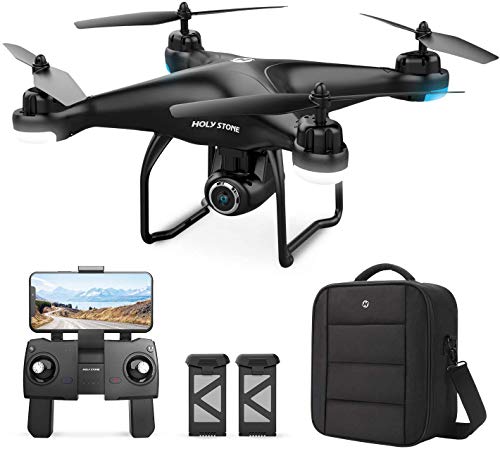
Holy Stone HS110G review: 97 specs compared

Avg. price:~£130Max flight time:13 minVideo resolution:1080p/30 fpsMax transmission distance:0.3 km

Holy Stone HS110G Review: Compare 97 technical specifications and 12 expert and video reviews to see how this product ranks in the Drones category and whether it is worth buying.

Holy Stone HS110G
5.8/10

Overall score

Score
5.8/ 10
✕
What it is
Our main score for this model, 1–10. It combines specs, best-of lists, expert reviews and owners.
How we count it
Parts: Technical score 35%, List score 30%, Reviews score 25%, Sentiment score 10%
Marks: Each part gets a mark out of 10. For reviews, lists and owners, a typical model in this category gets about 8 and the best one gets 10.
No data yet: A part with no data shows "?". It counts as the mark of a weaker model in this category (4 in 5 models with data score higher). This way, models with reviews, lists and owners usually come out ahead.
Score distribution
▼
<55-66-77-88-99-10
Score components

35%

5.1

Technical score

30%

?

List scoreNot enough data yet, so we use 7.5, the mark of a weaker model in this category

25%

5.1

Reviews score

10%

5.1

Sentiment score

▼Worse than 88% of drones
7.0

Value for money

Value for money
7.0/ 10
✕
What it is
An indicator that combines the drone's overall rating with its cost.
When it matters
When you are looking for a drone with a good balance between flight quality, camera features, and price.
Score distribution
▼
<55-66-77-88-99-10
Score components

70%

5.8

Overall score

30%

9.8

Price

▼Worse than 80%
5.1

Technical score

Technical score
5.1/ 10
✕
What it is
How good the specs are compared with the other models in this category, 1–10.
How we count it
Areas: We rate the specs in each area against the other models in this category.
Weighting: The areas that matter most to buyers count more. The shares are shown under Score components.
Share: The technical score is 35% of the overall score.
Score distribution
▼
<55-66-77-88-99-10
Score components

26%

3.1

Flight

24%

5.3

Camera

20%

6.7

Safety

16%

5.6

Connectivity

14%

5.8

Battery & Design

▼Worse than 79%
5.1

Reviews score

Reviews score
5.1/ 10
✕
What it is
Average grade from independent test sites, magazines and video reviewers, 1–10.
How we count it
Grades: Each review's own score is converted to 1–10; without one, we grade the review ourselves. Every review counts the same: written or video, short or full test.
Score: The average grade is 80% of the review mark; the number of reviews is the other 20% (1 review = 5, the typical number in this category = 8, the most-reviewed model = 10).
Enough data: With few reviews, the average grade is pulled toward the typical grade of this category. No reviews yet: 7.5 for now.
Share: Reviews count 25% of the overall score.
Score distribution
▼
<55-66-77-88-99-10

5.1

Mark 7.9 is below the typical mark 8.0 of this category, so it cannot lift the score above the technical score

80%

7.9

Average grade

20%

7.7

Popularity

Grades by review (12)
1 review + 11 videos, average 7.8/10. Reviews count 25% of the overall score.
User ratings collected online are not part of this score.
▼Worse than 87%
?

List score

List score
7.5/ 10
✕
What it is
How often independent test sites, magazines and video reviewers put this model in their best-of lists for this category.
How we count it
Points: The model in the most lists of this category gets 10; the others get 8 to 10 in proportion. In no list yet: 7.5. Lists count 30% of the overall score.
Enough data: Every list counts, even a single one. With fewer than 5 best-of lists in the category, this part is left out.
Lists with this model (0)
Not in any best-of list yet, so this part counts as 7.5. Models in a list get 8 to 10.
Not in any best-of list yet
  • holy-stone-hs110g
  • holy-stone-hs110g
  • holy-stone-hs110g
  • holy-stone-hs110g
  • holy-stone-hs110g
  • holy-stone-hs110g
  • holy-stone-hs110g
  • holy-stone-hs110g
  • holy-stone-hs110g
holy-stone-hs110g
holy-stone-hs110g
holy-stone-hs110g
holy-stone-hs110g
holy-stone-hs110g
holy-stone-hs110g
holy-stone-hs110g
holy-stone-hs110g
holy-stone-hs110g
Where to buy
    N/A~ £130

What reviewers say about the Holy Stone HS110G

Based on 3 · 12

Reviewers trust its return-to-home and steady flight, but shaky footage without proper stabilization and short flight time are common complaints.
Praised
Criticised
Pick a topic to see who said what

What owners say about the Holy Stone HS110G

Based on 63 owners sharing their experience in online comments

24%positive14%mixed62%negative

Owners praise wind handling and fun, while setup trouble, erratic flight, and short battery life drive many complaints.

What owners dislike

  • Owners say calibration often fails or takes around twenty minutes, and GPS satellites are hard to find indoors, so they go outside.8
  • Owners report it tilts to one side or drifts in one direction on takeoff, and sometimes circles or wanders instead of holding one spot.7
  • Owners report poor video quality, shaky footage with no stabilizer, stuttering, and a camera that will not start with a memory card.6
  • Owners say the controls feel very sensitive, and some crashed within seconds of takeoff, into walls or ponds, or after the drone ignored commands.6
  • Owners say GPS will not engage, and the app or controller may fail to pair; one fixed it by pairing devices in the right order.5
  • Owners say it takes off uncontrollably after the props start, going where it wants, and spins in circles or ignores commands once airborne.4
  • Owners say one battery gives about 10 to 13 minutes, and wind cuts that down, so flights often feel too short.4
  • Owners report batteries that stop charging after a few flights, or a charger that shows charging but the unit will not switch on.4
  • Owners say the phone bracket does not fit larger phones, which can pop off during flight; one owner used a hair tie instead.3
  • Owners say a replacement charger can take almost two months, and customer service is hard to reach or gives run-around email replies.3

Points mentioned by at least 3 owners, most mentioned first.

Loading...
Loading category ranking...

Technical Specifications of drone Holy Stone HS110G

Technical score
Technical score
5.1/ 10
✕
What it is
How good the specs are compared with the other models in this category, 1–10.
How we count it
Areas: We rate the specs in each area against the other models in this category.
Weighting: The areas that matter most to buyers count more. The shares are shown under Score components.
Share: The technical score is 35% of the overall score.
Score distribution
▼
<55-66-77-88-99-10
Score components:

26%

3.1

Flight

24%

5.3

Camera

20%

6.7

Safety

16%

5.6

Connectivity

14%

5.8

Battery & Design

5.1
Reviews score
5.1
List score
?
Value for money
Value for money
7.0/ 10
✕
What it is
An indicator that combines the drone's overall rating with its cost.
When it matters
When you are looking for a drone with a good balance between flight quality, camera features, and price.
Score distribution
▼
<55-66-77-88-99-10
Score components:

70%

5.8

Overall score

30%

9.8

Price

7.0
Max flight time
13 min
This drone has a max flight time of 13 min, shorter than 75% of drones and equal to 2.5% of drones.
Real-world flight time is often lower than the advertised maximum.
Max flight distance
0.3 km
This drone has a max flight distance of 0.3 km, shorter-range than 65.2% of drones and equal to 6.1% of drones.
Maximum range varies by region (for example FCC vs CE).
Max flight speed
3 m/s
This drone has a max flight speed of 3 m/s, slower than 98.7% of drones and equal to 0.6% of drones.
Max wind resistance
7.9 m/s
This drone has max wind resistance of 7.9 m/s, lower than 69.1% of drones and equal to 10.1% of drones.
Value may include conversion from Beaufort-scale rating to m/s.
Max service ceiling (ASL)
120 m
This drone has a max service ceiling of 120 m, lower than 70.2% of drones and equal to 20.2% of drones.
Altitude limit set in the app.
Show more
What reviewers say
Video resolution
1080p/30 fps
This drone records video at 1080p/30 fps, lower than 61.9% of drones and equal to 5.9% of drones.
4K camera
no
This drone does not support 4K video. 54.6% of drones support 4K video.
Sensor size
?
Main camera megapixels
2 MP
This drone has a main camera resolution of 2 MP, lower than 85.3% of drones and equal to 13.3% of drones.
Max movie bitrate
?
Show more
What reviewers say
Obstacle detection
no
This drone does not support obstacle detection. 31% of drones support obstacle detection.
Return to Home (RTH)
yes
This drone supports Return-to-Home (RTH). 33% of drones support Return-to-Home (RTH).
GPS
yes
This drone supports GPS. 35.3% of drones support GPS.
GNSS systems supported
GPS, GLONASS
This drone supports GPS, GLONASS GNSS systems, which are more comprehensive than those of 49.8% and the same as those of 17.1%.
Obstacle sensing directions
N/A
Show more
What reviewers say
Max transmission distance
0.3 km
This drone has a max transmission distance of 0.3 km, shorter-range than 62.2% of drones and equal to 6.1% of drones.
Transmission latency
?
Video transmission system
Wi-Fi
This drone uses Wi-Fi for video transmission, which is more advanced than the system used by 8.2% and the same as that used by 47.7%.
Live view quality
720p@25 fps
This drone offers live view quality of 720p@25 fps, lower-quality than 80.2% of drones and equal to 2.6% of drones.
Remote control
yes
This drone has a handheld remote controller. 5% of drones offer this.
Show more
Battery capacity
1,500 mAh
This drone has a battery capacity of 1,500 mAh, smaller than 63.7% of drones and equal to 3.1% of drones.
Battery energy
5.55 Wh
This drone has battery energy of 5.55 Wh, lower than 76.5% of drones and equal to 2.4% of drones.
Charging time
180 min
This drone charges in 180 min, slower than 84.4% of drones and equal to 6.9% of drones.
Weight
176 g
This drone weighs 176 g, lighter than 68% of drones.
Removable battery
yes
This drone has a removable battery. 0.5% of drones have a removable battery.
Show more

Holy Stone HS110G vs the average drone

246810TotalFlightCameraSafetyConnectivityBattery & Design
  • Supports TapFly
    This drone supports TapFly, while the average drone does not.
  • Supports smartphone control
    This drone supports smartphone control, while the average drone does not.
  • 28.5% lower weight
    This drone is lighter than the average drone (176 g vs 246 g). The average drone weighs 246 g.
    176 g vs 246 g
  • 48 mm narrower width
    This drone is narrower than the average drone (193 mm vs 241 mm). The average drone width is 241 mm.
    193 mm vs 241 mm
  • 20 ° wider field of view
    This drone has a wider field of view than the average drone (110 ° vs 90 °). The average drone has a field of view of 90 °.
    110 ° vs 90 °
  • 20 ° wider field of view
    This drone has a wider field of view than the average drone (110 ° vs 90 °). The average drone has a field of view of 90 °.
    110 ° vs 90 °
  • Supports TapFly
    This drone supports TapFly, while the average drone does not.
  • Supports smartphone control
    This drone supports smartphone control, while the average drone does not.
  • 28.5% lower weight
    This drone is lighter than the average drone (176 g vs 246 g). The average drone weighs 246 g.
    176 g vs 246 g
  • 48 mm narrower width
    This drone is narrower than the average drone (193 mm vs 241 mm). The average drone width is 241 mm.
    193 mm vs 241 mm
  • Lower video resolution
    This drone offers lower video resolution than the average drone (1080p/30 fps vs 4K/100 fps). The average drone offers a video resolution of 4K/100 fps.
    1080p/30 fps vs 4K/100 fps
  • 12 m/s slower flight speed
    This drone reaches a lower max flight speed than the average drone (3 m/s vs 15 m/s). The average drone reaches 15 m/s.
    3 m/s vs 15 m/s
  • 2.8 m/s lower wind resistance
    This drone handles weaker wind than the average drone (7.9 m/s vs 10.7 m/s). The average drone handles wind up to 10.7 m/s.
    Value may include conversion from Beaufort-scale rating to m/s.
    7.9 m/s vs 10.7 m/s
  • More basic transmission system
    This drone uses Wi-Fi for video transmission, while the average drone uses SkyLink 2.0.
    Wi-Fi vs SkyLink 2.0
  • Fewer GNSS systems
    This drone supports GPS, GLONASS GNSS systems, while the average drone supports GPS, GLONASS, Galileo, BeiDou.
    GPS, GLONASS vs GPS, GLONASS, Galileo, BeiDou
  • 28.2% lower review score
    Reviews score
    5.1/ 10
    ✕
    What it is
    Average grade from independent test sites, magazines and video reviewers, 1–10.
    How we count it
    Grades: Each review's own score is converted to 1–10; without one, we grade the review ourselves. Every review counts the same: written or video, short or full test.
    Score: The average grade is 80% of the review mark; the number of reviews is the other 20% (1 review = 5, the typical number in this category = 8, the most-reviewed model = 10).
    Enough data: With few reviews, the average grade is pulled toward the typical grade of this category. No reviews yet: 7.5 for now.
    Share: Reviews count 25% of the overall score.
    Score distribution
    ▼
    <55-66-77-88-99-10

    5.1

    Mark 7.9 is below the typical mark 8.0 of this category, so it cannot lift the score above the technical score

    80%

    7.9

    Average grade

    20%

    7.7

    Popularity

    Grades by review (12)
    1 review + 11 videos, average 7.8/10. Reviews count 25% of the overall score.
    User ratings collected online are not part of this score.
    5.1 vs 7.1
  • 7 min shorter flight time
    This drone offers shorter max flight time than the average drone (13 min vs 20 min). The average drone offers 20 min of max flight time.
    Real-world flight time is often lower than the advertised maximum.
    13 min vs 20 min
  • 90 min longer charging time
    This drone charges more slowly than the average drone (180 min vs 90 min). The average drone charges in 90 min.
    180 min vs 90 min
  • 28.2% lower review score
    Reviews score
    5.1/ 10
    ✕
    What it is
    Average grade from independent test sites, magazines and video reviewers, 1–10.
    How we count it
    Grades: Each review's own score is converted to 1–10; without one, we grade the review ourselves. Every review counts the same: written or video, short or full test.
    Score: The average grade is 80% of the review mark; the number of reviews is the other 20% (1 review = 5, the typical number in this category = 8, the most-reviewed model = 10).
    Enough data: With few reviews, the average grade is pulled toward the typical grade of this category. No reviews yet: 7.5 for now.
    Share: Reviews count 25% of the overall score.
    Score distribution
    ▼
    <55-66-77-88-99-10

    5.1

    Mark 7.9 is below the typical mark 8.0 of this category, so it cannot lift the score above the technical score

    80%

    7.9

    Average grade

    20%

    7.7

    Popularity

    Grades by review (12)
    1 review + 11 videos, average 7.8/10. Reviews count 25% of the overall score.
    User ratings collected online are not part of this score.
    5.1 vs 7.1
  • 32.9% lower sentiment score
    5.1 vs 7.6
  • 6.3% worse value for money
    Holy Stone HS110G has worse value for money than the average drone (7.04 vs 7.5).
    7.04 vs 7.48
  • 12 m/s slower flight speed
    This drone reaches a lower max flight speed than the average drone (3 m/s vs 15 m/s). The average drone reaches 15 m/s.
    3 m/s vs 15 m/s
  • 2.8 m/s lower wind resistance
    This drone handles weaker wind than the average drone (7.9 m/s vs 10.7 m/s). The average drone handles wind up to 10.7 m/s.
    Value may include conversion from Beaufort-scale rating to m/s.
    7.9 m/s vs 10.7 m/s
  • 7 min shorter flight time
    This drone offers shorter max flight time than the average drone (13 min vs 20 min). The average drone offers 20 min of max flight time.
    Real-world flight time is often lower than the advertised maximum.
    13 min vs 20 min
  • 3,380 m lower service ceiling
    This drone can fly at a lower max service ceiling than the average drone (120 m vs 3,500 m). The average drone reaches 3,500 m.
    Altitude limit set in the app.
    120 m vs 3,500 m
  • 4 years older release date
    This drone is older than the average drone (2019 vs 2023). The average drone was released in 2023.
    2019
    2019 vs 2023
  • Simpler motor design
    This drone uses brushed motors, while the average drone uses brushless motors.
    brushed vs brushless
  • Non-foldable design
    This drone does not have a foldable design, while the average drone does.
  • 0.7 km shorter flight distance
    This drone has a shorter max flight distance than the average drone (0.3 km vs 1 km). The average drone can fly up to 1 km.
    Maximum range varies by region (for example FCC vs CE).
    0.3 km vs 1 km
  • Lower video resolution
    This drone offers lower video resolution than the average drone (1080p/30 fps vs 4K/100 fps). The average drone offers a video resolution of 4K/100 fps.
    1080p/30 fps vs 4K/100 fps
  • Narrower tilt range
    This drone has a narrower tilt range than the average drone (fixed ° vs -90 to 20 °).
    fixed ° vs -90 to 20 °
  • Fewer photo format options
    This drone supports JPEG photo formats, while the average drone supports JPEG, DNG (RAW).
    JPEG vs JPEG, DNG (RAW)
  • More basic stabilization
    This drone uses None (Fixed) image stabilization, while the average drone uses EIS (Digital).
    None (Fixed) vs EIS (Digital)
  • Lower photo resolution
    This drone offers lower photo resolution than the average drone (2048x1152 px vs 4096x3072 px). The average drone offers a photo resolution of 4096x3072 px.
    2048x1152 px vs 4096x3072 px
  • 10 MP less camera resolution
    This drone has fewer main camera megapixels than the average drone (2 MP vs 12 MP). The average drone has 12 MP on the main camera.
    2 MP vs 12 MP
  • 3 x lower digital zoom
    This drone offers less digital zoom than the average drone (0 x vs 3 x). The average drone offers 3 x of digital zoom.
    0 x vs 3 x
  • No 4K video
    This drone does not support 4K video, while the average drone does.
  • Fewer GNSS systems
    This drone supports GPS, GLONASS GNSS systems, while the average drone supports GPS, GLONASS, Galileo, BeiDou.
    GPS, GLONASS vs GPS, GLONASS, Galileo, BeiDou
  • 1 fewer flight modes
    This drone offers fewer intelligent flight modes than the average drone (3 vs 4). The average drone offers 4 intelligent flight modes.
    Follow Me, POI, TapFly
    3 vs 4
  • 29.3% higher takeoff weight
    This drone has a higher max takeoff weight than the average drone (176 g vs 249 g). The average drone has a max takeoff weight of 249 g.
    176 g vs 249 g
  • More basic transmission system
    This drone uses Wi-Fi for video transmission, while the average drone uses SkyLink 2.0.
    Wi-Fi vs SkyLink 2.0
  • Lower live view quality
    This drone has worse live view quality than the average drone (720p@25 fps vs 1080p@25 fps). The average drone offers live view quality of 1080p@25 fps.
    720p@25 fps vs 1080p@25 fps
  • Fewer frequency bands
    This drone supports 2.4 GHz operating frequency bands, while the average drone supports 2.4 GHz, 5.8 GHz.
    2.4 GHz vs 2.4 GHz, 5.8 GHz
  • 0.7 km shorter transmission range
    This drone has a shorter max transmission distance than the average drone (0.3 km vs 1 km). The average drone reaches 1 km of transmission distance.
    0.3 km vs 1 km
  • 90 min longer charging time
    This drone charges more slowly than the average drone (180 min vs 90 min). The average drone charges in 90 min.
    180 min vs 90 min
  • 11.63 Wh less battery energy
    This drone has lower battery energy than the average drone (5.6 Wh vs 17.18 Wh). The average drone battery has 17.18 Wh of energy.
    5.55 Wh vs 17.18 Wh
  • 700 mAh less battery capacity
    This drone has a smaller battery capacity than the average drone (1,500 mAh vs 2,200 mAh). The average drone battery has a capacity of 2,200 mAh.
    1,500 mAh vs 2,200 mAh
  • 28.5 mm taller body height
    This drone is taller than the average drone (91 mm vs 62.5 mm). The average drone is 62.5 mm tall.
    91 mm vs 62.5 mm
  • 31 mm longer body length
    This drone is longer than the average drone (306 mm vs 275 mm). The average drone is 275 mm long.
    306 mm vs 275 mm

Video reviews

Hands-on testing, unboxing, and real-world video evaluations

8.0
Open Circuit RC & Tech
≈ estimated
14/02/2023
Hands-on review · flight test, GPS return and camera
Verdict
Holy Stone HS110G is a smooth, fun GPS drone and a good starting point, but not for spectacular video.
8.0
Random Tech
≈ estimated
22/06/2022
Hands-on review · flight test and range check
Verdict
Holy Stone HS110G is a durable, repairable toy drone with some flight quirks and a weak phone mount.
7.0
Rich Technology Group
≈ estimated
17/05/2022
Hands-on review · unboxing and flight test
Verdict
Holy Stone HS110G is decent and fun for a starter drone, but not suited to serious production work.
10
DOUG and NIKI
✓ explicit
28/04/2022
Hands-on review · test flight, range and return-to-home checks
Verdict
Holy Stone HS110G is fun and easy to fly, with excellent flight time and a reliable return-to-home function.
5.0
LaKad TV
≈ estimated
22/01/2022
Hands-on review · wind, camera and sunset tests
Verdict
Holy Stone HS110G is a fine toy for flying around, but it is too unstable and weak on camera for serious video, so it was returned.
8.0
B4U GO
≈ estimated
11/01/2022
Hands-on review · flight modes, app and controls walkthrough
Verdict
Holy Stone HS110G is good for beginners thanks to GPS and return-to-home, but only suits calm weather.
9.0
Alien Drones
≈ estimated
21/05/2021
Hands-on review · GPS, video and value test
Verdict
Holy Stone HS110G offers great value, though its brushed motors may not last very long.
9.0
Drones & Dogs
≈ estimated
04/09/2020
Hands-on review · range and return-to-home accuracy test
Verdict
Holy Stone HS110G is impressive for a cheap brushed drone, with range and return-home beating its claimed figures.
7.0
Epic Mazta
≈ estimated
01/09/2020
Hands-on review · flight test, return-home and unboxing
Verdict
The Holy Stone HS110G suits beginners learning to fly, but without a gimbal the camera is limited and the drone must stay close.
9.0
Drones & Dogs
≈ estimated
25/08/2020
Flight review · return-to-home, follow-me and speed tests
Verdict
Holy Stone HS110G hovers steadily and its follow-me and return-home work well, but the charging design is awkward.
9.0
CommQuest
≈ estimated
14/07/2022
Unboxing · first impressions and flying notes
Verdict
The Holy Stone HS110G is easy, fun and good value for an intermediate flyer, but charging the batteries is a hassle.
9.0
Charlie Gee
≈ estimated
09/07/2019
Unboxing and first flight · setup walkthrough
Verdict
Holy Stone HS110G is very light, easy to fly and good value for beginners, though its 13-minute flight time holds it back.
More graded video reviews (1)
creator’s own scoreestimated by us

Expert reviews

In-depth analysis and verdict from leading tech publications
5.0
richtechnologygroup.com
≈ estimated
05/10/2024
Summary review · GPS drone
Verdict
Holy Stone HS110G is a stable GPS beginner drone with reliable return-to-home, but it flies only 8–10 minutes and drifts in wind.

Third-party reviews

What customers like about Holy Stone HS110G

  • Excellent value for the price, often cited as a top-tier budget GPS drone
  • Highly beginner-friendly with stable flight and easy-to-use one-key takeoff/landing
  • Reliable GPS functions including precise Auto Return Home and stable hovering
  • Durable build quality that can withstand multiple crashes with minimal damage
  • Includes a high-quality protective carrying case and an extra battery
  • Highly rated 24/7 customer service that is responsive and helpful

What customers don't like about Holy Stone HS110G

  • Real-world battery life is often shorter than advertised, typically 8–10 minutes per battery
  • Fixed camera position lacks manual or remote tilt, meaning props are often visible in shots
  • Calibration can be tricky and difficult to get right for some users
  • Slow GPS signal acquisition can sometimes take several minutes before takeoff is possible
  • Very lightweight design makes it susceptible to drifting or being carried by wind
  • Batteries must be charged inside the drone one at a time, with no external charging dock

Verdict

The Holy Stone HS110G is a lightweight, GPS-enabled beginner drone weighing approximately 176g, featuring a fixed 1080P HD camera with a 110° field of view and real-time 720P FPV transmission. Its primary characteristics include a dual-battery system providing a total flight time of up to 26 minutes (roughly 13 minutes per battery), a control range of 984 feet, and advanced autonomous functions such as GPS Auto Return, Follow Me mode, and Custom Flight Path. Main pros include its durable, impact-resistant build, user-friendly features like Altitude Hold and One-Key Takeoff, and its reliable GPS positioning that ensures precise hovering and automatic return on low battery. However, notable cons include a long three-hour battery charging time, the lack of a motorized camera gimbal (leading to fixed-angle footage that may capture the propellers), and potential calibration difficulties or instability in moderate wind conditions due to its light frame.

Compare Holy Stone HS110G with other drones

1Product to compare no. 1
VS
2Product to compare no. 2
VS
3Product to compare no. 3 (optional)

Graphic comparison of Holy Stone HS110G and other drones

No results found