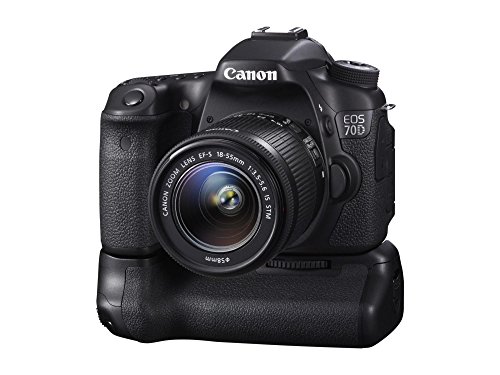
Canon EOS 70D review. Compare 108 technical specifications and user reviews to see how it ranks among cameras and if it is worth buying.
Overall score
What it is: An overall evaluation of the camera's quality, based on technical analyses and user reviews.
When it matters: When you need a quick reference to identify the best cameras on the market.
Score components:
90.0%
Technical Score
10.0%
User score
Technical Score
What it is: An assessment of the camera's technical performance, covering eight key areas: image quality, autofocus, video features, stabilization, lens compatibility, connectivity, battery, and design.
When it matters: When you want to compare cameras based on technical performance and available features.
Score components:
28.0%
Sensor & Image
25.0%
Photo Features
18.0%
Video & Audio
14.0%
Display & Design
8.0%
Battery & Power
7.0%
Connectivity & Storage
User score
What it is: A rating that combines user reviews and the total number of reviews received by the camera.
When it matters: When real-world owner satisfaction and review volume matter to your decision.
Score components:
70.0%
User reviews
30.0%
Popularity
Score components:
25.0%
Sensor size
20.0%
Main camera megapixels
20.0%
Dual card slots
15.0%
N. of focus points
10.0%
RAW photo capture
10.0%
Phase-detection autofocus (photos)
Score components:
35.0%
Weight
30.0%
Battery life (CIPA)
20.0%
Sensor-shift stabilization
15.0%
GPS
Score components:
30.0%
Price
20.0%
Weight
20.0%
AF tracking
20.0%
Battery life (CIPA)
10.0%
Touchscreen
Score components:
30.0%
Main camera megapixels
25.0%
Sensor size
20.0%
Main camera pixel size
15.0%
Sensor-shift stabilization
10.0%
RAW photo capture
Score components:
30.0%
Weight
25.0%
Thickness
20.0%
AF low-light sensitivity
15.0%
Sensor-shift stabilization
10.0%
Eye detection AF (human)
Score components:
30.0%
Sensor size
25.0%
Main camera pixel size
20.0%
Eye detection AF (human)
15.0%
Main camera megapixels
10.0%
Sensor-shift stabilization
Score components:
30.0%
Weight
25.0%
Battery life (CIPA)
20.0%
Min operating temperature
15.0%
Sensor-shift stabilization
10.0%
GPS
Available: ranking among products currently available (including other versions of this product).
All: ranking among all products in the database.
#8 in Best DSLRs for Beginners
#10 in Best Canon DSLR Cameras
#19 in Best Canon Vlogging Cameras
#26 in Best DSLR Cameras
#26 in Best SLR Cameras
#26 in Best Cameras under £200
#27 in Best Canon Digital Cameras
#27 in Best Canon EOS Cameras
#34 in Best Cameras for Beginners
#50 in Best Vlogging Cameras
#57 in Best Cameras under £300
#109 in Best Cameras
What it is: An assessment of the camera's technical performance, covering eight key areas: image quality, autofocus, video features, stabilization, lens compatibility, connectivity, battery, and design.
When it matters: When you want to compare cameras based on technical performance and available features.
Score components:
28.0%
Sensor & Image
25.0%
Photo Features
18.0%
Video & Audio
14.0%
Display & Design
8.0%
Battery & Power
7.0%
Connectivity & Storage
What it is: A rating that combines user reviews and the total number of reviews received by the camera.
When it matters: When real-world owner satisfaction and review volume matter to your decision.
Score components:
70.0%
User reviews
30.0%
Popularity
What it is: An indicator that combines the camera's overall rating with its cost.
When it matters: When you want to know how much overall quality you get for the price.
Score components:
60.0%
Overall score
40.0%
Price
Importance: HIGH
Good value: Full frame or larger
Importance: HIGH
Good value: At least 20 MP
Importance: HIGH
Good value: At least 3.5 µm
Importance: LOW
Importance: MEDIUM
Good value: At least ISO 25,600
Importance: MEDIUM
Importance: MEDIUM
Good value: At least 14-bit
Importance: LOW
Importance: LOW
Importance: LOW
Importance: LOW
Importance: LOW
Importance: LOW
Importance: LOW
Importance: LOW
Importance: MEDIUM
Importance: LOW
Importance: LOW
Importance: LOW
Importance: LOW
Importance: LOW
Importance: HIGH
Good value: At least 200 points
Importance: HIGH
Importance: MEDIUM
Importance: LOW
Importance: LOW
Importance: MEDIUM
Importance: MEDIUM
Importance: HIGH
Good value: At least 5 stops
Importance: LOW
Importance: MEDIUM
Good value: At least 10 fps
Importance: LOW
Importance: LOW
Importance: LOW
Importance: LOW
Importance: LOW
Importance: LOW
Importance: LOW
Importance: LOW
Importance: LOW
Importance: LOW
Importance: LOW
Importance: LOW
Importance: LOW
Importance: LOW
Importance: LOW
Importance: LOW
Good value: At least 200,000 actuations
Importance: LOW
Good value: At least 10x
Importance: HIGH
Good value: At least 3840 px
Importance: MEDIUM
Good value: At least 200 Mbps
Importance: MEDIUM
Good value: At least 10-bit
Importance: LOW
Importance: LOW
Importance: LOW
Importance: LOW
Importance: LOW
Importance: LOW
Importance: LOW
Good value: At least 30 min
Importance: LOW
Importance: LOW
Importance: LOW
Importance: LOW
Importance: LOW
Good value: At least 2 microphones
Importance: LOW
Importance: LOW
Importance: LOW
Importance: LOW
Importance: MEDIUM
Good value: 500 g or less
Importance: LOW
Importance: LOW
Importance: LOW
Importance: MEDIUM
Importance: MEDIUM
Good value: At least 2.36 million dots
Importance: LOW
Good value: 100%
Importance: LOW
Importance: LOW
Good value: At least 120 Hz
Importance: MEDIUM
Good value: At least 3 in
Importance: LOW
Importance: LOW
Importance: LOW
Importance: LOW
Importance: LOW
Importance: LOW
Importance: LOW
Good value: At least 10 m
Importance: LOW
Importance: LOW
Importance: LOW
Importance: LOW
Importance: MEDIUM
Good value: At least 400 shots
Importance: LOW
Good value: At least 1,500 mAh
Importance: LOW
Importance: LOW
Importance: LOW
Importance: LOW
Importance: LOW
Importance: LOW
Importance: LOW
Importance: LOW
Importance: LOW
Importance: LOW
Importance: LOW
Importance: LOW
Importance: LOW
Importance: LOW
Importance: LOW
Importance: LOW
Importance: LOW
Importance: LOW
Importance: HIGH
Importance: MEDIUM
Good value: At least 400 shots
Importance: LOW
Importance: LOW
Importance: LOW
Importance: LOW
Importance: LOW
Importance: LOW
Importance: MEDIUM
Importance: MEDIUM
Good value: 500 g or less
Importance: LOW
Good value: 100%
Importance: LOW
Importance: LOW
Importance: LOW
Importance: LOW
Importance: LOW
(Reviews last updated: July 2026)
The DPReview evaluation of the Canon EOS 70D highlights the enthusiast DSLR as a capable, well-rounded camera, featuring a 20.2-megapixel APS-C CMOS sensor with groundbreaking Dual Pixel AF that enables fast phase-detection autofocus in live view and movie mode. Key strengths include a highly responsive, fully articulated touchscreen, a robust 19-point viewfinder AF system, 7 fps continuous shooting, and built-in Wi-Fi. However, the review notes significant limitations, specifically that Dual Pixel AF is restricted to single-shot mode for stills, preventing active tracking, and the body lacks a dedicated headphone jack and clean HDMI output for advanced video. Other drawbacks include a single SD card slot and aggressive default JPEG sharpening.
The Canon EOS 70D is a highly versatile, mid-range DSLR that introduces a groundbreaking 20.2 Megapixel APS-C sensor featuring Dual Pixel CMOS AF technology. This innovative autofocus system turns 80% of the sensor's pixels into phase-detect sensors, delivering exceptionally fast, smooth, and confident continuous tracking while shooting movies or using Live View, matching the performance of top mirrorless cameras. Geared heavily toward multimedia enthusiasts, the camera inherits a robust 19-point all cross-type viewfinder AF system from the semi-pro EOS 7D, features an articulated 3-inch touchscreen, and boasts built-in Wi-Fi along with a fast 7fps continuous shooting speed. Pros and Cons Pros: Dual Pixel AF: Flawless, hunt-free movie and Live View autofocus. Articulated Touchscreen: Full articulation and highly responsive touch controls. Performance: Fast 7fps burst shooting and advanced 19-point AF system. Built-in Wi-Fi: Free remote control and social media sharing options. Video Features: Lossless 3x digital video crop and ALL-i compression options. Cons: Single Card Slot: Lacks the dual memory slots found on rivals like the Nikon D7100. No Headphone Jack: Cannot monitor audio while recording video. Slow Shot-to-Shot: Frustrating two-second...
The Canon EOS 70D is described by The-Digital-Picture.com as a versatile intermediate APS-C DSLR, highlighted by its 20.2-megapixel sensor, DIGIC 5+ processor, and a revolutionary Dual Pixel CMOS AF system that enables fast, smooth autofocus in Live View and video. Key performance pros include a 7 fps burst rate, a 19-point all cross-type AF system, built-in Wi-Fi, and an articulating touchscreen. Conversely, the review notes a plastic (polycarbonate) body construction rather than alloy, a single SD card slot without backup capabilities, and a lack of a headphone jack. Additionally, the review states that Wi-Fi operation disables video recording and that silent shooting modes are not fully silent.
The Canon EOS 70D is a fast and responsive mid-range DSLR that stands out primarily for its innovative Dual Pixel CMOS AF system. This technology splits the sensor's photodiodes to enable remarkably quick, smooth, and accurate phase-detection autofocus directly from the image sensor. It makes the camera exceptionally fluid when shooting in Live View mode or recording video, resolving the focus-hunting issues common to older models. The camera powers on and fires a shot in just 0.4 seconds, boasts a zippy 7.1 frames-per-second continuous shooting speed, and features a highly functional, articulated touchscreen interface that is easy to navigate even in direct sunlight. However, the camera leaves room for improvement regarding overall image quality and minor design choices. Its 20.2-megapixel sensor delivers images that are decent but ultimately fail to match the sharpness and detail of competitors like the Nikon D7100, showing soft details and limited dynamic range that makes recovering highlights or shadows difficult without adding noise. Video quality displays similar softness and is prone to low-light color noise and edge artifacts. For hardware and usability cons, the 70D...
The What Digital Camera review of the Canon EOS 70D awards it a 91% score, highlighting the 20.2-megapixel Dual Pixel CMOS AF sensor as a major pro for fast, fluid autofocus in live view and movie modes. Additional strengths include a robust 19-point all cross-type AF system, built-in Wi-Fi, excellent low-light performance up to ISO 6400, and a high-quality capacitive touchscreen. Conversely, the review identifies limitations, specifically noting that creative filters are restricted to live view and JPEG-only, and the auto white balance can produce overly neutral results. Despite these minor software and white balance issues, the camera is highly commended for its feature set, earning a 95% rating for its overall capabilities, making it a strong choice for enthusiasts.
summary of the Canon EOS 70D review: The Canon EOS 70D is an APS-C DSLR camera featuring a 20.2-megapixel sensor, a 14-bit DIGIC 5+ processor, and a 1.04-million-dot vari-angle LCD touch screen. It stands out as the first DSLR to utilize Dual Pixel CMOS AF technology, which greatly accelerates and refines autofocus performance during video recording and Live View mode. For still photography, the camera delivers fast 7 frames-per-second continuous shooting backed by a 19-point all-cross-type AF system, integrated Wi-Fi connectivity, and full HD video capability. The overall handling is highly user-friendly and approachable due to its substantial right-hand grip and multiple access points for camera controls. The primary pros highlighted in the review include exceptional image quality characterized by super-sharp details and highly accurate coloration, alongside a lightweight, portable physical build compared to full-frame alternatives. The autofocus system is praised for being remarkably fast and precise, and the built-in image stabilizer performs exceptionally well during video shooting. On the downside, the camera suffers from noticeable image noise starting at ISO 6400, which increases significantly and becomes "dodgy" at its...
The Canon EOS 70D is a well-rounded DSLR tailored for enthusiast photographers, notable for introducing an innovative 20.2-megapixel Dual Pixel CMOS sensor paired with a Digic 5 processor. This unique sensor design features two photodiodes per pixel site to facilitate fast phase-detection autofocusing across the central 80% of the frame during Live View and video modes. Designed for excellent handling and user comfort, the camera balances physical button controls with modern features, including an incredibly responsive, fully articulating 3.0-inch touchscreen and built-in Wi-Fi connectivity that allows for convenient remote camera operation via mobile devices. The review highlights several prominent advantages, such as exceptional overall image quality, deep control over image settings, a 19-point all cross-type autofocus system, and a 7fps burst shooting rate suitable for capturing action. On the downside, the 70D suffers from notable limitations in its creative tools, restricting both its built-in Creative Filters and HDR modes strictly to JPEG-only shooting, while also limiting those Creative Filters exclusively to Live View mode. Additionally, reviewers encountered metering inconsistencies in high-contrast environments and noted that the integrated viewfinder level can...
The Canon EOS 70D is a prosumer APS-C DSLR that provides a massive leap in functionality and handling over its predecessor, the 60D. The camera’s standout innovation is its Dual Pixel CMOS AF system, which utilizes two photodiodes per pixel to convert 80% of the frame into phase-detection autofocus sensors. This hardware upgrade delivers incredibly smooth, fast, and accurate autofocus during video and live-view mode, performing closely to a traditional camcorder. Video functionality is further bolstered by inherited ALL-I and IPB compression methods, a stereo microphone, and an excellent 3.0-inch vari-angle touchscreen that makes navigating menus and shifting focus points seamless. Additional pros include a boosted continuous frame rate of 7 frames per second, a built-in viewfinder electronic level, and the return of AF microadjustment. Photographers will also benefit from an inherited 7D feature called AF Point Switching, which automatically adjusts active autofocus points depending on the camera's horizontal or vertical orientation. Despite its impressive features, the 70D falls short in a few performance areas. The primary con is its image quality, which only offers a very mild improvement over...
The Canon EOS 70D, praised for its 20.2-megapixel sensor and innovative Dual Pixel CMOS AF, serves as a high-performance, mid-range tool for photo enthusiasts and videographers. Key advantages include fast, accurate Live View autofocus and a versatile articulated touch-screen, offering a significant upgrade for existing users. Photo Review However, testing revealed that the accompanying 18-135mm kit lens limits the camera's resolution potential, resulting in underwhelming Imatest results. While the body performs well, the review advises pairing it with higher-quality lenses to fully utilize its sensor capabilities.
The Digitalkamera.de review highlights the Canon EOS 70D as a successful, versatile DSLR featuring excellent ergonomics with a secure grip, robust build quality, and a 20.2-megapixel sensor. A key strength is the Dual Pixel CMOS AF technology for superior Live View/video autofocus, particularly when paired with the EF-S 18-55mm IS STM lens. Conversely, the camera is relatively heavy and features a cluttered button layout, while the Dual Pixel AF, despite improvements, does not match the speed of top mirrorless systems. The review also notes that reduced pixel pitch slightly impacts sensitivity.
The Canon EOS 70D is a solid middle-class DSLR camera designed with a durable, professional-grade body that offers ample space for tactile buttons, command dials, and an optical pentaprism viewfinder. It features a 20.2-megapixel APS-C CMOS sensor, a Digic 5+ image processor, a 3-inch swivelling touchscreen, and integrated Wi-Fi connectivity. The camera excels in performance speed, booting up in just 0.2 seconds and capturing continuous action shots at up to 6.5 frames per second. A major highlight of this model is its groundbreaking Dual Pixel CMOS AF technology, which delivers exceptionally fast, quiet, and precise automatic focusing during Full-HD video recording and Live View photography, placing its video capabilities on par with top-tier mirrorless system cameras. The review highlights several prominent pros, including its long-lasting battery capable of taking nearly 2,500 shots, built-in Wi-Fi functionality, high-quality Full-HD video, and rapid overall autofocus performance. However, a notable con is that optimal image sharpness through the optical viewfinder is highly dependent on the correct calibration between the camera body and the attached lens. During lab testing with a specific zoom lens, autofocus...
The Canon EOS 70D, reviewed by dkamera.de, is deemed a highly capable intermediate DSLR, defined by its 20.2-megapixel sensor and innovative Dual Pixel CMOS AF, which allows for exceptionally fast and smooth autofocus during Live View and video recording. Key advantages include a sturdy build, a vari-angle touchscreen, built-in Wi-Fi, and a rapid 7 frames-per-second burst rate. Despite these strengths, the review notes that still image quality offers only marginal improvements over older 18-megapixel models, and the 98% viewfinder coverage is not a full 100%. Specific limitations for advanced users include the lack of a headphone jack, limitations on video recording while using Wi-Fi, and a somewhat heavy body. YouTube
However, the review outlines notable "cons" and limitations, calling the camera a "revolution with limitations". Users and reviewers criticize the camera for failing to progress in pure image quality compared to older models like the 550D, particularly due to heavy aliasing and severe Moiré effects on fine, repeating patterns like leafless autumn branches or red tiled roofs,,. The official response from Canon support confirmed that Moiré is a physical sensor issue that cannot be serviced or fixed by the manufacturer. Furthermore, testers expressed a desire for advanced video controls—such as adjustable autofocus transition speeds and Bezier curves for smoother starting and stopping of the focus mechanism—and noted that the 1.17-second Live View autofocus speed for stills remains significantly slower than equivalent mirrorless competition from Panasonic, Olympus, and Sony,.
The Canon EOS 70D introduces notable hardware updates designed for mid-range DSLR users, bridging the gap for both photographers and videographers. A key physical update includes a dedicated live-view toggle switch on the back to shift seamlessly between photo and video modes, alongside a streamlined mode dial that consolidates individual scene modes into a single setting. While the camera inherits the 3-inch, 1-million-pixel articulating display from the EOS 60D, it upgrades the panel to a fully functional touchscreen. This allows users to easily control essential manual exposure settings like shutter speed and aperture with their fingertips via the quick menu. Additionally, the body is four millimeters narrower than its predecessor, yet retains traditional layout staples such as an optical viewfinder, a hot shoe, a pop-up flash, and a top control status display. The most significant upgrade is a newly developed 20-megapixel APS-C CMOS sensor equipped with Dual Pixel CMOS AF technology. This autofocus technology resolves the sluggish "focus hunting" typical of previous EOS models during live-view operation. In practical testing, this system delivers significantly faster focus times compared to models...
Canon EOS 70D Review Summary The Canon EOS 70D is a versatile mid-range DSLR tailored for both advanced photographers and videographers, driven by a 20-megapixel APS-C image sensor. A major highlight is its debut "Dual Pixel" autofocus technology, which delivers the fastest live-view autofocus of any Canon DSLR at the time, offering smooth and precise continuous tracking for video without focal "hunting" in daylight. Performance-wise, the camera boasts a swift burst shooting speed of nearly 7 frames per second for JPEGs and sets an impressive battery record capable of capturing up to 4,760 images per charge. Additional user-friendly pros include weather-sealed seams, integrated Wi-Fi for wireless data transfer and smartphone remote control, and a sharp, 3-inch articulating touchscreen that simplifies shooting from creative angles. Despite these strong features, the camera has several distinct cons that limit its professional appeal. The body relies heavily on plastic rather than a premium magnesium alloy, which compromises its aesthetic appeal despite the weather sealing. For audio monitoring, video creators will miss a dedicated headphone jack, even though a microphone input is provided. Storage flexibility...
The Canon EOS 70D is a highly responsive expert DSLR camera distinguished by its revolutionary Dual Pixel CMOS AF technology, which significantly enhances autofocus speed and fluid tracking during video recording and LiveView use. The camera features excellent construction, an intuitive interface that makes it easy to handle, an impressive battery life capable of capturing 1,000 photos and 15 minutes of video on a single charge, and integrated Wi-Fi for remote control and image sharing. It delivers outstanding video quality with advanced compression options (IPB and ALL-I), exceptional handling of chromatic noise in high sensitivities, and incorporates a highly responsive, articulating touchscreen display. However, the camera has notable limitations, including the absence of a dual SD card slot, weather sealing that falls short of its direct competitors, and a heavy video data stream that demands at least a Class 10 SD card. Ergonomically, the camera suffers from minor flaws, such as an inconveniently placed ON/OFF switch on the left shoulder and a rear control dial positioned too low for easy access without removing one's eye from the viewfinder. Additionally, image...
The provided review video by Les Numériques evaluates the Canon EOS 70D camera's performance when capturing Full HD video at a frame rate of 25 frames per second. The main pro highlighted in the footage is the highly efficient and smooth continuous tracking autofocus system. Placing the active autofocus point directly in the middle of the frame allows the camera to seamlessly maintain sharp focus on moving targets, which is actively demonstrated as the reviewer glides the camera smoothly down a set of miniature model railroad tracks. Additionally, the camera reacts quickly and locks focus accurately when transitioning between distinct foreground and background subjects, such as jumping the focus point between a toy rabbit and a box. However, the field test also reveals a notable con regarding the physical limitations of the lens system during close-up shooting. The continuous autofocus tracking mechanism fails completely and is unable to lock onto the intended target if the camera is positioned physically too close to the subject, due to exceeding the lens's minimum focusing distance. In terms of audio and ergonomics, the reviewer...
The Labofnac review of the Canon EOS 70D (18-135 mm) awards the DSLR camera a 4 out of 5-star rating, highlighting its robust, composite build made of polycarbonate, fiberglass, and aluminium. The reviewer praises the camera body's core specifications, which include a highly responsive 20.9-megapixel APS-C CMOS sensor with satisfying low-light sensitivity, an optical pentaprism viewfinder providing 98% coverage, and a dual-axis 7.6 cm articulating touchscreen. Performance stands out as a major strength, specifically due to the highly customizable 19 cross-type point autofocus system and its rapid continuous burst shooting speed that reaches up to 7 frames per second. However, the review points out clear limitations regarding the bundled EF-S 18-135 mm f/3.5-5.6 STM lens, noting that it underperforms by introducing distortion at wide angles alongside vignetting and chromatic aberrations in telephoto mode. Due to these optics lagging behind the camera's true potential, the author recommends switching to a prime (fixed focal length) lens to achieve optimal image quality. In short, the pros of this setup are its highly reactive body, excellent autofocus system, and strong low-light sensitivity, while the...
The Canon EOS 70D, evaluated in a kit with the EF-S 18-55 mm IS STM motorized zoom lens (29-88 mm 35mm equivalent), is a high-end DSLR camera designed for advanced amateurs. Launched in August 2013 to replace the EOS 60D, it serves as a direct competitor to the Nikon D7100. The device features a 20-megapixel sensor equipped with an autofocus system engineered to deliver faster focusing speeds during Live View framing on its high-quality, 77 mm articulating touchscreen. It also provides built-in Wi-Fi and is highly regarded for being fast and responsive, producing excellent photo quality across various shooting conditions. The reviewer highlights several notable features, including high-quality video performance with a 1920 × 1080 resolution utilizing H.264 encoding. In terms of hardware capabilities, the camera includes functional expansion options such as a hot shoe for an external flash and a dedicated jack for an external microphone. Despite these advantages, the evaluation notes that this specific model is no longer sold on the market. Additionally, the tester identifies its primary drawback as being relatively heavy and bulky to handle.
The Canon EOS 70D receives an overall iCamRank score of 62/100, highlighting its strong performance in daily, street, and sports photography, particularly due to its weather-sealed body, advanced autofocus, and articulated touchscreen. It is recognized for high user comfort and rapid operation, making it a capable tool for enthusiasts. However, the Camerarace review notes limitations in image quality, which scores a below-average 48/100, making it less suitable for high-detail landscape work. While relatively light at 755 grams, its performance capabilities are surpassed by newer, high-resolution models in the DSLR market.
The Canon EOS 70D serves as a versatile mid-range DSLR, introducing a 20.2-megapixel APS-C CMOS sensor, a Digic V processor, and a burst shooting speed of 7 fps. Its standout innovation is the Dual Pixel CMOS AF technology, which splits sensor photodiodes to vastly improve autofocus speed and accuracy during video recording and Live View mode. Ergonomically, the camera feels solid and comfortable, borrowing minor design adjustments from the 6D and integrating a highly responsive 3-inch articulated touchscreen that makes focus point selection effortless. Additionally, it features effective built-in Wi-Fi connectivity that pairs efficiently with mobile devices for remote shooting and image transfers. On the positive side (pros), the camera boasts a highly effective, fast, and precise 19-point all-cross-type autofocus system through the viewfinder, alongside smooth focus transitions in video thanks to the Dual Pixel technology. The dynamic range shows notable improvement over its predecessor (the 60D), especially when processing RAW files. On the negative side (cons), noise control becomes highly problematic at higher ISO levels, with noise being very evident starting at 6,400 ISO and rendering 12,800 ISO largely...
The Canon EOS 70D stands out primarily for its technological advancements over its predecessor, specifically the introduction of the Dual Pixel CMOS AF system and built-in Wi-Fi connectivity. In terms of performance pros, the review highlights a significantly improved sensor, faster burst shooting capabilities, an articulated touchscreen, and a major leap forward in Live View autofocus performance and video mode capabilities thanks to the Dual Pixel tech. However, the camera shows minimal progression in other core photography elements. The main cons identified in the review note that there is no substantial difference in overall image quality or noise control when compared directly to the previous generation. Ultimately, while it may not offer a massive leap for traditional still photographers, the review concludes that its improved video focusing system serves as the definitive selling point for content creators.
The Canon 70D is a capable mid-range DSLR reviewed by photographer Anais India. Standout features include its Dual Pixel CMOS AF technology for seamless live-view focusing, a 3-inch vari-angle touchscreen for intuitive tap-to-focus operation, and a 7 fps burst mode for action photography. Backed by a 20.2-megapixel sensor and a DIGIC V processor (ISO 100–12,800), this camera delivers highly detailed 14-bit image output with smooth tonal gradations. It also features integrated Wi-Fi with smartphone remote control and solid battery performance capable of shooting up to 900 photos per charge. However, the review outlines a few operational drawbacks to keep in mind. The wireless remote control lag can be slow at times, and you cannot use Wi-Fi simultaneously with video mode. Additionally, reaching the maximum native ISO of 12,800 introduces heavy image noise, rendering that extreme low-light setting somewhat impractical for clean professional shots. Despite these minor limits, it remains a highly efficient, user-friendly tool for video recording and multi-angle photography.
The Canon EOS 70D is a mid-range APS-C DSLR camera featuring a 20.2-megapixel sensor and a powerful Digic 5+ image processor, which helps deliver high image contrast, rich detail, and excellent color fidelity. A standout innovation highlighted in the review is the Dual Pixel CMOS AF technology, which significantly enhances autofocus speed and precision during live view and video recording, bridging the gap between traditional DSLRs and mirrorless systems. The camera excels in overall ergonomics, offering a secure grip, an intuitive button layout, and a highly functional 3-inch articulated touchscreen that allows users to seamlessly select focus points or trigger shots. Photographically, it provides reliable metering and excellent automatic white balance performance, alongside a highly capable low-light performance that maintains pristine image quality up to ISO 4,000. Despite its robust feature set, the review notes several clear drawbacks, most notably its heavily plastic exterior construction materials that diminish the premium feel expected at its price point. Additionally, the camera suffers from a noisy shutter mechanism, a limited and clunky creative filter system that can only be applied after photos are...
The Canon 70D is a prosumer DSLR camera that offers significant body and feature upgrades but keeps image quality similar to older models like the 7D and 60D. Its best features include a fully articulating 3.2-inch touchscreen LCD, built-in Wi-Fi, and the reintroduction of AF micro-adjustment. It also uses cheaper SDXC cards instead of CF cards. The biggest highlight is the new 20-megapixel sensor with Dual CMOS Phase Detection autofocus. This tool delivers exceptionally fast and accurate focusing during video recording and single-shot live view modes. However, the camera has some clear drawbacks depending on how you shoot. The innovative Dual CMOS autofocus only works in live view and video modes, meaning you cannot use it while looking through the traditional viewfinder. Even worse, this autofocus tracking fails during burst shooting mode, as the screen goes black and the camera cannot refocus after the first shot. Additionally, the continuous shooting speed of 7 frames per second is slightly slower than the older 7D. Finally, image quality, dynamic range, and high ISO noise performance show almost no improvement over its four-year-old...
The Canon EOS 70D is a versatile mid-range DSLR camera that bridges the gap between consumer and prosumer users by delivering high-quality photos and videos. Its standout feature is the 20-megapixel Dual Pixel CMOS sensor, which transforms every photodiode into a phase-detection sensor to enable fast, smooth, and precise continuous autofocus during video recording and live view. Users can effortlessly switch focus planes just by tapping the 3-inch articulated touchscreen monitor. Performance is further enhanced by an upgraded DIGIC 5+ processor, a fast 7 frames-per-second burst mode, and a reliable 19-point autofocus system inherited from the higher-end 7D. Built-in Wi-Fi allows for easy photo transmission and convenient remote shooting via smartphones or computers. The review highlights several pros and cons regarding the camera's design and features: Pros Excellent Video Autofocus: The Dual Pixel technology and STM lenses create smooth, cinematic focus transitions without hunting. High Image Quality: The camera boasts low noise at high ISO levels up to 1600, sharp detail, and great dynamic range. Improved Ergonomics: It features a dedicated autofocus mode button near the shutter and stereo microphones...
The Canon 70D, as reviewed on Binomania, is characterized as a versatile mid-range APS-C DSLR featuring a revolutionary Dual Pixel CMOS autofocus system that delivers smooth, fast tracking for live view and video. Key pros highlighted include excellent ergonomics with a fully articulated touchscreen and superior high ISO performance, offering usable, low-noise images up to ISO 2000. Conversely, the review notes specific cons, such as the polycarbonate construction which feels less robust than higher-end, all-metal magnesium alloy bodies. Furthermore, the rear control interface is criticized for replacing an independent joystick with a, at times, frustrating, integrated directional pad.
The Canon EOS 70D lab test report from the FotografiaStore.it product page provides an overview of a specialized digital magazine review by the Centro Studi Progresso Fotografico. Originally launched in 2013, this enthusiast-level DSLR features an APS-C crop sensor with a 20-megapixel resolution. The lab test explicitly covers standard digital performance metrics, focusing on key operational categories such as speed, battery autonomy, autofocus performance, exposure latitude, and sensor noise levels. A comprehensive evaluation of the camera highlights several distinct pros and cons for prospective users. On the positive side, its defining strength is the Dual Pixel CMOS autofocus system, which completely transforms live view tracking and delivers exceptionally smooth, camcorder-like focus transitions for video recording. It also features a fully articulating 3-inch touchscreen LCD, built-in Wi-Fi for remote camera control, and a capable 19-point all-cross-type autofocus system that captures 7 frames per second. However, the camera suffers from distinct limitations, notably its lack of a headphone jack for audio monitoring and the inclusion of only a single SD card slot, which lags behind dual-slot competitors. Additionally, the video capabilities are...
The Canon EOS 70D features a 20.2-megapixel APS-C sensor with groundbreaking Dual Pixel CMOS AF for fast live-view and video autofocus, plus a 7 fps burst rate and a fully articulating 3-inch touchscreen. Other pros include a 19-point all cross-type AF system, built-in Wi-Fi, and microadjustment capabilities. Cons include the inability to record video while Wi-Fi is active, 1080p video capped at 30fps, and a lack of focus tracking during continuous live-view shooting. Additional drawbacks are the single SD card slot and limited physical controls compared to competitors.
The Canon EOS 70D serves as a compelling mid-range DSLR that effectively bridges the gap between entry-level and professional systems, targeting both brand loyalists and budget-conscious enthusiasts. A major standout feature of this model is its innovative Dual Pixel CMOS AF technology, which uses two photodiodes per pixel to deliver exceptionally fast, precise, and stable autofocus tracking during video capture and Live View. Additional prominent pros highlighted in the review include an upgraded 20.2-megapixel APS-C CMOS sensor, a rapid continuous burst rate of 7 frames per second (up to 65 JPEGs or 16 RAW images), modest noise handling up to ISO 6400, and a highly intuitive, articulating 3-inch touchscreen display that simplifies manual settings. The camera also gains praise for its significantly improved, comfortable handgrip and integrated Wi-Fi connectivity, allowing users to remotely control exposure and focus via the EOS Remote application. Conversely, the review reveals a few notable limitations and cons regarding the camera's design and functionality. Despite the addition of integrated Wi-Fi for modern web and mobile sharing, the reviewer notes that the overall wireless implementation feels safe...
The Saggiamente review highlights the Canon EOS 70D as a versatile prosumer DSLR, heavily praising the revolutionary Dual Pixel CMOS AF system for exceptional autofocus speed during live view and video, alongside a 7 fps burst rate, Wi-Fi connectivity, and a fully articulating touchscreen. It is identified as an excellent hybrid camera suitable for enthusiasts and professional videographers, offering a comfortable, ergonomic build and intuitive controls. Conversely, the review identifies limitations, specifically noting that the Dual Pixel AF operates only in single-shot mode during high-speed burst photography, failing to track subjects continuously. Additionally, the sensor shows weaker high-ISO performance and dynamic range compared to competitors, with some design choices criticized, such as the lack of a second SD card slot and reduced battery life during heavy live-view usage. YouTube
The Canon EOS 70D is an innovative and highly versatile mid-range DSLR camera that acts as a strong all-round upgrade from its predecessor, the EOS 60D. Retaining a comfortable, time-tested physical design, it sits perfectly between smaller entry-level bodies and heavier professional models. Its standout features include an impressive 19-point autofocus system adapted from the EOS 7D, continuous phase-detection autofocus in Live View driven by new Dual Pixel technology, integrated Wi-Fi for wireless device control, and a responsive touchscreen combined with a fully articulating LCD screen. Performance is consistently fast thanks to the DIGIC 5+ processor, enabling accurate metering and a high-speed continuous shooting drive of 7 frames per second that excels at tracking fast-moving subjects like wildlife or sports.
The review details a practical test of the Canon EOS 70D during an event at the Artis Zoo in Amsterdam, where the camera's performance was evaluated under various shooting conditions. The photographer tested the camera's capabilities in two distinct environments: capturing zoo animals using a Canon EF 70-300mm f/4.0-5.6 L IS USM lens, and shooting body-painted models in a dimly lit, historic attic using a Canon EF 85mm f/1.2 L lens,. Additionally, the user tested the camera's handheld video capabilities and built-in Wi-Fi functionality,. Pros and Cons The evaluation highlighted several notable advantages and drawbacks of the camera system: Pro: Ergonomic design that feels comfortable in the hand. Pro: Responsive touchscreen that enables fast focusing via the Dual Pixel sensor during video recording,. Pro: Built-in Wi-Fi allowing remote control and seamless image transfers to smart devices. Pro: Dependable high ISO performance that delivers sharp images even under low-light conditions,. Con: Absence of a physical white balance button on the camera body. Con: Difficulties with stable handheld video recording due to the heavy weight of the body and lenses. Overall, the...
The Shoot.be review evaluates the Canon EOS 70D as a highly capable, mid-range prosumer DSLR that marks a significant evolution over its predecessor, the 60D. The review heavily praises its innovative 20.2-megapixel APS-C sensor, which introduces groundbreaking Dual Pixel CMOS autofocus technology. This system is a major highlight, delivering incredibly smooth, fast, and quiet autofocus during Live View and Full HD video recording, behaving much like a dedicated video camera. Additional structural and performance pros include its fast 7 frames-per-second (fps) continuous shooting speed, a responsive and smudge-resistant articulating touchscreen LCD, robust weather-sealed ergonomics, and built-in Wi-Fi connectivity for easy file sharing and remote operation. Despite these major advancements, the review highlights several specific limitations. A notable con is that the revolutionary Dual Pixel AF operates strictly in single-shot mode during continuous still photography, causing the screen to black out and failing to track focus between continuous frames. The review also points out that the Live View autofocus can struggle to lock onto subjects under dim, low-light conditions. Furthermore, physical design limitations are criticized, such as the inclusion of only...
The GadgetGear.nl review awards the Canon EOS 70D a 4.5/5 rating, highlighting it as a significant upgrade featuring a Dual-pixel CMOS sensor, robust autofocus, and an excellent touchscreen. Key benefits include fast, reliable focusing and versatile Wi-Fi functionality, positioning it as a top-tier enthusiast camera. Conversely, the review notes that the Wi-Fi setup process is challenging and the Live View feature struggles during continuous shooting, limiting its, performance for high-speed bursts. Despite these drawbacks, the 70D is recommended for its overall performance and borrowed high-end features.
summary of the Canon 70D: The Canon 70D is a versatile mid-range DSLR tailored for advanced amateur photographers, positioned between the entry-level 700D and the semi-pro 7D. Introduced as the successor to the popular 60D, it features a 20-megapixel sensor and acts as an excellent all-round camera that delivers high image quality, excellent handling, and an intuitive user interface with an adjustable touchscreen. Its standout innovation is the Dual Pixel CMOS AF system, which brings exceptionally fast phase-detection autofocus to Live View and video recording, making it significantly quicker at finding and tracking moving subjects (such as faces) compared to older Canon models. Additionally, it includes modern wireless features like built-in Wi-Fi for remote image capture and an in-camera HDR mode. However, the camera does have several distinct drawbacks, particularly regarding its advanced video and menu configurations. Despite the advanced autofocus, the review notes minor video limitations for serious filmmakers, such as the complete omission of focus peaking, a dedicated audio output (headphone jack), a clean HDMI output, and the ability to shoot 1080p at 50 or 60 fps. From...
The Tweakers user reviews frame the Canon EOS 70D as an exceptionally versatile and highly capable mid-range DSLR camera geared toward advanced hobbyists, enthusiasts, and entry-level professionals. A standout strength highlighted by multiple reviewers is the robust build quality and comfortable, ergonomic grip that makes the camera feel secure in the hand. Users praise its swift performance, specifically referencing its fast autofocus system and the impressive continuous drive speed of 7 frames per second. The innovative Dual-Pixel autofocus system, combined with a highly responsive, articulating touchscreen display, receives widespread acclaim for making focus tracking during video recording remarkably fluid and intuitive. Additionally, features like the top-facing LCD settings panel, an expansive custom profile menu, and rich background bokeh contribute heavily to its high user rating. Despite the overwhelming praise, reviewers point out several prominent drawbacks to consider. A frequent complaint centers on the built-in Wi-Fi functionality and its accompanying smartphone application, which users label as slow, unreliable in crowded spaces, and a massive drain on battery life. While the physical build is considered sturdy, some note that the weather sealing...
The Canon EOS 70D is a versatile DSLR camera that provides an intuitive user experience, particularly for those upgrading from entry-level models like the 650D. The reviewer noted that its touchscreen completely streamlines settings adjustments compared to cumbersome manual dials found on rival models. Paired with the EF-S 18-135mm f/3.5-5.6 IS STM kit lens, the camera proves highly capable for urban and architectural photography, yielding strong image contrast, excellent exposure latitude, and a wide dynamic range where highlights and shadows stay well-detailed without needing HDR tricks. Additionally, its battery life stands out as highly efficient, showing no drop on the battery indicator even after capturing 150 photos. However, the review highlights several drawbacks and omissions depending on user preferences. Its standout innovation—the 20.2-megapixel Dual Pixel sensor—enables significantly faster and more precise autofocusing in Live View and video modes, yet this feature provides almost no added value if you strictly shoot stills through the optical viewfinder. Furthermore, while the reviewer praised the sensor's handling of contrast, a commenter pointed out that the camera's actual raw dynamic range is limited to 11.6...
Compare