Scored using Cameras Methodology v3.0
Cameras Methodology v3.0
Mathematical & Unbiased Scoring
Products in this category are scored under Frontum Cameras Methodology v3.0: the technical score from the specifications is the base, and independent expert and video reviews (up to ±0.5 points), owner opinions (up to ±0.3) and best-of lists (up to +0.3) move it up or down.
Explore Cameras Methodology v3.0

Canon EOS 60Da review: 112 specs compared

Avg. price:~£260Sensor size:APS-CWeight:755 gBattery life (CIPA):1100 shots

Canon EOS 60Da Review: Compare 112 technical specifications and 5 expert and video reviews to see how this product ranks in the Cameras category and whether it is worth buying.
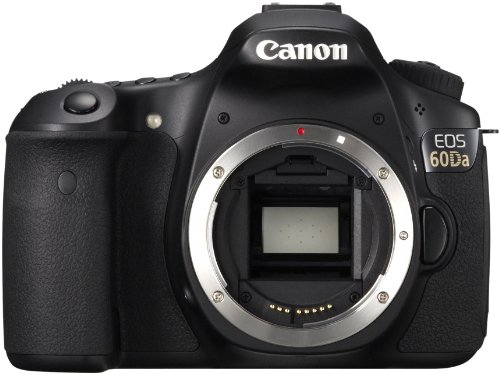
Canon EOS 60Da
6.2/10

Overall score

Score
6.2/ 10
✕
What it is
Our main score for this model, 1–10. It combines specs, best-of lists, expert reviews and owners.
How we count it
Parts: Technical score 35%, List score 30%, Reviews score 25%, Sentiment score 10%
Marks: Each part gets a mark out of 10. For reviews, lists and owners, a typical model in this category gets about 8 and the best one gets 10.
No data yet: A part with no data shows "?". It counts as the mark of a weaker model in this category (4 in 5 models with data score higher). This way, models with reviews, lists and owners usually come out ahead.
Score distribution
â–¼
<55-66-77-88-99-10
Score components

35%

5.3

Technical score

30%

?

List scoreNot enough data yet, so we use 7.5, the mark of a weaker model in this category

25%

5.3

Reviews score

10%

?

Sentiment scoreNot enough data yet, so we use 7.1, the mark of a weaker model in this category

â–¼Worse than 56% of cameras
7.1

Value for money

Value for money
7.1/ 10
✕
What it is
An indicator that combines the camera's overall rating with its cost.
When it matters
When you want to know how much overall quality you get for the price.
Score distribution
â–¼
<55-66-77-88-99-10
Score components

70%

6.2

Overall score

30%

9.2

Price

â–²Better than 59%
5.3

Technical score

Technical score
5.3/ 10
✕
What it is
How good the specs are compared with the other models in this category, 1–10.
How we count it
Areas: We rate the specs in each area against the other models in this category.
Weighting: The areas that matter most to buyers count more. The shares are shown under Score components.
Share: The technical score is 35% of the overall score.
Score distribution
â–¼
<55-66-77-88-99-10
Score components

28%

5.6

Sensor & Image

25%

4.8

Photo Features

18%

4.6

Video & Audio

14%

5.9

Display & Design

8%

8.8

Battery & Power

7%

2.7

Connectivity & Storage

â–²Better than 61%
5.3

Reviews score

Reviews score
5.3/ 10
✕
What it is
Average grade from independent test sites, magazines and video reviewers, 1–10.
How we count it
Grades: Each review's own score is converted to 1–10; without one, we grade the review ourselves. Big test sites count more, short reviews half as much as full tests. A video review counts half.
Score: The average grade is 80% of the review mark; the number of reviews is the other 20% (1 review = 5, the typical number in this category = 8, the most-reviewed model = 10).
Enough data: With few reviews, the average grade is pulled toward the typical grade of this category. No reviews yet: 7.5 for now.
Share: Reviews count 25% of the overall score.
Score distribution
â–¼
<55-66-77-88-99-10

5.3

Mark 7.7 is below the typical mark 7.9 of this category, so it cannot lift the score above the technical score

80%

8.0

Average grade

20%

6.7

Popularity

Grades by review (5)
4 reviews: 0 with a printed score, 4 estimated from the review. 1 video review, counting half as much as a written test. Reviews count 25% of the overall score.
User ratings collected online are not part of this score.
â–¼Worse than 59%
?

List score

List score
7.5/ 10
✕
What it is
How often independent test sites, magazines and video reviewers put this model in their best-of lists for this category.
How we count it
Points: The model in the most lists of this category gets 10; the others get 8 to 10 in proportion. In no list yet: 7.5. Lists count 30% of the overall score.
Enough data: Every list counts, even a single one. With fewer than 5 best-of lists in the category, this part is left out.
Lists with this model (0)
Not in any best-of list yet, so this part counts as 7.5. Models in a list get 8 to 10.
Not in any best-of list yet

What reviewers say about the Canon EOS 60Da

Based on 4 · 1

Reviewers praise the low image noise and are split on red sensitivity, but most find daytime colours disappointing.
Praised
Mixed views
Criticised
Pick a topic to see who said what
Loading...
Loading category ranking...

Technical Specifications of camera Canon EOS 60Da

Technical score
Technical score
5.3/ 10
✕
What it is
How good the specs are compared with the other models in this category, 1–10.
How we count it
Areas: We rate the specs in each area against the other models in this category.
Weighting: The areas that matter most to buyers count more. The shares are shown under Score components.
Share: The technical score is 35% of the overall score.
Score distribution
â–¼
<55-66-77-88-99-10
Score components:

28%

5.6

Sensor & Image

25%

4.8

Photo Features

18%

4.6

Video & Audio

14%

5.9

Display & Design

8%

8.8

Battery & Power

7%

2.7

Connectivity & Storage

5.3
Reviews score
5.3
List score
?
Value for money
Value for money
7.1/ 10
✕
What it is
An indicator that combines the camera's overall rating with its cost.
When it matters
When you want to know how much overall quality you get for the price.
Score distribution
â–¼
<55-66-77-88-99-10
Score components:

70%

6.2

Overall score

30%

9.2

Price

7.1
Sensor size
APS-C
This camera has a sensor size of APS-C, which is larger than 58.6% of cameras and the same as 24.8% of cameras.
Sensor resolution
18 MP
This camera captures images at 18 MP, which is higher than 55.5% of cameras and equal to 1.8% of cameras.
Sensor pixel size
4.3 µm
This camera has sensor pixels measuring 4.3 µm, which are larger than those in 72.1% of cameras and the same size as those in 1.1% of cameras.
Base ISO
100
This camera has a base ISO of 100, which is lower than 26.7% of cameras and equal to 53.4% of cameras.
Max ISO
ISO 6400 ISO
This camera reaches ISO 6,400, which is higher than 38.6% of cameras and equal to 15.7% of cameras.
Show more
What reviewers say
Lens mount
Canon EF/EF-S
Built-in focus motor
no
This camera does not have a built-in focus motor. 10.9% of cameras have a built-in focus motor.
N. of focus points
9
This camera has a focus-point count of 9, which is lower than 66.3% of cameras and equal to 26.2% of cameras.
Phase-detection autofocus (photos)
yes
This camera supports phase-detection autofocus for photos. 36.5% of cameras support phase-detection autofocus for photos.
AF tracking
yes
This camera supports AF tracking. This feature is available on 87.4% of cameras.
Show more
Max video resolution
1920 px
This camera records at 1920 px, which is higher than the resolution in 28.7% of cameras and the same as in 46.7% of cameras.
Video bitrate
46 Mbps
This camera records video at 46 Mbps, which is higher than 65.7% of cameras and equal to 1.1% of cameras.
Video bit depth
8 bit
This camera records in 8 bit, which is higher than the colour depth in 8.2% of cameras and the same as in 79.8% of cameras.
Video chroma subsampling
4:2:0
This camera records with 4:2:0, which is better than the chroma sampling in 8.2% of cameras and the same as in 70% of cameras.
Video codecs
H.264
Show more
Type
dslr
Weight
755 g
This camera weighs 755 g, which is heavier than 87.5% of cameras and equal to 0.2% of cameras.
Width
144.5 mm
This camera is 144.5 mm wide, which is wider than 91.6% of cameras and equal to 0.2% of cameras.
Height
105.8 mm
This camera is 105.8 mm tall, which is taller than 90.5% of cameras and equal to 0.1% of cameras.
Thickness
78.6 mm
This camera is 78.6 mm thick, which is thicker than 75.8% of cameras and equal to 0.1% of cameras.
Show more
Battery life (CIPA)
1,100 shots
This camera lasts for 1,100 shots per charge, which is longer than 97.1% of cameras and equal to 0.1% of cameras.
Battery capacity
1,800 mAh
This camera has 1,800 mAh battery capacity, which is larger than 78.2% of cameras and equal to 3.6% of cameras.
Removable battery
yes
This camera has a removable battery, and 97.8% of cameras include one.
USB Power Delivery (PD)
no
This camera does not support USB Power Delivery. 10.6% of cameras support USB Power Delivery.
Wi-Fi connectivity
no
This camera does not support Wi-Fi. 48.2% of cameras include this feature.
Wi-Fi version
N/A
Bluetooth connectivity
no
This camera does not have Bluetooth. 24.1% of cameras support Bluetooth.
Bluetooth version
N/A
USB Type-C
no
This camera does not include USB Type-C. 16.4% of cameras use USB-C.
Show more

Canon EOS 60Da vs the average camera

246810TotalDisplay & DesignSensor & ImagePhoto FeaturesVideo & AudioBattery & PowerConnectivity & Storage
  • Phase-detect AF for photos
    This camera supports phase-detection autofocus for photos, the average camera does not.
  • 770 shots longer battery life
    This camera lasts longer per charge than the average camera (1,100 shots vs 330 shots). The average camera lasts for 330 shots.
    1,100 shots vs 330 shots
  • Has microphone input
    This camera has microphone input, the average camera does not.
  • Fully articulated screen
    This camera has a fully articulated screen, the average camera does not.
  • Sensor cleaning system
    This camera includes a sensor cleaning system, the average camera does not.
    Self-cleaning sensor unit.
  • Larger image sensor
    This camera has a larger sensor than the average camera (APS-C vs 2/3"). The average camera's sensor size is 2/3".
    APS-C vs 2/3"
  • 680 mAh more battery capacity
    This camera has a larger battery than the average camera (1,800 mAh vs 1,120 mAh). The average camera has 1,120 mAh battery capacity.
    1,800 mAh vs 1,120 mAh
  • 1.26 µm larger sensor pixels
    This camera has larger sensor pixels than the average camera (4.3 µm vs 3.04 µm). The average sensor pixel size is 3.04 µm.
    4.3 µm vs 3.04 µm
  • Fully articulated screen
    This camera has a fully articulated screen, the average camera does not.
  • More advanced viewfinder
    This camera has a more advanced viewfinder than the average camera (optical vs none).
    Pentaprism optical viewfinder.
    optical vs none
  • 0.17 x bigger view
    This camera has a bigger viewfinder image than the average camera (1 x vs 0.78 x). The average camera has a magnification of 0.78 x.
    0.95 x vs 0.78 x
  • 3 more customisable buttons
    This camera has more customisable buttons than the average camera (3 vs 0). The average camera has 0 customisable buttons.
    3 vs 0
  • Sensor cleaning system
    This camera includes a sensor cleaning system, the average camera does not.
    Self-cleaning sensor unit.
  • Larger image sensor
    This camera has a larger sensor than the average camera (APS-C vs 2/3"). The average camera's sensor size is 2/3".
    APS-C vs 2/3"
  • 1.26 µm larger sensor pixels
    This camera has larger sensor pixels than the average camera (4.3 µm vs 3.04 µm). The average sensor pixel size is 3.04 µm.
    4.3 µm vs 3.04 µm
  • More megapixels
    This camera has more megapixels than the average camera (18 MP vs 16.2 MP). The average camera's sensor resolution is 16.2 MP.
    18 MP vs 16.2 MP
  • Phase-detect AF for photos
    This camera supports phase-detection autofocus for photos, the average camera does not.
  • Lossless compressed RAW
    This camera supports lossless compressed RAW, while the average camera does not.
    Lossless RAW capture is supported.
  • Has microphone input
    This camera has microphone input, the average camera does not.
  • Supports live streaming
    This camera supports live streaming, the average camera does not.
    EOS Webcam Utility.
  • Supports 24p cinema mode
    This camera supports 24p cinema mode, the average camera does not. 43.1% of cameras support this mode.
    Full HD only
  • 16 Mbps higher video bitrate
    This camera records video at a higher bitrate than the average camera (46 Mbps vs 30 Mbps). The average camera records video at 30 Mbps.
    46 Mbps vs 30 Mbps
  • 770 shots longer battery life
    This camera lasts longer per charge than the average camera (1,100 shots vs 330 shots). The average camera lasts for 330 shots.
    1,100 shots vs 330 shots
  • 680 mAh more battery capacity
    This camera has a larger battery than the average camera (1,800 mAh vs 1,120 mAh). The average camera has 1,120 mAh battery capacity.
    1,800 mAh vs 1,120 mAh
  • Worse low-light focus
    This camera has a worse low-light focus rating than the average camera (-0.5 vs -4). The average camera has a rating of -4.
    -0.5 vs -4
  • Lacks HDR mode
    This camera does not support HDR mode, the average camera does. 55% of cameras include HDR mode.
  • 365.5 g heavier
    This camera is heavier than the average camera (755 g vs 389.5 g). The average camera weighs 389.5 g.
    755 g vs 389.5 g
  • No continuous video AF
    This camera does not support continuous autofocus in video, the average camera does.
    single-shot AF only; button-press refocus only
  • 4 % less coverage
    This camera shows less of the frame than the average camera (96 % vs 100 %). The average camera shows 100 % of the frame.
    96 % vs 100 %
  • 1 fewer microphones
    This camera has fewer microphones than the average camera (1 vs 2). The average camera has a microphone count of 2.
    1 vs 2
  • 18.5% lower review score
    Reviews score
    5.3/ 10
    ✕
    What it is
    Average grade from independent test sites, magazines and video reviewers, 1–10.
    How we count it
    Grades: Each review's own score is converted to 1–10; without one, we grade the review ourselves. Big test sites count more, short reviews half as much as full tests. A video review counts half.
    Score: The average grade is 80% of the review mark; the number of reviews is the other 20% (1 review = 5, the typical number in this category = 8, the most-reviewed model = 10).
    Enough data: With few reviews, the average grade is pulled toward the typical grade of this category. No reviews yet: 7.5 for now.
    Share: Reviews count 25% of the overall score.
    Score distribution
    â–¼
    <55-66-77-88-99-10

    5.3

    Mark 7.7 is below the typical mark 7.9 of this category, so it cannot lift the score above the technical score

    80%

    8.0

    Average grade

    20%

    6.7

    Popularity

    Grades by review (5)
    4 reviews: 0 with a printed score, 4 estimated from the review. 1 video review, counting half as much as a written test. Reviews count 25% of the overall score.
    User ratings collected online are not part of this score.
    5.3 vs 6.5
  • 14 fewer focus points
    This camera has a lower focus-point count than the average camera (9 vs 23). The average camera has a count of 23.
    9 vs 23
  • 18.5% lower review score
    Reviews score
    5.3/ 10
    ✕
    What it is
    Average grade from independent test sites, magazines and video reviewers, 1–10.
    How we count it
    Grades: Each review's own score is converted to 1–10; without one, we grade the review ourselves. Big test sites count more, short reviews half as much as full tests. A video review counts half.
    Score: The average grade is 80% of the review mark; the number of reviews is the other 20% (1 review = 5, the typical number in this category = 8, the most-reviewed model = 10).
    Enough data: With few reviews, the average grade is pulled toward the typical grade of this category. No reviews yet: 7.5 for now.
    Share: Reviews count 25% of the overall score.
    Score distribution
    â–¼
    <55-66-77-88-99-10

    5.3

    Mark 7.7 is below the typical mark 7.9 of this category, so it cannot lift the score above the technical score

    80%

    8.0

    Average grade

    20%

    6.7

    Popularity

    Grades by review (5)
    4 reviews: 0 with a printed score, 4 estimated from the review. 1 video review, counting half as much as a written test. Reviews count 25% of the overall score.
    User ratings collected online are not part of this score.
    5.3 vs 6.5
  • 365.5 g heavier
    This camera is heavier than the average camera (755 g vs 389.5 g). The average camera weighs 389.5 g.
    755 g vs 389.5 g
  • 4 % less coverage
    This camera shows less of the frame than the average camera (96 % vs 100 %). The average camera shows 100 % of the frame.
    96 % vs 100 %
  • 32.1 mm taller body
    This camera is taller than the average camera (105.8 mm vs 73.7 mm). The average camera is 73.7 mm tall.
    105.8 mm vs 73.7 mm
  • 25.5 mm wider
    This camera is wider than the average camera (144.5 mm vs 119 mm). The average camera is 119 mm wide.
    144.5 mm vs 119 mm
  • 32.7 mm thicker
    This camera is thicker than the average camera (78.6 mm vs 45.9 mm). The average camera is 45.9 mm thick.
    78.6 mm vs 45.9 mm
  • Lacks HDR mode
    This camera does not support HDR mode, the average camera does. 55% of cameras include HDR mode.
  • 0.95 points lower landscape score
    This camera scores lower for landscapes on DxOMark than the average camera (11.5 points vs 12.45 points). The average camera scores 12.45 points.
    11.5 points vs 12.45 points
  • 0.8 points lower portrait score
    This camera has a lower portrait score than the average camera (22.2 points vs 23 points). The average camera scores 23 points for portraits.
    22.2 points vs 23 points
  • 7 points lower sensor score
    This camera scores lower on DxOMark than the average camera (66 points vs 73 points). The average camera scores 73 points.
    66 points vs 73 points
  • 12,800 ISO lower expanded sensitivity
    This camera extends sensitivity to a lower ISO than the average camera (12,800 ISO vs 25,600 ISO). The average camera extends sensitivity to 25,600 ISO.
    12,800 ISO vs 25,600 ISO
  • 2 years older
    This camera was released earlier than the average camera (2012 vs 2014). The average camera was released in 2014.
    April 2012
    2012 vs 2014
  • Worse low-light focus
    This camera has a worse low-light focus rating than the average camera (-0.5 vs -4). The average camera has a rating of -4.
    -0.5 vs -4
  • 14 fewer focus points
    This camera has a lower focus-point count than the average camera (9 vs 23). The average camera has a count of 23.
    9 vs 23
  • No manual exposure control
    This camera does not support manual exposure, the average camera does. 71.5% of cameras support manual exposure controls.
  • No continuous video AF
    This camera does not support continuous autofocus in video, the average camera does.
    single-shot AF only; button-press refocus only
  • 1 fewer microphones
    This camera has fewer microphones than the average camera (1 vs 2). The average camera has a microphone count of 2.
    1 vs 2

Video reviews

Hands-on testing, unboxing, and real-world video evaluations

7.0
AstroBackyard
≈ estimated
28/06/2019
Hands-on comparison · astrophotography test with a telescope
Verdict
Canon EOS 60Da delivers good results, but a modified regular DSLR can be more sensitive, so it's partly a collector's item.
Overview video
Not graded
Not graded

Expert reviews

In-depth analysis and verdict from leading tech publications

9.0
skyatnightmagazine.com
≈ estimated
14/08/2008
Astrophotography review · Modified DSLR
Verdict
The Canon EOS 60Da is a stock 60D with a filter that passes up to three times more red nebula light, making it a near-ideal camera for astrophotography.
9.0
shutterbug.com
≈ estimated
05/03/2013
Field test · Deep-sky imaging
Verdict
The Canon EOS 60Da is easy to use and low-noise for red nebula work, recording far more red light than an unmodified body.
8.0
astropix.com
≈ estimated
01/01/2012
Lab comparison · Red-light sensitivity
Verdict
The Canon EOS 60Da captures red nebula light much better than a stock 60D, but a modified 550D still records a little more.
7.0
astrobackyard.com
≈ estimated
01/01/2016
Personal review · Astro DSLR
Verdict
The Canon EOS 60Da is a nostalgic, collectible astro DSLR that captures red nebulae well, but its odd color tint makes it unsuited to everyday daytime photos.

Third-party reviews

What customers like about Canon EOS 60Da

  • Enhanced sensitivity to Hydrogen-Alpha (656nm) wavelengths, approximately 3x that of the standard 60D, allowing for better capture of reddish diffuse nebulae
  • Vari-angle 3.0-inch Clear View LCD screen makes focusing and framing easier when the camera is attached to a telescope
  • Low noise levels during long exposures and at high ISO settings (expandable up to 12,800)
  • Supplied with a remote controller adapter (RA-E3) and compatible with EOS Utility software for tethered PC/Mac control
  • Retains all standard DSLR functions, including 1080p video and compatibility with the full range of Canon EF/EF-S lenses

What customers don't like about Canon EOS 60Da

  • Not recommended for standard terrestrial photography as the modified IR filter can cause a noticeable reddish color cast in daytime images
  • Third-party 'astro-modified' DSLRs can sometimes outperform the 60Da's official filter in terms of raw sensitivity to faint details
  • Significantly higher price point at launch compared to the base 60D model despite having almost identical core hardware
  • Lacks a built-in headphone port for monitoring audio during video recording
  • Old hardware (released in 2012) using the older DIGIC 4 processor and lacking modern features like built-in Wi-Fi

Verdict

The Canon EOS 60Da is a specialised 18.0-megapixel APS-C DSLR specifically engineered for astrophotography, featuring a modified infrared-blocking filter that offers approximately three times higher sensitivity to Hydrogen-Alpha (Hα) light (656nm) than standard models. It utilises a DIGIC 4 processor, supports an ISO range of 100–6,400 (expandable to 12,800), and includes a 3.0-inch vari-angle Clear View LCD with 1.04 million dots, which is ideal for composing shots while mounted on a telescope. Key advantages include its ability to capture high-resolution details of reddish diffuse nebulae, a long battery life of approximately 1,100 shots, and a silent shooting mode in Live View to eliminate shutter-induced vibrations. However, its primary drawbacks are a potential reddish colour cast in standard terrestrial photography, a relatively dated 9-point autofocus system, and the lack of a modern headphone port for video monitoring.

Compare Canon EOS 60Da with other products in the Cameras category

1Product to compare no. 1
VS
2Product to compare no. 2
VS
3Product to compare no. 3 (optional)

Graphic comparison of Canon EOS 60Da and other products in the Cameras category

No results found