Which brands make the best air conditioners for bedrooms?
The brands with the highest average scores among quiet air conditioners suitable for bedrooms are as follows.
- LG (Average overall score: 8.4)
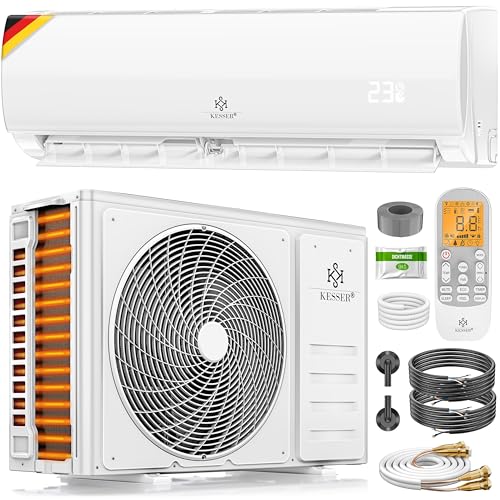
- KESSER (Average overall score: 7.8)
- DILOC (Average overall score: 7.5)
The chart below ranks brands by average overall score among quiet air conditioners suitable for bedrooms.
[horizontal-chart-15033788356508183976009458477248714821783202213067]
When should you consider buying an air conditioner for a bedroom?
You should consider buying an air conditioner for a bedroom if summer heat regularly disrupts sleep, the room retains heat overnight, or humidity makes a moderate temperature feel uncomfortable. It is especially useful in a top-floor room, a sun-facing room, or a space with limited cross-ventilation.
Choose a unit with low-speed noise data, stable inverter modulation, a timer, and airflow that can be directed away from the bed. If the room is only occasionally hot, a simpler unit may be enough; if humidity is the main problem, ventilation and a dedicated dehumidifier may solve more than extra cooling capacity.
What noise level is quiet enough for a bedroom air conditioner?
A bedroom air conditioner should ideally publish a low-speed indoor sound-power figure around 40–50 dB, with the lower end more comfortable for light sleepers. Compare the measurement mode and whether the specification is sound power or sound pressure, because those values are not interchangeable.
Maximum noise matters too: a unit rated at 48 dB on low may become much louder at high fan speed. Outdoor vibration, wall resonance, airflow hiss, and an incorrectly mounted drain can also make a nominally quiet system intrusive.
Prefer a documented night mode, smooth inverter control, a minimum fan setting that still dehumidifies acceptably, and an installer who can isolate vibration. Listen to the unit in the intended mode when possible rather than relying on one headline number.
Which settings help an air conditioner stay quiet at night?
The settings that usually help an air conditioner stay quiet at night are as follows:
- Night or sleep mode: This reduces fan and compressor output and may dim indicators, but check that the temperature rise is acceptable for the room.
- Low fan with automatic control: Automatic fan speed can prevent abrupt changes; a permanently low setting may cool too slowly after bedtime.
- Timer and temperature ramp: A timer can reduce output after you fall asleep, while a modest setpoint avoids unnecessary compressor demand.
- Indirect airflow: Aim louvers above or beside the bed so the room mixes gently without direct draught.
- Dehumidification when appropriate: Dry mode can reduce clamminess, but it may cool less predictably and should not replace ventilation in a damp room.
What cooling capacity is best for a bedroom air conditioner?
A bedroom air conditioner commonly needs about 2.5–3.5 kW of cooling, but the correct size depends on the room’s heat load. A shaded, insulated 15–25 m² room may need the lower end, while a sunny top-floor bedroom or a room with large glazing may need more.
Avoid choosing a large unit as a safety margin: fast cycling can remove less moisture, while an undersized system may run loudly at full output. Check nominal and minimum output, recommended area, sound level, night mode, and airflow direction, then ask the installer to calculate the bedroom separately from adjacent rooms.
How much electricity does overnight bedroom cooling use?
Over an eight-hour night, a bedroom air conditioner may use roughly 2–6 kWh of electricity, but the real figure depends on capacity, weather, insulation, set temperature, and how long the compressor runs. A correctly sized inverter can draw much less after the room reaches the target temperature than it does during pull-down.
A lower setpoint, open window, strong solar gain, dirty filter, or poor seal around the room increases consumption. Heating and cooling loads are not symmetrical, so do not apply a summer estimate to winter operation.
Use the unit’s rated input as an upper reference, then compare its seasonal efficiency and expected duty cycle. Timer scheduling, a moderate setpoint, closed curtains, and clean filters usually reduce overnight use more effectively than selecting a much larger unit.
How should a bedroom air conditioner be installed and drained?
A bedroom air conditioner should be installed with the indoor unit level, airflow directed away from the bed, and the condensate drain routed continuously downward or to a correctly sized pump. The outdoor unit needs clear airflow, secure vibration isolation, and a service position that does not transmit noise into the bedroom wall.
The installer should confirm pipe length, insulation, wall penetrations, electrical protection, refrigerant commissioning, and drainage testing before handover. A poorly sloped drain can drip or gurgle at night, while a long unsupported pipe can transmit vibration.
Keep filters accessible and leave clearance above and beside the indoor unit. Ask for a written commissioning record and warranty responsibilities, particularly when the bedroom is in a loft or a room with difficult external access.
How much do good bedroom air conditioners cost?
Good bedroom air conditioners usually cost about £300-£1,000 for the appliance, with installation extra. Basic quiet-capable units can start around £300-£520, while premium models with lower sound figures, A+++ cooling, better filtration, Wi-Fi, and refined night modes often cost £600-£1,000 or more.
Do not pay for capacity that the bedroom cannot use. Spend the budget on low-speed noise, stable modulation, service quality, efficient operation, and correct installation. The chart below shows the new-product price distribution for quiet small-room air conditioners.
The chart below shows the new-product price distribution for quiet small-room air conditioners.
[vertical-chart-12226578875017786613082922215629456635233860889130]
What should you check before buying an air conditioner for a bedroom?
Before buying an air conditioner for a bedroom, check the following factors:
- Low-speed noise: Look for a published low-mode figure near 40–50 dB and compare the maximum setting as well.
- Capacity and modulation: Aim for roughly 2.5–3.5 kW in a normal bedroom, then verify minimum output and the real heat load.
- Night control: Confirm sleep mode, timer ramp, dimming, independent temperature control, and indirect airflow.
- Humidity: Check dry-mode behaviour and drainage; cooling alone is not a complete remedy for persistent damp.
- Installation position: Avoid blowing directly at the bed and plan pipe, drain, wall, and outdoor-unit routes before purchase.
- Efficiency: Compare A++/A+++ cooling and SEER, using a moderate setpoint rather than assuming the label guarantees low bills.
- Maintenance: Verify filter access, self-cleaning claims, service intervals, spare parts, warranty, and who handles commissioning.