Scored using Cameras Methodology v1.0
Cameras Methodology v1.0
Mathematical & Unbiased Scoring
Products in this category are evaluated mathematically under Frontumo Cameras Methodology v1.0 using verified laboratory benchmarks, technical specifications, and authentic consumer ratings with 0% commercial bias.
Explore Cameras Methodology v1.0

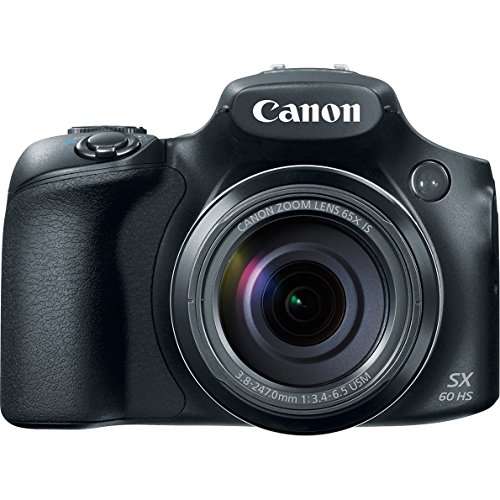
Canon PowerShot SX60 HS Review | 108 Data compared

Avg. price:~£290Sensor size:1/2.3"Weight:650 gBattery life (CIPA):340 shots

Canon PowerShot SX60 HS Review: Compare 108 technical specifications and user reviews to see how this product ranks in the Cameras category and whether it is worth buying.

5.0

Overall score

Score
5.0/ 10
✕
What it is
An overall evaluation of the camera's quality, based on technical analyses and user reviews.
When it matters
When you need a quick reference to identify the best cameras on the market.
Score distribution
â–¼
<55-66-77-88-99-10
Score components

90%

4.6

Technical score

10%

8.9

User score

â–¼Worse than 56% of cameras
4.6

Technical score

Technical score
4.6/ 10
✕
What it is
An assessment of technical performance for products in the Cameras category across these key areas: Sensor & Image, Photo Features, Video & Audio, Display & Design, Battery & Power, Connectivity & Storage.
When it matters
When you want to compare cameras based on technical performance and available features.
Score distribution
â–¼
<55-66-77-88-99-10
Score components

28%

3.9

Sensor & Image

25%

3.8

Photo Features

18%

5.4

Video & Audio

14%

6.2

Display & Design

8%

4.6

Battery & Power

7%

5.0

Connectivity & Storage

â–¼Worse than 66% of cameras
8.9

User score

User score
8.9/ 10
✕
What it is
A rating that combines user reviews and the total number of reviews received by the camera.
When it matters
When real-world owner satisfaction and review volume matter to your decision.
Score distribution
â–¼
<55-66-77-88-99-10
Score components

70%

8.5

User ratings

30%

10

Number of reviews

Based on 1,948 buyer reviews from online shops.
How we calculate this
User ratings – average star rating across all shop listings, weighted by how many reviews each has, on a 1–10 scale.
Number of reviews – how many buyer reviews the product has, on a logarithmic scale; the 8% most-reviewed models in the category get 10.
★Better than 92% of cameras
Loading...
Loading category ranking...

Technical Specifications of camera Canon PowerShot SX60 HS

Technical score
Technical score
4.6/ 10
✕
What it is
An assessment of technical performance for products in the Cameras category across these key areas: Sensor & Image, Photo Features, Video & Audio, Display & Design, Battery & Power, Connectivity & Storage.
When it matters
When you want to compare cameras based on technical performance and available features.
Score distribution
â–¼
<55-66-77-88-99-10
Score components:

28%

3.9

Sensor & Image

25%

3.8

Photo Features

18%

5.4

Video & Audio

14%

6.2

Display & Design

8%

4.6

Battery & Power

7%

5.0

Connectivity & Storage

4.6
User score
User score
8.9/ 10
✕
What it is
A rating that combines user reviews and the total number of reviews received by the camera.
When it matters
When real-world owner satisfaction and review volume matter to your decision.
Score distribution
â–¼
<55-66-77-88-99-10
Score components

70%

8.5

User ratings

30%

10

Number of reviews

Based on 1,948 buyer reviews from online shops.
How we calculate this
User ratings – average star rating across all shop listings, weighted by how many reviews each has, on a 1–10 scale.
Number of reviews – how many buyer reviews the product has, on a logarithmic scale; the 8% most-reviewed models in the category get 10.
8.9
Popularity
Popularity
10.0/ 10
✕
What it is
An indicator based on the number of reviews received by the camera.
When it matters
When you want to see which cameras attract the most buyer attention and review activity.
Score distribution
â–¼
<55-66-77-88-99-10
Popularity:
Canon PowerShot SX60 HS has a popularity score of 10, which is higher than 91.7% of cameras.
10
Value for money
Value for money
6.2/ 10
✕
What it is
An indicator that combines the camera's overall rating with its cost.
When it matters
When you want to know how much overall quality you get for the price.
Score distribution
â–¼
<55-66-77-88-99-10
Score components:

60%

5.0

Overall score

40%

9.0

Price

6.2
Sensor size
1/2.3"
Sensor size
1/2.3"
This camera uses a sensor classified as 1/2.3"; it is smaller than the sensor in 60.5% of cameras and the same size as the sensor in 38.1% of cameras.
Main camera megapixels
16.1 MP
Main camera megapixels
16.1 MP
This camera has a sensor resolution of 16.1 MP, which is lower than that of 53.3% of cameras and equal to that of 7.9% of cameras.
Main camera pixel size
1.4 µm
Main camera pixel size
1.4 µm
This camera has sensor pixels measuring 1.4 µm, which are smaller than those in 73% of cameras and the same size as those in 0.2% of cameras.
Base ISO
100
Base ISO
100
This camera has a base ISO of 100 which is higher than that of 19.9% of cameras and equal to that of 52.4% of cameras.
Max ISO
ISO 3200 ISO
Max ISO
ISO 3,200
This camera reaches a maximum sensitivity of ISO 3,200, which is lower than that of 62.9% of cameras and equal to that of 22.7% of cameras.
Show more
Lens mount
N/A
Built-in focus motor
no
Built-in focus motor
no
This camera does not have a built-in focus motor. 11% of cameras have a built-in focus motor.
N. of focus points
9
N. of focus points
9
This camera has 9 focus points, fewer than the number offered by 67.1% of cameras and equal to the number offered by 26% of cameras.
Phase-detection autofocus (photos)
no
Phase-detection autofocus (photos)
no
This camera does not support phase-detection autofocus for photos. 37.5% of cameras support phase-detection autofocus for photos.
AF tracking
yes
AF tracking
yes
This camera supports AF tracking. This feature is available on 88% of cameras.
Show more
Max video resolution
1920 px
Max video resolution
1920 px
This camera supports 1920 px video recording which is higher quality than that of 28.7% of cameras and equal to that of 47.1% of cameras.
Video bitrate
35 Mbps
Video bitrate
35 Mbps
This camera has a video bitrate of 35 Mbps which is higher than that of 53.8% of cameras and equal to that of 3.4% of cameras.
Video bit depth
8 bit
Video bit depth
8 bit
This camera supports video at 8 bit, a bit depth higher than that of 7.8% of cameras and equal to that of 80.6% of cameras.
Video chroma subsampling
4:2:0
Video chroma subsampling
4:2:0
This camera supports 4:2:0 video chroma subsampling which is more advanced than that of 7.8% of cameras and equal to that of 69.9% of cameras.
Video codecs
H.264
Show more
Type
bridge
Weight
650 g
Weight
650 g
This camera weighs 650 g which is heavier than 77.2% of cameras and equal to the weight of 0.5% of cameras.
Width
127.6 mm
Width
127.6 mm
This camera has a width of 127.6 mm which is wider than 66.5% of cameras.
Height
92.6 mm
Height
92.6 mm
This camera has a height of 92.6 mm which is taller than 70.3% of cameras and equal to that of 0.2% of cameras.
Thickness
114.3 mm
Thickness
114.3 mm
This camera has a thickness of 114.3 mm which is thicker than 96.1% of cameras.
Show more
Battery life (CIPA)
340 shots
Battery life (CIPA)
340 shots
This camera has a CIPA-rated battery life of 340 shots, which is longer than that of 52.2% of cameras and equal to that of 2.3% of cameras.
450 in Eco mode.
Battery capacity
920 mAh
Battery capacity
920 mAh
This camera has a battery capacity of 920 mAh which is smaller than the batteries in 77% of cameras and equal to those in 0.7% of cameras.
Removable battery
yes
Removable battery
yes
This camera has a removable battery, and 98.7% of cameras include one.
USB Power Delivery (PD)
no
USB Power Delivery (PD)
no
This camera does not support USB Power Delivery. 10.1% of cameras support USB Power Delivery.
Wi-Fi connectivity
yes
Wi-Fi connectivity
yes
This camera supports Wi-Fi. This feature is available on 47.8% of cameras.
Wi-Fi version
Wi-Fi 4 (802.11n)
Wi-Fi version
Wi-Fi 4 (802.11n)
This camera uses Wi-Fi version Wi-Fi 4 (802.11n) which is newer than that of 54.2% of cameras and equal to that of 35.6% of cameras.
Bluetooth connectivity
no
Bluetooth connectivity
no
This camera does not have Bluetooth. 22.7% of cameras support Bluetooth.
Bluetooth version
N/A
USB Type-C
no
USB Type-C
no
This camera does not include USB Type-C. 14.6% of cameras use USB-C.
Show more

Canon PowerShot SX60 HS vs the average camera

246810TotalDisplay & DesignSensor & ImagePhoto FeaturesVideo & AudioBattery & PowerConnectivity & Storage
  • Better viewfinder type
    Viewfinder type
    electronic
    This camera uses a more advanced viewfinder than the average camera (electronic vs none).
    electronic vs none
  • Uses a BSI sensor
    BSI sensor
    yes
    This camera uses a BSI sensor, the average camera does not. 34.8% of cameras use a BSI sensor.
  • Has microphone input
    Microphone input
    yes
    This camera has microphone input, the average camera does not.
  • Fully articulated screen
    Flip-out screen
    yes
    This camera has a fully articulated screen, the average camera does not.
  • Supports slow-motion video
    Slow-motion video
    yes
    This camera supports slow-motion video, the average camera does not.
    Supports up to 240 fps high-speed video.
  • Supports Wi-Fi connectivity
    Wi-Fi connectivity
    yes
    This camera supports Wi-Fi, the average camera does not. 47.8% of cameras support Wi-Fi.
  • Smartphone remote control
    Smartphone remote control
    yes
    This camera supports smartphone remote control, the average camera does not. 46.2% of cameras support smartphone remote control.
    via Canon Camera Connect
  • Lossless compressed RAW
    Lossless compressed RAW
    yes
    This camera supports lossless compressed RAW, while the average camera does not.
    Standard RAW is losslessly compressed.
  • 11.8% higher user score
    User score
    8.9/ 10
    ✕
    What it is
    A rating that combines user reviews and the total number of reviews received by the camera.
    When it matters
    When real-world owner satisfaction and review volume matter to your decision.
    Score distribution
    â–¼
    â–¼
    <55-66-77-88-99-10
    Canon PowerShot SX60 HS
    the average camera
    Canon PowerShot SX60 HS has a higher user score than the average camera (8.94 vs 8.000).
    8.94 vs 8
  • 5.18x more popular
    Canon PowerShot SX60 HS is more popular than the average camera (10 vs 1.9).
    10 vs 1.93
  • Better viewfinder type
    Viewfinder type
    electronic
    This camera uses a more advanced viewfinder than the average camera (electronic vs none).
    electronic vs none
  • Fully articulated screen
    Flip-out screen
    yes
    This camera has a fully articulated screen, the average camera does not.
  • 2 more customizable buttons
    Customizable button count
    2
    This camera has more customizable buttons than the average camera (2 vs 0). The average camera offers 0 customizable buttons.
    2 vs 0
  • Uses a BSI sensor
    BSI sensor
    yes
    This camera uses a BSI sensor, the average camera does not. 34.8% of cameras use a BSI sensor.
  • Lossless compressed RAW
    Lossless compressed RAW
    yes
    This camera supports lossless compressed RAW, while the average camera does not.
    Standard RAW is losslessly compressed.
  • 9.15x more optical zoom
    Optical zoom
    65 x
    40% more optical zoom: this camera offers 65 x, compared with 7.1 x on the average camera.
    The built-in lens provides 65x optical zoom.
    65 x vs 7.1 x
  • Has microphone input
    Microphone input
    yes
    This camera has microphone input, the average camera does not.
  • Supports slow-motion video
    Slow-motion video
    yes
    This camera supports slow-motion video, the average camera does not.
    Supports up to 240 fps high-speed video.
  • Supports Wi-Fi connectivity
    Wi-Fi connectivity
    yes
    This camera supports Wi-Fi, the average camera does not. 47.8% of cameras support Wi-Fi.
  • Smartphone remote control
    Smartphone remote control
    yes
    This camera supports smartphone remote control, the average camera does not. 46.2% of cameras support smartphone remote control.
    via Canon Camera Connect
  • Has NFC
    NFC
    yes
    This camera supports NFC, the average camera does not. 15% of cameras support NFC.
  • Smaller sensor
    Sensor size
    1/2.3"
    This camera has a smaller sensor than the average camera (1/2.3" vs APS-C).
    1/2.3" vs APS-C
  • 1.94 µm smaller sensor pixels
    Main camera pixel size
    1.4 µm
    This camera has smaller sensor pixels than the average camera (1.4 µm vs 3.34 µm). The average sensor pixel size is 3.34 µm.
    1.4 µm vs 3.34 µm
  • Lower RAW bit depth
    RAW bit depth
    12-bit
    This camera supports lower RAW bit depth than the average camera (12-bit vs 14-bit). The average camera supports 14-bit RAW capture.
    12-bit vs 14-bit
  • 3.8 points lower DxOMark Portrait score
    DxOMark portrait score
    19.2 points
    This camera has a lower DxOMark portrait score than the average camera (19.2 points vs 23 points). The average camera scores 23.0 points.
    19.2 points vs 23.0 points
  • 34 points lower DxOMark sensor score
    DxOMark sensor score
    39 points
    This camera has a lower DxOMark sensor score than the average camera (39 points vs 73 points). The average camera has a DxOMark sensor score of 73 points.
    39 points vs 73 points
  • 1438000 dots lower EVF resolution
    EVF resolution
    922,000 dots
    This camera has a lower EVF resolution than the average camera (922000 dots vs 2360000 dots). The average camera has an EVF resolution of 2360000 dots.
    922000 dots vs 2360000 dots
  • 255 g heavier
    Weight
    650 g
    This camera is heavier than the average camera (650 g vs 395 g). The average camera weighs 395 g.
    650 g vs 395 g
  • 716 points lower DxOMark Sports score
    DxOMark sports score
    127 points
    This camera has a lower DxOMark sports score than the average camera (127 points vs 843 points). The average camera has a DxOMark sports score of 843 points.
    127 points vs 843 points
  • 1438000 dots lower EVF resolution
    EVF resolution
    922,000 dots
    This camera has a lower EVF resolution than the average camera (922000 dots vs 2360000 dots). The average camera has an EVF resolution of 2360000 dots.
    922000 dots vs 2360000 dots
  • 255 g heavier
    Weight
    650 g
    This camera is heavier than the average camera (650 g vs 395 g). The average camera weighs 395 g.
    650 g vs 395 g
  • 68.3 mm thicker
    Thickness
    114.3 mm
    This camera is thicker than the average camera (114.3 mm vs 46 mm). The average camera has a thickness of 46 mm.
    114.3 mm vs 46 mm
  • 18.7 mm taller body
    Height
    92.6 mm
    This camera is taller than the average camera (92.6 mm vs 73.9 mm). The average camera has a height of 73.9 mm.
    92.6 mm vs 73.9 mm
  • 7.7 mm wider
    Width
    127.6 mm
    This camera is wider than the average camera (127.6 mm vs 119.9 mm). The average camera has a width of 119.9 mm.
    127.6 mm vs 119.9 mm
  • Smaller sensor
    Sensor size
    1/2.3"
    This camera has a smaller sensor than the average camera (1/2.3" vs APS-C).
    1/2.3" vs APS-C
  • 1.94 µm smaller sensor pixels
    Main camera pixel size
    1.4 µm
    This camera has smaller sensor pixels than the average camera (1.4 µm vs 3.34 µm). The average sensor pixel size is 3.34 µm.
    1.4 µm vs 3.34 µm
  • Lower RAW bit depth
    RAW bit depth
    12-bit
    This camera supports lower RAW bit depth than the average camera (12-bit vs 14-bit). The average camera supports 14-bit RAW capture.
    12-bit vs 14-bit
  • 3.8 points lower DxOMark Portrait score
    DxOMark portrait score
    19.2 points
    This camera has a lower DxOMark portrait score than the average camera (19.2 points vs 23 points). The average camera scores 23.0 points.
    19.2 points vs 23.0 points
  • 34 points lower DxOMark sensor score
    DxOMark sensor score
    39 points
    This camera has a lower DxOMark sensor score than the average camera (39 points vs 73 points). The average camera has a DxOMark sensor score of 73 points.
    39 points vs 73 points
  • 716 points lower DxOMark Sports score
    DxOMark sports score
    127 points
    This camera has a lower DxOMark sports score than the average camera (127 points vs 843 points). The average camera has a DxOMark sports score of 843 points.
    127 points vs 843 points
  • 1.6 points lower DxOMark Landscape score
    DxOMark landscape score
    10.8 points
    This camera has a lower DxOMark landscape score than the average camera (10.8 points vs 12.4 points). The average camera scores 12.4 points.
    10.8 points vs 12.4 points
  • 18,900 ISO lower extended sensitivity limit
    Max expanded ISO
    6,400 ISO
    This camera has a lower expanded ISO than the average camera (6400 ISO vs 25300 ISO). The average camera reaches an expanded ISO of 25300 ISO.
    Reduced resolution only.
    6,400 ISO vs 25,300 ISO
  • 3,200 ISO lower maximum sensitivity limit
    Max ISO
    3,200 ISO
    This camera has a lower maximum sensitivity than the average camera (3200 ISO vs 6400 ISO). The average camera reaches a maximum sensitivity of 6400 ISO.
    3,200 ISO vs 6,400 ISO
  • Lower sensor resolution
    Main camera megapixels
    16.1 MP
    This camera has a lower sensor resolution than the average camera (16.1 MP vs 16.2 MP). The average camera has a sensor resolution of 16.2 MP.
    16.1 MP vs 16.2 MP
  • 14 fewer AF points
    N. of focus points
    9
    This camera has fewer focus points than the average camera (9 vs 23). The average camera offers 23 focus points.
    9 vs 23
  • 0.5 stops less CIPA-rated stabilization
    Image stabilization rating (CIPA)
    3.5 stops
    This camera offers less CIPA-rated stabilization than the average camera (3.5 stops vs 4 stops). The average camera reaches 4 stops.
    3.5 stops vs 4 stops
  • 200 mAh smaller battery capacity
    Battery capacity
    920 mAh
    This camera has a lower battery capacity than the average camera (920 mAh vs 1120 mAh). The average camera has a battery capacity of 1120 mAh.
    920 mAh vs 1,120 mAh

Video reviews

Hands-on testing, unboxing, and real-world video evaluations

Expert reviews

In-depth analysis and verdict from leading tech publications

W
whatdigitalcamera.com
24/10/2014
Summary of the review
A
amateurphotographer.com
03/11/2014
Summary of the review
P
pcmag.com
24/11/2014
Summary of the review
C
cnet.com
13/02/2015
Summary of the review
D
dpreview.com
17/06/2015
Summary of the review
C
consumerreports.org
[No precise date listed]
Summary of the review
C
cameralabs.com
26/10/2014
Summary of the review
E
ephotozine.com
06/11/2014
Summary of the review
L
lelalondon.com
28/03/2015
Summary of the review
T
techradar.com
02/05/2017
Summary of the review
D
dpreview.com
17/06/2015
Summary of the review
C
chip.de
24/10/2014
Summary of the review
D
dkamera.de
02/11/2015
Summary of the review
L
lesnumeriques.com
01/06/2016
Summary of the review
O
ornithomedia.com
25/04/2015
Summary of the review
Q
quechoisir.org
10/12/2015
Summary of the review
C
camerarace.com
21/10/2026
Summary of the review
X
xatakafoto.com
27/03/2015
Summary of the review
S
smartworld.it
27/07/2015
Summary of the review
F
fotocamerapro.it
11/07/2015
Summary of the review
T
techdifferent.it
24/01/2015
Summary of the review
L
lafotocamera.it
04/03/2024
Summary of the review

Third-party reviews

Based on 1,948 buyer reviews from online shops.
Reviews last updated: July 2026 · How we calculate this

What we like about Canon PowerShot SX60 HS

  • Incredible 65x optical zoom range (21-1365mm equivalent)
  • Effective image stabilisation for handheld long-range shots
  • Fully articulating vari-angle LCD screen
  • Support for RAW image capture and manual controls
  • Good video quality (1080p/60fps) with an external microphone jack
  • Comfortable, DSLR-style ergonomic grip
  • Fast burst shooting at up to 6.4 fps

What we don't like about Canon PowerShot SX60 HS

  • Poor low-light performance due to a small 1/2.3-inch sensor
  • Slow autofocus speed, especially at maximum zoom or in low light
  • No proximity sensor to automatically switch between LCD and EVF
  • Electronic viewfinder (EVF) is relatively small and low resolution
  • LCD screen lacks touchscreen functionality
  • Image quality suffers from noise and loss of detail at high ISO settings
  • Noticeable purple fringing (chromatic aberration) in high-contrast scenes

Verdict

The Canon PowerShot SX60 HS is a versatile bridge camera featuring a 16.1-megapixel 1/2.3-inch CMOS sensor, a DIGIC 6 image processor, and a massive 65x optical zoom lens (21–1365mm equivalent) with an f/3.4–6.5 aperture range. Its main characteristics include an articulated 3-inch 922k-dot vari-angle LCD display, a 922k-dot electronic viewfinder, Wi-Fi and NFC connectivity, and a hot shoe for external flash units. Among its top pros are raw shooting support, Full HD 1080p video recording at 60 fps with an external microphone input, a 6.4 fps continuous shooting speed, and a convenient Zoom Framing Assist feature. However, some of its notable cons include sluggish autofocus performance in low-light conditions, lack of a touch-sensitive LCD display, the absence of an automatic EVF eye sensor, and visible noise at higher ISO settings.

Compare Canon PowerShot SX60 HS with other products in the Cameras category

1Product to compare no. 1
VS
2Product to compare no. 2
VS
3Product to compare no. 3 (optional)

Graphic comparison of Canon PowerShot SX60 HS and other products in the Cameras category

No results found