Meta Quest 3 Review | 89 Data compared

double-arrow
  • Avg. price in UK: ~£480
  • Avg. price in US: ~$600
  • Weight: 515 g
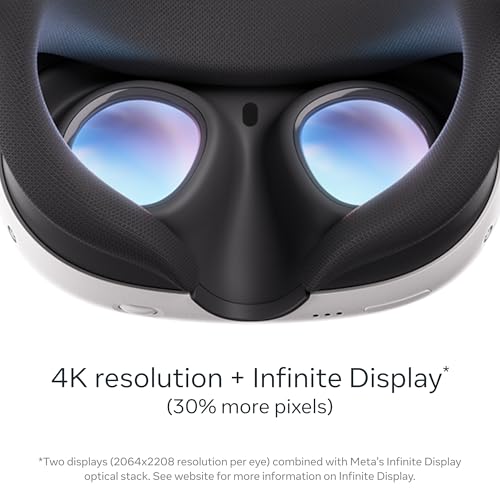
  • Resolution: 2064x2208
  • Refresh rate: 120 Hz
  • Display type: LCD
  • Device type: standalone

Meta Quest 3 review. Compare 89 technical specifications and user reviews to see how it ranks among VR headsets and if it is worth buying.

8.7

Overall score

What it is: An overall evaluation of the VR headset's quality, based on technical analyses and user reviews.

When it matters: When you need a quick reference to identify the best VR headsets on the market.

Score components:

80.0%

8.5

Technical Score

20.0%

9.4

User score

Excellent
8.5

Technical Score

What it is: An assessment of the VR headset's technical performance, covering eight key areas: display quality, tracking, comfort, controllers, connectivity, audio, battery, and design.

When it matters: When you want to compare VR headsets based on technical performance and available features.

Score components:

58.0%

8.2

Display & Optics

22.0%

9.0

Tracking & Sensors

10.0%

9.4

Controls & Audio

4.0%

7.4

Hardware

3.0%

9.1

Connectivity

3.0%

7.5

Design & Power

Excellent
9.4

User score

What it is: A rating that combines user reviews and the total number of reviews received by the VR headset.

When it matters: When you want to know how a VR headset performs in real use and how reliable it remains over time according to user feedback.

Score components:

70.0%

9.2

User reviews

30.0%

10

Popularity

User score:
United Kingdom
amazon
4.5
(4868)
amazon
4.5
(1420)
amazon
4.4
(62)
United States
Amazon_logo.png
4.6
(4960)
Amazon_logo.png
4.6
(732)

(Reviews last updated: July 2026)

Exceptional
  • 9.6
    Gaming

    Score components:

    40.0%

    10

    Refresh rate

    35.0%

    10

    Touch controllers

    25.0%

    8.6

    Resolution

  • 7.4
    Movies

    Score components:

    40.0%

    8.6

    Resolution

    35.0%

    5.2

    Display type

    25.0%

    8.5

    Visible FoV (horizontal)

  • meta-quest-3
  • meta-quest-3
  • meta-quest-3
  • meta-quest-3
meta-quest-3
meta-quest-3
meta-quest-3
meta-quest-3

Best prices in UK

Best rankings

?

Available: ranking among products currently available (including other versions of this product).
All: ranking among all products in the database.

Verdict

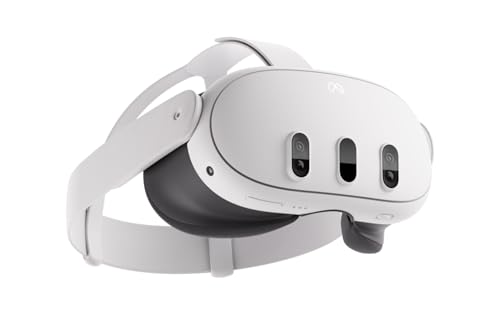
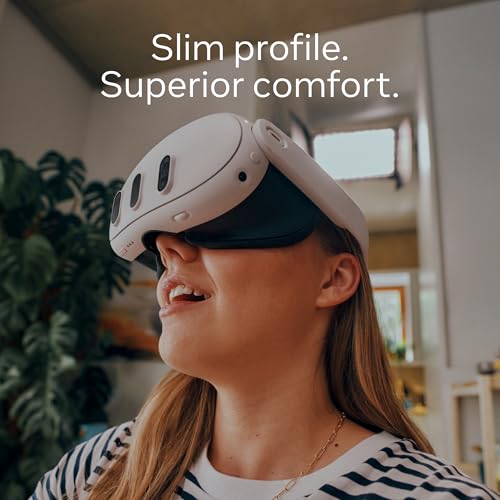
The Meta Quest 3 is a standalone VR headset powered by the Snapdragon XR2 Gen 2 chipset, offering double the GPU performance of its predecessor alongside 8GB of RAM and two LCD displays featuring 2064x2208 pixels per eye for 4K+ resolution. Its standout characteristics include high-fidelity pancake lenses that provide a 110-degree horizontal field of view and a 40% slimmer profile, paired with full-color passthrough cameras and a dedicated depth sensor for advanced mixed reality. Main pros include its exceptional image clarity, improved spatial audio, and ringless Touch Plus controllers with TruTouch haptics, though it is hampered by a short battery life of roughly 2 hours and an included soft head strap that many users find front-heavy and uncomfortable for long sessions.

Technical Specifications of Meta Quest 3

Technical Score

What it is: An assessment of the VR headset's technical performance, covering eight key areas: display quality, tracking, comfort, controllers, connectivity, audio, battery, and design.

When it matters: When you want to compare VR headsets based on technical performance and available features.

Score components:

58.0%

8.2

Display & Optics

22.0%

9.0

Tracking & Sensors

10.0%

9.4

Controls & Audio

4.0%

7.4

Hardware

3.0%

9.1

Connectivity

3.0%

7.5

Design & Power

8.5
Meta Quest 3 has a technical score of 8.49 points, which is higher than 100% of VR headsets.
User score

What it is: A rating that combines user reviews and the total number of reviews received by the VR headset.

When it matters: When you want to know how a VR headset performs in real use and how reliable it remains over time according to user feedback.

Score components:

70.0%

9.2

User reviews

30.0%

10

Popularity

User score:
United Kingdom
amazon
4.5
(4868)
amazon
4.5
(1420)
amazon
4.4
(62)
United States
Amazon_logo.png
4.6
(4960)
Amazon_logo.png
4.6
(732)

(Reviews last updated: July 2026)

9.4
Meta Quest 3 has a user score of 9.41 points, which is higher than 95.9% of VR headsets.
Popularity
What it is: An indicator based on the number of reviews received by the VR headset.
When it matters: When you prefer to buy a product chosen and reviewed by many other consumers.
10
Meta Quest 3 has a popularity of 10 points, which is higher than 67.4% of products in this category.
Ratio quality/price

What it is: An indicator that combines the VR headset's overall rating with its cost.

When it matters: When you are looking for a VR headset with a good balance between quality and price.

Score components:

60.0%

8.7

Overall score

40.0%

8.0

Price

8.5
Meta Quest 3 has a quality-to-price ratio of 8.5 points, which is higher than 100% of products in this category.
Resolution
What it is: The total number of pixels displayed on the screen, expressed as width x height, determining sharpness.
When it matters: When you want crisp text and sharp details in photos and videos.

Importance: HIGH

2064x2208
Meta Quest 3 has a screen resolution of 2064x2208 which is higher than that of 74.4% of VR headsets.
Screen size
What it is: The physical diagonal measurement of the display area, usually expressed in inches.
When it matters: When you want a larger image area that can feel more immersive in games, movies, and VR apps.

Importance: LOW

?
Refresh rate
What it is: The number of times per second the display updates the image, measured in Hertz (Hz); higher rates offer smoother motion.
When it matters: When you want scrolling to feel fluid and games to look smoother.

Importance: HIGH

Good value: >100 Hz

120 Hz
Meta Quest 3 supports a refresh rate of 120 Hz which is higher than in 74.4% of VR headsets and equal to that in 20.5% of VR headsets.
Visible FoV (horizontal)
What it is: Measures the visible horizontal field of view of the image, expressed in degrees.
When it matters: When you want a wider left-to-right view for racing, shooters, and room-scale immersion.

Importance: HIGH

Good value: >105 °

110 °
Meta Quest 3 offers a horizontal FoV of 110 ° which is wider than that of 75% of VR headsets and equal to that of 8.3% of VR headsets.
Visible FoV (vertical)
What it is: Measures the visible vertical field of view of the image, expressed in degrees.
When it matters: When a taller visible image helps scenes feel less cropped above and below your view.

Importance: HIGH

Good value: >97 °

96 °
Meta Quest 3 offers a vertical FoV of 96 ° which is wider than that of 51.4% of VR headsets and equal to that of 14.3% of VR headsets.
Show more
Tracking type
What it is: Specifies the tracking method used for positional detection, such as inside-out or outside-in.
When it matters: When you want to know whether tracking depends on onboard cameras or external hardware.

Importance: LOW

inside-out
360° head tracking
What it is: Shows whether the headset can track head movement across a full 360-degree space.
When it matters: When you turn around often in room-scale games and do not want tracking blind spots.

Importance: MEDIUM

yes
Meta Quest 3 supports full 360° head tracking. 2% of VR headsets support this tracking mode.
N. of tracking sensors
What it is: Counts the integrated sensors used for positional or motion tracking.
When it matters: When you compare how much built-in hardware the headset uses for motion tracking.

Importance: LOW

4
N. of cameras
What it is: Counts the built-in cameras used for tracking, passthrough, or environmental sensing.
When it matters: When passthrough quality, room mapping, and inside-out tracking matter to your setup.

Importance: MEDIUM

Good value: >4

6
Meta Quest 3 has 6 cameras which is more than in 83.3% of VR headsets and equal to that in 10.4% of VR headsets.
Tracking frequency
What it is: Indicates how often the tracking system updates position data, measured in hertz.
When it matters: When you want fast motion tracking to stay stable during quick head or hand movement.

Importance: LOW

Good value: >700 Hz

?
Show more
Operating system
What it is: The primary system software that manages the headset's hardware, apps, and core functions.
When it matters: When you have a preference for the user interface and app ecosystem.

Importance: LOW

Android
OpenXR support
What it is: Indicates whether the headset supports the OpenXR standard for compatible VR software.
When it matters: When you want broader compatibility with VR apps across different software platforms.

Importance: LOW

yes
Meta Quest 3 supports OpenXR. 35.6% of VR headsets support this cross-platform VR standard.
Wireless PC streaming
What it is: Shows whether the headset can receive PC VR content over a wireless connection.
When it matters: When you want PC VR without a cable running from the headset to your computer.

Importance: LOW

yes
Meta Quest 3 supports wireless PC streaming. 63.3% of VR headsets support cable-free PC VR streaming.
Wi-Fi connectivity
What it is: The ability of the headset to connect to a wireless network.
When it matters: When you want wireless downloads, streaming, updates, or online features without relying on a cable.

Importance: LOW

yes
Meta Quest 3 has Wi-Fi. 63.3% of VR headsets have Wi-Fi connectivity.
Wi-Fi version
What it is: Version of Wi-Fi standard supported.
When it matters: When compatibility with your router and wireless setup affects download speeds, streaming quality, or latency.

Importance: LOW

Wi-Fi 6E
Meta Quest 3 supports Wi-Fi Wi-Fi 6E, which is more advanced than 83.7% of VR headsets and equal to 12.2% of VR headsets.
Show more
Touch controllers
What it is: Shows whether dedicated motion controllers are included for hand-based input in VR.
When it matters: When your favorite games rely on precise hand input rather than hand tracking alone.

Importance: MEDIUM

yes
Meta Quest 3 includes touch controllers. 28.6% of VR headsets come with dedicated hand controllers.
Game controller included
What it is: Indicates whether game controllers are included in the standard package.
When it matters: When you want a complete VR package and do not want to buy controllers separately.

Importance: LOW

yes
Meta Quest 3 includes a game controller. 36.7% of VR headsets ship with controllers in the box.
Spatial audio
What it is: Supports immersive spatial audio playback.
When it matters: When movies, games, and VR experiences feel better with more immersive positional sound.

Importance: LOW

yes
Meta Quest 3 supports spatial audio. 10.6% of VR headsets support spatial audio.
N. of speakers
What it is: Counts the built-in speakers used for audio playback.
When it matters: When you plan to use the headset without separate headphones or external speakers.

Importance: LOW

2
Meta Quest 3 has 2 speakers which is more than in 39.1% of VR headsets and equal to that in 60.9% of VR headsets.
N. of microphones
What it is: The number of microphones built into the headset or its integrated hardware.
When it matters: When voice chat, voice commands, or in-headset recording quality matter to your setup.

Importance: LOW

2
Meta Quest 3 includes 2 microphones, which is more than 44.2% of VR headsets and equal to 48.8% of VR headsets.
Show more
Device type
What it is: Describes the overall headset class, such as standalone, PC VR, or mixed reality.
When it matters: When you choose between a standalone headset, a PC VR model, or mixed-reality use.

Importance: LOW

standalone
Chipset
What it is: The central System-on-Chip (SoC) that houses the CPU, GPU, modem, and other core processing components.
When it matters: When you want to know which processor powers the headset’s performance and supported features.

Importance: LOW

Snapdragon XR2 Gen 2
Meta Quest 3 uses the Snapdragon XR2 Gen 2 processor which is faster than processors in 77.8% of VR headsets and equal to processors in 11.1% of VR headsets.
CPU clock speed
What it is: Indicates the base operating frequency of the main processor, measured in gigahertz.
When it matters: When you compare standalone headset speed for games, menus, and mixed-reality apps.

Importance: LOW

Good value: >3 GHz

3.19 GHz
Meta Quest 3 has a CPU clock speed of 3.19 GHz which is higher than that of 77.8% of VR headsets and equal to that of 11.1% of VR headsets.
GPU model
What it is: The official model name of the graphics processor used in the VR headset.
When it matters: When you compare graphics hardware for gaming, video editing, or benchmarks.

Importance: LOW

Adreno 740
Meta Quest 3 uses the Adreno 740 GPU model, which is more advanced than that used in 77.8%.
RAM capacity
What it is: States the installed RAM capacity used for system operation and multitasking.
When it matters: When you want smoother multitasking and better headroom for demanding VR apps.

Importance: LOW

Good value: >8 GB

8 GB
Meta Quest 3 has 8 GB of RAM, which is more than 44.4% of VR headsets and equal to 22.2% of VR headsets.
Show more
Battery capacity
What it is: The amount of electric charge the battery can store, usually measured in mAh.
When it matters: When you want longer untethered play time without recharging the headset too often.

Importance: LOW

Good value: >4900 mAh

4,879 mAh
Meta Quest 3 has a battery capacity of 4,879 mAh mAh which is higher than that of 64.7% of VR headsets.
Charging time
What it is: Time required for a full charge.
When it matters: When charging speed, charging method, or battery upkeep convenience matters to your routine.

Importance: LOW

Good value: <2.5 hours

2.3 h
Meta Quest 3 recharges in 2.3 h, which is slower than 61.5% of VR headsets.
Weight
What it is: The total weight of the headset, affecting how heavy it feels during use.
When it matters: When you want a headset that feels lighter and more comfortable during longer VR sessions.

Importance: LOW

Good value: <500 g

515 g
Meta Quest 3 weighs 515 g which is lighter than 60% of VR headsets.
Headstrap type
What it is: Identifies the design of the headstrap used to secure the headset on the user's head.
When it matters: When comfort, balance, and pressure distribution matter during long VR sessions.

Importance: LOW

elastic strap
Meta Quest 3 uses a elastic strap headstrap, which is less comfortable than the design on 61.2%.
Body material
What it is: The main material used for the headset body or housing.
When it matters: When you care about how sturdy, premium, or lightweight the headset feels over time.

Importance: LOW

plastic
Show more

Meta Quest 3 vs the average VR headset

  • 33.3% higher refresh rate
    Meta Quest 3 has a higher refresh rate than the average VR headset (120 Hz vs 90 Hz). The average VR headset has a refresh rate of 90 Hz.
    What it is: The number of times per second the display updates the image, measured in Hertz (Hz); higher rates offer smoother motion.
    When it matters: When you want scrolling to feel fluid and games to look smoother.

    Importance: HIGH

    Good value: >100 Hz

    Meta Quest 3 has a higher refresh rate than the average VR headset (120 Hz vs 90 Hz). The average VR headset has a refresh rate of 90 Hz.120 Hz vs 90 Hz
  • 97.7% higher pixel density
    Meta Quest 3 has a higher pixel density than the average VR headset (1,218 ppi vs 616 ppi). The average VR headset has a pixel density of 616 ppi.
    What it is: The concentration of pixels on the display, measured in pixels per inch (PPI), affecting image clarity.
    When it matters: When you want the image to look perfectly smooth with no visible pixels.

    Importance: HIGH

    Good value: >850 ppi

    Meta Quest 3 has a higher pixel density than the average VR headset (1,218 ppi vs 616 ppi). The average VR headset has a pixel density of 616 ppi.1218 ppi vs 616 ppi
  • Higher screen resolution
    Meta Quest 3 has a higher screen resolution than the average VR headset (2064x2208 vs 1440x1600). The average VR headset has a screen resolution of 1440x1600.
    What it is: The total number of pixels displayed on the screen, expressed as width x height, determining sharpness.
    When it matters: When you want crisp text and sharp details in photos and videos.

    Importance: HIGH

    Meta Quest 3 has a higher screen resolution than the average VR headset (2064x2208 vs 1440x1600). The average VR headset has a screen resolution of 1440x1600.2064x2208 vs 1440x1600
  • Wider IPD adjustment range
    Meta Quest 3 has a higher IPD adjustment range than the average VR headset (53–75 mm vs 60–70 mm). The average VR headset supports an IPD adjustment range of 60–70 mm.
    What it is: Defines the range within which the lens spacing can be adjusted, usually measured in millimeters.
    When it matters: When you need the headset to fit users with narrower or wider interpupillary distance.

    Importance: MEDIUM

    Meta Quest 3 has a higher IPD adjustment range than the average VR headset (53–75 mm vs 60–70 mm). The average VR headset supports an IPD adjustment range of 60–70 mm.53–75 mm vs 60–70 mm
  • Better lens type
    Meta Quest 3 uses pancake lenses, while the average VR headset uses fresnel lenses.
    What it is: Identifies the optical lens design used by the headset, such as Fresnel or pancake.
    When it matters: When you compare edge clarity, glare behavior, and headset thickness across optical designs.

    Importance: MEDIUM

    Meta Quest 3 uses pancake lenses, while the average VR headset uses fresnel lenses.pancake vs fresnel
  • Supports eye relief adjustment
    Meta Quest 3 supports eye relief adjustment, the average VR headset does not. 25% of VR headsets support eye relief adjustment.
    What it is: Shows whether the distance between the eyes and lenses can be adjusted for comfort or glasses clearance.
    When it matters: When you wear glasses or need more space between your eyes and the lenses.

    Importance: MEDIUM

    Meta Quest 3 supports eye relief adjustment, the average VR headset does not. 25% of VR headsets support eye relief adjustment.
  • See-through mode
    Meta Quest 3 supports see-through mode, the average VR headset does not. 44.9% of VR headsets offer passthrough viewing.
    What it is: Shows whether the headset can display the outside world through passthrough cameras.
    When it matters: When you switch often between VR and seeing your room, keyboard, or nearby people.

    Importance: MEDIUM

    Meta Quest 3 supports see-through mode, the average VR headset does not. 44.9% of VR headsets offer passthrough viewing.
  • Supports hand tracking
    Meta Quest 3 supports hand tracking, the average VR headset does not. 24% of VR headsets support hand tracking.
    What it is: Shows whether the headset can track the user's hands without relying on controllers.
    When it matters: When you want controller-free interaction for menus, MR apps, or casual media use.

    Importance: MEDIUM

    Meta Quest 3 supports hand tracking, the average VR headset does not. 24% of VR headsets support hand tracking.
  • 33.3% higher refresh rate
    Meta Quest 3 has a higher refresh rate than the average VR headset (120 Hz vs 90 Hz). The average VR headset has a refresh rate of 90 Hz.
  • 97.7% higher pixel density
    Meta Quest 3 has a higher pixel density than the average VR headset (1,218 ppi vs 616 ppi). The average VR headset has a pixel density of 616 ppi.
  • Higher screen resolution
    Meta Quest 3 has a higher screen resolution than the average VR headset (2064x2208 vs 1440x1600). The average VR headset has a screen resolution of 1440x1600.
  • Wider IPD adjustment range
    Meta Quest 3 has a higher IPD adjustment range than the average VR headset (53–75 mm vs 60–70 mm). The average VR headset supports an IPD adjustment range of 60–70 mm.
  • Better lens type
    Meta Quest 3 uses pancake lenses, while the average VR headset uses fresnel lenses.
  • Supports eye relief adjustment
    Meta Quest 3 supports eye relief adjustment, the average VR headset does not. 25% of VR headsets support eye relief adjustment.
  • 10 ° wider horizontal FoV
    Meta Quest 3 has a higher horizontal visible FoV than the average VR headset (110 ° vs 100 °). The average VR headset offers a horizontal visible FoV of 100 °.
  • 0.5 ° wider vertical FoV
    Meta Quest 3 has a higher vertical visible FoV than the average VR headset (96 ° vs 95.5 °). The average VR headset offers a vertical visible FoV of 95.5 °.
  • See-through mode
    Meta Quest 3 supports see-through mode, the average VR headset does not. 44.9% of VR headsets offer passthrough viewing.
  • Supports color passthrough
    Meta Quest 3 supports color passthrough, the average VR headset does not.
  • Supports hand tracking
    Meta Quest 3 supports hand tracking, the average VR headset does not. 24% of VR headsets support hand tracking.
  • 4 more cameras
    Meta Quest 3 has more cameras than the average VR headset (6 vs 2). The average VR headset has 2 cameras.
  • Depth sensor included
    Meta Quest 3 has a depth sensor, the average VR headset does not. 10% of VR headsets include dedicated depth-sensing hardware.
  • Supports body tracking
    Meta Quest 3 supports body tracking, the average VR headset does not.
  • Larger tracking area
    Meta Quest 3 has a higher tracking area than the average VR headset (15x15 m vs 10x10 m). The average VR headset supports a tracking area of 10x10 m.
  • Wireless PC VR streaming
    Meta Quest 3 supports wireless PC streaming, the average VR headset does not.
  • Supports SteamVR
    Meta Quest 3 supports SteamVR, the average VR headset does not. 50% of VR headsets support this PC VR ecosystem.
  • Has Wi-Fi
    Meta Quest 3 has Wi-Fi, the average VR headset does not. 38% of VR headsets have Wi-Fi connectivity.
  • Compatible with Android
    Meta Quest 3 is compatible with Android, the average VR headset is not. 50% of VR headsets support Android pairing or companion apps.
  • Compatible with iOS
    Meta Quest 3 is compatible with iOS, the average VR headset is not. 34.7% of VR headsets support iPhone or iPad integration.
  • Supports voice commands
    Meta Quest 3 supports voice commands, the average VR headset does not. 42.6% of VR headsets include voice command functionality.
  • 18.7% lighter controllers
    Meta Quest 3 is lighter than the average VR headset (126 g vs 155 g). The average controller weighs 155 g.
  • 3 nm smaller process node
    Meta Quest 3 has a lower process node than the average VR headset (4 nm vs 7 nm). The average VR headset uses a process node of 7 nm.
  • 0.35 GHz higher CPU clock speed
    Meta Quest 3 has a higher CPU clock speed than the average VR headset (3.2 GHz vs 2.84 GHz). The average VR headset has a CPU clock speed of 2.84 GHz.
  • 5 newer release date
    Meta Quest 3 is newer than the average VR headset (2023 vs 2018). The average VR headset was released in 2018.
  • Battery level indicator
    Meta Quest 3 has a battery level indicator, the average VR headset does not. 46% of VR headsets include a battery level indicator.
  • 42.7 mm thinner
    Meta Quest 3 is thinner than the average VR headset (62.3 mm vs 105 mm). The average VR headset has a thickness of 105 mm.
  • Basic display type
    Meta Quest 3 uses LCD for display type, while the average VR headset uses Micro-OLED.
  • 2 fewer CPU threads
    Meta Quest 3 has fewer CPU threads than the average VR headset (6 vs 8). The average VR headset supports 8 CPU threads.
  • 250.5 lower single-core score
    Meta Quest 3 has a lower Geekbench 5 single-core score than the average VR headset (572 vs 822.5). The average VR headset has a Geekbench 5 single-core score of 822.5.
  • Inferior headstrap type
    Meta Quest 3 uses a elastic strap headstrap, while the average VR headset uses rigid halo.
  • 0.3 h slower charging
    Meta Quest 3 has a higher charging time than the average VR headset (2.3 h vs 2 h). The average VR headset reaches a charging time of 2 h.
  • Basic display type
    Meta Quest 3 uses LCD for display type, while the average VR headset uses Micro-OLED.
    What it is: The type of display panel used in the headset, such as LCD, OLED, or micro-OLED.
    When it matters: When you compare panel technologies that affect contrast, brightness, motion clarity, and black levels.

    Importance: HIGH

    Meta Quest 3 uses LCD for display type, while the average VR headset uses Micro-OLED.LCD vs Micro-OLED
  • Inferior headstrap type
    Meta Quest 3 uses a elastic strap headstrap, while the average VR headset uses rigid halo.
    What it is: Identifies the design of the headstrap used to secure the headset on the user's head.
    When it matters: When comfort, balance, and pressure distribution matter during long VR sessions.

    Importance: LOW

    Meta Quest 3 uses a elastic strap headstrap, while the average VR headset uses rigid halo.elastic strap vs rigid halo
  • 2 fewer CPU threads
    Meta Quest 3 has fewer CPU threads than the average VR headset (6 vs 8). The average VR headset supports 8 CPU threads.
    What it is: The total number of processing threads that the CPU can execute simultaneously.
    When it matters: When you run complex apps that split tasks into multiple parallel processes for efficiency.

    Importance: LOW

    Good value: >6

    Meta Quest 3 has fewer CPU threads than the average VR headset (6 vs 8). The average VR headset supports 8 CPU threads.6 vs 8
  • 0.3 h slower charging
    Meta Quest 3 has a higher charging time than the average VR headset (2.3 h vs 2 h). The average VR headset reaches a charging time of 2 h.
    What it is: Time required for a full charge.
    When it matters: When charging speed, charging method, or battery upkeep convenience matters to your routine.

    Importance: LOW

    Good value: <2.5 hours

    Meta Quest 3 has a higher charging time than the average VR headset (2.3 h vs 2 h). The average VR headset reaches a charging time of 2 h.2.3 h vs 2 h
  • 250.5 lower single-core score
    Meta Quest 3 has a lower Geekbench 5 single-core score than the average VR headset (572 vs 822.5). The average VR headset has a Geekbench 5 single-core score of 822.5.
    What it is: Shows the Geekbench 5 single-core result used to estimate processor speed in lightly threaded tasks.
    When it matters: When menu speed and lighter tasks depend more on fast single-core performance.

    Importance: LOW

    Good value: >850

    Meta Quest 3 has a lower Geekbench 5 single-core score than the average VR headset (572 vs 822.5). The average VR headset has a Geekbench 5 single-core score of 822.5.572 vs 822.5

Graphic comparison of Meta Quest 3 and

Attribute category
Attribute
No results found

Third-party reviews

(Reviews last updated: July 2026)

What customers like about Meta Quest 3?

  • Significantly sharper visuals and focus due to high-resolution pancake lenses
  • Vibrant full-color passthrough enables practical mixed reality and the ability to see surroundings clearly
  • Powerful Snapdragon XR2 Gen 2 processor delivers improved graphical fidelity and smoother performance
  • Slimmer, more balanced headset design enhances overall weight distribution and comfort
  • Slimmer Touch Plus controllers with improved haptic feedback and no tracking rings
  • Massive library of existing Quest games and support for PC VR titles
  • Integrated mechanical IPD adjustment wheel for precise optical fine-tuning

What customers dislike about Meta Quest 3?

  • Short battery life typically lasting only 1.5 to 2.5 hours per charge
  • Standard fabric head strap is often described as uncomfortable or painful for extended use
  • Higher starting price compared to previous generations, making it a significant investment
  • Color passthrough can appear grainy or warped, especially in low-light environments
  • Limited selection of dedicated mixed reality apps that fully utilize the new hardware
  • Basic 128GB storage model may fill up quickly given increasing game sizes
  • Lack of eye-tracking features found in higher-end or competing headsets

Expert reviews

T
theverge.com
09/10/2023
Summary of the review
A
arstechnica.com
13/10/2023
Summary of the review
T
techradar.com
03/10/2024
Summary of the review
S
sciencefocus.com
17/11/2023
Summary of the review
F
forbes.com
24/01/2025
Summary of the review
N
npr.org
09/10/2023
Summary of the review
G
gamingnexus.com
22/07/2024
Summary of the review
G
galaxus.at
21/11/2023
Summary of the review
I
ign.com
10/07/2024
Summary of the review
P
pocket-lint.com
09/10/2023
Summary of the review
S
space.com
20/11/2023
Summary of the review
T
trustedreviews.com
15/02/2024
Summary of the review
S
stuff.tv
20/01/2025
Summary of the review
E
expertreviews.co.uk
19/12/2023
Summary of the review
T
techgearlab.com
16/10/2024
Summary of the review
I
independent.co.uk
10/04/2024
Summary of the review
T
t3.com
11/10/2023
Summary of the review
U
uk.pcmag.com
26/10/2023
Summary of the review
R
rapidreviewsuk.com
08/04/2024
Summary of the review
M
mashable.com
09/10/2023
Summary of the review
C
chip.de
15/02/2024
Summary of the review
C
computerbild.de
29/04/2024
Summary of the review
C
computerbase.de
09/10/2023
Summary of the review
V
videolyser.de
02/06/2025
Summary of the review
S
space4games.com
05/01/2026
Summary of the review
H
hifi.de
09/12/2023
Summary of the review
S
spiegel.de
17/10/2023
Summary of the review
G
global.t3.com
21/06/2025
Summary of the review
F
frandroid.com
21/04/2025
Summary of the review
Z
zdnet.fr
04/02/2025
Summary of the review
T
techvers.eu
29/02/2024
Summary of the review
P
pesesurstart.com
30/11/2023
Summary of the review
C
cnetfrance.fr
12/10/2023
Summary of the review
B
bricolo2point0.fr
12/08/2026
Summary of the review
G
gamereactor.es
04/02/2025
Summary of the review
G
generacionxr.com
01 de noviembre de 2023
Summary of the review
D
duino.pro
02/01/2025
Summary of the review
R
realovirtual.com
19/10/2023
Summary of the review
S
smartworld.it
26/10/2023
Summary of the review
V
vr-italia.org
13/10/2023
Summary of the review
I
interactivelab.it
11/10/2023
Summary of the review
W
wired.it
28/09/2023
Summary of the review
B
backtovr.it
10/05/2024
Summary of the review
T
tweakers.net
16/10/2023
Summary of the review
G
gameliner.nl
18/10/2023
Summary of the review
G
gamepraat.nl
19/10/2023
Summary of the review

Video reviews

Compare Meta Quest 3 with

VS
VS

Compare