Scored using Smartwatches Methodology v2.0
Smartwatches Methodology v2.0
Mathematical & Unbiased Scoring
Products in this category are scored under Frontum Smartwatches Methodology v2.0: technical specifications plus grades from 3,948 independent expert reviews and 12,633 video reviews, with 0% commercial bias.
Explore Smartwatches Methodology v2.0

Fossil Q Julianna Hr Gen 5 Review | 126 Data compared

Avg. price:~£320Screen size:1.28 inchBattery life:1.25 daysDisplay type:AMOLED

Fossil Q Julianna Hr Gen 5 Review: Compare 126 technical specifications and 2 expert and video reviews to see how this product ranks in the Smartwatches category and whether it is worth buying.
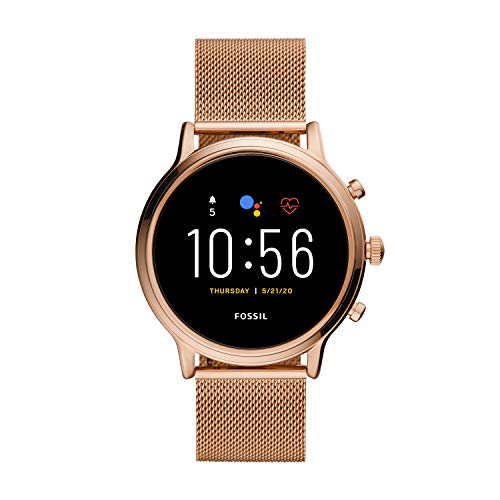
Fossil Q Julianna Hr Gen 5
6.9/10

Overall score

Score
6.9/ 10
✕
What it is
An overall evaluation of the smartwatch's quality, based on technical analyses and user reviews.
When it matters
When you need a quick reference to identify the best smartwatches on the market.
Score distribution
â–¼
<55-66-77-88-99-10
Score components

70%

6.8

Technical score

30%

7.2

Reviews score ( 0 · 2)

Reviews score 30% · 7.2 · based on 2 videos
2 videos count as 1 of the 5 needed; the rest counts as 7/10. Every model in this category gets the same split: reviews 30%, technical score 70%. A video or a short review counts less than a full test.
â–²Better than 61% of smartwatches
7.5

Value for money

Value for money
7.5/ 10
✕
What it is
An indicator that combines the smartwatch's overall rating with its cost.
When it matters
When you are looking for a smartwatch with a good balance between quality and price.
Score distribution
â–¼
<55-66-77-88-99-10
Score components

70%

6.9

Overall score

30%

8.8

Price

â–¼Worse than 54%
6.8

Technical score

Technical score
6.8/ 10
✕
What it is
An assessment of the smartwatchx27s technical performance, covering seven key areas: health, fitness, display & design, hardware, battery, smart features and connectivity.
When it matters
When you want to compare smartwatches based on technical performance and available features.
Score distribution
â–¼
<55-66-77-88-99-10
Score components

24%

4.8

Health

21%

9.5

Fitness

16%

5.5

Battery

14%

7.2

Smart features

12%

7.6

Connectivity

9%

7.2

Display & Design

4%

6.1

Hardware

â–²Better than 65%
7.2

Reviews score

Reviews score
7.2/ 10
✕
What it is
Average grade from independent test sites, magazines and video reviewers, 1–10.
How we count it
Grades: Each review's own score is converted to 1–10; without one, we grade the review ourselves.
Weighting: Big test sites count more, short reviews half as much as full tests. A video review counts half.
Share: Reviews are 30% of the overall score for every model in this category; each of the 5 needed reviews that is missing counts as 7/10.
Score distribution
â–¼
<55-66-77-88-99-10
Grades by review (2)
2 video reviews, each counting half as much as a written test. Share in the overall score: 30%, the same for every model in this category.
User ratings collected online are not part of this score.
â–¼Worse than 77%
Loading...
Loading category ranking...

Technical Specifications of smartwatch Fossil Q Julianna Hr Gen 5

Technical score
Technical score
6.8/ 10
✕
What it is
An assessment of the smartwatchx27s technical performance, covering seven key areas: health, fitness, display & design, hardware, battery, smart features and connectivity.
When it matters
When you want to compare smartwatches based on technical performance and available features.
Score distribution
â–¼
<55-66-77-88-99-10
Score components:

24%

4.8

Health

21%

9.5

Fitness

16%

5.5

Battery

14%

7.2

Smart features

12%

7.6

Connectivity

9%

7.2

Display & Design

4%

6.1

Hardware

6.8
Reviews score
7.2
Value for money
Value for money
7.5/ 10
✕
What it is
An indicator that combines the smartwatch's overall rating with its cost.
When it matters
When you are looking for a smartwatch with a good balance between quality and price.
Score distribution
â–¼
<55-66-77-88-99-10
Score components:

70%

6.9

Overall score

30%

8.8

Price

7.5
Brand name
Fossil
Heart rate monitor
yes
This smartwatch includes a heart rate monitor. 10.5% of smartwatches include a heart rate monitor.
Blood oxygen monitoring
no
This smartwatch does not support blood oxygen monitoring. 66.8% of smartwatches support blood oxygen monitoring.
ECG
no
This smartwatch does not support ECG. 16.6% of smartwatches support ECG.
Irregular heart rate warnings
no
This smartwatch does not support irregular heart rate warnings. 48.2% of smartwatches support irregular heart rate warnings.
Show more
What reviewers say
Accelerometer
yes
This smartwatch includes an accelerometer. 0.6% of smartwatches include an accelerometer.
Barometer
yes
This smartwatch includes a barometer. 50.6% of smartwatches include a barometer.
Gyroscope
yes
This smartwatch includes a gyroscope. 30.2% of smartwatches include a gyroscope.
Cadence sensor
no
This smartwatch does not include a cadence sensor. 31.2% of smartwatches include a cadence sensor.
Distance tracking
yes
This smartwatch supports distance tracking. 4.1% of smartwatches support distance tracking.
Show more
Battery life
1.25 days
This smartwatch offers a battery life of 1.25 days which is shorter than that of 86.7% of smartwatches and equal to that of 0.3% of smartwatches.
Battery life in training mode
6 h
This smartwatch lasts 6 h in training mode which is shorter than 83.5% of smartwatches and equal to that of 6.1% of smartwatches.
Battery life with GPS on
24 h
This smartwatch lasts 24 h with GPS on which is longer than 60.6% of smartwatches and equal to that of 2.5% of smartwatches.
Battery power
310 mAh
This smartwatch has a battery capacity of 310 mAh which is larger than the batteries in 54.3% of smartwatches and equal to those in 1.2% of smartwatches.
Charge time
60 min
This smartwatch charges in 60 min which is faster than 82.6% of smartwatches and equal to the charge time of 12.1% of smartwatches.
Approximate value from reported charging range: 60 minutes.
Show more
Operating system
Wear OS
This smartwatch runs Wear OS which is more advanced than the operating system in 79% of smartwatches and the same as that in 16.6% of smartwatches.
Software update frequency
occasional
This smartwatch has occasional software update support which is more active than that of 57.6% of smartwatches and equal to that of 36.2% of smartwatches.
Updates are typically released about every 3 months.
Third-party app support
yes
This smartwatch supports third-party apps. 52.4% of smartwatches support third-party apps.
Notifications
yes
This smartwatch supports notifications. 0.3% of smartwatches support notifications.
Voice assistant support
yes
This smartwatch supports voice assistants. 32.4% of smartwatches support voice assistants.
Show more
Cellular module
no
This smartwatch does not include a cellular module. 18% of smartwatches include a cellular module.
SIM cards
0
GPS
yes
This smartwatch supports GPS. 43.9% of smartwatches support GPS.
Galileo support
no
This smartwatch does not support Galileo navigation. 38.5% of smartwatches support Galileo navigation.
Compass
yes
This smartwatch includes a compass. 47.5% of smartwatches include a compass.
Show more
Screen size
1.28 inch
This smartwatch has a screen size of 1.28 inch which is smaller than the screens of 78.2% of smartwatches and equal to those of 5.2% of smartwatches.
Display type
AMOLED
This smartwatch uses a AMOLED display type which is more advanced than that of 49.9% of smartwatches and the same as that of 50.1% of smartwatches.
Resolution
416x 416
This smartwatch has a display resolution of 416x416 which is higher than that of 74.7% of smartwatches and equal to that of 3.1% of smartwatches.
Pixel density
460 ppi
This smartwatch has a pixel density of 460 ppi which is higher than that of 79.3% of smartwatches and equal to that of 5% of smartwatches.
Display brightness
?
Show more
CPU speed
1.2 GHz
This smartwatch uses a CPU configuration of 1.2 GHz which is faster than that in 61.2% of smartwatches and equal to that in 4.8% of smartwatches.
Processor model
Snapdragon Wear 3100
This smartwatch uses the Snapdragon Wear 3100 processor model.
RAM
1 GB
This smartwatch has 1 GB of RAM which is larger than the RAM in 31.3% of smartwatches and equal to that of 45.8% of smartwatches.
Internal storage
8 GB
This smartwatch uses 8 GB for internal storage which is larger than that of 67.6% of smartwatches and equal to that of 12.1% of smartwatches.
External memory slot
no
This smartwatch does not include an external memory slot. 0.3% of smartwatches include an external memory slot.
Show more

Fossil Q Julianna Hr Gen 5 vs the average smartwatch

246810TotalHealthFitnessBatteryConnectivityDisplay & DesignSmart featuresHardware
  • 60 min shorter charge time
    This smartwatch charges faster than the average smartwatch (60 min vs 120 min). The average smartwatch charges in 120 min.
    Approximate value from reported charging range: 60 minutes.
    60 min vs 120 min
  • More advanced operating system
    This smartwatch runs a more advanced operating system than the average smartwatch (Wear OS vs Proprietary OS).
    Wear OS vs Proprietary OS
  • Maps support
    This smartwatch supports maps, the average smartwatch does not. 31.5% of smartwatches support maps.
  • VO2 max measurement
    This smartwatch measures VO2 max, the average smartwatch does not. 47.6% of smartwatches measure VO2 max.
  • Supports wireless charging
    This smartwatch supports wireless charging, the average smartwatch does not. 24.5% of smartwatches support wireless charging.
    Supports Qi-compatible wireless charging.
  • NFC functionality
    This smartwatch supports NFC, the average smartwatch does not. 43.4% of smartwatches support NFC.
  • Third-party app support
    This smartwatch supports third-party apps, the average smartwatch does not. 47.6% of smartwatches support third-party apps.
  • External heart rate monitor support
    This smartwatch supports external heart rate monitor compatibility, the average smartwatch does not. 42.7% of smartwatches support external heart rate monitor compatibility.
    Supports external monitors over Bluetooth/BLE.
  • 58.7% more popular
    Fossil Q Julianna Hr Gen 5 has a higher popularity than the average smartwatch (9.71 vs 6.1).
    9.71 vs 6.12
  • VO2 max measurement
    This smartwatch measures VO2 max, the average smartwatch does not. 47.6% of smartwatches measure VO2 max.
  • Calorie tracking
    This smartwatch supports calorie tracking, the average smartwatch does not. 48.6% of smartwatches support calorie tracking.
  • Water intake tracking
    This smartwatch tracks water intake, the average smartwatch does not. 44% of smartwatches track water intake.
  • External heart rate monitor support
    This smartwatch supports external heart rate monitor compatibility, the average smartwatch does not. 42.7% of smartwatches support external heart rate monitor compatibility.
    Supports external monitors over Bluetooth/BLE.
  • Barometer sensor included
    This smartwatch includes a barometer, the average smartwatch does not. 49.5% of smartwatches include a barometer.
  • Route support
    This smartwatch supports route support, the average smartwatch does not. 50% of smartwatches support route support.
    Route support available via companion app.
  • 60 min shorter charge time
    This smartwatch charges faster than the average smartwatch (60 min vs 120 min). The average smartwatch charges in 120 min.
    Approximate value from reported charging range: 60 minutes.
    60 min vs 120 min
  • Supports wireless charging
    This smartwatch supports wireless charging, the average smartwatch does not. 24.5% of smartwatches support wireless charging.
    Supports Qi-compatible wireless charging.
  • 4 h longer GPS battery life
    This smartwatch lasts longer with GPS on than the average smartwatch (24 h vs 20 h). The average smartwatch lasts 20 h.
    24 h vs 20 h
  • Maps support
    This smartwatch supports maps, the average smartwatch does not. 31.5% of smartwatches support maps.
  • NFC functionality
    This smartwatch supports NFC, the average smartwatch does not. 43.4% of smartwatches support NFC.
  • Supports Wi-Fi
    This smartwatch supports Wi-Fi, the average smartwatch does not. 43.3% of smartwatches support Wi-Fi.
  • Better band material
    This smartwatch uses silicone, leather, stainless steel for the band material, while the average smartwatch uses silicone.
    silicone, leather, stainless steel vs silicone
  • 134 ppi higher pixel density
    This smartwatch has a higher pixel density than the average smartwatch (460 ppi vs 326 ppi). The average smartwatch display reaches 326 ppi.
    460 ppi vs 326 ppi
  • 4 mm narrower band
    This smartwatch has a narrower band width than the average smartwatch (18 mm vs 22 mm). The average smartwatch band is 22.0 mm wide.
    18.0 mm vs 22.0 mm
  • Better case material
    This smartwatch uses stainless steel for the case material, while the average smartwatch uses polycarbonate.
    stainless steel vs polycarbonate
  • Higher resolution
    This smartwatch has a display resolution of 416x416, while the average smartwatch reaches 352x430.
    416x416 vs 352x430
  • More advanced operating system
    This smartwatch runs a more advanced operating system than the average smartwatch (Wear OS vs Proprietary OS).
    Wear OS vs Proprietary OS
  • Third-party app support
    This smartwatch supports third-party apps, the average smartwatch does not. 47.6% of smartwatches support third-party apps.
  • More frequent updates
    This smartwatch receives occasional software updates, while the average smartwatch receives ended updates.
    Updates are typically released about every 3 months.
    occasional vs ended
  • More advanced processor model
    This smartwatch uses the Snapdragon Wear 3100 processor model, while the average smartwatch uses Silicon Labs EFM32 Giant Gecko.
    Snapdragon Wear 3,100 vs Silicon Labs EFM32 Giant Gecko
  • Faster CPU speed
    This smartwatch uses a CPU configuration of 1.2 GHz, while the average smartwatch uses 1 GHz.
    1.2 GHz vs 1 GHz
  • No blood oxygen monitoring
    This smartwatch does not support blood oxygen monitoring, the average smartwatch does. 66.7% of smartwatches support blood oxygen monitoring.
  • 5.75 days day/s shorter battery life
    This smartwatch offers 1.3 days of battery life, while the average smartwatch offers 7 days.
    1.25 days vs 7 days
  • 13.25 h shorter training battery life
    This smartwatch lasts less in training mode than the average smartwatch (6 h vs 19.25 h). The average smartwatch lasts 19.25 h.
    6 h vs 19.25 h
  • Lower IP rating
    This smartwatch has a lower IP rating than the average smartwatch (IP67 vs IP68).
    Also reported with 3 ATM water-resistance rating.
    IP67 vs IP68
  • 35 g heavier weight
    This smartwatch is heavier than the average smartwatch (80 g vs 45 g). The average smartwatch weighs 45.0 g.
    80.0 g vs 45.0 g
  • 20 m lower water resistance depth
    This smartwatch has a shallower waterproof rating than the average smartwatch (30 m vs 50 m). The average smartwatch reaches 50 m.
    30 m vs 50 m
  • 0.12 inch smaller screen size
    This smartwatch has a smaller screen size than the average smartwatch (1.3 inch vs 1.4 inch). The average smartwatch screen is 1.40 inch.
    1.28 inch vs 1.40 inch
  • No smart alarm
    This smartwatch does not support a smart alarm, the average smartwatch does. 52.7% of smartwatches support smart alarms.
  • 2.46x more expensive
    Fossil Q Julianna Hr Gen 5 is more expensive than the average smartwatch (£320 vs £130).
    £320 vs £130
  • No blood oxygen monitoring
    This smartwatch does not support blood oxygen monitoring, the average smartwatch does. 66.7% of smartwatches support blood oxygen monitoring.
  • 5.75 days day/s shorter battery life
    This smartwatch offers 1.3 days of battery life, while the average smartwatch offers 7 days.
    1.25 days vs 7 days
  • 13.25 h shorter training battery life
    This smartwatch lasts less in training mode than the average smartwatch (6 h vs 19.25 h). The average smartwatch lasts 19.25 h.
    6 h vs 19.25 h
  • Older Bluetooth version
    This smartwatch supports an older Bluetooth version than the average smartwatch (4.2 vs 5). The average smartwatch uses 5.0.
    4.2 vs 5.0
  • Lower IP rating
    This smartwatch has a lower IP rating than the average smartwatch (IP67 vs IP68).
    Also reported with 3 ATM water-resistance rating.
    IP67 vs IP68
  • 35 g heavier weight
    This smartwatch is heavier than the average smartwatch (80 g vs 45 g). The average smartwatch weighs 45.0 g.
    80.0 g vs 45.0 g
  • 20 m lower water resistance depth
    This smartwatch has a shallower waterproof rating than the average smartwatch (30 m vs 50 m). The average smartwatch reaches 50 m.
    30 m vs 50 m
  • 0.12 inch smaller screen size
    This smartwatch has a smaller screen size than the average smartwatch (1.3 inch vs 1.4 inch). The average smartwatch screen is 1.40 inch.
    1.28 inch vs 1.40 inch
  • 0.4 mm thicker watch body
    This smartwatch is thicker than the average smartwatch (12 mm vs 11.6 mm). The average smartwatch thickness is 11.6 mm.
    12 mm vs 11.6 mm
  • No smart alarm
    This smartwatch does not support a smart alarm, the average smartwatch does. 52.7% of smartwatches support smart alarms.
  • 2 year/s older release date
    This smartwatch is an older model than the average smartwatch (2019 vs 2021). The average smartwatch was released in 2021.
    August 2019
    2019 vs 2021

Video reviews

Hands-on testing, unboxing, and real-world video evaluations

7.0
LydiaaWong
≈ estimated
26/08/2019
Long-term test · one week of daily use
Verdict
Fossil Q Julianna HR Gen 5 is stylish and fluid with good apps and faces, but call audio, gestures and outdoor brightness let it down.
Not graded yet
Not graded yet
Not graded yet
Not graded yet

What reviewers agree on

Based on 0 · 3

The few reviewers agree health and fitness tracking works well, with no clear complaints raised.
Praised
Pick a topic to see who said what

Third-party reviews

What we like about Fossil Q Julianna Hr Gen 5

  • Elegant, traditional watch design that fits various styles
  • Vibrant, sharp AMOLED display with high pixel density and good visibility in sunlight
  • Customisable buttons and rotating crown for easy menu navigation
  • Built-in speaker allows for taking phone calls and hearing Google Assistant responses directly from the wrist
  • Fast and responsive performance due to 1GB of RAM and Snapdragon Wear 3100 processor
  • Rapid charging capability that can reach a full charge in approximately one hour

What we don't like about Fossil Q Julianna Hr Gen 5

  • Battery life typically lasts only about 24 hours, requiring daily charging
  • Lack of advanced health features like native sleep tracking and limited analysis in Google Fit
  • Heart rate monitoring can be inconsistent during high-intensity workouts compared to chest straps
  • Large 44mm case size may feel heavy or oversized on smaller wrists
  • Software experience on iOS is restricted, with no support for replying to iMessages
  • GPS usage significantly drains the battery and can be slow to acquire a signal

Verdict

The Fossil Gen 5 Julianna HR is a stylish 44mm Wear OS smartwatch featuring a 1.28-inch AMOLED display (328 ppi), a Qualcomm Snapdragon Wear 3100 processor, and 1GB of RAM for smooth performance. Its core features include a built-in speaker for phone calls and Google Assistant responses, 8GB of internal storage, and integrated GPS, NFC for Google Pay, and a heart rate monitor. Main pros include its premium stainless steel design, quick charging (reaching 80% in under an hour), and versatile custom battery modes that extend usage across multiple days. However, notable cons include a generally short battery life during heavy use, limited health tracking depth compared to specialized rivals, and a bulky 12mm thickness that may feel oversized on smaller wrists.

Compare Fossil Q Julianna Hr Gen 5 with other Smartwatches

1Product to compare no. 1
VS
2Product to compare no. 2
VS
3Product to compare no. 3 (optional)

Graphic comparison of Fossil Q Julianna Hr Gen 5 and other Smartwatches

No results found