Scored using Smartphones Methodology v3.0
Smartphones Methodology v3.0
Mathematical & Unbiased Scoring
Products in this category are scored under Frontum Smartphones Methodology v3.0: the technical score from the specifications is the base, and independent expert and video reviews (up to ±0.5 points), owner opinions (up to ±0.3) and best-of lists (up to +0.3) move it up or down.
Explore Smartphones Methodology v3.0

Xiaomi Redmi Note 15 Pro+ 5G (12GB + 512GB) review: 196 specs compared

Avg. price:~£470RAM capacity:12 GBInternal storage:512 GBScreen size:6.83 inchesMain camera megapixels:50 MP & 50 MP & 8 MP

Xiaomi Redmi Note 15 Pro+ 5G (12GB + 512GB) Review: Compare 196 technical specifications, 60 expert and video reviews and 2 best-of lists to see how this product ranks in the Smartphones category and whether it is worth buying.
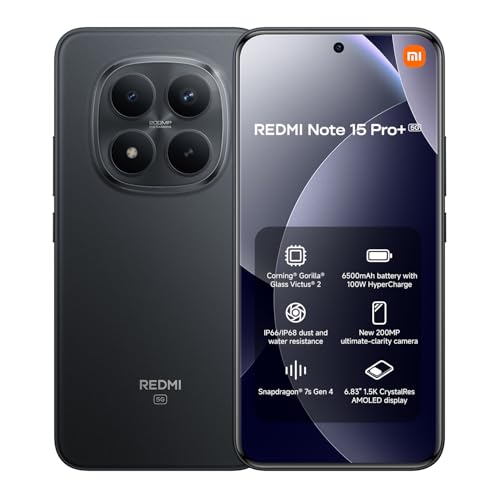
Xiaomi Redmi Note 15 Pro+ 5G (12GB + 512GB)
8.2/10

Overall score

Score
8.2/ 10
✕
What it is
Our main score for this model, 1–10. It combines specs, best-of lists, expert reviews and owners.
How we count it
Parts: Technical score 35%, List score 30%, Reviews score 25%, Sentiment score 10%
Marks: Each part gets a mark out of 10. For reviews, lists and owners, a typical model in this category gets about 8 and the best one gets 10.
No data yet: A part with no data shows "?". It counts as the mark of a weaker model in this category (4 in 5 models with data score higher). This way, models with reviews, lists and owners usually come out ahead.
Score distribution
▼
<55-66-77-88-99-10
Score components

35%

8.5

Technical score

30%

8.0

List score

25%

7.9

Reviews score

10%

8.2

Sentiment score

★Better than 91% of smartphones
8.1

Value for money

Value for money
8.1/ 10
✕
What it is
An indicator that combines the smartphone's overall rating with its cost.
When it matters
When you are looking for a smartphone with a good balance between quality and price.
Score distribution
▼
<55-66-77-88-99-10
Score components

70%

8.2

Overall score

30%

8.0

Price

▲Better than 87%
8.5

Technical score

Technical score
8.5/ 10
✕
What it is
How good the specs are compared with the other models in this category, 1–10.
How we count it
Areas: We rate the specs in each area against the other models in this category.
Weighting: The areas that matter most to buyers count more. The shares are shown under Score components.
Share: The technical score is 35% of the overall score.
Score distribution
▼
<55-66-77-88-99-10
Score components

25%

7.9

Performance

18%

8.5

Camera

15%

9.2

Display

15%

8.0

Battery

10%

9.3

Software

10%

8.4

Connectivity

4%

8.5

Audio

3%

8.2

Design

★Better than 95%
7.9

Reviews score

Reviews score
7.9/ 10
✕
What it is
Average grade from independent test sites, magazines and video reviewers, 1–10.
How we count it
Grades: Each review's own score is converted to 1–10; without one, we grade the review ourselves. Big test sites count more, short reviews half as much as full tests. A video review counts half.
Score: The average grade is 80% of the review mark; the number of reviews is the other 20% (1 review = 5, the typical number in this category = 8, the most-reviewed model = 10).
Enough data: With few reviews, the average grade is pulled toward the typical grade of this category. No reviews yet: 7.5 for now.
Share: Reviews count 25% of the overall score.
Score distribution
▼
<55-66-77-88-99-10

80%

7.6

Average grade

20%

9.0

Popularity

Grades by review (60)
5 reviews: 4 with a printed score, 1 estimated from the review. 55 video reviews, each counting half as much as a written test. Reviews count 25% of the overall score.
User ratings collected online are not part of this score.
▼Worse than 51%
8.0

List score

List score
8.0/ 10
✕
What it is
How often independent test sites, magazines and video reviewers put this model in their best-of lists for this category.
How we count it
Points: The model in the most lists of this category gets 10; the others get 8 to 10 in proportion. In no list yet: 7.5. Lists count 30% of the overall score.
Enough data: Every list counts, even a single one. With fewer than 5 best-of lists in the category, this part is left out.
Lists with this model (2)
List score: in 2 of 226 lists (1%)
▲Better than 89%

What reviewers say about the Xiaomi Redmi Note 15 Pro+ 5G (12GB + 512GB)

Based on 5 · 57

Reviewers praise the outstanding battery life, bright display and tough build, but criticize the weak extra lenses, bloated software and value.
Praised
Mixed views
Criticised
Pick a topic to see who said what

What owners say about the Xiaomi Redmi Note 15 Pro+ 5G (12GB + 512GB)

Based on 172 owners sharing their experience in online comments

51%positive6%mixed43%negative

Owners praise the long battery life, bright display, durability and value, but frequently criticize cameras, software smoothness, and battery drain.

What owners dislike

  • Owners say the main, selfie and video camera quality is weak, with flat colours, heavy processing, poor low-light results and blurry video calls.20
  • Owners say the battery drains quickly even with light use, and some report a sharp drop during standby after the HyperOS 3 update.11
  • Owners say HyperOS software becomes slow and buggy after a few months, and some report battery drain and network problems after updating to Android 16.11
  • Owners say the phone lags and freezes during multitasking and gaming, and Bluetooth audio quality drops; some report it overheating during calls.10
  • Owners say Wi-Fi 5 connections can take up to 30 seconds to connect, and some report weak 5G signal and blocked USB tethering.8
  • Owners say it costs too much for what it offers, with cheaper phones such as the Poco M8 giving similar screen, battery and speed.8
  • Owners say the screen looks dull and flat, is weak in direct sunlight, and some notice flicker and colour shifts depending on lighting.6
  • Owners say the phone overheats and freezes during long gaming sessions such as Call of Duty or PUBG, and gets hot during calls.5
  • Owners say the curved screen and exposed camera lenses scratch easily, and the fingerprint sensor sometimes fails to read.5
  • Owners say the phone shows intrusive ads and pre-installed apps that are hard to remove, and ads can't be fully disabled.5

Points mentioned by at least 3 owners, most mentioned first.

Loading...
Loading category ranking...

Technical Specifications of smartphone Xiaomi Redmi Note 15 Pro+ 5G (12GB + 512GB)

Technical score
Technical score
8.5/ 10
✕
What it is
How good the specs are compared with the other models in this category, 1–10.
How we count it
Areas: We rate the specs in each area against the other models in this category.
Weighting: The areas that matter most to buyers count more. The shares are shown under Score components.
Share: The technical score is 35% of the overall score.
Score distribution
▼
<55-66-77-88-99-10
Score components:

25%

7.9

Performance

18%

8.5

Camera

15%

9.2

Display

15%

8.0

Battery

10%

9.3

Software

10%

8.4

Connectivity

4%

8.5

Audio

3%

8.2

Design

8.5
Reviews score
7.9
List score
8.0
Value for money
Value for money
8.1/ 10
✕
What it is
An indicator that combines the smartphone's overall rating with its cost.
When it matters
When you are looking for a smartphone with a good balance between quality and price.
Score distribution
▼
<55-66-77-88-99-10
Score components:

70%

8.2

Overall score

30%

8.0

Price

8.1
Processor model
Qualcomm Snapdragon 7s Gen 4
This smartphone uses the Qualcomm Snapdragon 7s Gen 4 processor which is faster than processors in 67.2% of smartphones and equal to processors in 0.1% of smartphones.
Storage type
?
RAM capacity
12 GB
This smartphone has a RAM capacity of 12 GB which is larger than the RAM capacity of 59.3% of smartphones and equal to that of 24.3% of smartphones.
Internal storage
512 GB
This smartphone has an internal storage capacity of 512 GB which is larger than the storage of 77.4% of smartphones and equal to that of 17.1% of smartphones.
CPU boost clock speed
2.7 GHz
The CPU boost clock speed of this smartphone is 2.7 GHz which is higher than the boost speed of 62.7% of smartphones and equal to that of 0.9% of smartphones.
Show more
What reviewers say
Operating system
Android
This smartphone runs Android, which is more mainstream than the system in 4.8% of smartphones and the same as in 95.2% of smartphones.
Android 15 (HyperOS 2)
Android version
Android 15
This smartphone runs Android version Android 15 which is newer than that found in 70.5% of smartphones and equal to that in 25% of smartphones.
Direct OS updates
yes
This smartphone receives direct OS updates. 20.1% of smartphones receive direct updates.
Promised software updates
?
Open-source OS
yes
This smartphone runs an open-source operating system. 5.2% of smartphones offer this.
Show more
What reviewers say
Multi-lens main camera
yes
This smartphone includes a multi-lens main camera system. 93.7% of smartphones include multi-lens setups.
Main camera megapixels
50 MP & 50 MP & 8 MP
This smartphone has a main camera resolution of 50 MP & 50 MP & 8 MP which is higher than that of 68.6% of smartphones and equal to that of 1.8% of smartphones.
Main camera aperture
f/1.6 & f/2.2 & f/2.2
This smartphone has a main camera aperture of f/1.6 & f/2.2 & f/2.2 which is wider than that of 93.9% of smartphones and equal to that of 0.2% of smartphones.
or 1.7 & 2.2 & ? for global variant, or 1.65 & 1.9 & 2.4 for another variant
Main camera sensor area
?
Main camera pixel size
?
Show more
What reviewers say
Number of SIM slots
2
This smartphone has 2 SIM slots, which is more than in 3.7% of smartphones and equal to the number in 96.2% of smartphones.
2 Nano-SIM (or 1 Nano-SIM + 1 eSIM in some regions)
Cellular module
yes
This smartphone includes a cellular module. 100% of smartphones include cellular modules.
eSIM support
?
5G connectivity
yes
This smartphone supports 5G connectivity. 66.6% of smartphones support 5G.
LTE support
yes
This smartphone supports LTE. 99.7% of smartphones include LTE connectivity.
Show more
Screen size
6.83 inches
This smartphone has a screen size of 6.83 inches which is larger than the screens of 89.9% of smartphones and equal to those of 1.3% of smartphones.
Screen resolution
1220x 2772 px
This smartphone has a screen resolution of 1220x2772 px which is higher than that of 80.2% of smartphones and equal to that of 0.2% of smartphones.
Pixel density
443 ppi
This smartphone has a pixel density of 443 ppi which is higher than that of 77.4% of smartphones and equal to that of 0.3% of smartphones.
Display type
OLED/AMOLED
This smartphone uses a OLED/AMOLED display type. 58.4% of smartphones use this display technology.
Refresh rate
120 Hz
This smartphone supports a refresh rate of 120 Hz which is higher than in 34.4% of smartphones and equal to that in 55.6% of smartphones.
Show more
What reviewers say
Battery capacity
7,000 mAh
This smartphone has a battery capacity of 7,000 mAh which is larger than the batteries in 86% of smartphones and equal to those in 4.8% of smartphones.
Charging speed
90 W
This smartphone supports charging speeds of 90 W which is faster than in 86.6% of smartphones and equal to speeds in 3.5% of smartphones.
Fast charging
yes
This smartphone supports fast charging. 93.2% of smartphones support fast charging.
GSMArena full wired charge time
?
Wireless charging
no
This smartphone does not support wireless charging. 25.1% of smartphones support wireless charging.
Show more
What reviewers say
Stereo speakers
yes
This smartphone includes stereo speakers. 64.3% of smartphones provide stereo audio.
3.5 mm headphone jack
no
This smartphone does not have a headphone jack. 45.1% of smartphones offer this.
Number of microphones
2
This smartphone includes 2 microphones, which is more than in 10.3% of smartphones and equal to the number in 66.9% of smartphones.
FM radio
no
This smartphone does not have an FM radio. 34.3% of smartphones offer this.
aptX Lossless
yes
This smartphone supports aptX Lossless. 12.5% of smartphones provide aptX Lossless.
Show more
What reviewers say
Height
163.3 mm
This smartphone has a height of 163.3 mm which is shorter than 53.9% of smartphones and equal to that of 1.5% of smartphones.
Width
78.3 mm
This smartphone has a width of 78.3 mm which is wider than 86.2% of smartphones and equal to that of 0.3% of smartphones.
Thickness
7.9 mm
This smartphone has a thickness of 7.9 mm which is thinner than 72.1% of smartphones and equal to that of 5% of smartphones.
Weight
211 g
This smartphone weighs 211 g which is heavier than 74% of smartphones and equal to the weight of 1% of smartphones.
Device volume
101 cm³
This smartphone has a device volume of 101 cm³ which is smaller than 52.8% of smartphones and equal to that of 4.6% of smartphones.
Show more
What reviewers say

Xiaomi Redmi Note 15 Pro+ 5G (12GB + 512GB) vs the average smartphone

246810TotalPerformanceSoftwareCameraConnectivityDisplayBatteryAudioDesign
  • 40% larger battery capacity
    This smartphone has a larger battery capacity than the average smartphone (7,000 mAh vs 5,000 mAh). The average smartphone battery is 5,000 mAh.
    7,000 mAh vs 5,000 mAh
  • 2.5 x higher optical zoom
    This smartphone offers stronger optical zoom than the average smartphone (2.5 x vs 0 x). The average smartphone's optical zoom is 0 x.
    2.5 x vs 0 x
  • 2.73x faster charging speed
    This smartphone supports a faster charging speed than the average smartphone (90 W vs 33 W). The average charging speed is 33 W.
    90 W vs 33 W
  • Has optical image stabilization
    This smartphone has optical image stabilization (OIS), the average smartphone does not. 48.4% of smartphones feature OIS.
  • Direct OS updates
    This smartphone supports direct OS updates, the average smartphone does not. 20.1% of smartphones support this feature.
  • 2x more storage
    This smartphone offers more internal storage than the average smartphone (512 GB vs 256 GB). The average smartphone provides 256 GB of internal storage.
    512 GB vs 256 GB
  • 2,200 nits higher peak brightness
    This smartphone has a higher peak brightness than the average smartphone (3,200 nits vs 1,000 nits). The average peak brightness is 1,000 nits.
    3,200 nits vs 1,000 nits
  • 4 GB more RAM
    This smartphone has more RAM capacity than the average smartphone (12 GB vs 8 GB). The average smartphone has 8 GB of RAM.
    12 GB vs 8 GB
  • 8.2% higher review score
    Reviews score
    7.9/ 10
    ✕
    What it is
    Average grade from independent test sites, magazines and video reviewers, 1–10.
    How we count it
    Grades: Each review's own score is converted to 1–10; without one, we grade the review ourselves. Big test sites count more, short reviews half as much as full tests. A video review counts half.
    Score: The average grade is 80% of the review mark; the number of reviews is the other 20% (1 review = 5, the typical number in this category = 8, the most-reviewed model = 10).
    Enough data: With few reviews, the average grade is pulled toward the typical grade of this category. No reviews yet: 7.5 for now.
    Share: Reviews count 25% of the overall score.
    Score distribution
    ▼
    <55-66-77-88-99-10

    80%

    7.6

    Average grade

    20%

    9.0

    Popularity

    Grades by review (60)
    5 reviews: 4 with a printed score, 1 estimated from the review. 55 video reviews, each counting half as much as a written test. Reviews count 25% of the overall score.
    User ratings collected online are not part of this score.
    7.9 vs 7.3
  • 6% better value for money
    Xiaomi Redmi Note 15 Pro+ 5G (12GB + 512GB) has better value for money than the average smartphone (8.12 vs 7.7).
    8.12 vs 7.66
  • 3.9% higher list score
    List score
    8.0/ 10
    ✕
    What it is
    How often independent test sites, magazines and video reviewers put this model in their best-of lists for this category.
    How we count it
    Points: The model in the most lists of this category gets 10; the others get 8 to 10 in proportion. In no list yet: 7.5. Lists count 30% of the overall score.
    Enough data: Every list counts, even a single one. With fewer than 5 best-of lists in the category, this part is left out.
    Lists with this model (2)
    List score: in 2 of 226 lists (1%)
    8.0 vs 7.7
  • 2x more storage
    This smartphone offers more internal storage than the average smartphone (512 GB vs 256 GB). The average smartphone provides 256 GB of internal storage.
    512 GB vs 256 GB
  • 4 GB more RAM
    This smartphone has more RAM capacity than the average smartphone (12 GB vs 8 GB). The average smartphone has 8 GB of RAM.
    12 GB vs 8 GB
  • 33.3% smaller process node
    This smartphone uses a smaller process node than the average smartphone (4 nm vs 6 nm). The average process node size is 6 nm.
    4 nm vs 6 nm
  • Higher CPU base clock speed
    This smartphone has a higher CPU base clock speed than the average smartphone (1x2.7 GHz & 3x2.4 GHz & 4x1.8 GHz vs 2x2.2 GHz & 6x2 GHz). The average smartphone has a base clock speed of 2x2.2 GHz & 6x2 GHz.
    1x2.7 GHz & 3x2.4 GHz & 4x1.8 GHz vs 2x2.2 GHz & 6x2 GHz
  • 12.5% higher CPU boost clock speed
    This smartphone has a higher CPU boost clock speed than the average smartphone (2.7 GHz vs 2.4 GHz). The average smartphone has a boost clock speed of 2.4 GHz.
    2.7 GHz vs 2.4 GHz
  • 14.3% higher maximum RAM
    This smartphone supports more maximum RAM than the average smartphone (16 GB vs 14 GB). The average smartphone supports 14 GB RAM.
    16 GB vs 14 GB
  • 1 year/s newer release date
    This smartphone has a newer release date than the average smartphone (2025 vs 2024). 1.00% of smartphones are released annually.
    August 2025
    2025 vs 2024
  • Direct OS updates
    This smartphone supports direct OS updates, the average smartphone does not. 20.1% of smartphones support this feature.
  • Supports fast boot
    This smartphone supports fast boot, the average smartphone does not. 22.1% of smartphones include fast boot capabilities.
  • Newer Android version
    This smartphone features a newer Android version than the average smartphone (Android 15 vs Android 14). The average version is Android 14.
    Android 15 vs Android 14
  • 2.5 x higher optical zoom
    This smartphone offers stronger optical zoom than the average smartphone (2.5 x vs 0 x). The average smartphone's optical zoom is 0 x.
    2.5 x vs 0 x
  • Has optical image stabilization
    This smartphone has optical image stabilization (OIS), the average smartphone does not. 48.4% of smartphones feature OIS.
  • Supports RAW photo capture
    This smartphone supports RAW photo capture, the average smartphone does not. 37.3% of smartphones allow RAW files.
  • Wider main camera aperture
    This smartphone has a wider main camera aperture than the average smartphone (f/1.6 & f/2.2 & f/2.2 vs f/1.8 & f/2.2 & f/2.4 & f/2.4). The average smartphone has a main camera aperture of f/1.8 & f/2.2 & f/2.4 & f/2.4.
    or 1.7 & 2.2 & ? for global variant, or 1.65 & 1.9 & 2.4 for another variant
    f/1.6 & f/2.2 & f/2.2 vs f/1.8 & f/2.2 & f/2.4 & f/2.4
  • Supports 360° panorama
    This smartphone can capture 360° panoramas, the average smartphone cannot. 24.8% of smartphones support 360° panoramas.
  • Allows manual shutter speed
    This smartphone allows manual shutter speed control, the average smartphone does not. 29.5% of smartphones include this.
  • 1 more flash LEDs
    This smartphone has more flash LEDs than the average smartphone (2 vs 1). The average smartphone has 1 flash LEDs.
    2 vs 1
  • Supports HDR10 video recording
    This smartphone supports HDR10 video recording, the average smartphone does not. 35.7% of smartphones support HDR10.
  • Higher-resolution main camera
    This smartphone has a higher main camera resolution than the average smartphone (50 MP & 50 MP & 8 MP vs 50 MP & 8 MP). The average smartphone main camera has 50 MP & 8 MP megapixels.
    50 MP & 50 MP & 8 MP vs 50 MP & 8 MP
  • Higher front camera megapixels
    This smartphone has more front camera megapixels than the average smartphone (32 MP vs 16 MP). The average front camera has 16 MP megapixels.
    32 MP vs 16 MP
  • Has a heart rate monitor
    This smartphone features a heart rate monitor, the average smartphone does not. 4.8% of smartphones include a built-in heart rate sensor.
  • Includes crash detection
    This smartphone features crash detection, the average smartphone does not. 5.6% of smartphones include automatic crash detection.
  • Supports satellite SOS
    This smartphone supports satellite SOS functionality, the average smartphone does not. 7.9% of smartphones offer satellite emergency services.
  • Supports optical tracking
    This smartphone supports optical tracking, the average smartphone does not. 12.2% of smartphones include optical tracking.
  • Supports motion tracking
    This smartphone supports motion tracking, the average smartphone does not. 21.7% of smartphones offer motion tracking capabilities.
  • Newer Bluetooth version
    This smartphone supports a newer Bluetooth version than the average smartphone (5.4 vs 5.2). The average version is Bluetooth 5.2.
    5.4 vs 5.2
  • Newer Wi-Fi version
    This smartphone has more advanced Wi-Fi than the average smartphone (Wi-Fi 6 (802.11ax), Wi-Fi 5 (802.11ac), Wi-Fi 4 (802.11n) vs Wi-Fi 5 (802.11ac), Wi-Fi 4 (802.11n)).
    Wi-Fi 6 (802.11ax), Wi-Fi 5 (802.11ac), Wi-Fi 4 (802.11n) vs Wi-Fi 5 (802.11ac), Wi-Fi 4 (802.11n)
  • Has a barometer
    This smartphone features a barometer, the average smartphone does not. 19.7% of smartphones include a barometer.
  • Has an infrared sensor
    This smartphone includes an infrared sensor, the average smartphone does not. 33.4% of smartphones feature an IR blaster.
  • 2,200 nits higher peak brightness
    This smartphone has a higher peak brightness than the average smartphone (3,200 nits vs 1,000 nits). The average peak brightness is 1,000 nits.
    3,200 nits vs 1,000 nits
  • 0.16 inches inch larger screen size
    This smartphone has a larger screen size than the average smartphone (6.8 inches vs 6.67 inches). The average smartphone screen is 6.67 inches.
    6.83 inches vs 6.67 inches
  • Better display glass type
    This smartphone features a better display glass type than the average smartphone (Xiaomi Dragon Crystal Glass vs Corning Gorilla Glass 5). The average smartphone uses Corning Gorilla Glass 5 protection.
    Xiaomi Dragon Crystal Glass vs Corning Gorilla Glass 5
  • 2x higher touch sampling rate
    This smartphone has a higher touch sampling rate than the average smartphone (480 Hz vs 240 Hz). The average touch sampling rate is 240 Hz.
    480 Hz vs 240 Hz
  • Higher screen resolution
    This smartphone has a higher screen resolution than the average smartphone (1220x2772 px vs 1080x2400 px). The average smartphone resolution is 1080x2400 px.
    1220x2772 px vs 1080x2400 px
  • Supports Dolby Vision support
    This smartphone supports Dolby Vision, the average smartphone does not. 17.2% of smartphones are Dolby Vision compatible.
  • Supports HDR10+ support
    This smartphone supports HDR10+, the average smartphone does not. 22.4% of smartphones include HDR10+ support.
  • Higher contrast ratio
    This smartphone has a higher contrast ratio than the average smartphone (5000000:1 vs 1000000:1). The average smartphone contrast ratio is 1000000:1.
    5,000,000:1 vs 1,000,000:1
  • Supports HDR10 support
    This smartphone supports HDR10, the average smartphone does not. 42.6% of smartphones are HDR10 compatible.
  • 12.2% higher pixel density
    This smartphone has a higher pixel density than the average smartphone (443 ppi vs 395 ppi). The average smartphone has a pixel density of 395 ppi.
    443 ppi vs 395 ppi
  • Has an always-on display
    This smartphone features an always-on display, the average smartphone does not. 49.1% of smartphones offer always-on functionality.
  • Has a curved display
    This smartphone features a curved display, the average smartphone does not. 24.1% of smartphones have curved screens.
  • 40% larger battery capacity
    This smartphone has a larger battery capacity than the average smartphone (7,000 mAh vs 5,000 mAh). The average smartphone battery is 5,000 mAh.
    7,000 mAh vs 5,000 mAh
  • 2.73x faster charging speed
    This smartphone supports a faster charging speed than the average smartphone (90 W vs 33 W). The average charging speed is 33 W.
    90 W vs 33 W
  • Supports reverse wireless charging
    This smartphone supports reverse wireless charging, the average smartphone does not. 23.4% of smartphones offer reverse wireless charging.
  • Supports aptX Adaptive
    This smartphone supports aptX Adaptive, the average smartphone does not. 33.7% of smartphones include aptX Adaptive support.
  • Supports aptX Lossless
    This smartphone supports aptX Lossless, the average smartphone does not. 12.5% of smartphones include aptX Lossless support.
  • Supports aptX
    This smartphone supports aptX, the average smartphone does not. 49.5% of smartphones are aptX compatible.
  • Better IP rating
    This smartphone has a better IP rating than the average smartphone (IP68/IP69K vs IP67). The average IP rating is IP67.
    IP68/IP69K vs IP67
  • 1.5 m deeper water resistance
    This smartphone has a deeper water resistance rating than the average smartphone (1.5 m vs 0 m). The average depth rating is 0 m.
    1.5 m vs 0 m
  • 0.4 mm thinner
    This smartphone is thinner than the average smartphone (7.9 mm vs 8.3 mm). The average smartphone thickness is 8.3 mm.
    7.9 mm vs 8.3 mm
  • No memory card slot
    This smartphone does not have a memory card slot, the average smartphone does. 53.7% of smartphones feature expandable storage.
  • Does not allow app offloading
    This smartphone does not support app offloading, the average smartphone does. 52.5% of smartphones support app offloading to save space.
  • 5.8% slower GPU clock
    This smartphone has a lower GPU frequency than the average smartphone (895 MHz vs 950 MHz). The average smartphone has a GPU frequency of 950 MHz.
    895 MHz vs 950 MHz
  • 22.4% slower memory speed
    This smartphone has a lower memory speed than the average smartphone (2,133 MHz vs 2,750 MHz). The average smartphone has a memory speed of 2,750 MHz.
    2,133 MHz vs 2,750 MHz
  • 2.3 mm wider
    This smartphone is wider than the average smartphone (78.3 mm vs 76 mm). The average smartphone has a width of 76 mm.
    78.3 mm vs 76 mm
  • 7.5% heavier
    This smartphone is heavier than the average smartphone (211 g vs 196.2 g). The average smartphone weighs 196.2 g.
    211 g vs 196.2 g
  • 80.8% more expensive
    Xiaomi Redmi Note 15 Pro+ 5G (12GB + 512GB) is more expensive than the average smartphone (£470 vs £260).
    £470 vs £260
  • 1 fewer external displays supported
    This smartphone supports fewer external displays than the average smartphone (0 vs 1). The average smartphone supports 1 external displays.
    0 vs 1
  • 80.8% more expensive
    Xiaomi Redmi Note 15 Pro+ 5G (12GB + 512GB) is more expensive than the average smartphone (£470 vs £260).
    £470 vs £260
  • 5.8% slower GPU clock
    This smartphone has a lower GPU frequency than the average smartphone (895 MHz vs 950 MHz). The average smartphone has a GPU frequency of 950 MHz.
    895 MHz vs 950 MHz
  • 22.4% slower memory speed
    This smartphone has a lower memory speed than the average smartphone (2,133 MHz vs 2,750 MHz). The average smartphone has a memory speed of 2,750 MHz.
    2,133 MHz vs 2,750 MHz
  • Does not allow app offloading
    This smartphone does not support app offloading, the average smartphone does. 52.5% of smartphones support app offloading to save space.
  • No memory card slot
    This smartphone does not have a memory card slot, the average smartphone does. 53.7% of smartphones feature expandable storage.
  • 1 fewer external displays supported
    This smartphone supports fewer external displays than the average smartphone (0 vs 1). The average smartphone supports 1 external displays.
    0 vs 1
  • 2.3 mm wider
    This smartphone is wider than the average smartphone (78.3 mm vs 76 mm). The average smartphone has a width of 76 mm.
    78.3 mm vs 76 mm
  • 7.5% heavier
    This smartphone is heavier than the average smartphone (211 g vs 196.2 g). The average smartphone weighs 196.2 g.
    211 g vs 196.2 g

Video reviews

Hands-on testing, unboxing, and real-world video evaluations

Not graded yet
Not graded yet
Not graded yet
Not graded yet
Not graded yet
Not graded yet
Not graded yet
Not graded yet
Not graded yet
Not graded yet
Not graded yet
Not graded yet

Verdict

The Xiaomi Redmi Note 15 Pro+ 5G (12GB + 512GB) is a high-quality mid-range smartphone running Android 15 with HyperOS 2, featuring a robust Snapdragon 7s Gen 4 processor and a spacious 6.83-inch, 120Hz AMOLED display with an impressive 3200 nits peak brightness. Its standout characteristics include a powerful 200MP main camera and a substantial 6500mAh (or even 7000mAh depending on the region) battery with 100W (or 90W) fast charging support. Key pros are its excellent display quality, good battery life, fast charging speeds, high-quality build with IP68 dust/water resistance, and the inclusion of stereo speakers with Dolby Atmos. Potential cons include a mid-range chipset that may not be as powerful as some competitors in the same price bracket for intense gaming, an unexceptional ultrawide camera, and the presence of ads and potential late updates in the software experience.

Compare Xiaomi Redmi Note 15 Pro+ 5G (12GB + 512GB) with other smartphones

1Product to compare no. 1
VS
2Product to compare no. 2
VS
3Product to compare no. 3 (optional)

Graphic comparison of Xiaomi Redmi Note 15 Pro+ 5G (12GB + 512GB) and other smartphones

No results found