Are Neato robot vacuums good?
Neato robot vacuums have an average overall score of 5.7, ranking #22 among comparable robot vacuum brands.
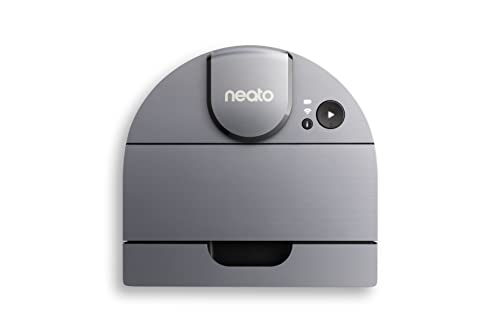
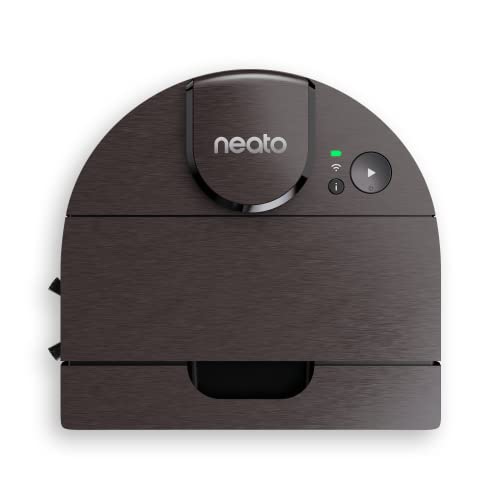
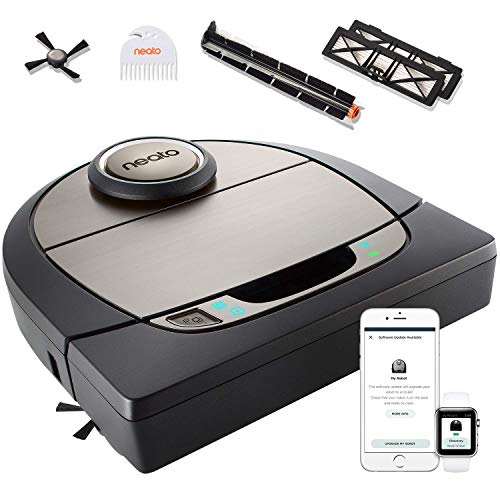
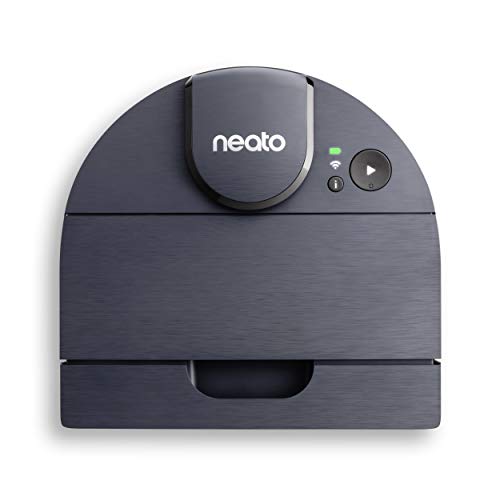
Neato robot vacuums remain technically distinctive for their D-shaped body, wide edge-mounted brush, 0.7-litre bin and LiDAR navigation that works in darkness. Final D8–D10 models add 100–300-minute claimed runtimes and recharge-and-resume, making them effective vacuum-only machines for open floors.
Neato robot vacuums are no longer a sound default factory-new purchase: production ended in 2023, cloud servers are shut down, and app maps, zones and schedules are unavailable. Manual full-house cleaning still works, but parts, batteries and warranty coverage must justify any remaining-stock price.
The chart below compares robot vacuum brands by average overall score.
[horizontal-chart-15406096130061009453140888914513010987580044587466]
What are the main advantages of Neato robot vacuums?
The main advantages of Neato robot vacuums are as follows:
- D-shaped edge cleaning: Neato placed a broad main brush near the flat front edge instead of between the wheels of a round chassis. The layout reaches closer to walls and square corners, while the side brush handles the final border.
- LiDAR navigation in darkness: Neato used LaserSmart navigation to map rooms and follow systematic routes without needing ambient light. The robots can detect their position, return for charging and resume a large cleaning run instead of relying on random movement.
- Long runtime in the final generation: D8, D9 and D10 were rated for up to 100, 200 and 300 minutes in their stated test conditions. D9 and D10 also use Quick Boost to recharge only enough to finish the remaining route, reducing the pause on large floors.
- Large brush and bin for dry debris: The final D series uses an 11-inch or 28 cm main brush and a 0.7-litre dirt bin, both unusually large for the category. That combination is useful for pet hair and broad carpet passes, although wrapped hair still requires routine brush cleaning.
- Manual operation survives the cloud closure: Official Neato guidance says one press still starts a full-house cleaning run after the servers shut down. The support site also retains manuals and maintenance instructions, so basic on-robot use and care remain documented even though connected features are gone.
What are the main disadvantages of Neato robot vacuums?
The main disadvantages of Neato robot vacuums are as follows:
- The brand and production line are discontinued: Vorwerk closed Neato in 2023, so there are no newly developed models or active factory production. Any unused unit now comes from remaining inventory, and seller-backed warranty terms need to be checked rather than inferred from the original launch.
- Cloud and app features are unavailable: Neato's current support page says servers for D3–D7 and D800/D8–D10 have been shut down. Floor maps, virtual no-go zones, zones, schedules, remote starts and voice-assistant control therefore cannot be counted as usable purchase benefits.
- No mopping or dock automation: Neato concentrated on dry vacuuming and never added a mop, automatic bin emptying or a self-cleaning water station. Owners must empty the 0.7-litre bin, clean the brush and maintain the filter directly after suitable intervals.
- LiDAR does not replace clutter recognition: Neato maps walls and navigates methodically, but its generations lack the modern front-camera or structured-light recognition used to identify cables, socks and pet waste. With cloud-based no-go tools gone, loose objects must be cleared and physical barriers used at hazardous drops or forbidden areas.
- Parts and batteries carry increasing risk: Filters and brushes remain easier to find than some model-specific batteries, wheels, charge bases or electronic parts. Vorwerk originally promised at least five years of parts and repair support after closure, but regional supply and the exact D generation should be confirmed before paying a premium.
Who makes Neato robot vacuums?
Neato robot vacuums were made by Neato Robotics, Inc., a Silicon Valley company founded in 2005 that launched its first robot-vacuum series in 2010. The company became known for introducing a D-shaped chassis and laser-guided navigation; Germany's Vorwerk Group began investing in Neato in 2010 and increased its holding to 100% in 2017, while Neato continued as a separate US brand.
Vorwerk closed Neato Robotics in 2023 after the independent business failed to meet its growth goals, moving its wider robot-vacuum development focus to Vorwerk in Germany. Vorwerk initially promised at least five years of Neato cloud, parts and repair support, but Neato announced the cloud phase-out in October 2025 and its current support page says the servers are now shut down. Existing robots still support a manual full-house run, while warranty commitments and online guidance remain; Neato is therefore a historical product line rather than a current manufacturer.
What are the main Neato robot vacuum series?
The main Neato robot vacuum series are as follows:
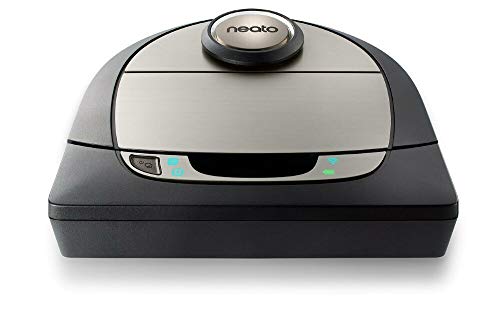
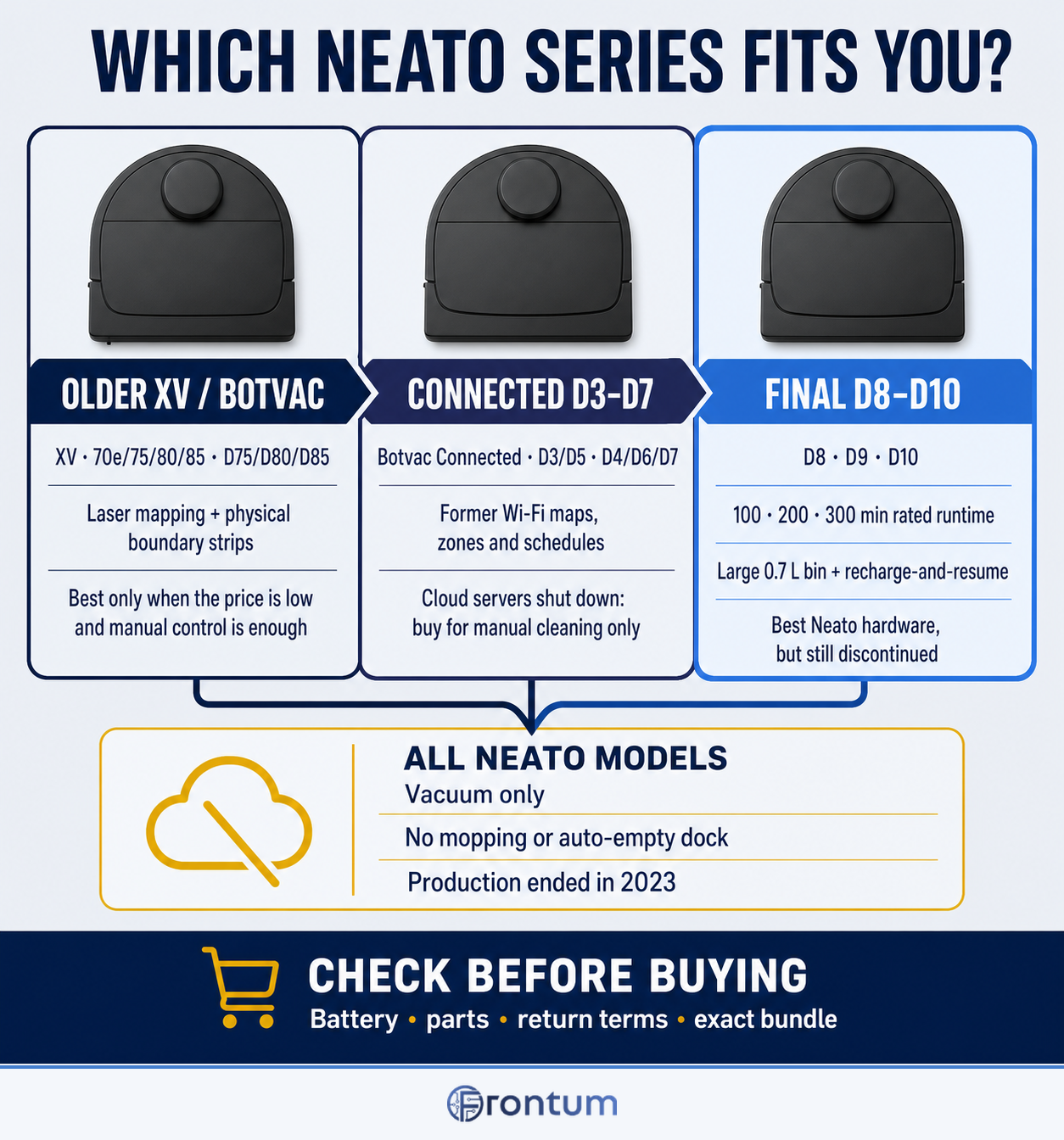
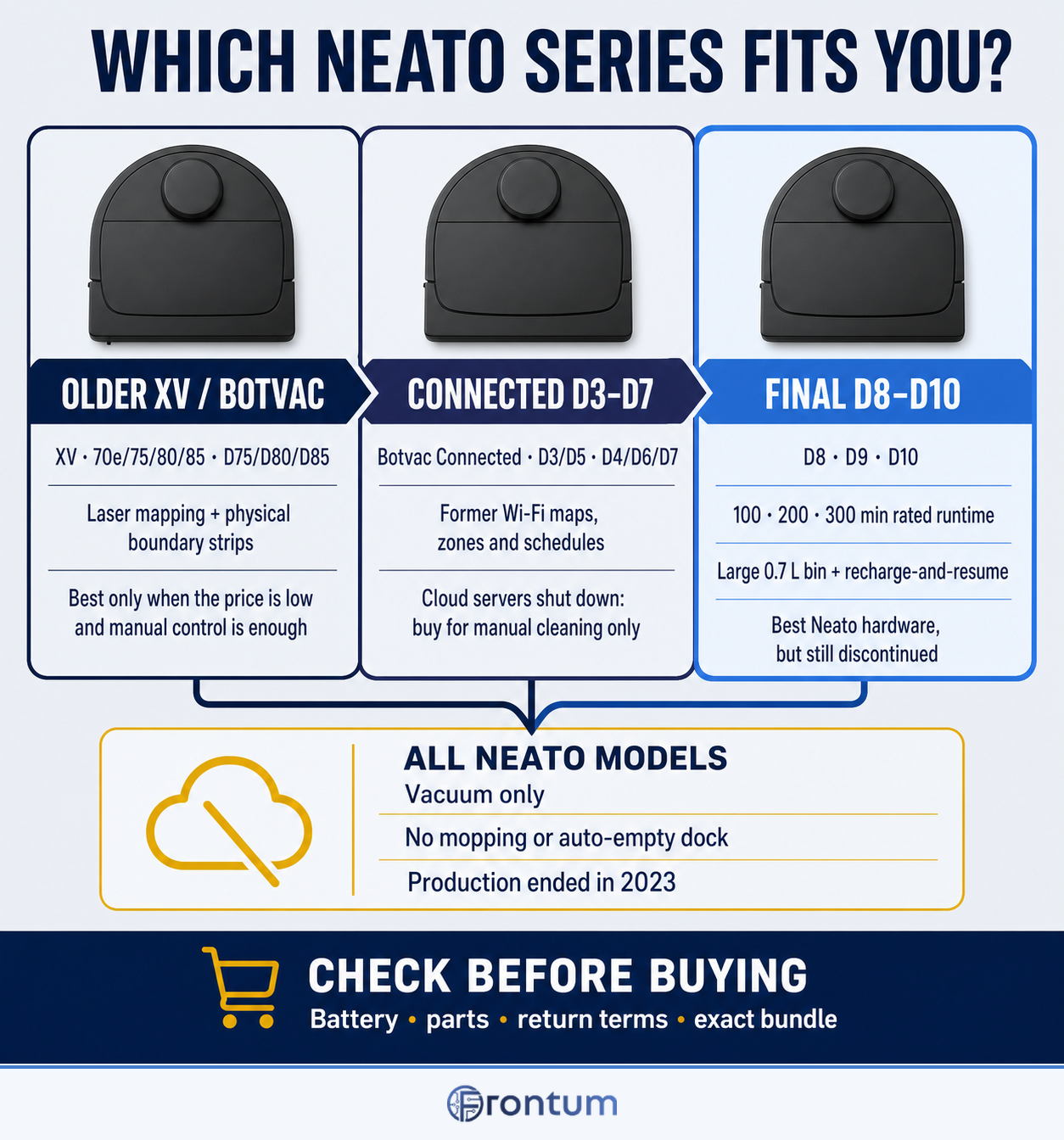
- XV Signature family: The XV-11, XV-12, XV-14, XV-15, XV-21 and Signature models established Neato's flat-front body, laser turret and systematic room coverage. These early machines use physical boundary strips and on-robot controls rather than the later connected map experience.
- Original Botvac family: Botvac 70e, 75, 80 and 85 refined the D-shape with a wide combination brush, side brush and larger bin. Higher numbers mainly changed filters, brush kits and included accessories, so the exact bundle matters more than assuming a major navigation leap.
- Botvac D75, D80 and D85: This pre-connected D generation retained laser mapping and physical boundary markers while updating cleaning hardware and filtration. It is best understood as the bridge between the original Botvac line and Wi-Fi-enabled Botvac Connected models.
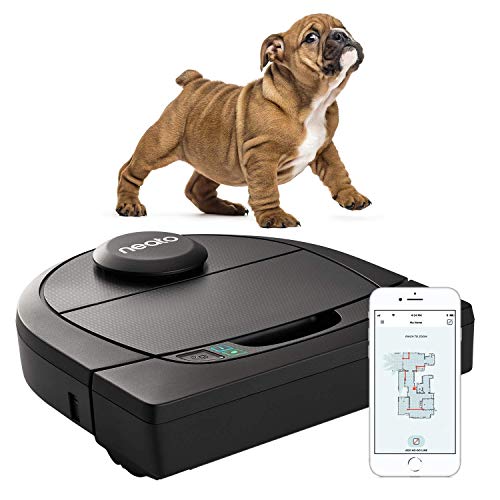
- Botvac Connected, D3 and D5: Botvac Connected introduced Wi-Fi control, while D3 and D5 broadened app scheduling and connected navigation at lower prices. Their historical app features depended on Neato cloud services and are no longer available now that the servers are shut down.
- D4 and D6 Connected: D4 and D6 added virtual no-go lines, with D6 positioned higher through a larger battery, stronger filter and side brush. They remain capable manual vacuuming platforms, but their former map editing and remote scheduling should not influence a current purchase.
- D7 Connected: D7 was the flagship of the older Neato app generation, adding zone cleaning, multiple floor plans and about 120 minutes of stated runtime. Its D-shape, wide brush and LiDAR still function for manual whole-home runs, while its premium connected functions are now lost.
- D8, D9 and D10: The final MyNeato generation paired 100-, 200- and 300-minute rated runtimes with progressively better filtration, and D9/D10 added zones, multiple floor plans and Quick Boost. Commercial references such as D304, D450, D502, D650, D750 and D800 identify regional or retail variants and must be matched to exact batteries, filters and charge bases.
How much do Neato robot vacuums cost?
Neato robot vacuums have no current manufacturer price because production ended in 2023. Remaining unused stock may still be listed at roughly £200-£800, but those figures reflect clearance inventory and historical generations rather than an active factory-new range.
D8 and D800 offers can appear around £170-£300, while D4/D7-related models and regional D-series bundles often sit around £300-£500. Final D9/D10 or premium D7 listings can reach £500-£800, where the missing cloud functions and narrowing support make a high price difficult to justify.
Allow for replacement filters, side and main brushes, and eventually the model-specific lithium-ion battery. Neato has no mop or auto-empty station, so there are no pads or station bags, but uncertain original-parts availability can matter more than routine consumable cost.
The chart below shows the price distribution of Neato robot vacuums.
[vertical-chart-03357952695995608830087102858937264554821830549940]
What should you consider when choosing a Neato robot vacuum?
Before buying a discontinued Neato robot vacuum, check the following:
- Current status: Neato ended robot-vacuum production in 2023, so even unopened stock is an ageing discontinued product rather than a current factory model. Warranty and repair cover now depend heavily on the seller, making clear return terms more important than the condition of the box.
- App support: The Connected service for D3–D7 models and the MyNeato service for D8–D10 models have shut down. App maps, virtual zones, schedules, remote starts and voice control are therefore unavailable, so do not pay extra for those former features.
- Manual use: A compatible Neato can still start a whole-floor clean from its physical button, return to the dock and use recharge-and-resume. It cannot offer app-based room selection or scheduling, so it only suits a routine built around button-started cleaning.
- Boundaries: Cloud-based no-go lines no longer provide a usable barrier. Check whether the exact model accepts magnetic boundary strips, and use a solid barrier near stairs, fireplaces or other hazards rather than relying only on cliff sensors.
- Size: Final D-series robots are about 33 by 34 cm and 10 cm high, with a roughly 28 cm brush near the flat front. The shape cleans edges and corners well but needs turning room, so measure chair gaps, narrow passages and low furniture.
- Battery and parts: Neato rated the D8, D9 and D10 for up to 100, 200 and 300 minutes, but an ageing battery may deliver much less. Locate the correct 2,100, 4,200 or 6,200 mAh battery before buying and confirm that the base, wheels, sensors and repair parts remain available.
- Cleaning limits: Neato models offer a wide brush and a useful 0.7-litre bin but no mopping, automatic emptying or dock washing. Choose an active brand if wet cleaning, hands-free disposal or dependable long-term parts support matters more than the Neato shape.