Scored using Graphics cards Methodology v3.0
Graphics cards Methodology v3.0
Mathematical & Unbiased Scoring
Products in this category are scored under Frontum Graphics cards Methodology v3.0: the technical score from the specifications is the base, and independent expert and video reviews (up to ±0.5 points), owner opinions (up to ±0.3) and best-of lists (up to +0.3) move it up or down.
Explore Graphics cards Methodology v3.0

ASUS TUF Gaming GeForce RTX 5060 review: 117 specs compared

Avg. price:~£360VRAM:8 GBMemory bus width:128 bitThermal Design Power (TDP):145 W

ASUS TUF Gaming GeForce RTX 5060 Review: Compare 117 technical specifications and 9 expert and video reviews to see how this product ranks in the Graphics cards category and whether it is worth buying.
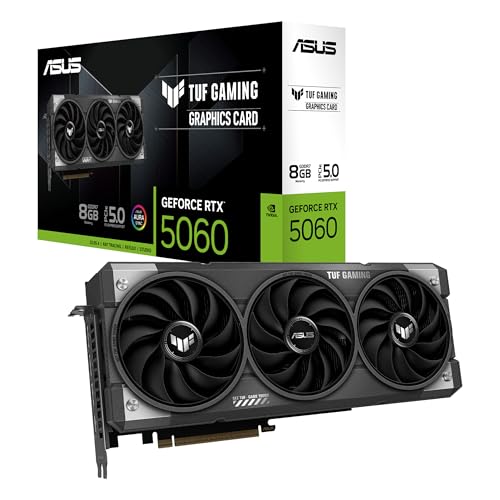
ASUS TUF Gaming GeForce RTX 5060
7.1/10

Overall score

Score
7.1/ 10
✕
What it is
Our main score for this model, 1–10. It combines specs, expert reviews, best-of lists and owners.
How we count it
Parts: Technical score 40%, Reviews score 25%, List score 25%, Sentiment score 10%
Marks: Each part gets a mark out of 10. For reviews, lists and owners, a typical model in this category gets about 8 and the best one gets 10.
No data yet: A part with no data shows "?". It counts as the mark of a weaker model in this category (4 in 5 models with data score higher). This way, models with reviews, lists and owners usually come out ahead.
Score distribution
▼
<55-66-77-88-99-10
Score components

40%

6.7

Technical score

25%

6.7

Reviews score

25%

?

List scoreNot enough data yet, so we use 7.5, the mark of a weaker model in this category

10%

8.2

Sentiment score

▼Worse than 64% of graphics cards
7.5

Value for money

Value for money
7.5/ 10
✕
What it is
An indicator that combines the graphics card's overall rating with its cost.
When it matters
When you are looking for a graphics card that offers a strong balance of performance, features, and price.
Score distribution
▼
<55-66-77-88-99-10
Score components

70%

7.1

Overall score

30%

8.6

Price

▲Better than 54%
6.7

Technical score

Technical score
6.7/ 10
✕
What it is
How good the specs are compared with the other models in this category, 1–10.
How we count it
Areas: We rate the specs in each area against the other models in this category.
Weighting: The areas that matter most to buyers count more. The shares are shown under Score components.
Share: The technical score is 40% of the overall score.
Score distribution
▼
<55-66-77-88-99-10
Score components

44%

5.9

Performance

24%

4.9

Memory

12%

9.5

Power

11%

9.8

Features

5%

6.2

Design

4%

10

Connectivity

▼Worse than 56%
6.7

Reviews score

Reviews score
6.7/ 10
✕
What it is
Average grade from independent test sites, magazines and video reviewers, 1–10.
How we count it
Grades: Each review's own score is converted to 1–10; without one, we grade the review ourselves. Big test sites count more, short reviews half as much as full tests. A video review counts half.
Score: The average grade is 80% of the review mark; the number of reviews is the other 20% (1 review = 5, the typical number in this category = 8, the most-reviewed model = 10).
Enough data: With few reviews, the average grade is pulled toward the typical grade of this category. No reviews yet: 7.6 for now.
Share: Reviews count 25% of the overall score.
Score distribution
▼
<55-66-77-88-99-10

6.7

Mark 7.8 is below the typical mark 7.9 of this category, so it cannot lift the score above the technical score

80%

7.6

Average grade

20%

8.5

Popularity

Grades by review (9)
7 reviews: 2 with a printed score, 5 estimated from the review. 2 video reviews, each counting half as much as a written test. Reviews count 25% of the overall score.
User ratings collected online are not part of this score.
▼Worse than 74%
?

List score

List score
7.5/ 10
✕
What it is
How often independent test sites, magazines and video reviewers put this model in their best-of lists for this category.
How we count it
Points: The model in the most lists of this category gets 10; the others get 8 to 10 in proportion. In no list yet: 7.5. Lists count 25% of the overall score.
Enough data: Every list counts, even a single one. With fewer than 5 best-of lists in the category, this part is left out.
Lists with this model (0)
Not in any best-of list yet, so this part counts as 7.5. Models in a list get 8 to 10.
Not in any best-of list yet
  • asus-tuf-gaming-geforce-rtx-5060
asus-tuf-gaming-geforce-rtx-5060
Where to buy
*As an Amazon Associate, we earn from qualifying purchases.

What reviewers say about the ASUS TUF Gaming GeForce RTX 5060

Based on 7 · 2

Reviewers agree it runs cool and quiet, but complain about game crashes, its bulky size and limited video memory.
Praised
Criticised
Pick a topic to see who said what

What owners say about the ASUS TUF Gaming GeForce RTX 5060

Based on 164 owners sharing their experience in online comments

74%positive14%mixed12%negative

Owners praise smooth, affordable gaming, while limited memory can force lower settings in demanding games.

What owners dislike

  • The 8GB memory fills up over time in demanding games, and frame rates can drop sharply after 15 minutes, forcing lower textures or settings.20
  • Owners say it struggles with heavy games and 1440p, with frame rates falling to around 30 to 60 fps in some titles unless settings or resolution drop.9

Points mentioned by at least 3 owners, most mentioned first.

Loading...
Loading category ranking...

Technical Specifications of graphics card ASUS TUF Gaming GeForce RTX 5060

Technical score
Technical score
6.7/ 10
✕
What it is
How good the specs are compared with the other models in this category, 1–10.
How we count it
Areas: We rate the specs in each area against the other models in this category.
Weighting: The areas that matter most to buyers count more. The shares are shown under Score components.
Share: The technical score is 40% of the overall score.
Score distribution
▼
<55-66-77-88-99-10
Score components:

44%

5.9

Performance

24%

4.9

Memory

12%

9.5

Power

11%

9.8

Features

5%

6.2

Design

4%

10

Connectivity

6.7
Reviews score
6.7
List score
?
Value for money
Value for money
7.5/ 10
✕
What it is
An indicator that combines the graphics card's overall rating with its cost.
When it matters
When you are looking for a graphics card that offers a strong balance of performance, features, and price.
Score distribution
▼
<55-66-77-88-99-10
Score components:

70%

7.1

Overall score

30%

8.6

Price

7.5
3DMark Time Spy benchmark score
13,400 points
This graphics card scores 13,400 points in 3DMark Time Spy, which is lower than 56.7% of graphics cards and equal to 0.6% of graphics cards.
3DMark Port Royal score
8,662 points
This graphics card scores 8,662 points in 3DMark Port Royal, which is lower than 53.1% of graphics cards and equal to 1.1% of graphics cards.
PassMark (G3D) result
21,440 points
This graphics card scores 21,440 points in PassMark G3D, which is lower than 56% of graphics cards and equal to 0.6% of graphics cards.
PassMark (DirectCompute) result
22,048 points
This graphics card scores 22,048 points in PassMark DirectCompute, which is higher than 85% of graphics cards.
FP32 performance
20.28 TFLOPS
This graphics card delivers 20.28 TFLOPS FP32 performance, which is lower than that of 57.1% of graphics cards.
Show more
VRAM
8 GB
This graphics card has 8 GB of VRAM, which is less than 56.8% of graphics cards and equal to 25.7% of graphics cards.
Memory type
GDDR7
This graphics card uses GDDR7 memory, which is newer than on 79.6% of graphics cards and equal to 20.4% of graphics cards.
Memory bus width
128 bit
This graphics card uses a 128 bit memory bus, which is narrower than that of 68.6% of graphics cards and equal to that of 26.7% of graphics cards.
Maximum memory bandwidth
448 GB/s
This graphics card reaches 448 GB/s memory bandwidth, which is higher than that of 41.3% of graphics cards and equal to that of 11.8% of graphics cards.
Effective memory speed
28,000 MHz
This graphics card reaches an effective memory speed of 28,000 MHz, which is faster than that of 78.9% of graphics cards and equal to that of 16.8% of graphics cards.
Show more
What reviewers say
PCI Express (PCIe) version
5
This graphics card supports PCIe 5, which is newer than on 73% of graphics cards and equal to 27% of graphics cards.
PCIe lanes
x8
This graphics card uses x8 PCIe lanes, which is fewer than 75.9% of graphics cards and equal to 22.9% of graphics cards.
DirectX version
12 Ultimate
This graphics card supports DirectX 12 Ultimate, which is more advanced than on 22.8% of graphics cards and equal to 77.2% of graphics cards.
Vulkan version
1.4
This graphics card supports Vulkan 1.4, which is more advanced than on 20.8% of graphics cards and equal to 79.2% of graphics cards.
OpenGL version
4.6
This graphics card supports OpenGL 4.6, which is more advanced than on 2% of graphics cards and equal to 98% of graphics cards.
Show more
What reviewers say
Max displays supported
4
This graphics card supports up to 4 displays, which is more than 9% of graphics cards and equal to 88.2% of graphics cards.
Max digital resolution
7680x4320
This graphics card supports a maximum digital resolution of 7680x4320, which is higher than that of 9.2% of graphics cards and equal to that of 90.9% of graphics cards.
DisplayPort outputs
3
This graphics card offers 3 DisplayPort outputs, which is more than 21.7% of graphics cards and equal to 76% of graphics cards.
DisplayPort version
2.1b
This graphics card supports DisplayPort 2.1b, which is more advanced than on 77.8% of graphics cards and equal to 22.2% of graphics cards.
DisplayPort link rates
40 Gbps
This graphics card supports DisplayPort link rates up to 40 Gbps, which is faster than on 77.8% of graphics cards and equal to 0.6% of graphics cards.
Show more
Thermal Design Power (TDP)
145 W
This graphics card has a TDP of 145 W, which is lower than that of 75.8% of graphics cards and equal to that of 2.6% of graphics cards.
Power consumption while under peak load
150 W
This graphics card draws 150 W under peak load, which is lower than 75.9% of graphics cards and equal to 1.4% of graphics cards.
Recommended PSU wattage
550 W
This graphics card recommends a 550 W PSU, which is lower than that of 61.8% of graphics cards and equal to that of 13.3% of graphics cards.
Board power limit
234 W
This graphics card has a board power limit of 234 W, which is higher than that of 52.6% of graphics cards and equal to that of 0.1% of graphics cards.
PCIe power spec
145 W
Show more
What reviewers say
Size
302x 133.5x 62 mm
Length
302 mm
This graphics card is 302 mm long, which is longer than 61.1% of graphics cards and equal in length to 0.4% of graphics cards.
Height
133.5 mm
This graphics card is 133.5 mm tall, which is taller than 67.4% of graphics cards and equal in height to 0.3% of graphics cards.
Slot width
3.1 slot/s
This graphics card occupies 3.1 slot/s, which is wider than 87.6% of graphics cards and equal in width to 0.9% of graphics cards.
Weight
1,134 g
This graphics card weighs 1,134 g, which is heavier than 57.1% of Graphics cards and equal to 0.2% of Graphics cards.
Show more
What reviewers say

ASUS TUF Gaming GeForce RTX 5060 vs the average graphics card

246810TotalPerformanceMemoryFeaturesConnectivityPowerDesign
  • 6.9% higher boost clock speed
    This graphics card has a higher boost GPU clock than the average graphics card (2,677 MHz vs 2,505 MHz). The average graphics card has a boost GPU clock of 2,505 MHz.
    2,677 MHz vs 2,505 MHz
  • 37.5% higher base clock speed
    This graphics card has a higher base GPU clock than the average graphics card (2,640 MHz vs 1920 MHz). The average graphics card has a base GPU clock of 1920 MHz.
    2,640 MHz vs 1,920 MHz
  • 47.4% faster memory speed
    This graphics card has a higher effective memory speed than the average graphics card (28,000 MHz vs 19,000 MHz). The average graphics card reaches an effective memory speed of 19,000 MHz.
    28,000 MHz vs 19,000 MHz
  • Newer PCIe version
    This graphics card supports a newer PCIe version than the average graphics card (5 vs 4).
    5 vs 4
  • 32.6% lower TDP
    This graphics card has a lower TDP than the average graphics card (145 W vs 215 W). The average graphics card has a TDP of 215 W.
    145 W vs 215 W
  • Newer DisplayPort version
    This graphics card supports a newer DisplayPort version than the average graphics card (2.1b vs 1.4a).
    2.1b vs 1.4a
  • 15.4% lower PSU requirement
    This graphics card has a lower PSU requirement than the average graphics card (550 W vs 650 W). The average graphics card has a PSU requirement of 650 W.
    550 W vs 650 W
  • 2 years newer
    This graphics card was released more recently than the average graphics card (2025 vs 2023).
    May 2025
    2025 vs 2023
  • 6.9% higher boost clock speed
    This graphics card has a higher boost GPU clock than the average graphics card (2,677 MHz vs 2,505 MHz). The average graphics card has a boost GPU clock of 2,505 MHz.
    2,677 MHz vs 2,505 MHz
  • 37.5% higher base clock speed
    This graphics card has a higher base GPU clock than the average graphics card (2,640 MHz vs 1920 MHz). The average graphics card has a base GPU clock of 1920 MHz.
    2,640 MHz vs 1,920 MHz
  • 2 years newer
    This graphics card was released more recently than the average graphics card (2025 vs 2023).
    May 2025
    2025 vs 2023
  • 82.7% higher compute score
    This graphics card has a higher compute score than the average graphics card (22,048 points vs 12,70.5 points). The average graphics card has a compute score of 12,070.5 points.
    22,048 points vs 12,070.5 points
  • 47.4% faster memory speed
    This graphics card has a higher effective memory speed than the average graphics card (28,000 MHz vs 19,000 MHz). The average graphics card reaches an effective memory speed of 19,000 MHz.
    28,000 MHz vs 19,000 MHz
  • Newer GDDR version
    This graphics card uses a newer GDDR version than the average graphics card (GDDR7 vs GDDR6).
    GDDR7 vs GDDR6
  • 8x more Infinity Cache
    This graphics card has more Infinity Cache than the average graphics card (32 MB vs 4 MB). The average graphics card has 4 MB Infinity Cache.
    32 MB vs 4 MB
  • Newer PCIe version
    This graphics card supports a newer PCIe version than the average graphics card (5 vs 4).
    5 vs 4
  • Newer DisplayPort version
    This graphics card supports a newer DisplayPort version than the average graphics card (2.1b vs 1.4a).
    2.1b vs 1.4a
  • Newer HDMI version
    This graphics card supports a newer HDMI version than the average graphics card (2.1b vs 2.1a).
    2.1b vs 2.1a
  • 32.6% lower TDP
    This graphics card has a lower TDP than the average graphics card (145 W vs 215 W). The average graphics card has a TDP of 215 W.
    145 W vs 215 W
  • 15.4% lower PSU requirement
    This graphics card has a lower PSU requirement than the average graphics card (550 W vs 650 W). The average graphics card has a PSU requirement of 650 W.
    550 W vs 650 W
  • 6 °C higher thermal ceiling
    This graphics card has a higher thermal ceiling than the average graphics card (89 °C vs 95 °C). The average graphics card has a thermal ceiling of 95 °C.
    89 °C vs 95 °C
  • 8 °C lower load temperature
    This graphics card has a lower load temperature than the average graphics card (59 °C vs 67 °C). The average graphics card has a load temperature of 67 °C.
    59 °C vs 67 °C
  • 6.5 dB quieter under load
    This graphics card has a lower load noise level than the average graphics card (28.9 dB vs 35.4 dB). The average graphics card has a load noise level of 35.4 dB.
    28.9 dB vs 35.4 dB
  • 4 GB less VRAM
    This graphics card has fewer VRAM than the average graphics card (8 GB vs 12 GB). The average graphics card has 12 GB VRAM.
    8 GB vs 12 GB
  • 10 fewer compute units
    This graphics card has fewer compute units than the average graphics card (30 vs 40). The average graphics card has 40 compute units.
    30 vs 40
  • 64 fewer TMUs
    This graphics card has fewer TMUs than the average graphics card (120 vs 184). The average graphics card has 184 TMUs.
    120 vs 184
  • 64 bit narrower memory bus
    This graphics card has a narrower memory bus than the average graphics card (128 bit vs 192 bit). The average graphics card has a memory bus width of 192 bit.
    128 bit vs 192 bit
  • Fewer PCIe lanes
    This graphics card has fewer PCIe lanes than the average graphics card (x8 vs x16). The average graphics card has x16 PCIe lanes.
    x8 vs x16
  • 10 fewer ray tracing cores
    This graphics card has fewer ray tracing cores than the average graphics card (30 vs 40). The average graphics card has 40 ray tracing cores.
    30 vs 40
  • 16 fewer ROPs
    This graphics card has fewer ROPs than the average graphics card (48 vs 64). The average graphics card has 64 ROPs.
    48 vs 64
  • 0.6 slot/s wider design
    This graphics card occupies more slots than the average graphics card (3.1 slot/s vs 2.5 slot/s). The average graphics card occupies 2.5 slot/s.
    3.1 slot/s vs 2.5 slot/s
  • 6.9% lower review score
    Reviews score
    6.7/ 10
    ✕
    What it is
    Average grade from independent test sites, magazines and video reviewers, 1–10.
    How we count it
    Grades: Each review's own score is converted to 1–10; without one, we grade the review ourselves. Big test sites count more, short reviews half as much as full tests. A video review counts half.
    Score: The average grade is 80% of the review mark; the number of reviews is the other 20% (1 review = 5, the typical number in this category = 8, the most-reviewed model = 10).
    Enough data: With few reviews, the average grade is pulled toward the typical grade of this category. No reviews yet: 7.6 for now.
    Share: Reviews count 25% of the overall score.
    Score distribution
    ▼
    <55-66-77-88-99-10

    6.7

    Mark 7.8 is below the typical mark 7.9 of this category, so it cannot lift the score above the technical score

    80%

    7.6

    Average grade

    20%

    8.5

    Popularity

    Grades by review (9)
    7 reviews: 2 with a printed score, 5 estimated from the review. 2 video reviews, each counting half as much as a written test. Reviews count 25% of the overall score.
    User ratings collected online are not part of this score.
    6.7 vs 7.2
  • 10 fewer compute units
    This graphics card has fewer compute units than the average graphics card (30 vs 40). The average graphics card has 40 compute units.
    30 vs 40
  • 64 fewer TMUs
    This graphics card has fewer TMUs than the average graphics card (120 vs 184). The average graphics card has 184 TMUs.
    120 vs 184
  • 10 fewer ray tracing cores
    This graphics card has fewer ray tracing cores than the average graphics card (30 vs 40). The average graphics card has 40 ray tracing cores.
    30 vs 40
  • 16 fewer ROPs
    This graphics card has fewer ROPs than the average graphics card (48 vs 64). The average graphics card has 64 ROPs.
    48 vs 64
  • 16.2% lower texture rate
    This graphics card has a lower texture rate than the average graphics card (316.8 GTexel/s vs 378 GTexel/s). The average graphics card has a texture rate of 378 GTexel/s.
    316.8 GTexel/s vs 378 GTexel/s
  • 21.5% lower pixel rate
    This graphics card has a lower pixel rate than the average graphics card (126.7 GPixel/s vs 161.3 GPixel/s). The average graphics card has a pixel rate of 161.3 GPixel/s.
    126.7 GPixel/s vs 161.3 GPixel/s
  • 24 fewer AI cores
    This graphics card has fewer AI cores than the average graphics card (120 vs 144). The average graphics card has 144 AI cores.
    120 vs 144
  • 10.3% lower FP32 performance
    This graphics card has a lower FP32 performance than the average graphics card (20.3 TFLOPS vs 22.6 TFLOPS). The average graphics card has FP32 performance of 22.6 TFLOPS.
    20.28 TFLOPS vs 22.6 TFLOPS
  • 4 GB less VRAM
    This graphics card has fewer VRAM than the average graphics card (8 GB vs 12 GB). The average graphics card has 12 GB VRAM.
    8 GB vs 12 GB
  • 64 bit narrower memory bus
    This graphics card has a narrower memory bus than the average graphics card (128 bit vs 192 bit). The average graphics card has a memory bus width of 192 bit.
    128 bit vs 192 bit
  • Fewer PCIe lanes
    This graphics card has fewer PCIe lanes than the average graphics card (x8 vs x16). The average graphics card has x16 PCIe lanes.
    x8 vs x16
  • 0.6 slot/s wider design
    This graphics card occupies more slots than the average graphics card (3.1 slot/s vs 2.5 slot/s). The average graphics card occupies 2.5 slot/s.
    3.1 slot/s vs 2.5 slot/s
  • 8.5 mm higher card profile
    This graphics card is taller than the average graphics card (133.5 mm vs 125 mm). The average graphics card has a height of 125 mm.
    133.5 mm vs 125 mm
  • 19.8 mm longer card length
    This graphics card is longer than the average graphics card (302 mm vs 282.2 mm). The average graphics card has a length of 282.2 mm.
    302 mm vs 282.2 mm

Video reviews

Hands-on testing, unboxing, and real-world video evaluations

8.0
iVadim
≈ estimated
25/05/2025
Hands-on review · noise, thermals and power tests
Verdict
ASUS TUF Gaming GeForce RTX 5060 runs cool and quiet, but its 8 GB of memory holds it back.

Expert reviews

In-depth analysis and verdict from leading tech publications

7.0
en.gamegpu.com
≈ estimated
09/06/2025
Benchmark test · 1080p gaming
Verdict
The ASUS TUF Gaming GeForce RTX 5060 is a quiet, balanced entry card for 1080p with DLSS, but its 8GB of memory holds it back in heavy games.
6.0
clubic.com
✓ explicit
24/06/2025
Hands-on test · 1080p and Blender
Verdict
The ASUS TUF Gaming RTX 5060 OC suits 1080p gamers and Blender users, but its 8GB of memory holds it back in demanding 1440p games.
8.0
fr.gamegpu.com
≈ estimated
09/06/2025
Benchmark review · 1080p gaming
Verdict
The ASUS TUF Gaming RTX 5060 is a balanced entry-level card for 1080p gaming with DLSS, but its 8GB of memory limits heavy ray tracing.
7.8
profesionalreview.com
✓ explicit
21/05/2025
Lab test · 1080p gaming
Verdict
The ASUS TUF Gaming RTX 5060 handles 1080p at Ultra and 1440p with DLSS, but its 8GB of memory runs short at 4K.
6.0
elchapuzasinformatico.com
≈ estimated
13/06/2025
Hands-on test · Cooling and noise
Verdict
The ASUS TUF Gaming GeForce RTX 5060 OC stays cool and quiet thanks to an oversized cooler for its 155W draw, but it is large.
7.0
es.gamegpu.com
≈ estimated
09/06/2025
Benchmark test · 1080p gaming
Verdict
The ASUS TUF Gaming GeForce RTX 5060 is a quiet, balanced entry card for 1080p with DLSS, but its 8GB of memory holds it back in heavy games.
7.0
tuttotech.net
≈ estimated
15/06/2025
Hands-on test · Cooling and tuning
Verdict
The ASUS TUF Gaming RTX 5060 OC is a sturdy, good-looking card for 1080p and ray tracing, but its size makes it a poor fit for small builds.

Third-party reviews

What customers like about ASUS TUF Gaming GeForce RTX 5060

  • Excellent thermal performance with temperatures consistently staying under 70°C even during extended gaming sessions.
  • Remarkably quiet operation, often measured at just 38dB under load, making it quieter than many dual-fan competitors.
  • Premium build quality featuring a robust metal backplate and a durable stainless steel design.
  • Equipped with a dual BIOS switch allowing users to easily toggle between 'Performance' and 'Quiet' hardware modes.
  • Strong 1080p and capable 1440p gaming performance, significantly outperforming the previous generation's RTX 4060.
  • Highly energy-efficient, requiring only a single 8-pin power connector and a 550W power supply.
  • Future-proof connectivity with support for DisplayPort 2.1b and HDMI 2.1b.

What customers don't like about ASUS TUF Gaming GeForce RTX 5060

  • The 8GB VRAM capacity is seen as a significant limitation for long-term viability and high-fidelity 1440p or 4K gaming.
  • The large physical size (approx. 320mm length, 3.1-slot thickness) may cause compatibility issues with smaller PC cases.
  • Noticeable coil whine reported by some users when running at extremely high framerates.
  • Struggles to maintain consistent performance in demanding modern titles at 4K resolution without significant settings compromises.
  • A higher price point compared to MSRP and other entry-level RTX 5060 models like the ASUS Dual series.

Verdict

The ASUS TUF Gaming GeForce RTX 5060 is a rugged mid-range graphics card built on the NVIDIA Blackwell architecture, featuring 3,840 CUDA cores and 8GB of high-speed GDDR7 memory on a 128-bit bus with 448 GB/s bandwidth. This OC Edition is designed for durability with military-grade capacitors, a vented metal exoskeleton, and an advanced triple-fan Axial-tech cooling system that occupies 3.1 slots and utilizes a single 8-pin power connector. Main pros include exceptional thermal management that keeps the card under 60°C, a Dual BIOS for quiet operation, and full support for DLSS 4 with Multi Frame Generation for smooth 1080p and 1440p gaming. However, its primary cons are the relatively limited 8GB VRAM capacity, which may bottleneck performance in memory-intensive modern titles, and its bulky physical size that might pose compatibility issues in smaller PC cases.

Compare ASUS TUF Gaming GeForce RTX 5060 with other products in the Graphics cards category

1Product to compare no. 1
VS
2Product to compare no. 2
VS
3Product to compare no. 3 (optional)

Graphic comparison of ASUS TUF Gaming GeForce RTX 5060 and other products in the Graphics cards category

No results found