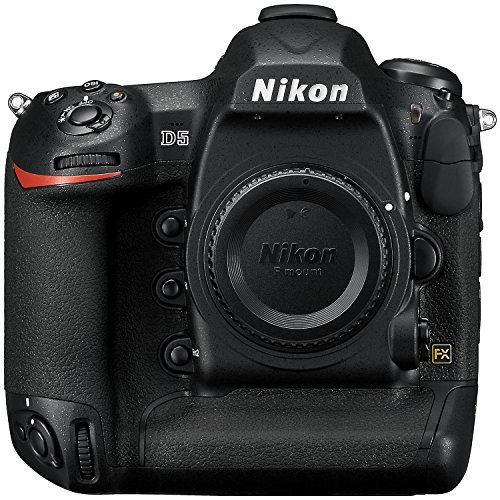
Nikon D5 review. Compare 108 technical specifications and user reviews to see how it ranks among cameras and if it is worth buying.
Overall score
What it is: An overall evaluation of the camera's quality, based on technical analyses and user reviews.
When it matters: When you need a quick reference to identify the best cameras on the market.
Score components:
90.0%
Technical Score
10.0%
User score
Technical Score
What it is: An assessment of the camera's technical performance, covering eight key areas: image quality, autofocus, video features, stabilization, lens compatibility, connectivity, battery, and design.
When it matters: When you want to compare cameras based on technical performance and available features.
Score components:
28.0%
Sensor & Image
25.0%
Photo Features
18.0%
Video & Audio
14.0%
Display & Design
8.0%
Battery & Power
7.0%
Connectivity & Storage
User score
What it is: A rating that combines user reviews and the total number of reviews received by the camera.
When it matters: When real-world owner satisfaction and review volume matter to your decision.
Score components:
70.0%
User reviews
30.0%
Popularity
Score components:
25.0%
Sensor size
20.0%
Main camera megapixels
20.0%
Dual card slots
15.0%
N. of focus points
10.0%
RAW photo capture
10.0%
Phase-detection autofocus (photos)
Score components:
35.0%
Weight
30.0%
Battery life (CIPA)
20.0%
Sensor-shift stabilization
15.0%
GPS
Score components:
30.0%
Price
20.0%
Weight
20.0%
AF tracking
20.0%
Battery life (CIPA)
10.0%
Touchscreen
Score components:
30.0%
Main camera megapixels
25.0%
Sensor size
20.0%
Main camera pixel size
15.0%
Sensor-shift stabilization
10.0%
RAW photo capture
Score components:
30.0%
Weight
25.0%
Thickness
20.0%
AF low-light sensitivity
15.0%
Sensor-shift stabilization
10.0%
Eye detection AF (human)
Score components:
30.0%
Sensor size
25.0%
Main camera pixel size
20.0%
Eye detection AF (human)
15.0%
Main camera megapixels
10.0%
Sensor-shift stabilization
Score components:
30.0%
Weight
25.0%
Battery life (CIPA)
20.0%
Min operating temperature
15.0%
Sensor-shift stabilization
10.0%
GPS
Available: ranking among products currently available (including other versions of this product).
All: ranking among all products in the database.
#9 in Best DSLR Cameras
#9 in Best SLR Cameras
#17 in Best Nikon Cameras
#42 in Best Low Light Cameras
#68 in Best Cameras
#68 in Best 4K Cameras
#68 in Best Digital Cameras
#423 in Best Travel Cameras
#429 in Best Cameras for Hiking
What it is: An assessment of the camera's technical performance, covering eight key areas: image quality, autofocus, video features, stabilization, lens compatibility, connectivity, battery, and design.
When it matters: When you want to compare cameras based on technical performance and available features.
Score components:
28.0%
Sensor & Image
25.0%
Photo Features
18.0%
Video & Audio
14.0%
Display & Design
8.0%
Battery & Power
7.0%
Connectivity & Storage
What it is: A rating that combines user reviews and the total number of reviews received by the camera.
When it matters: When real-world owner satisfaction and review volume matter to your decision.
Score components:
70.0%
User reviews
30.0%
Popularity
What it is: An indicator that combines the camera's overall rating with its cost.
When it matters: When you want to know how much overall quality you get for the price.
Score components:
60.0%
Overall score
40.0%
Price
Importance: HIGH
Good value: Full frame or larger
Importance: HIGH
Good value: At least 20 MP
Importance: HIGH
Good value: At least 3.5 µm
Importance: LOW
Importance: MEDIUM
Good value: At least ISO 25,600
Importance: MEDIUM
Importance: MEDIUM
Good value: At least 14-bit
Importance: LOW
Importance: LOW
Importance: LOW
Importance: LOW
Importance: LOW
Importance: LOW
Importance: LOW
Importance: LOW
Importance: MEDIUM
Importance: LOW
Importance: LOW
Importance: LOW
Importance: LOW
Importance: LOW
Importance: HIGH
Good value: At least 200 points
Importance: HIGH
Importance: MEDIUM
Importance: LOW
Importance: LOW
Importance: MEDIUM
Importance: MEDIUM
Importance: HIGH
Good value: At least 5 stops
Importance: LOW
Importance: MEDIUM
Good value: At least 10 fps
Importance: LOW
Importance: LOW
Importance: LOW
Importance: LOW
Importance: LOW
Importance: LOW
Importance: LOW
Importance: LOW
Importance: LOW
Importance: LOW
Importance: LOW
Importance: LOW
Importance: LOW
Importance: LOW
Importance: LOW
Importance: LOW
Good value: At least 200,000 actuations
Importance: LOW
Good value: At least 10x
Importance: HIGH
Good value: At least 3840 px
Importance: MEDIUM
Good value: At least 200 Mbps
Importance: MEDIUM
Good value: At least 10-bit
Importance: LOW
Importance: LOW
Importance: LOW
Importance: LOW
Importance: LOW
Importance: LOW
Importance: LOW
Good value: At least 30 min
Importance: LOW
Importance: LOW
Importance: LOW
Importance: LOW
Importance: LOW
Good value: At least 2 microphones
Importance: LOW
Importance: LOW
Importance: LOW
Importance: LOW
Importance: MEDIUM
Good value: 500 g or less
Importance: LOW
Importance: LOW
Importance: LOW
Importance: MEDIUM
Importance: MEDIUM
Good value: At least 2.36 million dots
Importance: LOW
Good value: 100%
Importance: LOW
Importance: LOW
Good value: At least 120 Hz
Importance: MEDIUM
Good value: At least 3 in
Importance: LOW
Importance: LOW
Importance: LOW
Importance: LOW
Importance: LOW
Importance: LOW
Importance: LOW
Good value: At least 10 m
Importance: LOW
Importance: LOW
Importance: LOW
Importance: LOW
Importance: MEDIUM
Good value: At least 400 shots
Importance: LOW
Good value: At least 1,500 mAh
Importance: LOW
Importance: LOW
Importance: LOW
Importance: LOW
Importance: LOW
Importance: LOW
Importance: LOW
Importance: LOW
Importance: LOW
Importance: LOW
Importance: LOW
Importance: LOW
Importance: LOW
Importance: LOW
Importance: LOW
Importance: LOW
Importance: LOW
Importance: LOW
Importance: HIGH
Importance: MEDIUM
Good value: At least ISO 25,600
Importance: HIGH
Good value: At least 3.5 µm
Importance: MEDIUM
Good value: At least 10 fps
Importance: MEDIUM
Importance: MEDIUM
Good value: At least 400 shots
Importance: MEDIUM
Good value: At least 200 Mbps
Importance: LOW
Importance: MEDIUM
Good value: 500 g or less
Importance: LOW
Importance: LOW
Importance: LOW
Importance: LOW
Importance: LOW
Importance: LOW
Importance: MEDIUM
Good value: At least 14-bit
(Reviews last updated: July 2026)
The DPReview assessment of the Nikon D5 highlights a rugged, flagship DSLR designed for professional sports and action, boasting top-tier 153-point autofocus, 12 fps continuous shooting, and incredible high-ISO, low-light performance. Key advantages include exceptional battery life, a highly durable, customizable body with illuminated buttons, and effective touchscreen functionality for swift image review. Conversely, the review notes significant limitations, specifically poor dynamic range at low ISO settings and a heavy, over three-pound body unsuitable for travel. Video features are also restricted by a 1.3x crop factor and a three-minute limit on 4K recording, along with a lack of built-in Wi-Fi.
The Nikon D5 stands out as a highly rugged, professional-grade DSLR built explicitly for low-light performance and sports photography rather than high pixel counts. Its primary strengths lie in an incredible 153-point autofocus system powered by a dedicated AF CPU, near-infinite buffer performance when paired with dual XQD cards, and a massive battery life that easily surpasses 4,000 to 6,000 shots per charge. Furthermore, its 20.8MP sensor delivers exceptional color fidelity and minimal fixed-pattern noise at high ISO sensitivities, making it arguably the finest tool available for extreme low-light environments above ISO 3200. However, the camera has notable limitations, particularly its reduced dynamic range at base ISO (around 9.5 stops), which makes it worse at low ISOs than its predecessor, the D4s, and less ideal for landscape or studio work. The sensor utilizes a multiplication method to achieve lower sensitivities, causing anomalous dynamic range drops at intermediate values like ISO 160 and creating a discrepancy between what you see on the rear LCD and the actual raw file exposure. Additional drawbacks include its heavy, bulky design, a lack of touch-screen...
The Nikon D5 is a powerhouse professional DSLR tailored specifically for speed, unmatched autofocus performance, and exceptional low-light shooting. Equipped with a 20-megapixel sensor, the camera excels at high ISO settings—delivering remarkably clean images even at ISO 25,600—and introduces valuable workflow updates like a responsive touch screen for 1:1 zooming and an effortless automatic autofocus lens calibration feature. Built with robust, professional-grade components that provide incredible ergonomics and a massive battery life exceeding 4,000 shots per charge, it offers a significantly more reliable and durable experience than mid-tier bodies like the D750.
a little longerThe Fstoppers review highlights the Nikon D5Go to product viewer dialogue for this item. as a premier, versatile DSLR, emphasizing its improved ergonomics, robust magnesium-alloy body, and a 153-point autofocus system that excels in action photography. It offers an impressive 12-14 fps burst rate and extreme low-light capabilities with an expanded ISO reaching 3,280,000, making it highly suitable for demanding professional environments. Conversely, the camera is criticized for having a lower dynamic range at base ISO compared to competitors and poor image quality at its highest, unusable ISO settings. Additionally, the D5 is noted for its heavy 1.4kg weight and a high cost, positioning it strictly as a tool for professional, rather than enthusiast, photographers. The
The Nikon D5 is highly praised for its rugged, ergonomic build quality, featuring a deeper grip that balances well with large telephoto lenses and subtly improved button placements, such as moving the ISO control closer to the index finger. Its standout features include a massive raw file buffer (using XQD cards) that prevents shooting bottlenecks, a dedicated AF processor providing exceptionally reliable 153-point dynamic tracking even against chaotic backgrounds, and excellent high ISO image performance up to ISO 9000. However, the camera does have a noticeable drawback in low ISO dynamic range. When shadow areas are heavily boosted in post-processing at sub-1600 ISO levels, the D5 shows more shadow noise and less color retention than older landscape-focused cameras like the Nikon D800. Additionally, despite extensive weather sealing, a user comment noted a complete camera failure after exposure to rain and snow, showing that it may not be entirely impervious to water damage under all circumstances.
The PPA Professional Photographer review highlights the Nikon D5 as a highly responsive camera, praising its blistering 12 fps speed, minimal mirror blackout, and 100% accurate, low-light autofocus. The review notes the camera easily tracks erratic subjects and provides near-instant image previews, making it an ideal choice for high-speed photography. PPA | Professional Photographers of America However, the review outlines cons, stating that while the ISO can be expanded significantly, the practical, usable limit for high-quality images tops out at ISO 25,600. Furthermore, achieving maximum image quality and color accuracy at high ISOs requires mandatory post-processing using specific external noise reduction software to mitigate artifacts. PPA | Professional Photographers of America
Despite its strengths, the Nikon D5 has notable disadvantages, particularly its lack of dynamic range at lower ISO sensitivities, which causes noise when pulling detail out of shadows in Raw files. Its video capabilities are also limited by a restrictive 1.5x crop factor when shooting in 4K—mimicking an APS-C field of view—and a maximum clip length that was initially capped at 3 minutes until a firmware update extended it to 30 minutes. Furthermore, video autofocus relies on a contrast-based Live View system that suffers from a distracting back-and-forth motion when acquiring focus, making manual focusing or competitor systems like Canon's Dual Pixel AF preferable for video work. Finally, the camera lacks a built-in flash or built-in GPS, is exceptionally heavy and bulky at 3.1 pounds (body only), and carries a premium pro-tier price tag of $6,499.95.
The ePHOTOzine review highlights the Nikon D5 as a top-tier DSLR featuring an outstanding 153-point AF system, exceptional low-light capabilities with high ISO performance, and a robust, weather-sealed magnesium alloy body. Key strengths include 4K UHD video, a 12fps continuous shooting rate, an impressive 3.2-inch touchscreen, and a remarkable 8,000-shot battery life. Conversely, the review notes significant limitations, including the lack of built-in Wi-Fi and GPS, alongside a restricted 3-minute, 4K video recording limit. Furthermore, the touchscreen functionality is limited to playback and live view, rather than menu navigation, and the camera commands a very high price point.
Nikon D5 Review Summary The Nikon D5 is a highly specialized, ruggedly built full-frame DSLR engineered primarily for professional sports and action photographers who prioritize raw speed over high pixel counts. Launched ahead of the 2016 Olympics, the camera relies on a modest 20.8-megapixel sensor that allows it to achieve extreme performance metrics. Key strengths of the device include a rapid 12fps continuous shooting speed, a massive 200-shot raw buffer capacity, and a highly advanced 153-point autofocus system that excels at tracking fast-moving subjects in low light. Additionally, it introduces 4K video recording capabilites and offers a massive standard sensitivity range starting at ISO 100. Despite these formidable professional features, the camera has clear limitations, especially when compared to its direct rival, the Canon EOS-1D X Mark II. A major drawback is its live view and video autofocus, which relies strictly on slower contrast-detection rather than on-sensor phase-detection technology. Furthermore, while the expanded sensitivity reaches an astronomical ISO 3,280,000, shooting at these ultra-high settings yields exceptionally poor image quality with severe noise. In lab environments, the D5 also shows mildly...
The Nikon D5 is an exceptional flagship DSLR tailored for high-speed action and challenging low-light wildlife photography. Built around a robust, beautifully sculpted full-size body with an integrated vertical grip, it introduces ergonomic upgrades like a dedicated Fn3 button for quick photo star ratings and a highly responsive image-playback touchscreen. The camera's standout feature is its phenomenal 153-point Multi-CAM 20K autofocus system, which delivers blazing speed, accurate continuous tracking on fast subjects like otters and puffins, and reliable low-light locking even half an hour after sunset. Driven by the fast Expeed 5 processor and dual XQD memory card slots, the D5 eliminates buffer bottlenecks by writing a staggering 154 uncompressed 14-bit RAW files to the card in just 21 seconds at continuous frame rates up to 14 frames per second. However, the camera requires a clear trade-off between extreme performance and raw sensor latitude. On the positive side, its 20.8-megapixel sensor excels at mid-to-high ISO ranges, yielding exceptionally clean, grain-textured images up to ISO 8,000 that hold up beautifully in high-quality magazine and A3/A2-sized prints even at ISO 20,000 and...
Steve Davey’s review in Amateur Photographer identifies the Nikon D5 as a specialized, market-leading powerhouse designed for high-stakes sports and low-light photography. The camera excels with legendary ISO performance, blazing drive speeds, and robust, professional-grade build quality that thrives in challenging environments. Amateur Photographer Conversely, the D5 is considered a niche, high-cost tool with a lower 20.8-megapixel resolution and reduced dynamic range at low ISO compared to landscape-focused cameras. Its significant weight and £5,000-plus price tag make it less ideal for general use, limiting its appeal primarily to professionals requiring unmatched speed and low-light performance.
In his hands-on review, sports photographer Philip Field praises the Nikon D5 as the ideal hybrid of speed and resolution, bridging the gap between older flagship models and high-resolution bodies. Tested during a professional golf tournament in Switzerland, the camera earns major pros for its outstanding physical ergonomics, perfectly balanced weight distribution, and a highly intuitive touchscreen interface that mimics smartphone navigation. Performance-wise, the new 153-point autofocus system delivers rapid subject tracking, which is easily controlled via a newly integrated thumb selector. Additionally, its lightning-fast 12 frames-per-second (fps) burst rate, paired with dual XQD card slots, completely eliminates buffer lag, while the low-light capabilities remain exceptionally clean even at ISO 10000. Despite its stellar performance, the reviewer highlights two significant cons that limit the camera's appeal. First, the mechanical shutter produces a very loud "clack clack" sound, making the D5 poorly suited for quiet environments like weddings, snooker matches, or formal events where near-silence is necessary. Second, the camera carries an eye-watering retail price tag of £5199, positioning it strictly as a specialized, financial investment for full-time professional action photographers...
The Nikon D5 hands-on preview from Photography Life showcases a flagship DSLR designed for high-performance action and low-light photography, featuring a groundbreaking 153-point AF system and a native ISO range up to 102,400. Key pros include exceptional subject tracking, superior high-ISO image quality, and a 3.2-inch touchscreen for improved handling. Conversely, the review notes cons such as initial, slight softness in full-resolution images requiring post-processing, and a heavy, bulky chassis lacking a removable battery grip. Additionally, the touchscreen functionality is limited, as it cannot be used to navigate the main menu system.
In a DPReview opinion piece, professional photographer Mark Pain praises the Nikon D5 as an exceptionally responsive, "over-engineered" flagship camera featuring a blisteringly fast 153-point autofocus system and minimal viewfinder blackout for shooting action at 12 fps. The D5 is lauded for its robust build, excellent ergonomics, and dependable performance in challenging lighting conditions, marking a significant leap in autofocus capability from the D4s. Conversely, the review identifies drawbacks, including a notable decrease in low-ISO dynamic range compared to previous models, and limited 4K video functionality, which is restricted by a 1.5x crop factor and a three-minute time limit. Additionally, the camera's substantial weight and reliance on expensive XQD cards are noted as practical limitations for photographers outside the sports genre.
The Nikon D5 is a robust, high-speed professional DSLR designed for sports and photojournalism, featuring a fast 153-point autofocus system and 12 fps continuous shooting. Key advantages include exceptional low-light ISO performance, a durable magnesium-alloy body, and outstanding battery life. Conversely, the camera is heavy, weighing roughly 1.4 kilograms, and offers a modest 20.8-megapixel resolution suited more for speed than high-detail photography. The review also notes limited 4K video recording, which is restricted to short clips, along with a high price point.
The Nikon D5 professional DSLR features a upgraded 21-megapixel sensor that expands crop flexibility and produces images large enough for magazine spreads. It introduces an advanced autofocus system boasting 153 focus points, including 99 cross-type sensors, which delivers excellent tracking performance for moving subjects like birds in flight. Additional operational enhancements include a responsive touchscreen interface for navigating playback and setting focus points in live view, an upgraded 180,000-pixel metering sensor, a larger viewfinder, and a high-resolution display. The camera also marks Nikon's entry into 4K video recording, utilizing the H.264 codec at 125 MBit/s to capture highly detailed footage, and upgrades its physical connectivity to USB 3.0 alongside a redesigned dual card slot configuration that accepts either two XQD or two CompactFlash cards. However, the review highlights several limitations, particularly regarding its video capabilities and specific performance metrics. The 4K recording is heavily restricted to a maximum duration of just three minutes per clip and forces a significant 3x image crop, while Full HD videos are limited to ten minutes at 60 frames per second. In terms of speed,...
The Nikon D5 is a high-end full-frame DSLR tailored for professional sports, wildlife, and reportage photographers who require maximum shooting speed and durability. It features an exceptionally fast 153-point autofocus system that excels at tracking moving subjects. The camera delivers blistering continuous shooting speeds of up to 14 frames per second and can capture an impressive buffer of up to 200 RAW images consecutively when using fast XQD or CF storage cards. Housed in a robust, weather-sealed magnesium alloy chassis with a built-in vertical grip, it offers extensive connectivity options like LAN and USB 3.0, a 3.2-inch touchscreen, and an outstanding battery life capable of reaching nearly 6,000 shots per charge when using the viewfinder. Key Pros and Cons Pro: Extremely fast and reliable autofocus performance. Pro: Rapid continuous bursts with a deep 200-image RAW buffer. Pro: Clean low-light image quality up to ISO 6,400. Pro: Robust, sealed body with extensive pro-grade connections. Pro: Phenomenal battery life of up to 6,020 shots. Con: Severely limited Ultra-HD recording length capped at 3 minutes. Con: High power consumption that drains battery quickly...
Nikon D5 Review Summary The Nikon D5 is a professional-grade flagship DSLR featuring a 20.7-megapixel full-frame sensor that delivers exceptional detail and virtually noise-free image quality up to ISO 6,400. Designed for ultimate speed and durability, its highly robust, weather-sealed magnesium body includes a built-in vertical grip, highly customizable physical controls, dual monochrome information screens, and a sharp 3.2-inch touch display. Performance-wise, the camera boasts a class-leading 153-point autofocus system (with 99 cross-type sensors) that remains accurate down to -4 EV. Combined with rapid burst shooting of up to 12 frames per second with full AF/AE tracking (and 14.1 fps with fixed focus), it utilizes fast XQD memory cards to capture continuous sequences of up to 200 RAW files without slowing down. Despite these stellar performance features, the D5 has notable limitations. While its expanded sensitivity reaches an astronomical ISO 3,280,000, settings beyond ISO 102,400 suffer from severe noise and lost detail, making them practically unusable. Additionally, the sensor exhibits a reduced dynamic range compared to previous Nikon full-frame cameras, leading to unusually high noise when aggressively pushing shadows. For...
The Andreas Pollok Nikon D5 review outlines the real-world performance of the flagship DSLR from the perspective of an active wedding and reportage photographer. The pros highlight a highly advanced autofocus system that remains exceptionally fast, precise, and reliable even during challenging backlit situations or dark receptions. The camera offers a high-capacity image buffer capable of capturing 200 consecutive RAW frames, which pairs perfectly with its rapid 12 frames-per-second continuous shooting speed. Image quality from the 20.8-megapixel full-frame sensor stands out for delivering sharp details, crisp contrast, natural skin tones, and an improved white balance system. Additionally, the camera boasts excellent high-ISO noise handling, an intuitive layout with a customisable front button setup, illuminated control keys for night shoots, an integrated automatic autofocus fine-tuning feature, and long-lasting battery life. The cons detailed in the review focus primarily on the sensor's lower dynamic range at low ISO settings (such as ISO 100), where it falls short compared to older bodies like the Nikon D750 or D810. This drawback makes it less ideal for photographers who frequently require deep shadow recovery in...
The Zielfoto community reviews rate the Nikon D5 highly with an average score of 4.9 out of 5 stars, celebrating it as a reliable "workhorse" for challenging environments like dark concert venues and festivals. The primary pros highlighted by reviewers include its exceptional low-light performance and minimal image noise at high ISO values, which work alongside a fast, highly accurate hybrid autofocus system to track rapid movements. Reviewers also heavily praise its outstanding battery life, natural colour reproduction from the 20.8-megapixel sensor, and an ergonomic, robust build featuring a bright optical viewfinder and dual controls for seamless switching between landscape and portrait formats. Conversely, the users point out a few clear cons, most notably its heavy weight and bulky size, making it cumbersome despite being well-balanced. Reviewers also criticize its lack of a tilting or articulating screen, and note that its video features are dated and weren't top-tier even at its initial launch. Additionally, the camera is described as very expensive, though users generally agree that this high cost is justified by its long-term durability and legendary reliability.
The Nikon D5 is a professional full-frame (FX) camera engineered specifically for speed, sports journalism, and extreme low-light environments. It delivers exceptional performance with a rapid continuous shooting speed of up to 14 frames per second, a lightning-fast 153-point autofocus system featuring 99 cross-type sensors, and a robust, weather-sealed magnesium-alloy body. Reviewers praise its remarkable maximum expanded ISO of 3,280,000, which allows users to capture visible details even in near-total darkness, as well as its clean image quality up to ISO 6,400 from its 20.8-megapixel sensor. Additional practical design pros include dual XQD memory card slots for efficient file backup, illuminated buttons for night-time operation, and a sharp, fixed rear monitor that enhances overall structural durability. However, the camera comes with a few notable drawbacks and limitations depending on user preferences. On the technical side, it entirely lacks built-in wireless connectivity and positioning features, meaning users must purchase separate external accessories like the Nikon WT-6 adapter for Wi-Fi or standalone GPS modules. While the camera is capable of recording 4K UHD video and includes a touchscreen feature, the reviewer found...
However, the review details prominent drawbacks, including the camera's massive weight and bulk, which can cause user fatigue during extended handheld shooting sessions. Critically, the camera lacks built-in GPS and Wi-Fi capabilities, requiring expensive external add-on accessories (like the Nikon WT-6 adapter) that add clutter to the rig. The reviewer also notes that the 20.2-megapixel sensor feels slightly low for the premium price tag, the autofocus points do not cover the entire frame to the outer edges, and it misses consumer-friendly features found on newer, cheaper models like the Nikon D850—specifically focus-peaking, a deeper grip, and a tilting touch display. Ultimately, the review concludes that while the D5 is an exceptional tool for photographers who absolutely depend on maximum burst speeds, the more affordable D850 offers a nearly identical autofocus system and broader functionality, making the D5's high price premium difficult to justify for most users.
The Nikon D5 is an exceptionally fast and light-sensitive professional DSLR designed primarily for sports and action photojournalists. Equipped with a 20-megapixel full-frame sensor and a dedicated autofocus processor, it sets a benchmark for speed and low-light performance. The camera offers an astounding standard sensitivity up to ISO 102,400, which can be extended to an unprecedented ISO 3,280,000, ensuring highly usable, sharp image quality even in extremely dim settings up to ISO 25,600. Furthermore, its newly integrated 153-point autofocus system tracks moving subjects with remarkable accuracy. Performance is bolstered by a rapid continuous shooting speed of 11 frames per second with full focus tracking, a massive 200-frame RAW buffer limit when using ultra-fast XQD cards, and an extraordinary battery life capable of delivering up to 6,500 to 8,000 shots on a single charge. Despite its stellar engineering, the camera comes with notable downsides regarding its body design, video features, and pricing. Retailing at a steep launch price of approximately €7,000 for the body alone, it demands a massive financial commitment. Physically, the camera's rugged metal housing is bulky and remarkably...
The dkamera.de review highlights the Nikon D5 as an action-photography powerhouse, featuring a robust 153-point autofocus system and 12 fps shooting speed. It boasts exceptional high-ISO image quality and superior build quality with a long-lasting battery, making it ideal for sports and professional use. Key drawbacks include limited dynamic range at low ISO settings and restrictive 4K video recording, which features a significant crop and a 3-minute time limit. Furthermore, the camera lacks built-in Wi-Fi and is notably large and heavy, weighing over 1.4 kilograms.
The DigitalPHOTO review celebrates the Nikon D5 as a premier professional DSLR, awarding it an impressive 94.4% overall score. The camera transitions from a purely sports-centric model into a versatile all-rounder, largely due to its advanced internal upgrades. Key pros highlighted in the review include its lightning-fast burst mode capable of hitting 14 frames per second (with the mirror up) and a massive buffer memory that smoothly stores up to 200 consecutive RAW files. Performance is anchored by a highly accurate 153-point autofocus system (including 99 cross-type sensors) that boasts a swift pre-focused release time of 0.07 seconds. Image quality from the 20.7-megapixel full-frame FX sensor delivers exceptional sharpness and contrast with minimal image noise even up to ISO 6400, operating within an unprecedented expanded sensitivity range reaching up to ISO 3,280,000. Additionally, the camera introduces an upgrade to professional 4K video recording at 30p, uncompressed 8-bit HDMI output, a highly responsive 3.2-inch touchscreen display with 2.36 million dots, and a weather-sealed magnesium alloy body optimized for comfortable landscape and portrait handling. However, the flagship comes with distinct cons regarding...
The Nikon D5 is a high-end, professional DSLR camera engineered specifically for sports and action photographers, sporting a robust metal body and a 20-megapixel sensor. It breaks industry records with its extreme low-light capabilities, featuring a native ISO of 102,400 that can be extended up to an unprecedented 3,280,000. The camera excels in performance, utilizing a dedicated autofocus processor with 153 focus points that can lock onto targets even in moonlight. It achieves a rapid continuous shooting speed of 11 frames per second with precise tracking for up to 200 RAW images when paired with fast XQD cards. Other major improvements include an upgraded 1024x768 pixel touchscreen display and exceptional battery longevity, delivering between 6,500 to 8,000 shots on a single charge. However, the camera comes with notable downsides, primarily its steep retail price of approximately €7,000 for the body alone, as well as its massive, heavy build weighing 1,405 grams with the battery. While it is the first Nikon DSLR to offer 4K video recording, its video functionality is hindered by a strict 3-minute recording limit per clip and...
The Nikon D5 is a high-end, professional full-frame DSLR camera designed for action, sports, and wildlife photographers who require exceptional speed and reliable low-light performance. Built with a highly durable magnesium alloy chassis and an integrated vertical grip, it features a 20.8-megapixel CMOS sensor with a maximum resolution of 5568 x 3712 pixels, optimized for magazine print layouts. The camera boasts a vastly upgraded autofocus system featuring 153 AF-meshing fields (including 99 cross sensors) and a 180,000-pixel 3D Color Matrix metering sensor, allowing it to focus accurately in extreme low-light conditions down to -4 EV. In performance testing, its continuous shooting speed excelled, slightly exceeding its promise by delivering 12.3 frames per second (fps) with full autofocus tracking, and up to 14 fps with the mirror locked up. Additionally, it features a high-resolution 3.2-inch rear touchscreen that supports image playback gestures and focus point selection. The review highlights several prominent advantages and drawbacks of the camera system: Pros: Key strengths include its outstanding high-ISO noise performance (outperforming its predecessor by a full stop up to ISO 51,200), an incredibly fast...
The Nikon D5 is a high-performance, professional DSLR designed primarily for sports and action photographers who require exceptional speed and low-light capabilities. It features a 20.8-megapixel full-frame sensor paired with an advanced Expeed 5 image processor. This combination delivers sharp, nearly noise-free images at low ISO levels and retains excellent detail even at high ISO ranges, achieving a peak dynamic range of 11.6 f-stops at ISO 200. On the downside, the camera lacks a built-in image stabiliser and requires separate purchases for basic features standard in cheaper cameras, most notably a Wi-Fi adapter.
The Nikon D5 is an impressive flagship DSLR designed to give professional photographers a robust, reliable tool capable of capturing images under any circumstance. The camera excels with its extraordinary low-light capabilities, expanding to a staggering maximum sensitivity of ISO 3,280,000, and an advanced Multi-CAM 20K autofocus system featuring 153 AF points (99 cross-type) sensitive down to -4 EV. Additional major pros highlighted in the review include its blazing fast continuous shooting speeds of 12 frames per second (up to 14 fps with the mirror locked up), exceptional tank-like build quality, a 100% optical viewfinder, an integrated touchscreen display, and outstanding battery life. Conversely, the camera suffers from several distinct drawbacks, particularly regarding its heavy, bulky design weighing in at 1,415 grams without a lens. Its video functionalities are also heavily restricted, with 4K UHD recording limited to a maximum of 3 minutes per clip alongside complicated cropping factors depending on the resolution. Furthermore, the review notes prominent connectivity omissions such as the lack of built-in Wi-Fi and GPS, a mandatory dual XQD card slot configuration by default with no...
The Fnac Lab review presents the Nikon D5 as a highly balanced, top-of-the-line flagship DSLR designed to compete directly with the Canon 1DX. Tested alongside the AF-S 24-70mm f/2.8 lens, this professional-grade device offers an extensive array of settings and deep customization options. It stands out as a powerful machine tailored to meet the demanding requirements of professional photographers. The review highlights several core strengths, including an exceptional burst rate of 12 frames per second, a massive expandable sensitivity up to ISO 3,280,000, and superb low-light capabilities. The lab tests praise its excellent sharpness (piqué), highly accurate color management, and a top-performing autofocus system. Conversely, the primary downside identified by the lab is the total absence of built-in Wi-Fi. Additionally, localized customer feedback from Fnac buyers notes that used models may suffer from heavily worn batteries, which fail to reach the standard 2,500 to 3,000 shots expected on a single charge.
The Nikon D5 is a rugged, professional full-frame DSLR featuring a 20.8 MP sensor paired with an Expeed 5 image processor. It stands out for its exceptional low-light performance, delivering clean images up to ISO 12,800 and usable results at ISO 25,600, alongside an expandable sensitivity ceiling of over 3 million ISO. Its core strengths lie in its lightning-fast response times, including a 12 fps burst rate with full autofocus tracking and an advanced Multi-Cam 20K AF system sporting 153 focus points. Additionally, the body features a highly detailed 2.36-million-dot touchscreen LCD—a first for a pro-tier Nikon DSLR—automatic AF micro-adjustments, dual high-speed XQD card slots, and an outstanding battery life that easily crosses 2,000 to 3,700 shots. However, the camera has notable limitations, particularly regarding video capture, as its Ultra HD (4K) recording is strictly throttled to a short 3-minute limit per clip. The review criticises its video autofocus for being slow and prone to hunting, and points out the complete absence of a high-frame-rate slow-motion mode or standard cinema aspect ratios. From an ergonomic standpoint, the touchscreen cannot be...
The Nikon D5 provides a robust and highly reliable option for extreme action and mountain photography, maintaining the ergonomic feel of its predecessor, the D4s, but offering an improved grip. A standout feature is the completely upgraded autofocus system equipped with 99 cross-type sensors. This system delivers absolute sharpness and relentless subject tracking, even when navigating high-contrast lighting or near-total darkness inside rocky caves. Additionally, its mid-range ISO capabilities (between 400 and 3200 ISO) significantly enhance image quality, allowing photographers to utilize faster shutter speeds and tighter apertures without compromising clarity. The camera's high-speed performance of 10 to 12 frames per second, paired with an expanded memory buffer, also ensures that critical split-second moments are never missed due to camera lag. Despite its strengths, the review highlights that the camera cannot replace the photographer’s intuition, as the user must still pre-visualize scenes and manually select the appropriate autofocus modes to optimize results. For pros, the extreme maximum ISO limits act more as a technical specification than a feature for daily use, with the real-world value concentrated in the standard mid-ISO...
The Nikon D5 DXOMARK sensor review awards the camera an overall sensor score of 88 points, positioning it on par with its predecessor, the D4s. The review highlights a clear engineering trade-off: Nikon optimized this 20.8-megapixel full-frame CMOS sensor specifically for high-speed action, sports, and extreme low-light environments rather than maximum dynamic range. Consequently, the camera achieves a strong portrait colour depth score of 25.1 bits and a sports low-light score of 2434 ISO, but it falls short behind competitors and older models in basic studio and landscape scenarios due to a lower landscape dynamic range score of 12.3 EVs. The primary pros identified in the evaluation include its exceptional color sensitivity at base ISO (100), highly capable sports/low-light handling, and a unique sensor design where the dynamic range outlasts competitors as the ISO climbs higher into extreme values. On the flip side, the major cons center around its surprisingly weak dynamic range at lower ISO settings (ISO 100 to 400), where it actually underperforms compared to the older D4s and smaller bodies like the D750. This lack of low-ISO...
The Camerarace review highlights the Nikon D5 as an outstanding, durable, and weather-sealed DSLR for action and portrait photography, featuring exceptional color depth and a 3,780-shot battery capacity. Key performance advantages include a rapid burst mode and high-speed shutter, although the 20.8-megapixel sensor limits extensive cropping. However, the camera is noted for being bulky and heavy, which can cause fatigue, and its extreme high-ISO settings produce severe, unusable noise. Additionally, video capabilities are restricted by a three-minute 4K limit and a significant 1.3x crop factor.
The Nikon D5 is evaluated as a massive, high-performance "racing beast" specifically optimized for extreme low-light environments, action photography, and rugged field conditions. Tested extensively during a street and landscape photography trip across Vietnam, the flagship DSLR centers on a 20.8 MP full-frame sensor and excels primarily through its speed and low-light adaptability. Major pros highlighted in the review include its phenomenal high-ISO low-light sensitivity (jumping up three stops compared to its predecessor to reach 102,400 ISO), a blisteringly fast burst mode capable of 12 to 14 frames per second, and a remarkably intelligent, highly customizable ergonomic layout. It also earns high praise for its bright 100% coverage optical viewfinder, a professional dual-battery charger, and its highly responsive 3.2-inch (2,360,000-dot) touchscreen, which drastically accelerates image selection via intuitive smartphone-like pinching and swiping gestures. Conversely, the camera has notable physical and financial drawbacks. Its core disadvantages are its substantial weight of 1,415 grams (body only) and its highly imposing volume. When paired with professional, heavy full-frame glass like the AF-S NIKKOR 14-24mm f/2.8G ED or the 24-120mm f/4G ED VR, the...
The Nikon D5 provides a major ergonomic upgrade over its predecessor, the D4s, by moving the ISO button next to the shutter release, enabling easy one-handed sensitivity adjustments for wildlife photographers. Equipped with a new 20.8-megapixel FX-format CMOS sensor and a highly precise 180,000-pixel RGB metering sensor, the camera delivers outstanding image quality with excellent shadow and highlight recovery. Its standout features include a high-resolution 3.2-inch touchscreen LCD that simplifies navigation, an advanced 153-point autofocus system with 99 cross-type sensors for exceptional subject tracking, and dual card slots optimized for rapid XQD cards. This media transition expands the continuous shooting buffer to 200 shots, matching its impressive burst rate of 12 frames per second. Additionally, it is the first Nikon camera to support 4K/UHD video recording, and it features an extraordinary native ISO range of up to 102,400 that yields incredibly clean backgrounds even at high settings like ISO 3,200.
The Nikon D5 is reviewed by Javier Rosa as a highly capable, high-speed professional tool engineered for intense, real-world environments like live music festivals. Its stand-out pros include an ultra-fast continuous shooting speed of 12 frames per second (expanding to 14 fps with the mirror locked up), driven by a powerful EXPEED 5 processor that smoothly handles intense burst sequences. The camera excels in low-light and high-contrast performance, featuring a reliable 153-point autofocus system that operates with "Swiss precision" under minimal lighting. Additionally, it delivers upgraded image sharpness, rich color vividness, dual memory card slots (offered in either dual CF or dual XQD configurations), a highly robust and weather-sealed build, and an exceptionally long-lasting battery that easily exceeds 3,000 shots per charge. On the downside, the reviewer highlights several notable cons regarding the camera's physical design and connectivity limitations. The overall ergonomics, weight, and layout lack innovation, remaining roughly 90% identical to its predecessors, the D4 and D4S. Despite being a high-end professional camera costing around €6,300, it lacks integrated Wi-Fi transmission capabilities, requiring photographers to purchase an external WT-6...
The Fotografi Digitali review crowns the Nikon D5 as the finest flagship DSLR the brand has ever produced, presenting a masterful overhaul hidden beneath a familiar exterior. At the heart of its pros is a completely revamped internal architecture, highlighted by a new 20.8-megapixel FX CMOS sensor and the high-performance EXPEED 5 image processor. The camera delivers staggering technical capabilities, notably an extreme native ISO range reaching 102,400 ISO (further expandable up to a massive 3,280,000 equivalent) and a robust MultiCAM 20K autofocus system that handles high-speed tracking with ease. Testing revealed that behind these headline numbers lies a highly practical, all-around performer built on solid substance and improved speed, resolution, and LiveView functionality. Conversely, the review notes several cons, chief among them being the steep financial entry point. With an official list price of 6,990 Euros, it launched at roughly 500 Euros more than its primary rival, the Canon EOS 1D X Mark II, though street prices online showed a closer alignment. While the review acknowledges that the camera is not entirely flawless and that its boundary-pushing ISO settings...
The Nikon D5 field review by Mauro Maratta highlights the camera as a powerhouse designed for speed, action, and low-light extremes, making it the spiritual successor to the iconic Nikon F5. The reviewer notes significant ergonomic upgrades over the D4, such as moving the ISO button to the right side near the shutter release for single-handed operation, a high-resolution rear touchscreen, and uniform dual memory card slots supporting high-speed XQD 2.0 cards. Performance-wise, the camera delivers an exceptional, quiet shutter mechanism, highly consistent auto-white balance, and a primetime Expeed 5 processor that yields excellent out-of-camera JPEGs. Its standout features are the Multi-Cam 20K autofocus system, which reliably locks onto subjects even in near-pitch darkness down to -4EV, and an aggressive low-light amplification that delivers highly usable, noise-controlled files at extreme ranges like ISO 12,800 to 51,200. However, this specialized performance comes with clear drawbacks. The most notable con is its limited dynamic range at low ISO settings (below ISO 800), which results in noise and banding if shadows are aggressively lifted during post-processing. The reviewer also notes exposure inconsistencies, with...
The Camerarace review highlights the Nikon D5 as an exceptional professional DSLR designed for speed and reliability, featuring a robust, weather-sealed magnesium alloy body, outstanding color depth for portraits, and an ultra-fast burst mode. Key advantages include massive battery life (up to 3,780 shots), dual memory card slots, and an effective LCD with live view for demanding action photography. Conversely, the review notes the 20.8-megapixel sensor has limited dynamic range at low ISO compared to landscape-focused models, and the resolution restricts heavy cropping for wildlife shooters. Significant drawbacks include 4K video limitations—such as a 3-minute clip limit and a 1.3x crop—a lack of built-in Wi-Fi, and a heavy, bulky design. YouTube ·Tony &
The Nikon D5 is a highly reliable, professional full-frame DSLR camera built for speed, durability, and top-tier performance in challenging environments. Designed with an ergonomic double-grip metal body and weather sealing, it shares a layout similar to the D4S but shifts the ISO button to the top right for quicker access. It features a 20.8MP sensor, a rapid 12 fps continuous shooting speed (expandable to 14 fps with mirror-up), and an advanced 153-point autofocus system with 99 cross-type sensors. Additionally, the camera is capable of recording 4K UHD video up to 30 fps, includes dual memory card slots (either XQD or CompactFlash), and boasts an outstanding battery life rated for 3,780 shots. A major highlight of this model is its exceptional low-light performance and noise control across its native 100-102,400 ISO range, which extends to an unprecedented expanded maximum of ISO 3,280,000. On the negative side, the review notes that the camera is large and heavy, its native ISO dynamic range is lower than its predecessor's, and the extreme upper limits of the expanded ISO are virtually unusable due to...
Nikon D5 Review Summary The Nikon D5 is a high-end professional full-frame (FX format) DSLR camera built for speed, exceptional low-light performance, and robust durability. Equipped with a 20.8 MP CMOS sensor and the Expeed 5 processor, it focuses on image quality in challenging environments rather than high pixel counts. Its standout features include a record-breaking ISO range that is expandable up to an incredible 3,280,000, and a next-generation autofocus system featuring 153 AF points and 99 cross-type sensors. Designed for high-speed workflows, the camera delivers rapid continuous shooting speeds of up to 12 fps with full AE/AF tracking (and up to 14 fps with mirror up), backed by a high-performance buffer capable of capturing 200 RAW or Large JPEG images in a single burst. It also incorporates an 8.0 cm touchscreen LCD monitor and dual memory card slots, allowing buyers to choose between a dual XQD or a dual CompactFlash version at the same price point. Pros & Cons
Nikon's D5 and D500 flagships deliver exceptional professional-grade performance, featuring robust, weather-sealed magnesium alloy bodies and advanced, shared technology like the EXPEED 5 engine and 153-point AF system. The D5 offers blistering 12 fps burst speeds, while the DX-format D500 excels with 10 fps in a lighter, maneuverable body ideal for wildlife photographers. However, the hands-on review notes that the D5's high ISO performance shows diminishing returns above 102,400 despite its 3-million ISO rating and highlights disappointing dynamic range and shadow noise compared to smaller sensors. Additionally, the D5's 4K video functionality is severely hampered by a restrictive 3-minute recording limit per clip.
The FotografiaStore.it review of the Nikon D5 outlines a flagship full-frame DSLR (introduced in 2016) with a 20.8 megapixel resolution sensor. Evaluated by the Centro Studi Progresso Fotografico, the camera is noted for its substantial innovations compared to its predecessor, the D4s. The laboratory testing specifically measures key technical metrics including speed, battery autonomy, sensitometric curves, MTF sharpening, noise levels, exposure latitude, and autofocus performance. The review highlights distinct pros and cons for professional photographers: Pros: The camera delivers record-breaking operational speed, exceptional overall image quality, and remarkable performance at ultra-high sensitivities. It also provides professional flexibility by offering hardware versions optimized for either high-speed XQD or standard CF memory cards. Cons: While the text summary focuses heavily on its strengths, the specific inclusion of laboratory tests for "noise" and "exposure latitude" (latitudine di posa) points to the inherent technical trade-offs of the sensor, which other industry analyses show sacrifices some low-ISO dynamic range to achieve its industry-leading high-ISO capabilities. Additionally, at a digital purchase price of €5.00, the full data charts are gatekept behind a paid download.
The Nikon D5 is a rugged, professional full-frame DSLR built for action, sports, and extreme low-light photography. It features a 20.7-megapixel FX sensor capable of shooting at an expandable ISO range up to an astronomical 3 million. Performance is exceptionally fast, delivering 12 frames per second (fps) with full AE/AF tracking. The redesigned autofocus system utilizes a dedicated processor and 153 AF points (99 cross-type). This ensures rapid, accurate focus down to -4 EV. Coupled with an dual XQD card configuration, the camera boasts a massive buffer. It can seamlessly capture continuous sequences of up to 200 14-bit RAW images without slowing down. It also steps up video capability by introducing 4K UHD recording. Pros and Cons The standout pros highlighted in the review include: Autofocus Performance: Rapid 153-point AF system that functions efficiently in near-pitch darkness. Massive Buffer & Tracking Speed: Shoots 12 fps with continuous tracking, holding up to 200 RAW files via dual XQD slots. Extreme Low-Light Capability: Strong dynamic range at high ISOs and clean files up to ISO 12,800. Battery Life & Build: Incredible longevity...
The Nikon D5 stands out as a high-tier, professional DSLR camera engineered specifically for action, sports, and low-light photography. The review highlights its industry-leading performance advantages, particularly its exceptional low-light capabilities. The camera boasts a legendary maximum native sensitivity of ISO 102,400, which can be digitally extended to an astonishing ISO 3,280,000, making it capable of capturing detailed imagery in near-total darkness. Driven by a powerful EXPEED 5 processor, its autofocus system is incredibly rapid and precise, utilizing 153 AF points to seamlessly track subjects. Additionally, action photographers will benefit from its blazing-fast continuous shooting speeds of up to 12 to 14 frames per second (fps), an exceptionally deep memory buffer, a rugged weather-sealed body, and a remarkable battery life rated for over 3,700 shots per charge. However, these professional optimizations come with notable compromises. The most critical drawback for general photography is its weak dynamic range at low ISO settings, meaning it struggles to retain highlight and shadow details in high-contrast scenes compared to studio or landscape-oriented models like the Nikon D810. Its 20.8-megapixel sensor, while excellent for file-handling...
The lab review of the Nikon D5 by DIGIFOTO Pro reveals that the camera performs surprisingly well in real-world scenarios, despite initial industry reports indicating a limited dynamic range. The primary downside noted is a slightly smaller dynamic range at lower ISO sensitivities (such as ISO 100), where heavy underexposure results in more visible shadow noise compared to other Nikon bodies like the Nikon D810. Additionally, severely underexposed low-ISO images can display a reddish tint in dark areas, though this color shift is easily fixed in post-processing. Conversely, the key advantages of the camera emerge at high ISO levels. The review highlights that the Nikon D5 exhibits greater ISO invariance (independence) as sensitivities climb, causing the dynamic range gap between it and alternative models to narrow significantly. Testing a 5-stop underexposed image shot at ISO 3200 showed highly flexible shadow recovery. Furthermore, its RAW files respond exceptionally well to noise reduction tools within software like Adobe Camera RAW and NoiseWare, proving that the camera delivers outstanding, practical image quality in extreme low-light environments.
The Frankwandelt review hails the Nikon D5 as a magnificent, "pure" photographic tool that sets a benchmark for professional sports, action, and reportage photographers. While keeping an identical exterior to its predecessor to preserve immediate operational familiarity for pros, the camera introduces major internal upgrades, notably a 20.8-megapixel full-frame sensor and the EXPEED 5 image processor. Reviewers extensively praise its pros: an industry-leading, incredibly fast 153-point autofocus system (with 99 cross-type sensors) equipped with its own dedicated processor, exceptional low-light capability reaching an expandable ISO of 3,280,000, and a massive buffer allowing a continuous burst of 12 to 14 frames per second for up to 200 RAW files. Additionally, its robust, tank-like weather sealing, a high-resolution 3.2-inch LCD touchscreen, dual XQD card slots, and an outstanding battery capacity capable of up to 3,780 shots are highlighted as major strengths. On the downside, the review balances these stellar achievements by pointing out several notable cons. The camera is extremely heavy and bulky, weighing 1,405 grams for the body alone, which makes it less suitable as an all-purpose or travel camera. Critics...
Compare