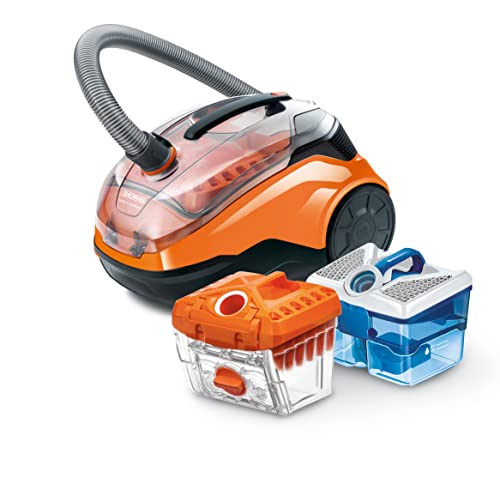

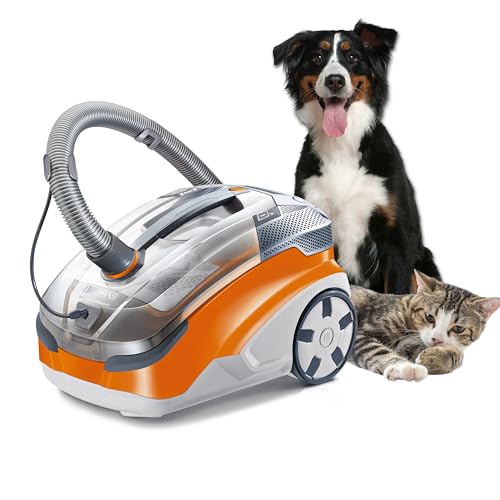
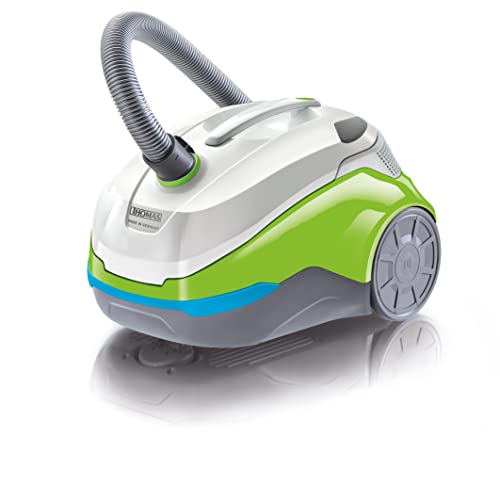


How do water-filter vacuums work in practice?
Water-filter vacuums work by accelerating incoming air into a separator where water captures much of the dust, hair and pollen. The dirty water then remains in a removable tank, while baffles and a downstream filter catch droplets and finer particles before the air leaves the machine.
The water is part of the filtration path, not a substitute for suction or a sealed exhaust system. Around 25–30 kPa and 30–35 L/s are useful starting points for a full-size canister when measurements are comparable, but floorhead design and unblocked airways determine how much pickup reaches the floor; motor input such as 1,700 W describes electricity use, not suction output.
The main practical benefit is that collected dust is poured away in water instead of forming a dry cloud during emptying. The compromise is preparation and cleanup: the tank must contain the specified amount of fresh water before use, must not exceed its fill limit and cannot be left wet and dirty after cleaning.
How do water-filter vacuums compare with bagged and bagless models?
Water-filter vacuums can reduce the dry dust released during emptying, whereas bagged machines seal debris inside a disposable bag and conventional bagless cyclones collect it in a dry bin. A well-sealed bagged vacuum is usually the simplest option for allergy-sensitive disposal; a water system is attractive when you prefer to pour away wet debris and do not mind cleaning the tank immediately.
Conventional bagless vacuums are normally lighter and faster to empty, but fine dust can coat the bin and filters. Water-filter canisters are typically heavier—roughly 7–8 kg is realistic—and require water before every session, yet they avoid recurring dust bags and can handle larger quantities of fine dry debris without a dusty bin cloud.
Do not assume that water filtration automatically provides better floor pickup or certified HEPA performance. Compare the complete sealed system, final-filter class, floorhead and measured suction under similar conditions; choose bagged for minimum routine handling, dry bagless for speed and compactness, or water filtration for wet-contained disposal and its particular maintenance routine.
What maintenance does a water-filtration vacuum require?
A water-filtration vacuum requires the separator tank to be emptied, rinsed and left open to dry after every cleaning session. Dirty water contains organic debris that can smell quickly, and storing the machine with moisture trapped inside encourages deposits on baffles, seals and filters.
Fill the tank only to the manufacturer's mark; many full-size systems use about 1 L of clean water for dry vacuuming. For long sessions, inspect the water periodically—some manufacturers specify changing it after roughly 30 minutes—because heavily loaded or evaporated water captures particles less effectively and can reach the separator limit.
Rinse removable baffles and foam elements with clean water, clear hair from the intake and floorhead, and allow every washable part to dry completely before reassembly.
Do not wash a pleated or HEPA filter unless its instructions explicitly permit it. Replace seals or filters when damaged because bypass leakage defeats the filtration system.