Scored using Graphics cards Methodology v3.0
Graphics cards Methodology v3.0
Mathematical & Unbiased Scoring
Products in this category are scored under Frontum Graphics cards Methodology v3.0: the technical score from the specifications is the base, and independent expert and video reviews (up to ±0.5 points), owner opinions (up to ±0.3) and best-of lists (up to +0.3) move it up or down.
Explore Graphics cards Methodology v3.0

ASUS GeForce RTX 5080 Noctua OC Edition review: 117 specs compared

Avg. price:~£1,500VRAM:16 GBMemory bus width:256 bitThermal Design Power (TDP):360 W

ASUS GeForce RTX 5080 Noctua OC Edition Review: Compare 117 technical specifications and 22 expert and video reviews to see how this product ranks in the Graphics cards category and whether it is worth buying.
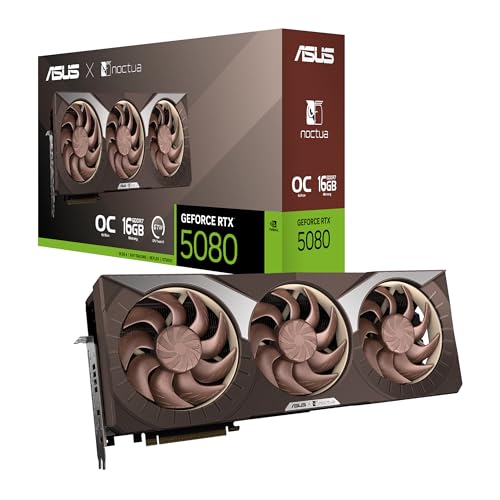
ASUS GeForce RTX 5080 Noctua OC Edition
8.5/10

Overall score

Score
8.5/ 10
✕
What it is
Our main score for this model, 1–10. It combines specs, expert reviews, best-of lists and owners.
How we count it
Parts: Technical score 40%, Reviews score 25%, List score 25%, Sentiment score 10%
Marks: Each part gets a mark out of 10. For reviews, lists and owners, a typical model in this category gets about 8 and the best one gets 10.
No data yet: A part with no data shows "?". It counts as the mark of a weaker model in this category (4 in 5 models with data score higher). This way, models with reviews, lists and owners usually come out ahead.
Score distribution
▼
<55-66-77-88-99-10
Score components

40%

9.3

Technical score

25%

8.3

Reviews score

25%

?

List scoreNot enough data yet, so we use 7.5, the mark of a weaker model in this category

10%

8.1

Sentiment score

★Better than 97% of graphics cards
6.7

Value for money

Value for money
6.7/ 10
✕
What it is
An indicator that combines the graphics card's overall rating with its cost.
When it matters
When you are looking for a graphics card that offers a strong balance of performance, features, and price.
Score distribution
▼
<55-66-77-88-99-10
Score components

70%

8.5

Overall score

30%

2.6

Price

▼Worse than 83%
9.3

Technical score

Technical score
9.3/ 10
✕
What it is
How good the specs are compared with the other models in this category, 1–10.
How we count it
Areas: We rate the specs in each area against the other models in this category.
Weighting: The areas that matter most to buyers count more. The shares are shown under Score components.
Share: The technical score is 40% of the overall score.
Score distribution
▼
<55-66-77-88-99-10
Score components

44%

10

Performance

24%

9.6

Memory

12%

7.6

Power

11%

10

Features

5%

3.9

Design

4%

10

Connectivity

★Better than 96%
8.3

Reviews score

Reviews score
8.3/ 10
✕
What it is
Average grade from independent test sites, magazines and video reviewers, 1–10.
How we count it
Grades: Each review's own score is converted to 1–10; without one, we grade the review ourselves. Big test sites count more, short reviews half as much as full tests. A video review counts half.
Score: The average grade is 80% of the review mark; the number of reviews is the other 20% (1 review = 5, the typical number in this category = 8, the most-reviewed model = 10).
Enough data: With few reviews, the average grade is pulled toward the typical grade of this category. No reviews yet: 7.6 for now.
Share: Reviews count 25% of the overall score.
Score distribution
▼
<55-66-77-88-99-10

80%

8.1

Average grade

20%

9.1

Popularity

Grades by review (22)
16 reviews: 8 with a printed score, 8 estimated from the review. 6 video reviews, each counting half as much as a written test. Reviews count 25% of the overall score.
User ratings collected online are not part of this score.
▲Better than 77%
?

List score

List score
7.5/ 10
✕
What it is
How often independent test sites, magazines and video reviewers put this model in their best-of lists for this category.
How we count it
Points: The model in the most lists of this category gets 10; the others get 8 to 10 in proportion. In no list yet: 7.5. Lists count 25% of the overall score.
Enough data: Every list counts, even a single one. With fewer than 5 best-of lists in the category, this part is left out.
Lists with this model (0)
Not in any best-of list yet, so this part counts as 7.5. Models in a list get 8 to 10.
Not in any best-of list yet

What reviewers say about the ASUS GeForce RTX 5080 Noctua OC Edition

Based on 16 · 6

Reviewers love the cool, quiet running and excellent fans, but the card is huge and many dislike its looks.
Praised
Mixed views
Criticised
Pick a topic to see who said what

What owners say about the ASUS GeForce RTX 5080 Noctua OC Edition

Based on 221 owners sharing their experience in online comments

70%positive8%mixed22%negative

Owners praise its fast gaming and overclocking, while high prices and 16GB of VRAM are the clearest drawbacks.

What owners dislike

  • Many owners felt the price was steep for the performance gained, especially compared with a cheaper RTX 5070 Ti.10
  • Owners wish for 24 GB; in heavy path-traced games at 4K, VRAM can nearly fill, limiting settings.7
  • Some owners see low 1% frame rates, stutters, or big drops in heavy games and shader-modded Minecraft, sometimes fixed by a restart.6
  • Some owners found the gain over a 4080 or 4080 Super modest, with some saying it barely beats a 5070 Ti.5

Points mentioned by at least 3 owners, most mentioned first.

Loading...
Loading category ranking...

Technical Specifications of graphics card ASUS GeForce RTX 5080 Noctua OC Edition

Technical score
Technical score
9.3/ 10
✕
What it is
How good the specs are compared with the other models in this category, 1–10.
How we count it
Areas: We rate the specs in each area against the other models in this category.
Weighting: The areas that matter most to buyers count more. The shares are shown under Score components.
Share: The technical score is 40% of the overall score.
Score distribution
▼
<55-66-77-88-99-10
Score components:

44%

10

Performance

24%

9.6

Memory

12%

7.6

Power

11%

10

Features

5%

3.9

Design

4%

10

Connectivity

9.3
Reviews score
8.3
List score
?
Value for money
Value for money
6.7/ 10
✕
What it is
An indicator that combines the graphics card's overall rating with its cost.
When it matters
When you are looking for a graphics card that offers a strong balance of performance, features, and price.
Score distribution
▼
<55-66-77-88-99-10
Score components:

70%

8.5

Overall score

30%

2.6

Price

6.7
3DMark Time Spy benchmark score
35,198 points
This graphics card scores 35,198 points in 3DMark Time Spy, which is higher than 94.9% of graphics cards and equal to 0.3% of graphics cards.
3DMark Port Royal score
22,321 points
This graphics card scores 22,321 points in 3DMark Port Royal, which is higher than 90.1% of graphics cards and equal to 0.1% of graphics cards.
PassMark (G3D) result
36,247 points
This graphics card scores 36,247 points in PassMark G3D, which is higher than 91.3% of graphics cards and equal to 1.1% of graphics cards.
PassMark (DirectCompute) result
20,421 points
This graphics card scores 20,421 points in PassMark DirectCompute, which is higher than 81.2% of graphics cards and equal to 0.1% of graphics cards.
FP32 performance
56.3 TFLOPS
This graphics card delivers 56.3 TFLOPS FP32 performance, which is higher than that of 90.1% of graphics cards and equal to that of 0.7% of graphics cards.
Show more
What reviewers say
VRAM
16 GB
This graphics card has 16 GB of VRAM, which is more than 62% of graphics cards and equal to 28.1% of graphics cards.
Memory type
GDDR7
This graphics card uses GDDR7 memory, which is newer than on 79.6% of graphics cards and equal to 20.4% of graphics cards.
Memory bus width
256 bit
This graphics card uses a 256 bit memory bus, which is wider than that of 50.7% of graphics cards and equal to that of 35.5% of graphics cards.
Maximum memory bandwidth
960 GB/s
This graphics card reaches 960 GB/s memory bandwidth, which is higher than that of 88.3% of graphics cards and equal to that of 5.7% of graphics cards.
Effective memory speed
?
Show more
PCI Express (PCIe) version
5
This graphics card supports PCIe 5, which is newer than on 73% of graphics cards and equal to 27% of graphics cards.
PCIe lanes
x16
This graphics card uses x16 PCIe lanes, which is more than 24.1% of graphics cards and equal to 75.9% of graphics cards.
DirectX version
12 Ultimate
This graphics card supports DirectX 12 Ultimate, which is more advanced than on 22.8% of graphics cards and equal to 77.2% of graphics cards.
Vulkan version
1.4
This graphics card supports Vulkan 1.4, which is more advanced than on 20.8% of graphics cards and equal to 79.2% of graphics cards.
OpenGL version
4.6
This graphics card supports OpenGL 4.6, which is more advanced than on 2% of graphics cards and equal to 98% of graphics cards.
Show more
Max displays supported
4
This graphics card supports up to 4 displays, which is more than 9% of graphics cards and equal to 88.2% of graphics cards.
Max digital resolution
7680x4320
This graphics card supports a maximum digital resolution of 7680x4320, which is higher than that of 9.2% of graphics cards and equal to that of 90.9% of graphics cards.
DisplayPort outputs
3
This graphics card offers 3 DisplayPort outputs, which is more than 21.7% of graphics cards and equal to 76% of graphics cards.
DisplayPort version
2.1b
This graphics card supports DisplayPort 2.1b, which is more advanced than on 77.8% of graphics cards and equal to 22.2% of graphics cards.
DisplayPort link rates
80 Gbps
This graphics card supports DisplayPort link rates up to 80 Gbps, which is faster than on 84.9% of graphics cards and equal to 14.9% of graphics cards.
Show more
What reviewers say
Thermal Design Power (TDP)
360 W
This graphics card has a TDP of 360 W, which is higher than that of 89% of graphics cards and equal to that of 4.3% of graphics cards.
Power consumption while under peak load
360 W
This graphics card draws 360 W under peak load, which is higher than 86% of graphics cards and equal to 4% of graphics cards.
Recommended PSU wattage
850 W
This graphics card recommends a 850 W PSU, which is higher than that of 83.6% of graphics cards and equal to that of 11.9% of graphics cards.
Board power limit
450 W
This graphics card has a board power limit of 450 W, which is higher than that of 92.5% of graphics cards and equal to that of 2.6% of graphics cards.
PCIe power spec
360 W
Show more
What reviewers say
Size
385x 151x 80 mm
Length
385 mm
This graphics card is 385 mm long, which is longer than 100% of graphics cards.
Height
151 mm
This graphics card is 151 mm tall, which is taller than 96.6% of graphics cards and equal in height to 0.5% of graphics cards.
Slot width
4 slot/s
This graphics card occupies 4 slot/s, which is wider than 97.6% of graphics cards and equal in width to 2.3% of graphics cards.
Weight
2,670 g
This graphics card weighs 2,670 g, which is heavier than 97.9% of Graphics cards.
Show more
What reviewers say

ASUS GeForce RTX 5080 Noctua OC Edition vs the average graphics card

246810TotalPerformanceMemoryFeaturesConnectivityPowerDesign
  • 44 more compute units
    This graphics card has more compute units than the average graphics card (84 vs 40). The average graphics card has 40 compute units.
    84 vs 40
  • 9% higher boost clock speed
    This graphics card has a higher boost GPU clock than the average graphics card (2,730 MHz vs 2,505 MHz). The average graphics card has a boost GPU clock of 2,505 MHz.
    2,730 MHz vs 2,505 MHz
  • 44 more ray tracing cores
    This graphics card has more ray tracing cores than the average graphics card (84 vs 40). The average graphics card has 40 ray tracing cores.
    84 vs 40
  • 2.14x higher memory bandwidth
    This graphics card has a higher memory bandwidth than the average graphics card (960 GB/s vs 448 GB/s). The average graphics card has a memory bandwidth of 448 GB/s.
    960 GB/s vs 448 GB/s
  • 2.33x higher texture rate
    This graphics card has a higher texture rate than the average graphics card (879.3 GTexel/s vs 378 GTexel/s). The average graphics card has a texture rate of 378 GTexel/s.
    879.3 GTexel/s vs 378 GTexel/s
  • 152 more TMUs
    This graphics card has more TMUs than the average graphics card (336 vs 184). The average graphics card has 184 TMUs.
    336 vs 184
  • 48 more ROPs
    This graphics card has more ROPs than the average graphics card (112 vs 64). The average graphics card has 64 ROPs.
    112 vs 64
  • 87.5% higher pixel rate
    This graphics card has a higher pixel rate than the average graphics card (302.4 GPixel/s vs 161.3 GPixel/s). The average graphics card has a pixel rate of 161.3 GPixel/s.
    302.4 GPixel/s vs 161.3 GPixel/s
  • 15.3% higher review score
    Reviews score
    8.3/ 10
    ✕
    What it is
    Average grade from independent test sites, magazines and video reviewers, 1–10.
    How we count it
    Grades: Each review's own score is converted to 1–10; without one, we grade the review ourselves. Big test sites count more, short reviews half as much as full tests. A video review counts half.
    Score: The average grade is 80% of the review mark; the number of reviews is the other 20% (1 review = 5, the typical number in this category = 8, the most-reviewed model = 10).
    Enough data: With few reviews, the average grade is pulled toward the typical grade of this category. No reviews yet: 7.6 for now.
    Share: Reviews count 25% of the overall score.
    Score distribution
    ▼
    <55-66-77-88-99-10

    80%

    8.1

    Average grade

    20%

    9.1

    Popularity

    Grades by review (22)
    16 reviews: 8 with a printed score, 8 estimated from the review. 6 video reviews, each counting half as much as a written test. Reviews count 25% of the overall score.
    User ratings collected online are not part of this score.
    8.3 vs 7.2
  • 44 more compute units
    This graphics card has more compute units than the average graphics card (84 vs 40). The average graphics card has 40 compute units.
    84 vs 40
  • 9% higher boost clock speed
    This graphics card has a higher boost GPU clock than the average graphics card (2,730 MHz vs 2,505 MHz). The average graphics card has a boost GPU clock of 2,505 MHz.
    2,730 MHz vs 2,505 MHz
  • 44 more ray tracing cores
    This graphics card has more ray tracing cores than the average graphics card (84 vs 40). The average graphics card has 40 ray tracing cores.
    84 vs 40
  • 2.33x higher texture rate
    This graphics card has a higher texture rate than the average graphics card (879.3 GTexel/s vs 378 GTexel/s). The average graphics card has a texture rate of 378 GTexel/s.
    879.3 GTexel/s vs 378 GTexel/s
  • 152 more TMUs
    This graphics card has more TMUs than the average graphics card (336 vs 184). The average graphics card has 184 TMUs.
    336 vs 184
  • 48 more ROPs
    This graphics card has more ROPs than the average graphics card (112 vs 64). The average graphics card has 64 ROPs.
    112 vs 64
  • 87.5% higher pixel rate
    This graphics card has a higher pixel rate than the average graphics card (302.4 GPixel/s vs 161.3 GPixel/s). The average graphics card has a pixel rate of 161.3 GPixel/s.
    302.4 GPixel/s vs 161.3 GPixel/s
  • 192 more AI cores
    This graphics card has more AI cores than the average graphics card (336 vs 144). The average graphics card has 144 AI cores.
    336 vs 144
  • 2.49x higher FP32 performance
    This graphics card has a higher FP32 performance than the average graphics card (56.3 TFLOPS vs 22.6 TFLOPS). The average graphics card has FP32 performance of 22.6 TFLOPS.
    56.3 TFLOPS vs 22.6 TFLOPS
  • 19.8% higher base clock speed
    This graphics card has a higher base GPU clock than the average graphics card (2,300 MHz vs 1920 MHz). The average graphics card has a base GPU clock of 1920 MHz.
    2,300 MHz vs 1,920 MHz
  • 2.38x higher gaming score
    This graphics card has a higher gaming score than the average graphics card (35,198 points vs 14,779 points). The average graphics card has a gaming score of 14,779 points.
    35,198 points vs 14,779 points
  • 2.44x higher ray tracing score
    This graphics card has a higher ray tracing score than the average graphics card (22,321 points vs 9,148 points). The average graphics card has a ray tracing score of 9,148 points.
    22,321 points vs 9,148 points
  • 60.1% higher PassMark score
    This graphics card has a higher PassMark score than the average graphics card (36,247 points vs 22,638 points). The average graphics card has a PassMark score of 22,638 points.
    36,247 points vs 22,638 points
  • 2 years newer
    This graphics card was released more recently than the average graphics card (2025 vs 2023).
    August 2025
    2025 vs 2023
  • 7.44x higher INT8 performance
    This graphics card has a higher INT8 performance than the average graphics card (1,801 TOPS vs 242 TOPS). The average graphics card has INT8 performance of 242 TOPS.
    1,801 TOPS vs 242 TOPS
  • 6,400 more FP32 units
    This graphics card has more FP32 units than the average graphics card (10,752 vs 4,352). The average graphics card has 4,352 FP32 units.
    10,752 vs 4,352
  • 2.14x higher memory bandwidth
    This graphics card has a higher memory bandwidth than the average graphics card (960 GB/s vs 448 GB/s). The average graphics card has a memory bandwidth of 448 GB/s.
    960 GB/s vs 448 GB/s
  • 4 GB more VRAM
    This graphics card has more VRAM than the average graphics card (16 GB vs 12 GB). The average graphics card has 12 GB VRAM.
    16 GB vs 12 GB
  • 64 bit wider memory bus
    This graphics card has a wider memory bus than the average graphics card (256 bit vs 192 bit). The average graphics card has a memory bus width of 192 bit.
    256 bit vs 192 bit
  • Supports ECC memory
    This graphics card supports ECC memory, the average graphics card does not.
  • 2.67x larger L2 cache
    This graphics card has more L2 cache than the average graphics card (64 MB vs 24 MB). The average graphics card has 24 MB L2 cache.
    64 MB vs 24 MB
  • 16x more Infinity Cache
    This graphics card has more Infinity Cache than the average graphics card (64 MB vs 4 MB). The average graphics card has 4 MB Infinity Cache.
    64 MB vs 4 MB
  • 7.1% faster VRAM clock
    This graphics card has a higher VRAM clock than the average graphics card (1,875 MHz vs 1,750 MHz). The average graphics card runs its VRAM at 1,750 MHz.
    1,875 MHz vs 1,750 MHz
  • Newer GDDR version
    This graphics card uses a newer GDDR version than the average graphics card (GDDR7 vs GDDR6).
    GDDR7 vs GDDR6
  • Newer PCIe version
    This graphics card supports a newer PCIe version than the average graphics card (5 vs 4).
    5 vs 4
  • Newer DisplayPort version
    This graphics card supports a newer DisplayPort version than the average graphics card (2.1b vs 1.4a).
    2.1b vs 1.4a
  • Newer HDMI version
    This graphics card supports a newer HDMI version than the average graphics card (2.1b vs 2.1a).
    2.1b vs 2.1a
  • 3.7x higher DisplayPort bandwidth
    This graphics card has a higher DisplayPort bandwidth than the average graphics card (80 Gbps vs 21.6 Gbps). The average graphics card has DisplayPort bandwidth of 21.6 Gbps.
    80 Gbps vs 21.6 Gbps
  • 7 °C higher thermal ceiling
    This graphics card has a higher thermal ceiling than the average graphics card (88 °C vs 95 °C). The average graphics card has a thermal ceiling of 95 °C.
    88 °C vs 95 °C
  • 11.5 dB quieter under load
    This graphics card has a lower load noise level than the average graphics card (23.9 dB vs 35.4 dB). The average graphics card has a load noise level of 35.4 dB.
    23.9 dB vs 35.4 dB
  • 9 °C lower load temperature
    This graphics card has a lower load temperature than the average graphics card (58 °C vs 67 °C). The average graphics card has a load temperature of 67 °C.
    58 °C vs 67 °C
  • 67.4% higher TDP
    This graphics card has a higher TDP than the average graphics card (360 W vs 215 W). The average graphics card has a TDP of 215 W.
    360 W vs 215 W
  • 102.8 mm longer card length
    This graphics card is longer than the average graphics card (385 mm vs 282.2 mm). The average graphics card has a length of 282.2 mm.
    385 mm vs 282.2 mm
  • No RGB lighting
    This graphics card does not include RGB lighting, the average graphics card does.
  • 26 mm higher card profile
    This graphics card is taller than the average graphics card (151 mm vs 125 mm). The average graphics card has a height of 125 mm.
    151 mm vs 125 mm
  • 30.8% higher PSU requirement
    This graphics card has a higher PSU requirement than the average graphics card (850 W vs 650 W). The average graphics card has a PSU requirement of 650 W.
    850 W vs 650 W
  • 1.5 slot/s wider design
    This graphics card occupies more slots than the average graphics card (4 slot/s vs 2.5 slot/s). The average graphics card occupies 2.5 slot/s.
    4 slot/s vs 2.5 slot/s
  • 2.05x higher board power limit
    This graphics card has a higher board power limit than the average graphics card (450 W vs 220 W). The average graphics card has a board power limit of 220 W.
    450 W vs 220 W
  • 2.88x more expensive
    ASUS GeForce RTX 5080 Noctua OC Edition is more expensive than the average graphics card (£1,500 vs £520).
    £1,500 vs £520
  • 2.88x more expensive
    ASUS GeForce RTX 5080 Noctua OC Edition is more expensive than the average graphics card (£1,500 vs £520).
    £1,500 vs £520
  • 10.4% worse value for money
    ASUS GeForce RTX 5080 Noctua OC Edition has worse value for money than the average graphics card (6.72 vs 7.4).
    6.72 vs 7.41
  • 67.4% higher TDP
    This graphics card has a higher TDP than the average graphics card (360 W vs 215 W). The average graphics card has a TDP of 215 W.
    360 W vs 215 W
  • 30.8% higher PSU requirement
    This graphics card has a higher PSU requirement than the average graphics card (850 W vs 650 W). The average graphics card has a PSU requirement of 650 W.
    850 W vs 650 W
  • 2.05x higher board power limit
    This graphics card has a higher board power limit than the average graphics card (450 W vs 220 W). The average graphics card has a board power limit of 220 W.
    450 W vs 220 W
  • 63.6% higher peak power draw
    This graphics card has a higher peak power draw than the average graphics card (360 W vs 220 W). The average graphics card has a peak power draw of 220 W.
    360 W vs 220 W
  • 102.8 mm longer card length
    This graphics card is longer than the average graphics card (385 mm vs 282.2 mm). The average graphics card has a length of 282.2 mm.
    385 mm vs 282.2 mm
  • No RGB lighting
    This graphics card does not include RGB lighting, the average graphics card does.
  • 26 mm higher card profile
    This graphics card is taller than the average graphics card (151 mm vs 125 mm). The average graphics card has a height of 125 mm.
    151 mm vs 125 mm
  • 1.5 slot/s wider design
    This graphics card occupies more slots than the average graphics card (4 slot/s vs 2.5 slot/s). The average graphics card occupies 2.5 slot/s.
    4 slot/s vs 2.5 slot/s
  • 2.63x heavier
    This graphics card is heavier than the average graphics card (2,670 g vs 1,014 g). The average graphics card weighs 1,014 g.
    2,670 g vs 1,014 g

Video reviews

Hands-on testing, unboxing, and real-world video evaluations

9.0
Vortez
≈ estimated
04/01/2026
Hands-on review · thermal and 4K gaming tests
Verdict
ASUS GeForce RTX 5080 Noctua OC Edition has a top-tier cooler and strong 4K performance, but it is large and pricey, ideal for Noctua fans.
9.0
Tech Notice
≈ estimated
18/11/2025
Hands-on review · thermal, fan and power tests
Verdict
ASUS GeForce RTX 5080 Noctua OC Edition has excellent cooling and low noise, but the 5080 label feels like a missed 5090 opportunity.
7.0
JCustom
≈ estimated
14/11/2025
Build overview · temperature and fan noise tests
Verdict
ASUS GeForce RTX 5080 Noctua OC Edition is well built and very quiet, but it is pricey, and base 5080 models offer better value.
6.0
der8auer EN
≈ estimated
25/09/2025
Hands-on review · cooling, noise and coil whine tests
Verdict
ASUS GeForce RTX 5080 Noctua OC Edition is quieter and cools better, but the Astral has more features, so there is no clear winner.
5.0
KitGuruTech
≈ estimated
21/08/2025
Hands-on review · engineering, noise, temperature and overclock tests
Verdict
ASUS GeForce RTX 5080 Noctua OC Edition has impressive engineering and strong cooling, but it is hard to justify at this price compared with the RTX 5090.
Brand video

Expert reviews

In-depth analysis and verdict from leading tech publications

10
techpowerup.com
✓ explicit
12/08/2025
Review · Quiet cooling
Verdict
The ASUS RTX 5080 Noctua OC is a very quiet, well-cooled RTX 5080 whose 2700 MHz boost clock is only a small step above the standard model.
7.0
kitguru.net
✓ explicit
21/08/2025
Review · Size and noise
Verdict
The ASUS RTX 5080 Noctua Edition is a near-silent RTX 5080 with an owl-inspired design, best for builders with large cases who want quiet operation.
9.0
pcguide.com
✓ explicit
19/03/2026
Lab test · Cooling and sound
Verdict
The ASUS RTX 5080 Noctua OC Edition is a cool, quiet RTX 5080 with lots of overclocking room, best for custom builders who like its beige and brown look.
7.0
club386.com
✓ explicit
29/10/2025
Lab test · Noise and cooling
Verdict
The ASUS RTX 5080 Noctua OC Edition is near-silent and cool, best for owners of very large cases since its speed barely beats stock.
7.2
pcgamer.com
✓ explicit
12/02/2026
Benchmark review · Quiet cooling
Verdict
The ASUS RTX 5080 Noctua Edition is very quiet and cool with plenty of overclocking room, though its game speed matches other RTX 5080 cards.
9.0
tomshardware.com
✓ explicit
06/03/2026
Lab test · Ultra-quiet cooling
Verdict
The ASUS RTX 5080 Noctua Edition is the quietest card tested so far, with full RTX 5080 gaming speed, but its bulk limits it to dedicated quiet-PC builders.
8.0
igorslab.de
≈ estimated
30/04/2026
Hands-on review · Air-cooled silence
Verdict
The ASUS RTX 5080 Noctua OC suits a dedicated quiet build, with semi-passive fans and a support bracket, but its size limits it to large cases.
8.9
pcgameshardware.de
✓ explicit
15/10/2025
Lab test · Noctua fans
Verdict
The ASUS RTX 5080 Noctua OC Edition runs very quietly and stays cool, but its 2,688 g weight and four-slot thickness make it a tight fit in many cases.
9.0
computerbase.de
≈ estimated
14/08/2025
Lab test · Quiet cooling
Verdict
The ASUS RTX 5080 Noctua OC Edition stays very quiet even when overclocked at 400 W, but its 38.5 cm length needs a very big case.
9.0
overclocking.com
≈ estimated
10/10/2025
Lab test · Cooling and overclocking
Verdict
The ASUS RTX 5080 Noctua OC Edition runs a few percent faster than the Founders Edition and stays near-silent, with real overclocking room for enthusiasts.
8.0
hardwareand.co
≈ estimated
29/12/2025
Lab test · Noise and temperatures
Verdict
The ASUS RTX 5080 Noctua Edition OC is nearly inaudible and runs cool, best for large cases and buyers who like its brown Noctua look.
8.7
pausehardware.com
✓ explicit
19/04/2026
Lab test · Silent cooling
Verdict
The ASUS RTX 5080 Noctua OC is a powerful, very quiet card for builders who have already tuned the rest of their system, though its size limits it.
9.0
overclocking.com
≈ estimated
10/10/2025
Lab test · Noise and BIOS
Verdict
The ASUS RTX 5080 Noctua OC stays near 34 dBA under stress, with its Quiet BIOS only about 8°C hotter, though overclocking gains little.
9.0
elchapuzasinformatico.com
≈ estimated
14/11/2025
Hands-on test · Silent cooling
Verdict
The ASUS RTX 5080 Noctua Edition is a silent RTX 5080 with a strong power section for overclocking, best for large cases where quiet matters most.
9.0
hwupgrade.it
≈ estimated
21/10/2025
Hands-on test · Cooling and noise
Verdict
The ASUS RTX 5080 Noctua OC Edition is a very quiet, cool RTX 5080 with plenty of overclocking room, but it is huge and suits only large cases.
9.0
tweakers.net
≈ estimated
13/11/2025
Lab test · Noise and temperature
Verdict
The ASUS GeForce RTX 5080 Noctua OC Edition is the quietest card in the test, staying cool under load, though its speed barely beats the Founders Edition.

Third-party reviews

What customers like about ASUS GeForce RTX 5080 Noctua OC Edition

  • Unparalleled acoustic performance, frequently described as 'whisper-quiet' or nearly inaudible even under full load
  • Exceptional thermal management with best-in-class cooling that keeps the GPU under 65°C during intense gaming
  • Utilises high-quality standard 120mm Noctua NF-A12x25 G2 fans which are easier to replace or maintain than proprietary GPU fans
  • Excellent build quality featuring a full-length metal backplate and a robust 16+3 phase VRM design
  • Strong overclocking headroom with users reporting gains of 10-12% over factory settings
  • Includes a well-designed, adjustable GPU support bracket to prevent 'sag' due to its weight

What customers don't like about ASUS GeForce RTX 5080 Noctua OC Edition

  • Extremely expensive, commanding a significant price premium (up to 50-65%) over the base RTX 5080 MSRP
  • Massive physical dimensions (quad-slot height and 385mm length) that require a large chassis and may block other motherboard slots
  • Polarising aesthetic; the signature Noctua beige and brown color scheme does not appeal to all users or match most PC builds
  • Lack of RGB lighting, which may be a drawback for enthusiasts who prefer a more modern, illuminated look
  • Performance-to-value ratio is questionable as the high price brings it close to the cost of a significantly more powerful RTX 5090
  • Reports of audible coil whine in some units when under high electrical load

Verdict

The Asus GeForce RTX 5080 Noctua OC Edition is an enthusiast-grade graphics card based on NVIDIA's Blackwell architecture, featuring 10,752 CUDA cores and 16GB of high-speed GDDR7 memory on a 256-bit bus. This factory-overclocked model reaches boost clocks of 2730 MHz in OC mode and utilizes a massive quad-slot cooling solution equipped with three Noctua NF-A12x25 G2 fans and an optimized vapor chamber with 11 heat pipes. Main pros include its best-in-class near-silent operation (as low as 14dB(A)), exceptional thermal performance, and high overclocking potential. However, its significant cons include its massive physical footprint at 385mm in length and 80mm in height, a premium price tag of approximately £1,500-£1,640, and a polarizing brown-and-beige aesthetic that lacks RGB lighting.

Compare ASUS GeForce RTX 5080 Noctua OC Edition with other products in the Graphics cards category

1Product to compare no. 1
VS
2Product to compare no. 2
VS
3Product to compare no. 3 (optional)

Graphic comparison of ASUS GeForce RTX 5080 Noctua OC Edition and other products in the Graphics cards category

No results found