Which brands make the best wet-dry vacuums for cars?
Armor All, Vacmaster, BLACK+DECKER, DEWALT, and Craftsman are strong starting points for car-focused wet-dry cleaning, with the best choice depending on whether compact storage, cordless portability, or workshop-level capacity matters most.
Armor All specialises in compact wet-dry canisters with car-friendly hoses and accessory kits, while Vacmaster spans small value models and larger machines with stronger reach. BLACK+DECKER is useful for buyers who want straightforward compact canisters and easy storage.
DEWALT and Craftsman suit users who need more capacity, rugged construction, or battery-platform options that can also serve a garage. Their larger models are less convenient inside a small car, so compare hose reach and lift weight rather than choosing by tank size alone.
Are wet-dry vacuums good for cleaning cars?
Wet-dry vacuums are good for cleaning cars because they can collect sand, crumbs, pet hair, damp dirt, and small liquid spills with one durable machine. A narrow hose and the correct hand tools reach areas that a floor head cannot, while a wet-rated tank is safer than using an ordinary dry vacuum on moisture.
They are less effective when the nozzle kit is too bulky, the hose cannot reach across the cabin, or suction is so aggressive that it grips delicate fabric and loose mats. For washing seats or carpets, choose an extraction-capable setup and avoid saturating foam, electrical connectors, airbag seams, or sound insulation.
Is a cordless or corded wet-dry vacuum better for cleaning a car?
A cordless wet-dry vacuum is better for quick car cleaning and locations without a nearby socket, while a corded model is better for long sessions, stubborn grit, and repeated wet extraction.
Cordless operation avoids dragging a cable past paintwork and makes it easy to clean a vehicle outdoors. Aim for enough normal-mode runtime to finish the cabin with a useful reserve, because maximum suction, powered brushes, and water pumps can reduce the longest advertised battery figure sharply.
A corded canister maintains steady airflow and can support a larger tank and longer hose. It is the stronger choice for multiple vehicles, heavily soiled mats, workshop use, or upholstery washing, provided the cable and hose together reach every side of the car without placing the machine against the body.
Battery-platform models offer a useful middle ground when you already own compatible packs. Confirm whether the quoted price includes the battery and charger, and check that the portable body does not sacrifice the crevice tools or wet shut-off needed for car work.
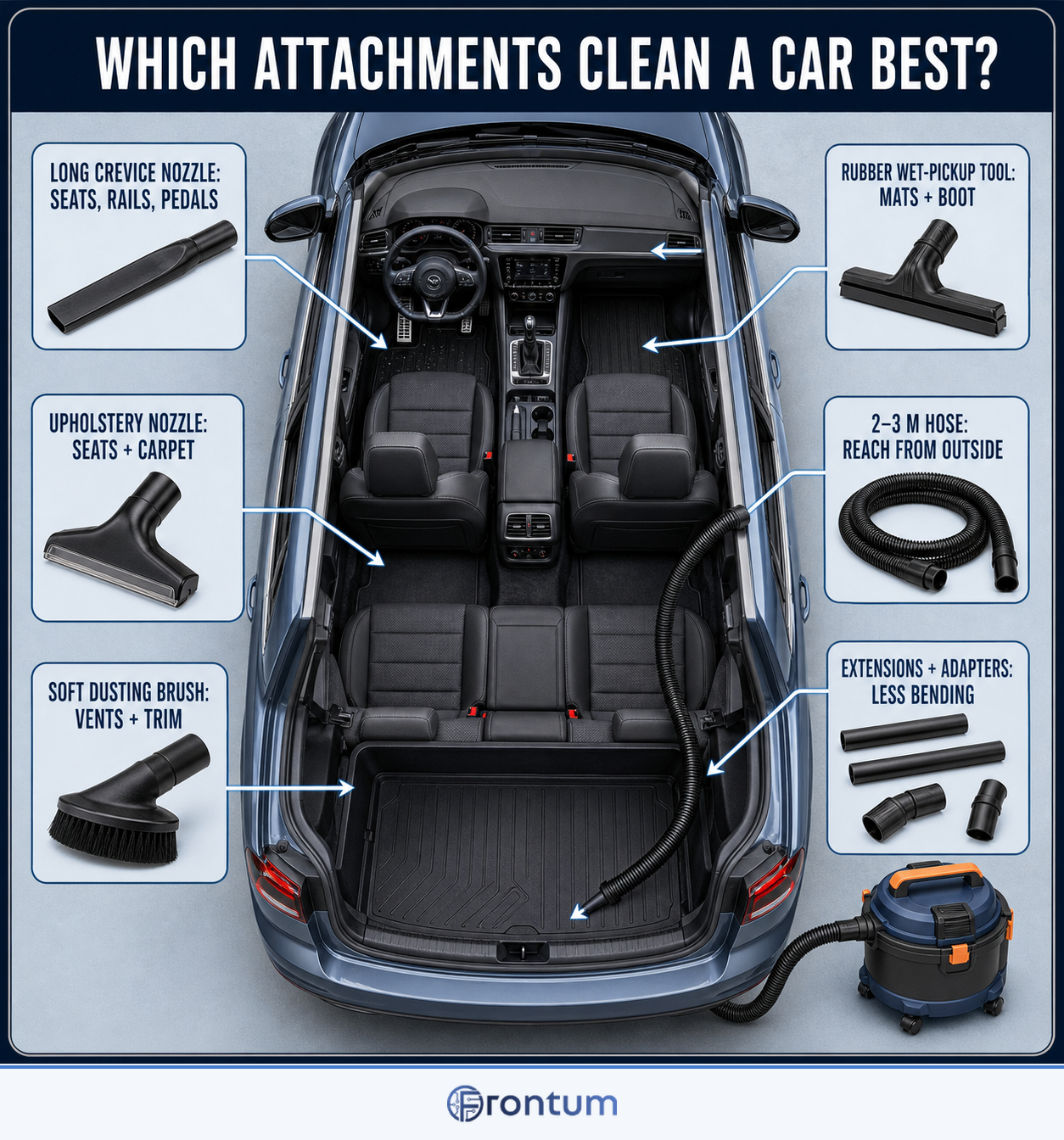
Which attachments are useful for cleaning a car with a wet-dry vacuum?
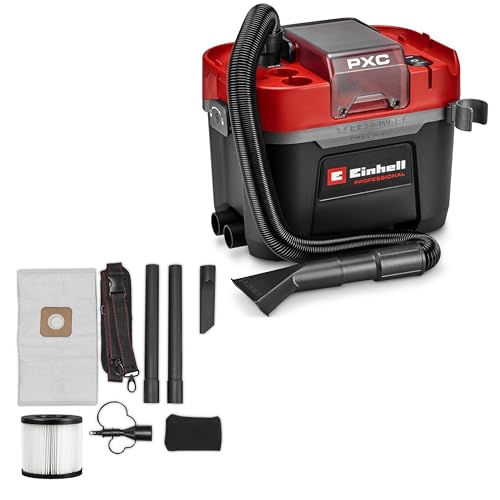
Useful attachments for cleaning a car with a wet-dry vacuum include the following:
- Long crevice nozzle: A slim rigid tool reaches between seats, along rails, under pedals, and beside the centre console. Rounded edges help prevent marks on plastic trim and leather.
- Upholstery nozzle: A wider hand tool spreads suction across seats, carpet, and the boot lining. For wet extraction, a transparent head shows how much solution is still being recovered.
- Soft dusting brush: Soft bristles loosen dust from vents, dashboards, switches, and textured plastics without concentrating suction on delicate parts. The brush should be clean and free from workshop grit before it touches interior trim.
- Flexible hose: Around 2–3 m of kink-resistant hose provides useful reach from outside the vehicle. A compact diameter improves handling, but the bore must still pass leaves, stones, and coarse debris without blocking.
- Rubber wet-pickup tool: A small squeegee nozzle recovers liquid from rubber mats and flat boot surfaces. It should leave a narrow path for air so the nozzle does not seal completely to the surface.
- Extension and adapter set: Short extensions reduce bending when cleaning the boot, while tapered adapters can connect specialist detailing tools. Secure locking joints prevent a nozzle from detaching beneath a seat.

How much do wet-dry vacuums for cars cost?
Wet-dry vacuums for cars generally cost about £50-£220. Compact corded models often sit around £50-£130, while cordless battery-platform machines and extractor-capable packages commonly cost about £100-£220.
Below £90, prioritize a secure hose, crevice tool, wet shut-off, and replacement-filter availability rather than maximum tank capacity. A simple compact canister can clean a car very effectively when its accessory kit fits the cabin.
Above £170, the extra money should provide a useful battery system, stronger upholstery extraction, quieter operation, or a more complete detailing kit. Pay for those functions only when they match how you clean, because a larger tank or higher motor rating alone does not make a vacuum better inside a car.
What should you consider when choosing a wet-dry vacuum for your car?
Before choosing a wet-dry vacuum for your car, consider the following factors:
- Power source and runtime: Choose cordless for outdoor access and quick sessions, or corded for sustained pickup and extraction. For battery models, size normal-mode runtime for the whole cabin with about 20% reserve and confirm whether the battery and charger are included.
- Suction and airflow: Roughly 15–23 kPa is a useful canister reference, but compare only measurements made under similar conditions. Hose diameter, filter loading, and nozzle shape influence real pickup, so motor-input watts alone do not indicate car-cleaning performance.
- Hose reach: Around 2–3 m is a practical target for reaching both footwells and the boot while the vacuum stays outside. Check kink resistance, swivel movement, and whether the hose remains flexible in cool weather.
- Size and weight: A compact 5–15 L tank is usually easier to place beside a car than a 20–30 L workshop model. Prioritize a stable lift handle, protected wheels, and a body that cannot roll into the vehicle.
- Wet safety: Automatic full-tank shut-off and a wet-compatible filter arrangement are essential for spills. Never extract near exposed electrical connectors or soak seat foam, airbag seams, roof lining, or sound insulation.
- Interior tools: Require a long crevice nozzle, upholstery head, and soft brush, then check that their edges will not scratch trim. A transparent extraction tool is valuable when washing seats or carpet.
- Noise and maintenance: Around 72–80 dB is a useful broad reference, with lower figures more comfortable in enclosed garages. Filters, tanks, hoses, and wet tools should be easy to rinse and dry before the machine is stored.