
Are Bosch wet-dry vacuums good?
Bosch wet-dry vacuums have an average overall score of 7.3, ranking #7 among comparable wet-dry vacuum brands.
Bosch wet-dry vacuums are strongest for mixed DIY, workshop, and trade use: UniversalVac, AdvancedVac, and PAS cover routine debris and spills, while Professional GAS models add dust-class options, stronger filtration, and semi-automatic or automatic filter cleaning.
Bosch wet-dry vacuums vary sharply by family, so buyers should check dust class, battery platform, power-tool socket, and filter-cleaning system rather than choosing by tank size alone. Cordless models favor mobility; larger GAS machines favor sustained extraction but cost and weigh more.
The leading Bosch wet-dry vacuums by overall score are as follows:
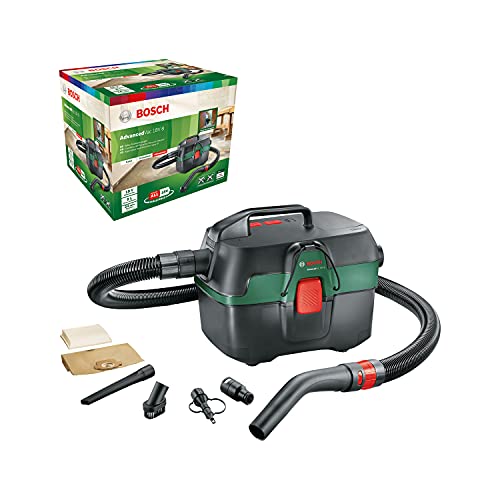
- Bosch AdvancedVac 20 (Overall score: 7.82)
- Bosch Universalvac 15 (Overall score: 7.6)
- Bosch AdvancedVac 18V-8 (Overall score: 6.72)
The chart below compares the average overall scores of wet-dry vacuum brands.
[horizontal-chart-11886932346268468034146667223140412694972275145767]

What are the main Bosch wet-dry vacuum series?
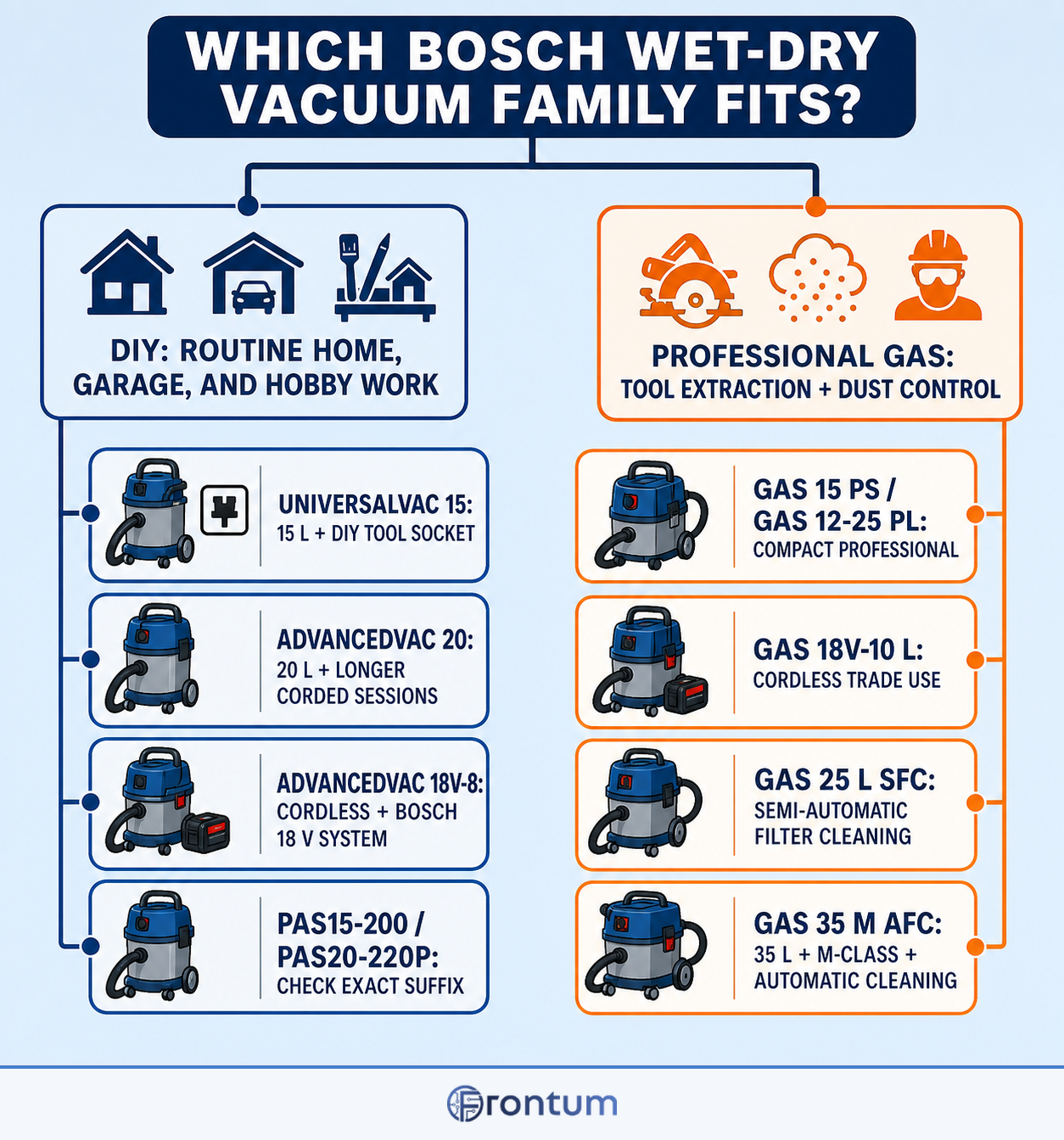
The main Bosch wet-dry vacuum series are as follows:
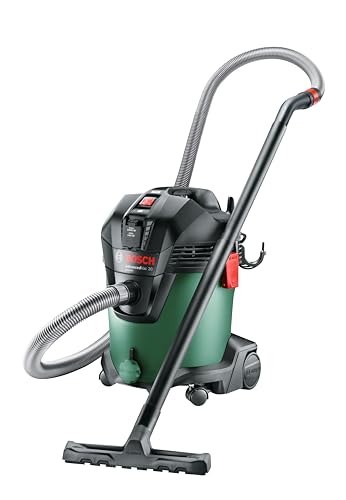
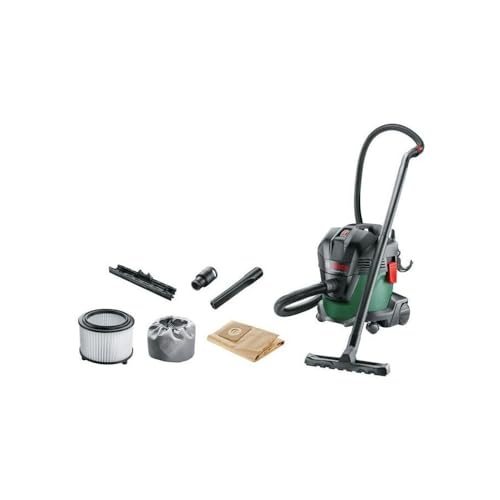
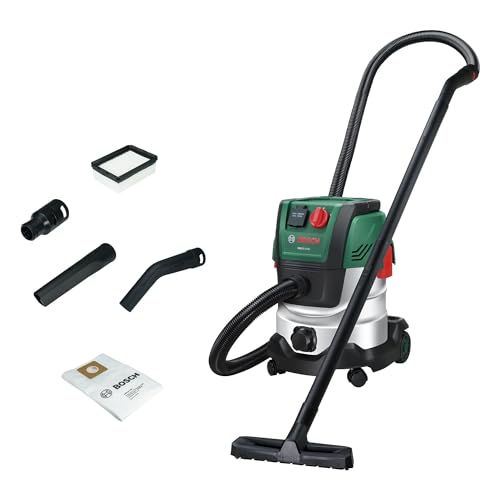
- UniversalVac: The UniversalVac 15 is an accessible corded DIY canister with a 15 L container and a power-tool socket. It suits routine home, garage, and hobby-workshop cleanup when professional dust classification and automatic filter cleaning are unnecessary.
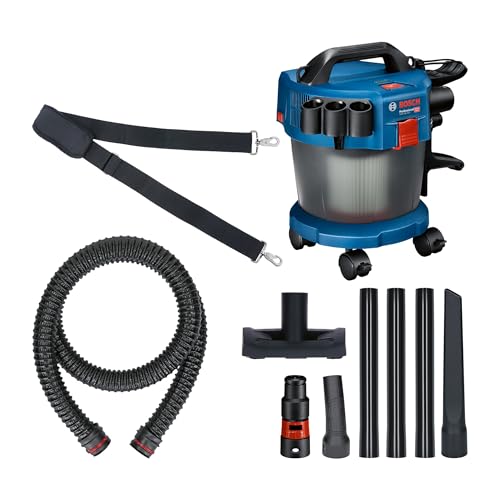
- AdvancedVac: AdvancedVac covers the 20 L corded AdvancedVac 20 and the compact 18 V AdvancedVac 18V-8. The corded model is better for longer tool-connected sessions, while the cordless model prioritizes portability and light cleanup within the Bosch 18 V battery system.
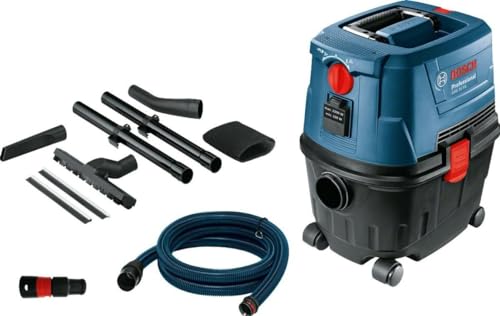
- PAS: The PAS15-200 and PAS20-220P are older compact DIY and workshop models. The larger P version adds a power-tool socket, so buyers comparing PAS machines should check the exact suffix and included hose rather than assuming identical equipment.
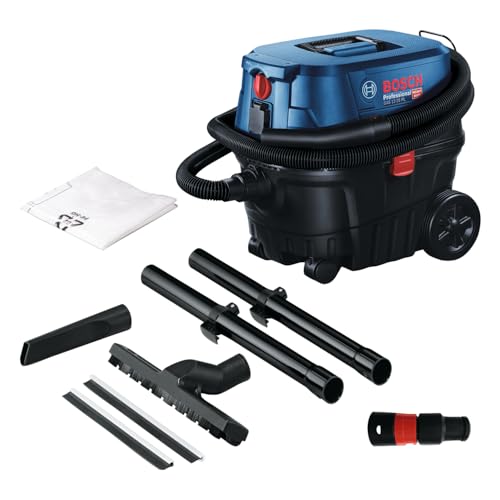
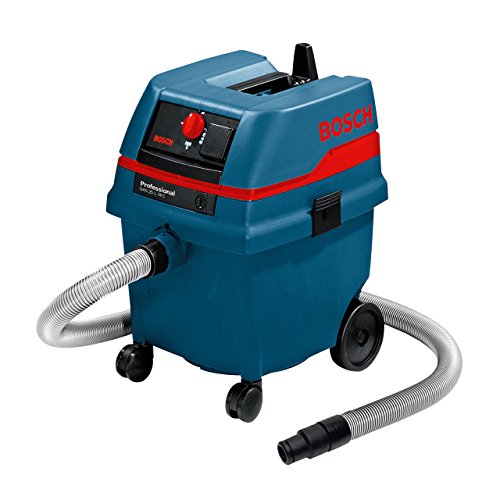
- Professional GAS compact models: The GAS 15 PS, GAS 12-25 PL, and cordless GAS 18V-10 L bridge portable trade use and more controlled dust extraction. Their suffixes and dust-class positioning distinguish tool-socket support, filtration, and the types of jobsite dust they are intended to handle.
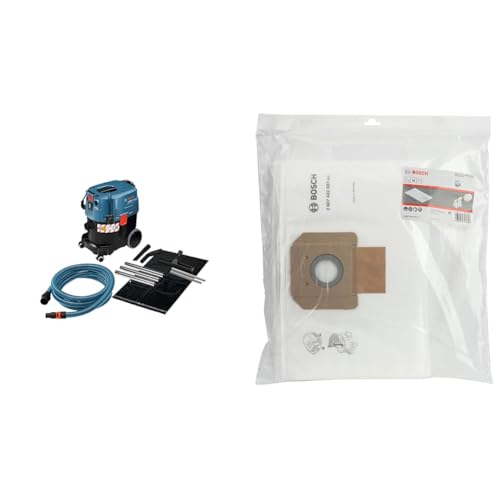
- Professional GAS SFC and AFC models: The GAS 25 L SFC uses semi-automatic filter cleaning, while the GAS 35 M AFC combines a larger 35 L container, M-class positioning, and automatic filter cleaning. These heavier machines suit repeated professional extraction where airflow consistency and dust control justify the extra size and cost.

How much do Bosch wet-dry vacuums cost?
Bosch wet-dry vacuums generally cost about £100-£500. Compact DIY models such as UniversalVac, AdvancedVac, and PAS machines are commonly around £90-£150, including both small cordless units and corded canisters with useful workshop features such as a power-tool socket.
Professional GAS models span a much wider range. Compact trade-oriented machines can remain around £110-£170, while larger L- or M-class models with semi-automatic or automatic filter cleaning rise to roughly £300-£500. Include the cost of compatible batteries and chargers for cordless versions, plus replacement filters, bags, hoses, and tool adapters when comparing the real system price.
The chart below shows the price distribution of Bosch wet-dry vacuums.
[vertical-chart-15035958632678333280089376903785701234342321024274]
What should you consider when choosing a Bosch wet-dry vacuum?
Before choosing a Bosch wet-dry vacuum, consider the following factors:
- Product family and duty cycle: Choose UniversalVac, AdvancedVac, or PAS for normal household, garage, and DIY use; choose Professional GAS when the vacuum will be paired with tools or used repeatedly on jobsites. A larger professional machine adds capability, but also costs more and can be less convenient to carry and store.
- Dust class and material: Confirm whether the vacuum is intended for ordinary debris, wet pickup, or regulated fine dust. L- and M-class labels describe different exposure-control levels, and M-class work should not be replaced by an unclassified DIY canister simply because both machines can collect visible dust.
- Capacity and liquid handling: Bosch tanks range from about 8–35 L, so compact models are easier to move while larger machines reduce emptying during renovation or workshop work. Check usable liquid capacity, float shut-off behavior, tank material, and drainage arrangements because the nominal tank figure does not describe every wet-pickup detail.
- Suction pressure and airflow: Published figures span roughly 9.2–27 kPa and 29–74 L/s across Bosch models. Higher figures can help with long hoses, coarse debris, and tool extraction, but nozzle design, filter condition, and airflow under load often matter more than choosing the largest headline number.
- Filter cleaning and filtration: Basic models rely on manual filter care, SFC machines provide semi-automatic cleaning, and AFC models clean the filter automatically during demanding work. Frequent fine-dust extraction benefits most from active cleaning, while occasional wet pickup may favor a simpler system that is easier and cheaper to maintain.
- Corded, cordless, and tool-socket operation: The AdvancedVac 18V-8 and GAS 18V-10 L prioritize mobility, but runtime depends on battery capacity and workload. For stationary workshop tools, check for a compatible power-tool socket, automatic start behavior, maximum connected load, and the correct hose adapter.
- Reach, handling, noise, and accessories: Bosch models vary substantially in weight, hose length, cable length, operating radius, and noise, so compare the complete working setup rather than tank size alone. Confirm that floor nozzles, crevice tools, extraction adapters, storage points, filters, and bags match the intended mix of wet pickup, dry debris, and power-tool dust.