Scored using Vacuum Cleaners Methodology v3.0
Vacuum Cleaners Methodology v3.0
Mathematical & Unbiased Scoring
Products in this category are scored under Frontum Vacuum Cleaners Methodology v3.0: the technical score from the specifications is the base, and independent expert and video reviews (up to ±0.5 points), owner opinions (up to ±0.3) and best-of lists (up to +0.3) move it up or down.
Explore Vacuum Cleaners Methodology v3.0

Philips 9000 Series Bagless review: 53 specs compared

Avg. price:~£250Suction power (AW):?Battery runtime:N/A minutesCapacity:2.2 LWeight:6.2 kg

Philips 9000 Series Bagless Review: Compare 53 technical specifications to see how this product ranks in the Vacuum Cleaners category and whether it is worth buying.
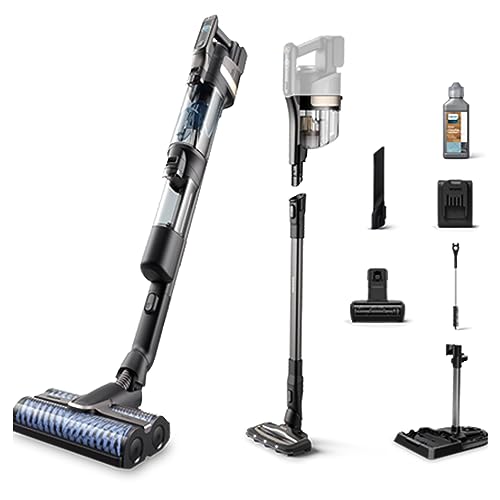
Philips 9000 Series Bagless
7.0/10

Overall score

Score
7.0/ 10
✕
What it is
Our main score for this model, 1–10. It combines specs, expert reviews, best-of lists and owners.
How we count it
Parts: Technical score 50%, Reviews score 25%, List score 20%, Sentiment score 5%
Marks: Each part gets a mark out of 10. For reviews, lists and owners, a typical model in this category gets about 8 and the best one gets 10.
No data yet: A part with no data shows "?". It counts as the mark of a weaker model in this category (4 in 5 models with data score higher). This way, models with reviews, lists and owners usually come out ahead.
Score distribution
â–¼
<55-66-77-88-99-10
Score components

50%

6.7

Technical score

25%

?

Reviews scoreNot enough data yet, so we use 7.4, the mark of a weaker model in this category

20%

?

List scoreNot enough data yet, so we use 7.5, the mark of a weaker model in this category

5%

?

Sentiment scoreNot enough data yet, so we use 6.7, the mark of a weaker model in this category

â–²Better than 51% of vacuum cleaners
7.7

Value for money

Value for money
7.7/ 10
✕
What it is
An indicator that combines the vacuum cleaner's overall score with its price.
When it matters
When you are looking for a vacuum cleaner with a good balance between quality and price.
Score distribution
â–¼
<55-66-77-88-99-10
Score components

70%

7.0

Overall score

30%

9.2

Price

â–¼Worse than 76%
6.7

Technical score

Technical score
6.7/ 10
✕
What it is
How good the specs are compared with the other models in this category, 1–10.
How we count it
Areas: We rate the specs in each area against the other models in this category.
Weighting: The areas that matter most to buyers count more. The shares are shown under Score components.
Share: The technical score is 50% of the overall score.
Score distribution
â–¼
<55-66-77-88-99-10
Score components

28%

7.6

Performance

22%

4.9

Battery

18%

9.4

Filtration

14%

7.1

Attachments

10%

4.7

Design

8%

4.0

Smart features

â–²Better than 55%
?

Reviews score

Reviews score
✕
What it is
Average grade from independent test sites, magazines and video reviewers, 1–10.
How we count it
Grades: Each review's own score is converted to 1–10; without one, we grade the review ourselves. Big test sites count more, short reviews half as much as full tests. A video review counts half.
Score: The average grade is 80% of the review mark; the number of reviews is the other 20% (1 review = 5, the typical number in this category = 8, the most-reviewed model = 10).
Enough data: With few reviews, the average grade is pulled toward the typical grade of this category. No reviews yet: 7.4 for now.
Share: Reviews count 25% of the overall score.
Score distribution
â–¼
<55-66-77-88-99-10
Grades by review (0)
We have not found an independent test of this model yet. Until we do, its review part counts as 7.4.
User ratings collected online are not part of this score.
No expert tests yet
?

Sentiment score

Sentiment score
6.7/ 10
✕
What it is
How positive owners are about this model in their comments under video reviews and on forums. We read each comment, keep only people who say they own the model, and sort them into positive, mixed or negative.
How we count it
Score: We compare how satisfied this model’s owners are with the other models in this category: the typical model gets 8, the most satisfied tenth 10, the least satisfied 4. This is 80% of the owner mark; the number of owners is the other 20%.
Enough data: A model counts with 10+ owners from 4+ different discussions. With fewer, the owner part changes nothing.
Share: Owners count 5% of the overall score (left out in categories where fewer than 10 models have enough owner comments).
Score distribution
â–¼
<55-66-77-88-99-10
Owners (0)
Not enough owner comments yet (10+ owners from 4+ discussions needed), so the owner part changes nothing.
Our own analysis of online owner opinions, not a rating from any website.
Not enough owner comments yet
?

List score

List score
7.5/ 10
✕
What it is
How often independent test sites, magazines and video reviewers put this model in their best-of lists for this category.
How we count it
Points: The model in the most lists of this category gets 10; the others get 8 to 10 in proportion. In no list yet: 7.5. Lists count 20% of the overall score.
Enough data: Every list counts, even a single one. With fewer than 5 best-of lists in the category, this part is left out.
Lists with this model (0)
Not in any best-of list yet, so this part counts as 7.5. Models in a list get 8 to 10.
Not in any best-of list yet
Loading...
Loading category ranking...

Technical Specifications of vacuum cleaner Philips 9000 Series Bagless

Technical score
Technical score
6.7/ 10
✕
What it is
How good the specs are compared with the other models in this category, 1–10.
How we count it
Areas: We rate the specs in each area against the other models in this category.
Weighting: The areas that matter most to buyers count more. The shares are shown under Score components.
Share: The technical score is 50% of the overall score.
Score distribution
â–¼
<55-66-77-88-99-10
Score components:

28%

7.6

Performance

22%

4.9

Battery

18%

9.4

Filtration

14%

7.1

Attachments

10%

4.7

Design

8%

4.0

Smart features

6.7
Reviews score
7.4
Sentiment score
?
List score
?
Value for money
Value for money
7.7/ 10
✕
What it is
An indicator that combines the vacuum cleaner's overall score with its price.
When it matters
When you are looking for a vacuum cleaner with a good balance between quality and price.
Score distribution
â–¼
<55-66-77-88-99-10
Score components:

70%

7.0

Overall score

30%

9.2

Price

7.7
Suction power (AW)
?
Suction power (kPa)
?
Airflow
?
Motor type
brushed
Power consumption
900 W
This vacuum cleaner draws 900 W, which is higher than the power consumption of 87.9% of vacuum cleaners and equal to that of 5% of vacuum cleaners.
Show more
Cordless
no
This vacuum cleaner does not work cordlessly. 51.2% of vacuum cleaners offer cordless operation.
Battery runtime
N/A
Charging time
N/A
Battery capacity
N/A
Battery voltage
N/A
Show more
Filter class
hepa 13
This vacuum cleaner uses filter class hepa 13, which is more advanced than the class used by 85.2% of vacuum cleaners and the same as the class used by 13.6% of vacuum cleaners.
Minimum overall efficiency
99.95%
This vacuum cleaner reaches 99.95% minimum overall efficiency, which is higher than that of 33% of vacuum cleaners and equal to that of 26.9% of vacuum cleaners.
Suitable for allergy sufferers
yes
This vacuum cleaner is suitable for allergy sufferers. 83.3% of vacuum cleaners are allergy-friendly.
Capacity
2.2 L
This vacuum cleaner has a dust capacity of 2.2 L, which is larger than that of 75.8% of vacuum cleaners and equal to that of 0.6% of vacuum cleaners.
Bagless
yes
This vacuum cleaner uses a bagless design. 78.8% of vacuum cleaners use this setup.
Show more
Main brush type
classic
Roller type
none
Anti-tangle brush
no
This vacuum cleaner does not include an anti-tangle brush. 30% of vacuum cleaners include this feature.
Mini motorized brush
no
This vacuum cleaner does not include a mini motorized brush. 25.4% of vacuum cleaners include this attachment.
Suitable for pet owners
yes
This vacuum cleaner is suitable for pet owners. 75% of vacuum cleaners handle pet hair well.
Show more
Vacuum type
canister
Weight
6.2 kg
This vacuum cleaner weighs 6.2 kg, which is greater than the weight of 81.6% of vacuum cleaners and equal to that of 0.9% of vacuum cleaners.
2-in-1 design
no
This vacuum cleaner does not offer a 2-in-1 design. 51.6% of vacuum cleaners offer this flexible format.
Self-standing
no
This vacuum cleaner does not stand on its own. 19.5% of vacuum cleaners offer this convenience.
Adjustable tube height
yes
This vacuum cleaner includes adjustable tube height. 46.1% of vacuum cleaners offer this ergonomic feature.
Show more
Auto suction adjustment
no
This vacuum cleaner does not support automatic suction adjustment. 22.3% of vacuum cleaners support this feature.
Dust particle sensor
no
This vacuum cleaner does not include a dust particle sensor. 9.5% of vacuum cleaners include this feature.
LED display
no
This vacuum cleaner does not include an LED display. 25.7% of vacuum cleaners include this interface feature.
Nozzle light
no
This vacuum cleaner does not include a nozzle light. 42.7% of vacuum cleaners include this visibility feature.
Mopping support
no
This vacuum cleaner does not support mopping. 8.4% of vacuum cleaners support this multi-function feature.

Philips 9000 Series Bagless vs the average vacuum cleaner

246810TotalPerformanceBatteryFiltrationAttachmentsDesignSmart features
  • Higher filter class
    This vacuum cleaner uses a better filter class than the average vacuum cleaner (hepa 13 vs hepa).
    hepa 13 vs hepa
  • 3 more power levels
    This vacuum cleaner offers more speed levels than the average vacuum cleaner (5 vs 2).
    5 vs 2
  • 1.3 L larger dust container
    This vacuum cleaner has a larger dust capacity than the average vacuum cleaner (2.2 L vs 0.9 L).
    2.2 L vs 0.9 L
  • Adjustable tube height
    This vacuum cleaner has adjustable tube height, the average vacuum cleaner does not.
  • 790 mm shorter body
    This vacuum cleaner is shorter than the average vacuum cleaner (300 mm vs 1,090 mm).
    300 mm vs 1,090 mm
  • 30 mm wider cleaning path
    This vacuum cleaner has a wider cleaning path than the average vacuum cleaner (290 mm vs 260 mm).
    290 mm vs 260 mm
  • 1.5 m longer power cord
    This vacuum cleaner has a longer power cord than the average vacuum cleaner (8 m vs 6.5 m).
    8 m vs 6.5 m
  • 3 more power levels
    This vacuum cleaner offers more speed levels than the average vacuum cleaner (5 vs 2).
    5 vs 2
  • 30 mm wider cleaning path
    This vacuum cleaner has a wider cleaning path than the average vacuum cleaner (290 mm vs 260 mm).
    290 mm vs 260 mm
  • 1.5 m longer power cord
    This vacuum cleaner has a longer power cord than the average vacuum cleaner (8 m vs 6.5 m).
    8 m vs 6.5 m
  • Higher filter class
    This vacuum cleaner uses a better filter class than the average vacuum cleaner (hepa 13 vs hepa).
    hepa 13 vs hepa
  • 1.3 L larger dust container
    This vacuum cleaner has a larger dust capacity than the average vacuum cleaner (2.2 L vs 0.9 L).
    2.2 L vs 0.9 L
  • Adjustable tube height
    This vacuum cleaner has adjustable tube height, the average vacuum cleaner does not.
  • 790 mm shorter body
    This vacuum cleaner is shorter than the average vacuum cleaner (300 mm vs 1,090 mm).
    300 mm vs 1,090 mm
  • No cordless operation
    This vacuum cleaner does not work cordlessly, the average vacuum cleaner does.
  • No handheld conversion
    This vacuum cleaner does not have a 2-in-1 design, the average vacuum cleaner does.
  • 67.6% higher weight
    This vacuum cleaner is heavier than the average vacuum cleaner (6.2 kg vs 3.7 kg).
    6.2 kg vs 3.7 kg
  • 320 W higher power consumption
    This vacuum cleaner draws more power than the average vacuum cleaner (900 W vs 580 W).
    900 W vs 580 W
  • 232 mm deeper body
    This vacuum cleaner is deeper than the average vacuum cleaner (500 mm vs 268 mm).
    500 mm vs 268 mm
  • 34 mm wider body
    This vacuum cleaner is wider than the average vacuum cleaner (300 mm vs 266 mm).
    300 mm vs 266 mm
  • 78.6% more expensive
    This vacuum cleaner is more expensive than the average vacuum cleaner (£250 vs £140).
    £250 vs £140
  • 1.5% worse value for money
    This vacuum cleaner offers worse value for money than the average vacuum cleaner (7.69 vs 7.8).
    7.69 vs 7.81
  • 78.6% more expensive
    This vacuum cleaner is more expensive than the average vacuum cleaner (£250 vs £140).
    £250 vs £140
  • 1.5% worse value for money
    This vacuum cleaner offers worse value for money than the average vacuum cleaner (7.69 vs 7.8).
    7.69 vs 7.81
  • 320 W higher power consumption
    This vacuum cleaner draws more power than the average vacuum cleaner (900 W vs 580 W).
    900 W vs 580 W
  • No cordless operation
    This vacuum cleaner does not work cordlessly, the average vacuum cleaner does.
  • No handheld conversion
    This vacuum cleaner does not have a 2-in-1 design, the average vacuum cleaner does.
  • 67.6% higher weight
    This vacuum cleaner is heavier than the average vacuum cleaner (6.2 kg vs 3.7 kg).
    6.2 kg vs 3.7 kg
  • 232 mm deeper body
    This vacuum cleaner is deeper than the average vacuum cleaner (500 mm vs 268 mm).
    500 mm vs 268 mm
  • 34 mm wider body
    This vacuum cleaner is wider than the average vacuum cleaner (300 mm vs 266 mm).
    300 mm vs 266 mm

Video reviews

Hands-on testing, unboxing, and real-world video evaluations
Not graded
Hands-on video, no verdict
Not graded

Third-party reviews

What customers like about Philips 9000 Series Bagless

  • Extremely powerful suction performance driven by PowerCyclone 10 technology
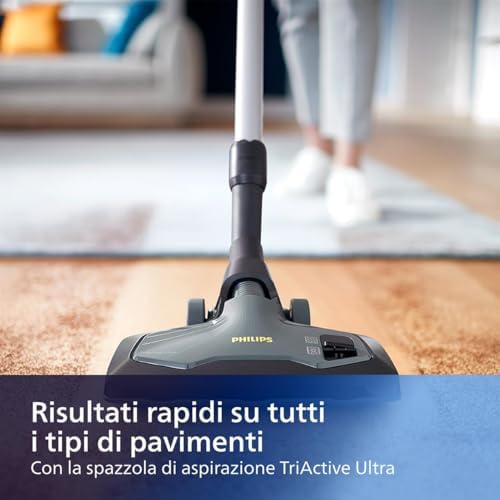
  • Highly efficient TriActive Ultra nozzle that pulls in dirt from all sides in a single pass
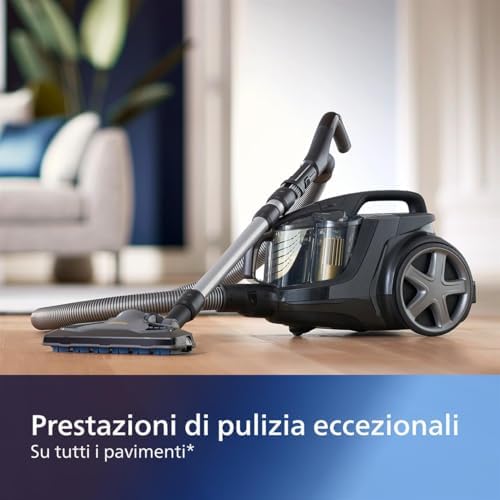
  • Excellent multi-surface capability on both hard floors and carpets
  • Super Turbo brush attachment effectively removes embedded pet hair and lint
  • H13 Allergy Filter system captures 99.9% of fine dust, pollen, and pet allergens
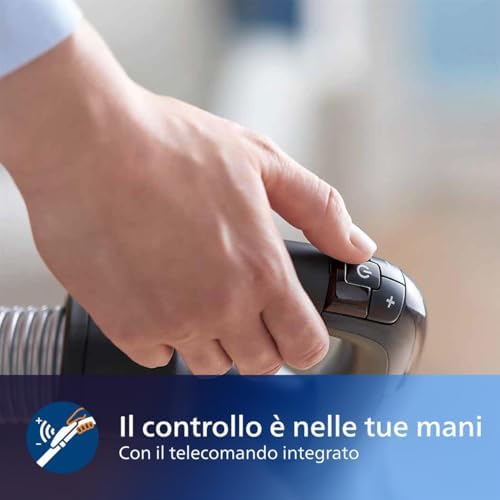
  • Convenient suction controls located directly on the ergonomic handle
  • Long power cord reduces the need to frequently switch wall outlets
  • Transparent dust container is straightforward to remove and empty hygienically

What customers don't like about Philips 9000 Series Bagless

  • The heavy metal wand can cause user shoulder strain during extended cleaning sessions
  • Noticeably bulky and heavy canister design makes it harder to lift or carry up stairs
  • Operational noise level is quite loud during high-power suction modes
  • The large nozzle head can sometimes push a massive pile of debris rather than instantly sucking it up
  • Can be difficult to maneuver or slide smoothly on deeper, thicker pile carpets

Verdict

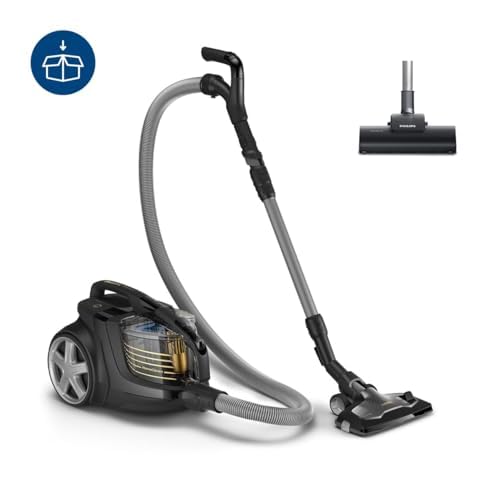
The Philips 9000 Series Bagless vacuum cleaner (such as the XB9154/09) is a high-performance corded cylinder vacuum featuring an 899W to 900W motor, a generous 2.2-litre dust capacity, and an Allergy H13 filtration system that captures 99.9% of fine dust. Driven by advanced PowerCyclone 10 technology and a TriActive Ultra nozzle, it delivers exceptional, long-lasting suction power across all floor types. Notable pros include its hygienic, one-handed NanoClean dust-disposal system, a built-in handle brush, and convenient remote control power adjustments right on the handle. However, notable cons include its relatively heavy metal telescopic wand that can cause user fatigue, a bulky cleaning head that limits tight-space maneuverability, and a loud operating noise level of up to 78 decibels.

Compare Philips 9000 Series Bagless with other vacuum cleaners

1Product to compare no. 1
VS
2Product to compare no. 2
VS
3Product to compare no. 3 (optional)

Graphic comparison of Philips 9000 Series Bagless and other vacuum cleaners

No results found