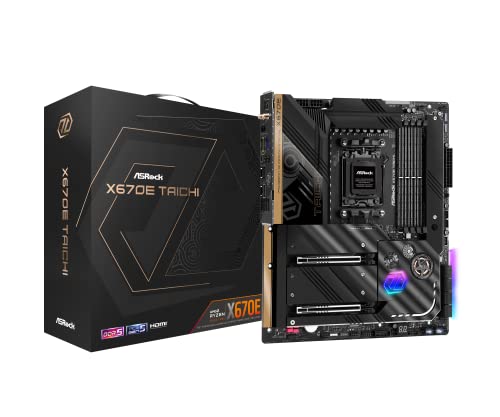
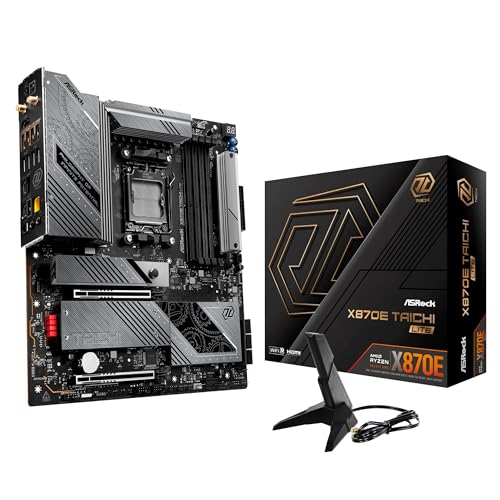
ASRock X870E Taichi Review | 107 Data compared

Avg. price in UK:~£420Avg. price in US:~$450CPU socket:AM5Chipset:AMD X870EForm factor:E-ATX

ASRock X870E Taichi Review: Compare 107 technical specifications and user reviews to see how this product ranks in the Motherboards category and whether it is worth buying.

9.1

Overall score

Score
9.1/ 10
✕
What it is
An overall evaluation of the motherboard's quality, based on technical analyses and user reviews.
When it matters
When you need a quick reference to identify the best motherboards on the market.
Score distribution
â–¼
<55-66-77-88-99-10
Score components

90%

9.3

Technical Score

10%

8.0

User score

★Better than 97% of motherboards
9.3

Technical Score

Technical score
9.3/ 10
✕
What it is
An assessment of technical performance for products in the Motherboards category across these key areas: Platform & Features, Memory, Storage, Expansion, Ports & USB, Network, Audio, Power & Cooling.
When it matters
When you want to compare motherboards based on technical performance and available features.
Score distribution
â–¼
<55-66-77-88-99-10
Score components

19%

10

Memory

16%

9.6

Platform & Features

16%

9.6

Storage

15%

9.7

Network

13%

8.5

Ports & USB

8%

6.3

Expansion

8%

9.7

Power & Cooling

5%

9.2

Audio

★Better than 98% of motherboards
8.0

User score

User score
8.0/ 10
✕
What it is
A rating that combines user reviews and the total number of reviews received by the motherboard.
When it matters
When you want to understand how a motherboard performs in real-world builds and how reliable it is in terms of stability, BIOS usability, connectivity, and long-term ownership.
Score distribution
â–¼
<55-66-77-88-99-10
Score components

70%

8.4

User reviews

30%

6.9

Popularity

User score:
United Kingdom
amazon
4.2
(93)
United States
Amazon_logo.png
4.2
(100)

(Reviews last updated: May 2026)

â–¼Worse than 65% of motherboards
  • asrock-x870e-taichi
  • asrock-x870e-taichi
  • asrock-x870e-taichi
  • asrock-x870e-taichi
  • asrock-x870e-taichi
  • asrock-x870e-taichi
  • asrock-x870e-taichi
  • asrock-x870e-taichi
  • asrock-x870e-taichi
asrock-x870e-taichi
asrock-x870e-taichi
asrock-x870e-taichi
asrock-x870e-taichi
asrock-x870e-taichi
asrock-x870e-taichi
asrock-x870e-taichi
asrock-x870e-taichi
asrock-x870e-taichi

Best prices in UK

Best rankings

Available: ranking among products currently available (including other versions of this product).All: ranking among all products in the database.
Loading...
Loading category ranking...

Verdict

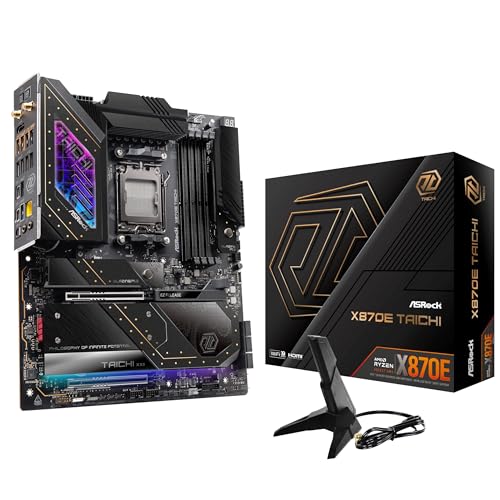
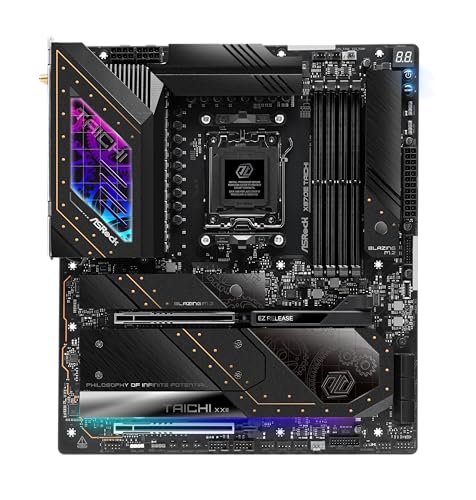
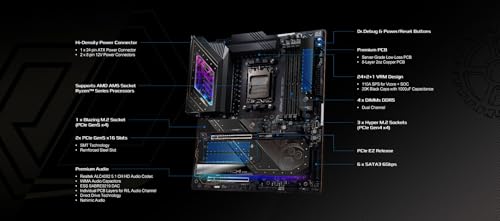
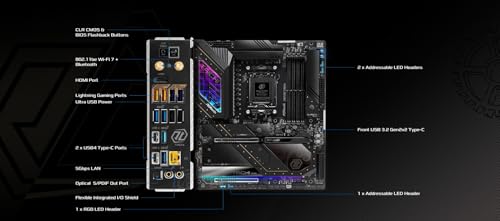
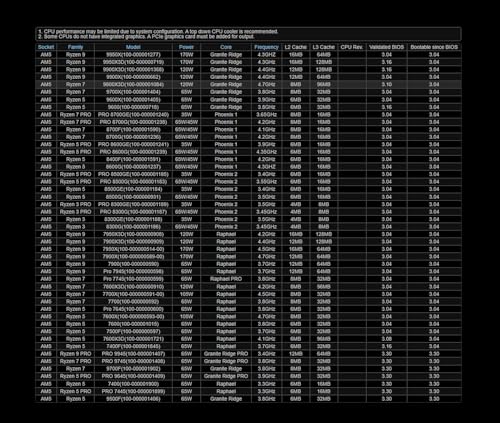
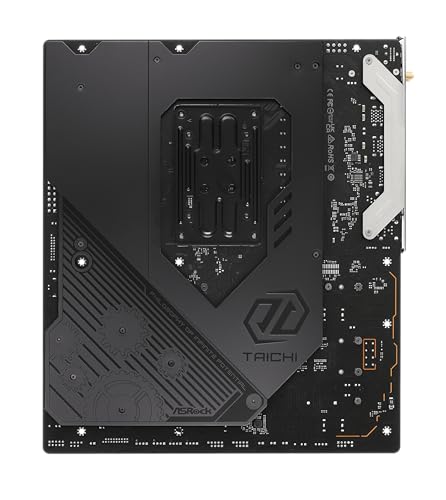
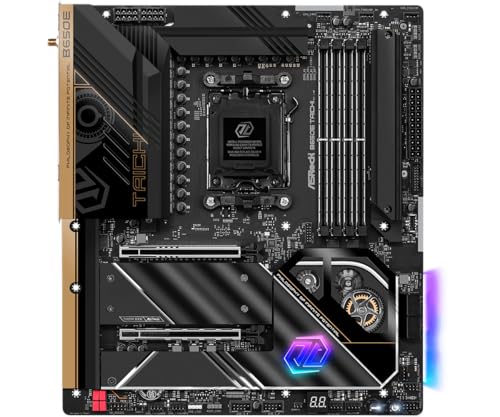
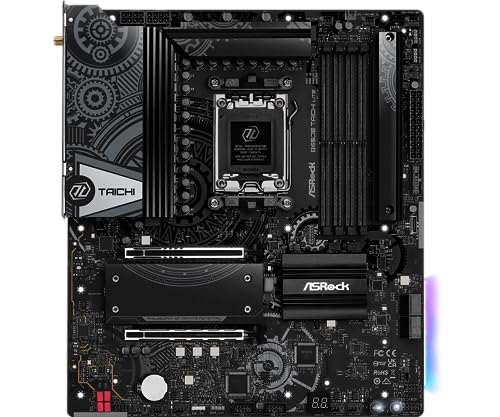
The ASRock X870E Taichi is a flagship E-ATX motherboard designed for the AMD AM5 socket, featuring a robust 24+2+1 power phase design with 110A Smart Power Stages and high-end 20K black capacitors for extreme overclocking stability. It offers cutting-edge connectivity including dual USB4 Type-C ports (40Gbps), Wi-Fi 7, 5G LAN, and four M.2 slots (one PCIe 5.0 and three PCIe 4.0), alongside support for DDR5 memory speeds up to 8200+(OC). Its main pros include exceptional power delivery, comprehensive high-speed networking, and a premium aesthetic with integrated RGB lighting and a reinforced server-grade 8-layer PCB. However, its large E-ATX form factor may limit case compatibility, the BIOS interface can feel somewhat dated compared to competitors, and its high price point places it strictly in the enthusiast category.

Technical Specifications of motherboard ASRock X870E Taichi

Technical Score
Technical score
9.3/ 10
✕
What it is
An assessment of technical performance for products in the Motherboards category across these key areas: Platform & Features, Memory, Storage, Expansion, Ports & USB, Network, Audio, Power & Cooling.
When it matters
When you want to compare motherboards based on technical performance and available features.
Score distribution
â–¼
<55-66-77-88-99-10
Score components:

19%

10

Memory

16%

9.6

Platform & Features

16%

9.6

Storage

15%

9.7

Network

13%

8.5

Ports & USB

8%

6.3

Expansion

8%

9.7

Power & Cooling

5%

9.2

Audio

9.3
ASRock X870E Taichi has a technical score of 9.3 points, which is higher than that of 97.6% of products in this category.
User score
User score
8.0/ 10
✕
What it is
A rating that combines user reviews and the total number of reviews received by the motherboard.
When it matters
When you want to understand how a motherboard performs in real-world builds and how reliable it is in terms of stability, BIOS usability, connectivity, and long-term ownership.
Score distribution
â–¼
<55-66-77-88-99-10
Score components

70%

8.4

User reviews

30%

6.9

Popularity

User score:
United Kingdom
amazon
4.2
(93)
United States
Amazon_logo.png
4.2
(100)

(Reviews last updated: May 2026)

8.0
ASRock X870E Taichi has a user score of 7.96 points, which is lower than that of 64.8% of products in this category.
Popularity
Popularity
6.9/ 10
✕
What it is
An indicator based on the number of reviews received by the motherboard.
When it matters
When you prefer a motherboard that has already been bought and reviewed by many other users.
Score distribution
â–¼
<55-66-77-88-99-10
Popularity:
ASRock X870E Taichi has a popularity score of 6.9 points, which is higher than that of 57% of products in this category.
6.9
ASRock X870E Taichi has a popularity score of 6.9 points, which is higher than that of 57% of products in this category.
Ratio quality/price
Value for money
8.9/ 10
✕
What it is
An indicator that combines the motherboard's overall rating with its cost.
When it matters
When you are looking for a motherboard that offers a strong balance of features, performance, and price.
Score distribution
â–¼
<55-66-77-88-99-10
Score components:

60%

9.1

Overall score

40%

8.3

Price

8.9
ASRock X870E Taichi has a value-for-money score of 8.9 points, which is higher than that of 91.3% of products in this category.
Brand name
Asrock
CPU socket
AM5
CPU socket
AM5
This motherboard uses the AM5 CPU socket, which is more advanced than that of 85.8% of motherboards and equal to that of 14.2% of motherboards.
CPU platform
AMD
CPU platform
AMD
This motherboard is built for the AMD CPU platform, which is less common than that of 68.5% of motherboards and equal to that of 31.5% of motherboards.
Chipset
AMD X870E
Chipset
AMD X870E
This motherboard uses the AMD X870E chipset, which is more advanced than that of 98.3% of motherboards and equal to that of 1.7% of motherboards.
Form factor
E-ATX
Form factor
E-ATX
This motherboard has the E-ATX form factor, which is less versatile than that of 92% of motherboards and equal to that of 6.8% of motherboards.
Show more
DDR memory version
DDR5
DDR memory version
DDR5
This motherboard uses DDR5 memory, which is newer than that of 64.3% of motherboards and equal to that of 35.7% of motherboards.
Memory slots
4
Memory slots
4
This motherboard has 4 Memory slots, which is more than 21.5% of motherboards and equal to 72.5% of motherboards.
Maximum memory capacity
256 GB
Maximum memory capacity
256 GB
This motherboard supports up to 256 GB of memory, which is more than 82.9% of motherboards and equal to 16.4% of motherboards.
Memory channels
2
Memory channels
2
This motherboard supports 2 memory channels, which is more than 0.2% of motherboards and equal to 92.6% of motherboards.
Maximum RAM speed
8,200 MT/s
Maximum RAM speed
8,200 MT/s
This motherboard supports memory speeds up to 8,200 MT/s, which is higher than that of 90.7% of motherboards and equal to that of 2.3% of motherboards.
Show more
N. of M.2 sockets
4
N. of M.2 sockets
4
This motherboard has 4 M.2 sockets, which is more than 84.1% of motherboards and equal to 10.7% of motherboards.
M.2 slot interface per slot
1x PCIe 5.0 x4, 3x PCIe 4.0 x4
M.2 slot interface per slot
1x PCIe 5.0 x4, 3x PCIe 4.0 x4
This motherboard offers 1x PCIe 5.0x4, 3x PCIe 4.0x4 for M.2 slot interfaces, which is faster than that of 93.6% of motherboards and equal to that of 1.4% of motherboards.
N. of SATA 3 connectors
6
N. of SATA 3 connectors
6
This motherboard has 6 SATA 3 connectors, which is more than 52.6% of motherboards and equal to 32.1% of motherboards.
Supported RAID levels
0/1/10
Supported RAID levels
0/1/10
This motherboard supports RAID levels 0/1/10, which is narrower than 68.1% of motherboards and equal to 23.3% of motherboards.
NVMe RAID support
yes
NVMe RAID support
yes
This motherboard supports NVMe RAID. 40.3% of motherboards support this feature.
Show more
N. of PCIe 5.0 x16 slots
2
N. of PCIe 5.0 x16 slots
2
This motherboard has 2 PCIe 5.0x16 slots, which is more than 95.2% of motherboards and equal to 4.3% of motherboards.
lane split supported
N. of PCIe 4.0 x16 slots
0
N. of PCIe 4.0 x16 slots
0
This motherboard has 0 PCIe 4.0x16 slots, which is fewer than 44.5% of motherboards and equal to 55.5% of motherboards.
N. of PCIe 3.0 x16 slots
0
N. of PCIe 3.0 x16 slots
0
This motherboard has 0 PCIe 3.0x16 slots, which is fewer than 59.6% of motherboards and equal to 40.4% of motherboards.
PCIe slot electrical configuration
x16/x0, x8/x8
PCIe slot electrical configuration
x16/x0, x8/x8
This motherboard uses x16/x0, x8/x8 for PCIe slot electrical configuration, which is less flexible than that of 76.4% of motherboards and equal to that of 2.9% of motherboards.
Depends on slot/M.2 population.
PCIe bifurcation support
yes
PCIe bifurcation support
yes
This motherboard supports PCIe bifurcation. 40.4% of motherboards support this feature.
x8/x8, x8/x4/x4, x4/x4/x4/x4.
Show more
Total USB ports (rear I/O)
12
Total USB ports (rear I/O)
12
This motherboard has 12 USB ports (rear I/O), which is more than 92.6% of motherboards and equal to 5.7% of motherboards.
Total USB ports (including headers)
21
Total USB ports (including headers)
21
This motherboard has 21 USB ports (including headers), which is more than 94.3% of motherboards and equal to 2.8% of motherboards.
Total USB-C ports (rear I/O)
2
Total USB-C ports (rear I/O)
2
This motherboard has 2 USB-C ports (rear I/O), which is more than 84.2% of motherboards and equal to 12.3% of motherboards.
Total USB-C ports (including headers)
3
Total USB-C ports (including headers)
3
This motherboard has 3 USB-C ports (including headers), which is more than 84.6% of motherboards and equal to 11% of motherboards.
N. of USB 3.2 Gen2x2 ports (USB-C)
0
N. of USB 3.2 Gen2x2 ports (USB-C)
0
This motherboard has 0 USB 3.2 Gen2x2 ports (USB-C), which is fewer than 18.3% of motherboards and equal to 81.7% of motherboards.
Show more
LAN speed
5 Gbps
LAN speed
5 Gbps
This motherboard supports LAN speeds up to 5 Gbps, which is higher than that of 90.8% of motherboards and equal to that of 5% of motherboards.
LAN controller
Realtek RTL8126
LAN controller
Realtek RTL8126
This motherboard uses the Realtek RTL8126 LAN controller, which is more advanced than that of 86.9% of motherboards and equal to that of 2% of motherboards.
N. of RJ45 ports
1
N. of RJ45 ports
1
This motherboard has 1 RJ45 ports, which is fewer than 14.4% of motherboards and equal to 85.6% of motherboards.
Wi-Fi connectivity
yes
Wi-Fi connectivity
yes
This motherboard supports Wi-Fi connectivity. 50% of motherboards support this feature.
Wi-Fi version
Wi-Fi 7 (802.11be)
Wi-Fi version
Wi-Fi 7 (802.11be)
This motherboard supports Wi-Fi 7 (802.11be), which is newer than that of 88.7% of motherboards and equal to that of 11.3% of motherboards.
Show more
Audio codec
Realtek ALC4082
Audio codec
Realtek ALC4082
This motherboard uses the Realtek ALC4082 audio codec, which is more advanced than that of 96.8% of motherboards and equal to that of 3.1% of motherboards.
with ESS DAC.
Audio channels
5.1
Audio channels
5.1
This motherboard offers 5.1 audio channels, which is fewer than 95.2% of motherboards and equal to 4.1% of motherboards.
full 7.1 needs front panel audio.
Audio SNR
130 dB
Audio SNR
130 dB
This motherboard has an audio SNR of 130 dB, which is higher than that of 97.8% of motherboards and equal to that of 2% of motherboards.
Headphone amp support
yes
Headphone amp support
yes
This motherboard supports a headphone amp. 40.8% of motherboards support this feature.
headphone amp on front panel.
N. of 3.5mm audio jacks
2
N. of 3.5mm audio jacks
2
This motherboard has 2 3.5mm audio jacks, which is fewer than 88.6% of motherboards and equal to 11.1% of motherboards.
Show more
VRM phases
24+2+1
VRM phases
24+2+1
This motherboard has 24+2+1 VRM phases, which is more than 98.8% of motherboards and equal to 0.4% of motherboards.
N. of CPU power connectors
2
N. of CPU power connectors
2
This motherboard has 2 CPU power connectors, which is more than 54.6% of motherboards and equal to 45.1% of motherboards.
N. of fan headers
8
N. of fan headers
8
This motherboard has 8 fan headers, which is more than 82.2% of motherboards and equal to 15% of motherboards.
Pump header
yes
Pump header
yes
This motherboard has a pump header. 21.9% of motherboards include this feature.
Pump header max current
3 A
Pump header max current
3 A
This motherboard supports up to 3 A on the pump header, which is higher than that of 77.8% of motherboards and equal to that of 22.1% of motherboards.
Show more

ASRock X870E Taichi vs the average motherboard

246810TotalPlatform & FeaturesMemoryStorageExpansionPorts & USBNetworkAudioPower & Cooling
  • 2 more M.2 sockets
    N. of M.2 sockets
    4
    This motherboard has more M.2 sockets than the average motherboard (4 vs 2). The average motherboard has 2 M.2 socket/s.
    4 vs 2
  • Newer CPU socket
    CPU socket
    AM5
    This motherboard has newer CPU socket than the average motherboard (AM5 vs LGA 1151). The average motherboard uses LGA 1151 CPU socket.
    AM5 vs LGA 1,151
  • 2x more maximum memory capacity
    Maximum memory capacity
    256 GB
    This motherboard has more maximum memory capacity than the average motherboard (256 GB vs 128 GB). The average motherboard supports 128 GB of memory.
    256 GB vs 128 GB
  • 2 more PCIe 5.0x16 slots
    N. of PCIe 5.0 x16 slots
    2
    This motherboard has more PCIe 5.0x16 slots than the average motherboard (2 vs 0). The average motherboard has 0 PCIe 5.0x16 slot/s.
    lane split supported
    2 vs 0
  • 4 more rear USB ports
    Total USB ports (rear I/O)
    12
    This motherboard has more rear USB ports than the average motherboard (12 vs 8). The average motherboard has 8 rear USB port/s.
    12 vs 8
  • Newer DDR memory generation
    DDR memory version
    DDR5
    This motherboard has newer DDR memory generation than the average motherboard (DDR5 vs DDR4). The average motherboard supports DDR4 memory.
    DDR5 vs DDR4
  • 4 more USB 3.2 Gen2 ports
    N. of USB 3.2 Gen2 ports (USB-A)
    5
    This motherboard has more USB 3.2 Gen2 ports than the average motherboard (5 vs 1). The average motherboard has 1 USB 3.2 Gen2 port/s.
    5 vs 1
  • More VRM phases
    VRM phases
    24+2+1
    This motherboard has more VRM phases than the average motherboard (24+2+1 vs 10). The average motherboard has 10 VRM phase/s.
    24+2+1 vs 10
  • 19.9% better value for money
    ASRock X870E Taichi has better value for money than the average motherboard (8.89 vs 7.4).
    8.89 vs 7.41
  • Newer CPU socket
    CPU socket
    AM5
    This motherboard has newer CPU socket than the average motherboard (AM5 vs LGA 1151). The average motherboard uses LGA 1151 CPU socket.
    AM5 vs LGA 1,151
  • Integrated I/O shield
    Integrated I/O shield
    yes
    This motherboard has an integrated I/O shield, while the average motherboard does not. 46% of motherboards include an integrated I/O shield.
  • Includes POST code display
    POST code display
    yes
    This motherboard has a POST code display, while the average motherboard does not. 27.2% of motherboards include a POST code display.
  • Rear-panel CMOS reset button
    Rear-panel CMOS reset button
    yes
    This motherboard has a rear-panel CMOS reset button, while the average motherboard does not. 26.7% of motherboards include a rear-panel CMOS reset button.
  • Better motherboard chipset
    Chipset
    AMD X870E
    This motherboard has better motherboard chipset than the average motherboard (AMD X870E vs Intel B860). The average motherboard uses Intel B860 chipset.
    AMD X870E vs Intel B860
  • Includes onboard power button
    Onboard power button
    yes
    This motherboard has an onboard power button, while the average motherboard does not. 27.7% of motherboards include an onboard power button.
  • Includes onboard reset button
    Onboard reset button
    yes
    This motherboard has an onboard reset button, while the average motherboard does not. 27.6% of motherboards include an onboard reset button.
    Power and reset buttons.
  • Broader Windows support
    Supported Windows versions
    Windows 11, Windows 10, Windows 7
    This motherboard has broader Windows support than the average motherboard (Windows 11, Windows 10, Windows 7 vs Windows 11, Windows 10). The average motherboard supports Windows 11, Windows 10.
    Windows 11, Windows 10, Windows 7 vs Windows 11, Windows 10
  • 2x more maximum memory capacity
    Maximum memory capacity
    256 GB
    This motherboard has more maximum memory capacity than the average motherboard (256 GB vs 128 GB). The average motherboard supports 128 GB of memory.
    256 GB vs 128 GB
  • Newer DDR memory generation
    DDR memory version
    DDR5
    This motherboard has newer DDR memory generation than the average motherboard (DDR5 vs DDR4). The average motherboard supports DDR4 memory.
    DDR5 vs DDR4
  • 73.3% higher maximum RAM speed
    Maximum RAM speed
    8,200 MT/s
    This motherboard has a higher maximum RAM speed than the average motherboard (8200 MT/s vs 4733 MT/s). The average motherboard supports RAM speed of 4733 MT/s.
    8,200 MT/s vs 4,733 MT/s
  • Supports ECC memory
    ECC memory support
    yes
    This motherboard supports ECC memory, while the average motherboard does not. 21% of motherboards support ECC memory.
    supports ECC unbuffered memory.
  • 66.2% higher overclocked RAM speed
    Maximum overclocked RAM speed
    8,200 MT/s
    This motherboard has a higher overclocked RAM speed than the average motherboard (8200 MT/s vs 4933 MT/s). The average motherboard supports overclocked RAM speed of 4933 MT/s.
    8,200 MT/s vs 4,933 MT/s
  • 2 more M.2 sockets
    N. of M.2 sockets
    4
    This motherboard has more M.2 sockets than the average motherboard (4 vs 2). The average motherboard has 2 M.2 socket/s.
    4 vs 2
  • 2 more SATA 3 connectors
    N. of SATA 3 connectors
    6
    This motherboard has more SATA 3 connectors than the average motherboard (6 vs 4). The average motherboard has 4 SATA 3 connectors.
    6 vs 4
  • Faster M.2 slot interfaces
    M.2 slot interface per slot
    1x PCIe 5.0 x4, 3x PCIe 4.0 x4
    This motherboard has faster M.2 slot interfaces than the average motherboard (1x PCIe 5x4, 3x PCIe 4x4 vs 1x PCIe 5x4, 2x PCIe 4x4). The average motherboard uses 1x PCIe 5.0x4, 2x PCIe 4.0x4 M.2 slot interfaces.
    1x PCIe 5.0x4, 3x PCIe 4.0x4 vs 1x PCIe 5.0x4, 2x PCIe 4.0x4
  • 2 more PCIe 5.0x16 slots
    N. of PCIe 5.0 x16 slots
    2
    This motherboard has more PCIe 5.0x16 slots than the average motherboard (2 vs 0). The average motherboard has 0 PCIe 5.0x16 slot/s.
    lane split supported
    2 vs 0
  • 4 more rear USB ports
    Total USB ports (rear I/O)
    12
    This motherboard has more rear USB ports than the average motherboard (12 vs 8). The average motherboard has 8 rear USB port/s.
    12 vs 8
  • 4 more USB 3.2 Gen2 ports
    N. of USB 3.2 Gen2 ports (USB-A)
    5
    This motherboard has more USB 3.2 Gen2 ports than the average motherboard (5 vs 1). The average motherboard has 1 USB 3.2 Gen2 port/s.
    5 vs 1
  • 6 more total USB connections
    Total USB ports (including headers)
    21
    This motherboard has more total USB connections than the average motherboard (21 vs 15). The average motherboard has 15 total USB connections.
    21 vs 15
  • 1 more rear USB-C ports
    Total USB-C ports (rear I/O)
    2
    This motherboard has more rear USB-C ports than the average motherboard (2 vs 1). The average motherboard has 1 rear USB-C port/s.
    2 vs 1
  • 1 more USB 3.2 Gen1 headers
    N. of USB 3.2 Gen1 headers (USB-A)
    2
    This motherboard has more USB 3.2 Gen1 headers than the average motherboard (2 vs 1). The average motherboard has 1 USB 3.2 Gen1 header/s.
    two internal headers
    2 vs 1
  • 2 more total USB-C connections
    Total USB-C ports (including headers)
    3
    This motherboard has more total USB-C connections than the average motherboard (3 vs 1). The average motherboard has 1 total USB-C connections.
    3 vs 1
  • 1 more USB 3.2 Gen2x2 headers
    N. of USB 3.2 Gen2x2 headers (USB-C)
    1
    This motherboard has more USB 3.2 Gen2x2 headers than the average motherboard (1 vs 0). The average motherboard has 0 USB 3.2 Gen2x2 header/s.
    1 vs 0
  • Newer Wi-Fi standard
    Wi-Fi version
    Wi-Fi 7 (802.11be)
    This motherboard has newer Wi-Fi standard than the average motherboard (Wi-Fi 7 (802.11be) vs Wi-Fi 5 (802.11ac)). The average motherboard supports Wi-Fi 5 (802.11ac) Wi-Fi.
    Wi-Fi 7 (802.11be) vs Wi-Fi 5 (802.11ac)
  • More advanced LAN controller
    LAN controller
    Realtek RTL8126
    This motherboard has better LAN controller than the average motherboard (Realtek RTL8126 vs Killer + Intel + Realtek). The average motherboard uses Killer + Intel + Realtek LAN controller.
    Realtek RTL8126 vs Killer + Intel + Realtek
  • 2x higher LAN speed
    LAN speed
    5 Gbps
    This motherboard has a higher LAN speed than the average motherboard (5 Gbps vs 2.5 Gbps). The average motherboard offers LAN speed of 2.5 Gbps.
    5 Gbps vs 2.5 Gbps
  • Supports Bluetooth
    Bluetooth connectivity
    yes
    This motherboard supports Bluetooth, while the average motherboard does not. 48.9% of motherboards support Bluetooth.
  • Better audio codec
    Audio codec
    Realtek ALC4082
    This motherboard has better audio codec than the average motherboard (Realtek ALC4082 vs Realtek ALC897). The average motherboard uses Realtek ALC897 audio codec.
    with ESS DAC.
    Realtek ALC4082 vs Realtek ALC897
  • 15 dB higher audio SNR
    Audio SNR
    130 dB
    This motherboard has a higher audio SNR than the average motherboard (130 dB vs 115 dB). The average motherboard has audio SNR of 115 dB.
    130 dB vs 115 dB
  • More VRM phases
    VRM phases
    24+2+1
    This motherboard has more VRM phases than the average motherboard (24+2+1 vs 10). The average motherboard has 10 VRM phase/s.
    24+2+1 vs 10
  • 1 more CPU power connectors
    N. of CPU power connectors
    2
    This motherboard has more CPU power connectors than the average motherboard (2 vs 1). The average motherboard has 1 CPU power connectors.
    2 vs 1
  • 2.5 more fan headers
    N. of fan headers
    8
    This motherboard has more fan headers than the average motherboard (8 vs 5.5). The average motherboard has 5.5 fan header/s.
    8 vs 5.5
  • 1 more ARGB headers
    N. of ARGB headers (3-pin)
    3
    This motherboard has more ARGB headers than the average motherboard (3 vs 2). The average motherboard has 2 ARGB header/s.
    3 vs 2
  • 1 A higher pump header current limit
    Pump header max current
    3 A
    This motherboard has a higher pump header current than the average motherboard (3 A vs 2 A). The average motherboard provides pump header current of 2 A.
    3 A vs 2 A
  • Fewer RAID options
    Supported RAID levels
    0/1/10
    This motherboard has fewer RAID options than the average motherboard (0/1/10 vs 0/1/5/10). The average motherboard has 0/1/5/10 RAID level/s.
    0/1/10 vs 0/1/5/10
  • Less flexible PCIe lane configuration
    PCIe slot electrical configuration
    x16/x0, x8/x8
    This motherboard has less flexible PCIe lane configuration than the average motherboard (x16/x0, x8/x8 vs x16/x0/x4, x8/x8/x4). The average motherboard uses x16/x0/x4, x8/x8/x4 PCIe slot lane configuration.
    Depends on slot/M.2 population.
    x16/x0, x8/x8 vs x16/x0/x4, x8/x8/x4
  • 3 fewer 3.5mm audio jacks
    N. of 3.5mm audio jacks
    2
    This motherboard has fewer 3.5mm audio jacks than the average motherboard (2 vs 5). The average motherboard has 5 3.5mm audio jacks.
    2 vs 5
  • Fewer audio channels
    Audio channels
    5.1
    This motherboard has fewer audio channels than the average motherboard (5.1 vs 7.1). The average motherboard has 7.1 audio channel/s.
    full 7.1 needs front panel audio.
    5.1 vs 7.1
  • 1 fewer DisplayPort outputs
    N. of DisplayPort outputs
    0
    This motherboard has fewer DisplayPort outputs than the average motherboard (0 vs 1). The average motherboard has 1 DisplayPort outputs.
    0 vs 1
  • 2.63x more expensive
    ASRock X870E Taichi is more expensive than the average motherboard (£420 vs £160).
    £420 vs £160
  • 1 fewer USB 3.2 Gen1 ports
    N. of USB 3.2 Gen1 ports (USB-A)
    3
    This motherboard has fewer USB 3.2 Gen1 ports than the average motherboard (3 vs 4). The average motherboard has 4 USB 3.2 Gen1 port/s.
    3 vs 4
  • Fewer BIOS update options
    BIOS update methods
    UEFI utility, flashback
    This motherboard has fewer BIOS update options than the average motherboard (UEFI utility, flashback vs UEFI utility, flashback, Windows app). The average motherboard offers UEFI utility, flashback, Windows app BIOS update methods.
    UEFI utility, flashback vs UEFI utility, flashback, Windows app
  • 2.63x more expensive
    ASRock X870E Taichi is more expensive than the average motherboard (£420 vs £160).
    £420 vs £160
  • Less versatile form factor
    Form factor
    E-ATX
    This motherboard has less versatile form factor than the average motherboard (E-ATX vs ATX). The average motherboard comes in ATX form factor.
    E-ATX vs ATX
  • Fewer BIOS update options
    BIOS update methods
    UEFI utility, flashback
    This motherboard has fewer BIOS update options than the average motherboard (UEFI utility, flashback vs UEFI utility, flashback, Windows app). The average motherboard offers UEFI utility, flashback, Windows app BIOS update methods.
    UEFI utility, flashback vs UEFI utility, flashback, Windows app
  • Older CPU platform
    CPU platform
    AMD
    This motherboard uses the AMD CPU platform compared to Intel on the average motherboard. The average motherboard uses Intel CPU platform.
    AMD vs Intel
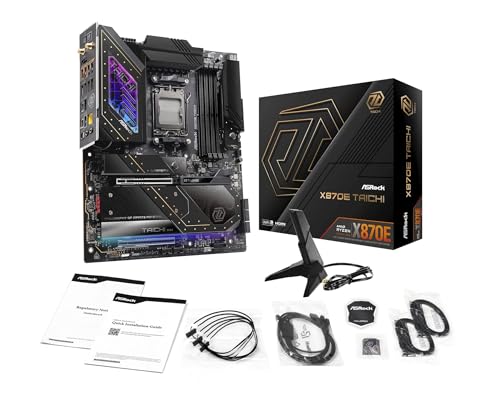
  • Fewer useful accessories
    Included accessories
    SATA cables, Wi-Fi antenna, RGB cable, thermistor cable
    This motherboard has fewer useful accessories than the average motherboard (SATA cables, Wi-Fi antenna, RGB cable, thermistor cable vs 2x SATA cables, Wi-Fi antenna, M.2 kit, front-panel adapter, RGB cable). The average motherboard comes with 2x SATA cables, Wi-Fi antenna, M.2 kit, front-panel adapter, RGB cable.
    SATA cables, Wi-Fi antenna, RGB cable, thermistor cable vs 2x SATA cables, Wi-Fi antenna, M.2 kit, front-panel adapter, RGB cable
  • Fewer RAID options
    Supported RAID levels
    0/1/10
    This motherboard has fewer RAID options than the average motherboard (0/1/10 vs 0/1/5/10). The average motherboard has 0/1/5/10 RAID level/s.
    0/1/10 vs 0/1/5/10
  • Less flexible PCIe lane configuration
    PCIe slot electrical configuration
    x16/x0, x8/x8
    This motherboard has less flexible PCIe lane configuration than the average motherboard (x16/x0, x8/x8 vs x16/x0/x4, x8/x8/x4). The average motherboard uses x16/x0/x4, x8/x8/x4 PCIe slot lane configuration.
    Depends on slot/M.2 population.
    x16/x0, x8/x8 vs x16/x0/x4, x8/x8/x4
  • 1 fewer PCIe x1 slots
    N. of PCIe x1 slots
    0
    This motherboard has fewer PCIe x1 slots than the average motherboard (0 vs 1). The average motherboard has 1 PCIe x1 slot/s.
    0 vs 1
  • 1 fewer PCIe 3.0x16 slots
    N. of PCIe 3.0 x16 slots
    0
    This motherboard has fewer PCIe 3.0x16 slots than the average motherboard (0 vs 1). The average motherboard has 1 PCIe 3.0x16 slot/s.
    0 vs 1
  • 1 fewer DisplayPort outputs
    N. of DisplayPort outputs
    0
    This motherboard has fewer DisplayPort outputs than the average motherboard (0 vs 1). The average motherboard has 1 DisplayPort outputs.
    0 vs 1
  • 1 fewer USB 3.2 Gen1 ports
    N. of USB 3.2 Gen1 ports (USB-A)
    3
    This motherboard has fewer USB 3.2 Gen1 ports than the average motherboard (3 vs 4). The average motherboard has 4 USB 3.2 Gen1 port/s.
    3 vs 4
  • 3 fewer 3.5mm audio jacks
    N. of 3.5mm audio jacks
    2
    This motherboard has fewer 3.5mm audio jacks than the average motherboard (2 vs 5). The average motherboard has 5 3.5mm audio jacks.
    2 vs 5
  • Fewer audio channels
    Audio channels
    5.1
    This motherboard has fewer audio channels than the average motherboard (5.1 vs 7.1). The average motherboard has 7.1 audio channel/s.
    full 7.1 needs front panel audio.
    5.1 vs 7.1
  • 23 mm wider
    Width
    267 mm
    This motherboard is wider than the average motherboard (267 mm vs 244 mm). The average motherboard width is 244 mm.
    267 mm vs 244 mm

Graphic comparison of ASRock X870E Taichi and other products in the Motherboards category

No results found

Third-party reviews

United Kingdom
United States

(Reviews last updated: May 2026)

What customers like about ASRock X870E Taichi?

  • Robust 24+2+1 phase power delivery (VRM) ideal for high-end Ryzen 9000 series overclocking.
  • Excellent connectivity including dual USB4 (40Gbps) ports, Wi-Fi 7, and 5G LAN.
  • Premium build quality with a high-quality 8-layer PCB and aesthetic 'cog' RGB design.
  • DIY-friendly features like toolless M.2 heatsink removal and 'Graphics Card EZ Release' latch.
  • Supports high-speed DDR5 memory (up to 8200+ MT/s) and provides two PCIe 5.0 x16 slots.
  • Effective cooling solutions with active VRM fans and substantial heatsinks for PCIe 5.0 NVMe drives.

What customers dislike about ASRock X870E Taichi?

  • Large E-ATX form factor may not fit in all mid-tower cases and can obstruct cable routing holes.
  • BIOS/UEFI interface and companion software feel dated and less intuitive compared to competitors.
  • High premium price point makes it a luxury choice for enthusiasts rather than general users.
  • Some users reported initial stability issues and the need for immediate firmware updates to fix bugs like Secure Boot defaults.
  • Limited bundled accessories considering the flagship price (e.g., lacks a physical manual or flash drive).
  • Slow initial boot times reported by some users, often taking 30-60 seconds even after optimization.

Video reviews

Hands-on testing, unboxing, and real-world video evaluations
Compare ASRock X870E Taichi with other products in the Motherboards category

1Product to compare no. 1
VS
2Product to compare no. 2
VS
3Product to compare no. 3 (optional)