
Are Sony DSLR cameras good?
Sony DSLR cameras were good for their time, particularly for photographers who valued in-body SteadyShot stabilization, Minolta A-mount lens compatibility, and conventional optical-viewfinder handling. Models such as the Alpha A700, A850, and A900 offered solid controls and image quality, while the A500/A550/A560/A580 generation made stabilized APS-C photography accessible to enthusiasts.
These cameras are not sensible default purchases in 2026 because Sony ended DSLR and A-mount body production and shifted to E-mount mirrorless. Current models are far ahead in autofocus, high-ISO quality, connectivity, burst depth, and video; early Sony DSLRs often lack video entirely. An A700-, A850-, or A900-era body remains relevant mainly for an existing Minolta/Sony A-mount lens collection or a strong optical-viewfinder preference. A77 and A99 SLT models share the mount but use a translucent mirror and electronic viewfinder, so they are not true DSLRs.
What are the main Sony DSLR camera series?
The main Sony DSLR camera series and models are as follows:
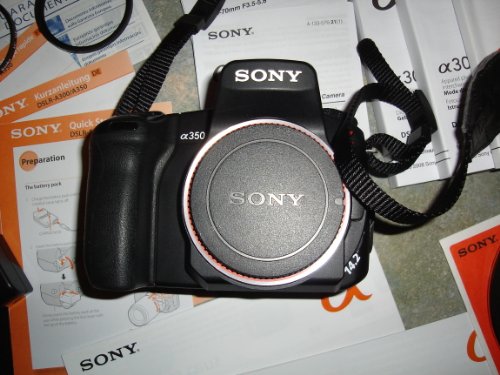
- Alpha A100 and A200/A300 series: The A100 launched Sony's Alpha DSLR line using the A-mount inherited from Minolta, and later A200, A230, A290, A300, A330, A350, A380, and A390 models targeted beginners. They provide APS-C sensors and in-body stabilization, but autofocus, viewfinders, screens, live view, and high-ISO quality vary substantially and are modest by current standards.
- Alpha A450, A500, A550, A560, and A580: These later APS-C enthusiast models improved speed, live view, screen usability, and sensor performance while retaining A-mount lenses and sensor-shift stabilization. The A560 and A580 are among the most developed true Sony DSLRs and add Full HD-era video, but their autofocus during video and overall recording tools remain far behind modern mirrorless cameras.
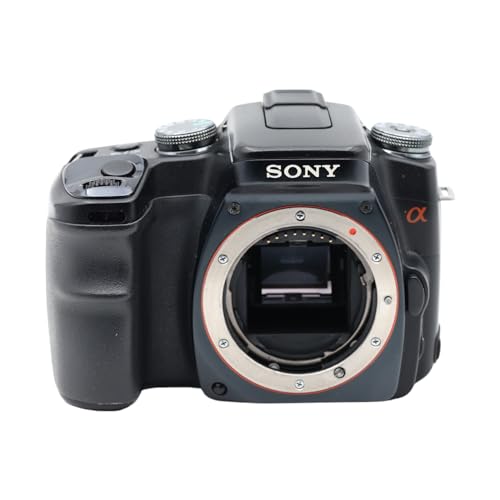
- Alpha A700: The A700 is a semi-professional APS-C DSLR with a robust body, direct controls, a pentaprism optical viewfinder, and compatibility with Minolta/Sony A-mount lenses and flashes. It suits photographers who value tactile operation and still-image shooting, but it predates live-view and video features expected on later cameras.
- Alpha A850 and A900: These are Sony's true full-frame DSLR flagships, built around approximately 24 MP sensors, large optical viewfinders, in-body stabilization, and professional-style controls. The A900 is the higher-positioned model and the A850 is its more affordable sibling; both can still deliver detailed low-ISO files with strong lenses, but they lack live view, video, modern autofocus tracking, and current connectivity.
- Sony SLT cameras are a separate family: Alpha A33/A55, A57/A65, A77, A99, and related models use a fixed translucent mirror and electronic viewfinder rather than the moving mirror and optical viewfinder of a DSLR. They share the A-mount and belong in Sony's system history, but they should not be mixed into a true Sony DSLR comparison or used to describe Sony's true DSLR range.

How much do Sony DSLR cameras cost?
Sony DSLR cameras do not have a meaningful current new-product price range because every Sony DSLR and the entire A-mount body system have been discontinued. Sony has no current DSLR retail line or manufacturer-supported entry, midrange, and professional tiers, so historical price records should not be presented as today's new-camera market.
The remaining system-level costs relate to using an existing A-mount setup rather than entering a current product range. Regional availability of compatible batteries, chargers, flashes, cables, service, and specialist accessories can be limited, and no future DSLR body or native A-mount lens development should be expected.
For a current Sony alternative, budget roughly £560-£1,000 for an APS-C E-mount body or kit and about £1,000-£2,600 for mainstream full frame, before lenses. Selected A-mount lenses work through Sony LA-EA adapters, but autofocus drive, frame coverage, teleconverter support, and shooting speed depend on the exact body, adapter, and lens. Staying with A-mount makes sense only when existing lenses or an optical viewfinder outweigh E-mount’s stronger autofocus, video, connectivity, and support path.
How do Sony DSLR cameras compare with Canon DSLR models?
Sony’s discontinued DSLRs and SLT cameras offered in-body stabilization and distinctive translucent-mirror shooting, while Canon DSLRs generally provide broader lens familiarity, simpler compatibility, and stronger live-view autofocus on Dual Pixel-equipped models. Neither is a current development path.
New-old-stock pricing is irregular because both DSLR lines are effectively legacy products; a current Sony E-mount APS-C kit is typically about £560-£1,000, while remaining Canon DSLR kits may start near £340 and rise beyond £860. Choose an older Sony body only for an existing A-mount lens kit; otherwise, compare current Sony E and Canon EOS R packages.
What should you consider while choosing the best Sony DSLR camera?
Consider the following points while choosing a Sony DSLR camera:
- Confirm that it is a true DSLR: A100 through A900 DSLR bodies use a moving reflex mirror and optical viewfinder, while later A33/A55, A57/A65, A77, and A99 SLT bodies use a fixed translucent mirror and electronic viewfinder. The handling, autofocus behavior, battery use, and live-view experience differ, so an A-mount badge alone does not identify the camera type.
- Account for discontinued-system support: Sony no longer develops A-mount bodies, firmware, or native lenses, and regional access to official service, batteries, chargers, cables, screens, and other accessories will become more limited over time. Treat the system as technically mature but closed rather than expecting features, compatibility updates, or a future DSLR upgrade path.
- Check A-mount lens compatibility: Full-frame A850/A900 bodies need full-frame lenses for complete sensor coverage, while DT lenses are designed for APS-C cameras and may vignette or force a crop elsewhere. Also verify screw-drive autofocus versus SAM/SSM motor support, aperture operation, flash compatibility, and whether a third-party lens requires updated electronics.
- Match the sensor and body class: Entry Alpha DSLRs use APS-C sensors and simpler controls, the A700 is a more robust APS-C enthusiast body, and the A850/A900 use approximately 24 MP full-frame sensors. High resolution on the full-frame models rewards strong lenses and careful focus, but high-ISO performance and dynamic range should be judged against their generation rather than current full-frame standards.
- Understand stabilization and optical-viewfinder behavior: In-body SteadyShot stabilizes many compatible A-mount lenses, including older Minolta optics without lens-based stabilization. The optical viewfinder provides a direct, lag-free view but cannot preview exposure, white balance, or stabilization in the same way as a modern electronic viewfinder, and live-view implementation differs across DSLR generations.
- Treat video as secondary or absent: A100, A700, A850, and A900-era bodies do not provide modern live-view video, while later A560/A580-class cameras offer only early Full HD-era recording. None is appropriate when 4K, dependable video autofocus, microphone monitoring, long recording, or current creator codecs are important.
- Verify ecosystem and software compatibility: Sony DSLR generations use different batteries, chargers, memory formats, flash arrangements, and connection standards, while current availability of these supporting components varies by region. Confirm that RAW files remain supported in the intended editing software and that the required Minolta/Sony flash system, tethering method, and storage format fit the planned workflow.
- Compare the E-mount alternative before committing: Current Sony mirrorless bodies provide far better autofocus, video, connectivity, and lens-development prospects, and selected A-mount lenses can be adapted with LA-EA adapters. Adaptation is not universal—autofocus motor type, frame coverage, burst speed, teleconverters, and body support vary—so verify the exact lens, adapter, and E-mount body combination before treating A-mount compatibility as a complete upgrade solution.