Scored using Wi-Fi extenders Methodology v3.0
Wi-Fi extenders Methodology v3.0
Mathematical & Unbiased Scoring
Products in this category are scored under Frontum Wi-Fi extenders Methodology v3.0: the technical score from the specifications is the base, and independent expert and video reviews (up to ±0.5 points), owner opinions (up to ±0.3) and best-of lists (up to +0.3) move it up or down.
Explore Wi-Fi extenders Methodology v3.0

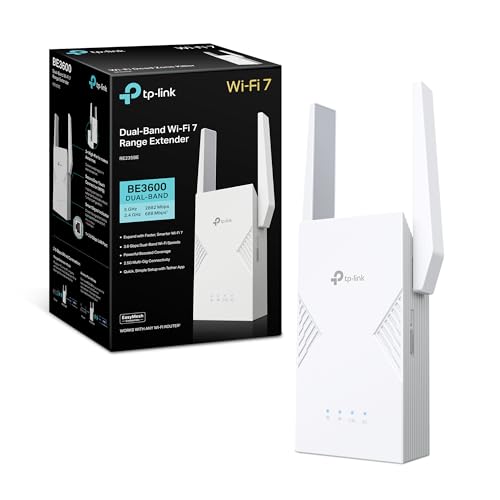
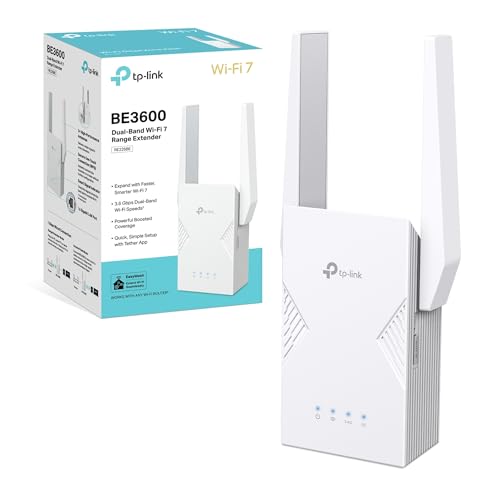
TP-Link RE223BE review: 64 specs compared

Avg. price:~£?Wi-Fi version:Wi-Fi 7 (802.11be)Wi-Fi speed:3200 MbpsCoverage area:?

TP-Link RE223BE Review: Compare 64 technical specifications and 1 best-of list to see how this product ranks in the Wi-Fi extenders category and whether it is worth buying.
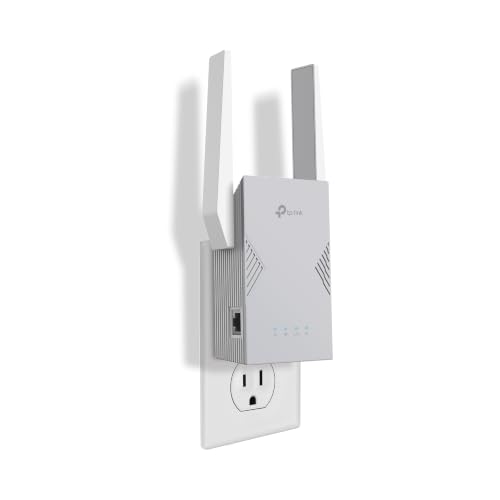
TP-Link RE223BE
8.2/10

Overall score

Score
8.2/ 10
✕
What it is
Our main score for this model, 1–10. It combines specs, best-of lists, expert reviews and ratings from across the web.
How we count it
Parts: Technical score 45%, List score 30%, Reviews score 15%, User score 10%
Marks: Each part gets a mark out of 10. For reviews, lists and owners, a typical model in this category gets about 8 and the best one gets 10.
No data yet: A part with no data shows "?". It counts as the mark of a weaker model in this category (4 in 5 models with data score higher). This way, models with reviews, lists and owners usually come out ahead.
Score distribution
▼
<55-66-77-88-99-10
Score components

45%

8.5

Technical score

30%

8.1

List score

15%

?

Reviews scoreNot enough data yet, so we use 7.5, the mark of a weaker model in this category

10%

8.1

User score

★Better than 90% of wi fi extenders
?

Value for money

Value for money
✕
What it is
An indicator that combines the Wi-Fi extender's overall rating with its cost.
When it matters
When you are looking for a Wi‑Fi extender with a good balance between performance and price.
Score distribution
▼
<55-66-77-88-99-10
Score components

70%

8.2

Overall score

30%

?

Price

Price not known yet
8.5

Technical score

Technical score
8.5/ 10
✕
What it is
How good the specs are compared with the other models in this category, 1–10.
How we count it
Areas: We rate the specs in each area against the other models in this category.
Weighting: The areas that matter most to buyers count more. The shares are shown under Score components.
Share: The technical score is 45% of the overall score.
Score distribution
▼
<55-66-77-88-99-10
Score components

40%

8.9

Wi-Fi Performance

30%

8.4

Network

12%

9.7

Setup

10%

6.6

Hardware

8%

7.8

Ports

▲Better than 87%
?

Reviews score

Reviews score
✕
What it is
Average grade from independent test sites, magazines and video reviewers, 1–10.
How we count it
Grades: Each review's own score is converted to 1–10; without one, we grade the review ourselves. Big test sites count more, short reviews half as much as full tests. A video review counts half.
Score: The average grade is 80% of the review mark; the number of reviews is the other 20% (1 review = 5, the typical number in this category = 8, the most-reviewed model = 10).
Enough data: With few reviews, the average grade is pulled toward the typical grade of this category. No reviews yet: 7.5 for now.
Share: Reviews count 15% of the overall score.
Score distribution
▼
<55-66-77-88-99-10
Grades by review (0)
We have not found an independent test of this model yet. Until we do, its review part counts as 7.5.
Ratings from across the web count in the User score, not in this score.
No expert tests yet
8.1

User score

User score
8.1/ 10
✕
What it is
How happy buyers are with this model, based on ratings from across the web.
How we count it
Enough data: A model needs at least 1 rating from across the web. Without one, it counts as 7.6, the mark of a weaker rated model in this category.
Share: User score counts 10% of the overall score.
Score distribution
▼
<55-66-77-88-99-10

70%

8.4

Rating

30%

7.5

Popularity

▼Worse than 53%
8.1

List score

List score
8.1/ 10
✕
What it is
How often independent test sites, magazines and video reviewers put this model in their best-of lists for this category.
How we count it
Points: The model in the most lists of this category gets 10; the others get 8 to 10 in proportion. In no list yet: 7.5. Lists count 30% of the overall score.
Enough data: Every list counts, even a single one. With fewer than 5 best-of lists in the category, this part is left out.
Lists with this model (1)
List score: in 1 of 47 lists (2%)
▲Better than 54%
  • tp-link-re223be
  • tp-link-re223be
  • tp-link-re223be
  • tp-link-re223be
  • tp-link-re223be
  • tp-link-re223be
tp-link-re223be
tp-link-re223be
tp-link-re223be
tp-link-re223be
tp-link-re223be
tp-link-re223be
Where to buy
    N/A~ £?
Loading...
Loading category ranking...

Technical Specifications of Wi-Fi extender TP-Link RE223BE

Technical score
Technical score
8.5/ 10
✕
What it is
How good the specs are compared with the other models in this category, 1–10.
How we count it
Areas: We rate the specs in each area against the other models in this category.
Weighting: The areas that matter most to buyers count more. The shares are shown under Score components.
Share: The technical score is 45% of the overall score.
Score distribution
▼
<55-66-77-88-99-10
Score components:

40%

8.9

Wi-Fi Performance

30%

8.4

Network

12%

9.7

Setup

10%

6.6

Hardware

8%

7.8

Ports

8.5
Reviews score
7.5
User score
8.1
List score
8.1
Value for money
Value for money
8.8/ 10
✕
What it is
An indicator that combines the Wi-Fi extender's overall rating with its cost.
When it matters
When you are looking for a Wi‑Fi extender with a good balance between performance and price.
Score distribution
▼
<55-66-77-88-99-10
Score components:

70%

8.2

Overall score

30%

?

Price

8.8
Wi-Fi version
Wi-Fi 7 (802.11be)
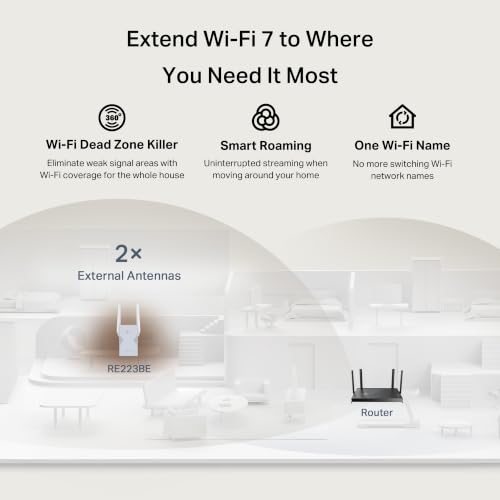
This Wi-Fi extender supports Wi-Fi 7 (802.11be), more advanced than 89% of Wi-Fi extenders and equal to 11% of Wi-Fi extenders.
Wi-Fi bands
Dual-band
This Wi-Fi extender supports Dual-band, more versatile than 15% of Wi-Fi extenders and equal to 74.5% of Wi-Fi extenders.
6 GHz band support
no
This Wi-Fi extender does not support the 6 GHz band. 3.9% of Wi-Fi extenders support the 6 GHz band.
Wi-Fi speed
3,200 Mbps
This Wi-Fi extender reaches 3,200 Mbps Wi-Fi speed, faster than 84.9% of Wi-Fi extenders.
Max speed 2.4 GHz
688 Mbps
This Wi-Fi extender reaches 688 Mbps on the 2.4 GHz band, which is faster than 88.4% of Wi-Fi extenders and equal to 7.5% of Wi-Fi extenders.
Show more
Ethernet backhaul
?
Mesh compatibility
?
Mesh standard
EasyMesh
Roaming feature
yes
This Wi-Fi extender supports roaming. 11.8% of Wi-Fi extenders support roaming.
802.11k support
yes
This Wi-Fi extender supports 802.11k. 24.3% of Wi-Fi extenders support 802.11k.
Show more
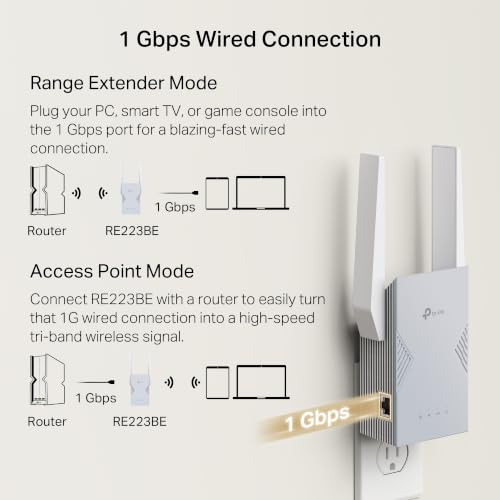
N. of LAN ports
1
This Wi-Fi extender has 1 LAN port/s, more than 7.4% of Wi-Fi extenders and equal to 79.1% of Wi-Fi extenders.
Ethernet port speed
1 Gbps
This Wi-Fi extender offers 1 Gbps Ethernet speed, faster than 30.1% of Wi-Fi extenders and equal to 60.3% of Wi-Fi extenders.
N. of USB ports
0
This Wi-Fi extender has 0 USB port/s, fewer than 2% of Wi-Fi extenders and equal to 98.1% of Wi-Fi extenders.
PoE standard
N/A
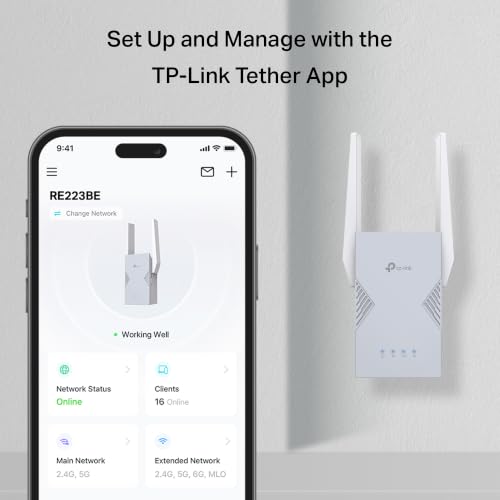
Dedicated smartphone app
yes
This Wi-Fi extender comes with a dedicated smartphone app. 10.4% of Wi-Fi extenders come with a dedicated smartphone app.
Web UI management
yes
This Wi-Fi extender has a web management interface. 1.3% of Wi-Fi extenders have a web management interface.
Automatic firmware updates
?
LED control
yes
This Wi-Fi extender has LED control. 9.7% of Wi-Fi extenders have LED control.
Buttons present
?
Show more
Mounting type
wall-plug
Portable design
yes
This Wi-Fi extender has a portable design. 24.5% of Wi-Fi extenders have a portable design.
Height
?
Width
?
Thickness
?
Show more

TP-Link RE223BE vs the average Wi-Fi extender

246810TotalWi-Fi PerformanceNetworkPortsSetupHardware
  • Modern Wi-Fi standard
    This Wi-Fi extender supports a more advanced Wi-Fi version than the average Wi-Fi extender (Wi-Fi 7 (802.11be) vs Wi-Fi 5 (802.11ac)). The average Wi-Fi extender supports Wi-Fi 5 (802.11ac).
    Wi-Fi 7 (802.11be) vs Wi-Fi 5 (802.11ac)
  • 72% faster 2.4 GHz speed
    This Wi-Fi extender delivers faster 2.4 GHz speeds than the average Wi-Fi extender (688 Mbps vs 400 Mbps). The average Wi-Fi extender reaches 400 Mbps on 2.4 GHz.
    688 Mbps vs 400 Mbps
  • 82.9% faster Wi-Fi speed
    This Wi-Fi extender reaches faster Wi-Fi speed than the average Wi-Fi extender (3,200 Mbps vs 1,750 Mbps). The average Wi-Fi extender reaches 1,750 Mbps Wi-Fi speed.
    3,200 Mbps vs 1,750 Mbps
  • Supports OFDMA
    This Wi-Fi extender supports OFDMA, while the average Wi-Fi extender does not. 46.4% of Wi-Fi extenders support OFDMA.
  • 2.16x faster 5 GHz speed
    This Wi-Fi extender delivers faster 5 GHz speeds than the average Wi-Fi extender (2,594 Mbps vs 1,201 Mbps). The average Wi-Fi extender reaches 1,201 Mbps on 5 GHz.
    2,594 Mbps vs 1,201 Mbps
  • Wide channel support
    This Wi-Fi extender supports broader channel widths than the average Wi-Fi extender (160 + 80 + 40 + 20 vs 80 + 40 + 20). The average Wi-Fi extender supports 80 + 40 + 20 channel widths.
    160 + 80 + 40 + 20 vs 80 + 40 + 20
  • Advanced QAM level
    This Wi-Fi extender uses a more advanced QAM level than the average Wi-Fi extender (4096-QAM vs 256-QAM). The average Wi-Fi extender uses 256-QAM.
    4,096-QAM vs 256-QAM
  • Supports BSS coloring
    This Wi-Fi extender supports BSS coloring, while the average Wi-Fi extender does not. 44.6% of Wi-Fi extenders support BSS coloring.
  • 6.2% better value for money
    TP-Link RE223BE has a higher value-for-money score than the average Wi-Fi extender (8.76 vs 8.2).
    8.76 vs 8.25
  • Modern Wi-Fi standard
    This Wi-Fi extender supports a more advanced Wi-Fi version than the average Wi-Fi extender (Wi-Fi 7 (802.11be) vs Wi-Fi 5 (802.11ac)). The average Wi-Fi extender supports Wi-Fi 5 (802.11ac).
    Wi-Fi 7 (802.11be) vs Wi-Fi 5 (802.11ac)
  • 72% faster 2.4 GHz speed
    This Wi-Fi extender delivers faster 2.4 GHz speeds than the average Wi-Fi extender (688 Mbps vs 400 Mbps). The average Wi-Fi extender reaches 400 Mbps on 2.4 GHz.
    688 Mbps vs 400 Mbps
  • 82.9% faster Wi-Fi speed
    This Wi-Fi extender reaches faster Wi-Fi speed than the average Wi-Fi extender (3,200 Mbps vs 1,750 Mbps). The average Wi-Fi extender reaches 1,750 Mbps Wi-Fi speed.
    3,200 Mbps vs 1,750 Mbps
  • Supports OFDMA
    This Wi-Fi extender supports OFDMA, while the average Wi-Fi extender does not. 46.4% of Wi-Fi extenders support OFDMA.
  • 2.16x faster 5 GHz speed
    This Wi-Fi extender delivers faster 5 GHz speeds than the average Wi-Fi extender (2,594 Mbps vs 1,201 Mbps). The average Wi-Fi extender reaches 1,201 Mbps on 5 GHz.
    2,594 Mbps vs 1,201 Mbps
  • Wide channel support
    This Wi-Fi extender supports broader channel widths than the average Wi-Fi extender (160 + 80 + 40 + 20 vs 80 + 40 + 20). The average Wi-Fi extender supports 80 + 40 + 20 channel widths.
    160 + 80 + 40 + 20 vs 80 + 40 + 20
  • Advanced QAM level
    This Wi-Fi extender uses a more advanced QAM level than the average Wi-Fi extender (4096-QAM vs 256-QAM). The average Wi-Fi extender uses 256-QAM.
    4,096-QAM vs 256-QAM
  • Supports BSS coloring
    This Wi-Fi extender supports BSS coloring, while the average Wi-Fi extender does not. 44.6% of Wi-Fi extenders support BSS coloring.

Third-party reviews

What customers like about TP-Link RE223BE

  • Wi-Fi 7 gives up to 2594 Mbps on the 5 GHz band.
  • 160 MHz channels widen the path for big file transfers.
  • 4096-QAM squeezes more data into each transmission.
  • Roaming and band steering keep phones on the strongest link.
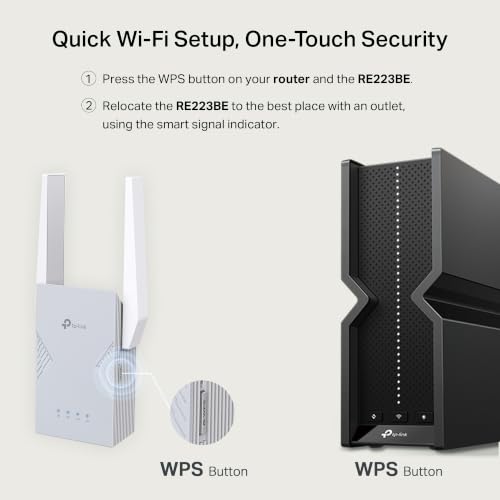
  • A dedicated app handles setup from a phone.
  • Mesh support lets it join your router as one network.

What customers don't like about TP-Link RE223BE

  • There is no 6 GHz band, which is a gap on a Wi-Fi 7 model.
  • There is no guest network, so visitors share your main password.
  • It has no IP rating and works only between 0 and 40 °C.
  • A single LAN port means only one wired device can plug in.
  • Wi-Fi 7 speeds only show up on devices that support the standard.

Verdict

A 160 MHz Wi-Fi 7 link is what sets the TP-Link RE223BE apart from older extenders. Speeds reach 2594 Mbps on 5 GHz and 688 Mbps on 2.4 GHz, 3200 Mbps in total. Its 4096-QAM encoding carries more data per transmission, so a busy house with several streams gets more out of the link. Mesh support, roaming and a phone app keep setup simple. The weak spot is the lack of a 6 GHz band, a real gap on a Wi-Fi 7 model. It runs between 0 and 40 °C and has no IP rating, so it stays indoors. It suits a house with heavy streaming and gaming, where people want the newest standard and a fast link to the router for years to come.

Compare TP-Link RE223BE with other products in the Wi-Fi extenders category

1Product to compare no. 1
VS
2Product to compare no. 2
VS
3Product to compare no. 3 (optional)

Graphic comparison of TP-Link RE223BE and other products in the Wi-Fi extenders category

No results found