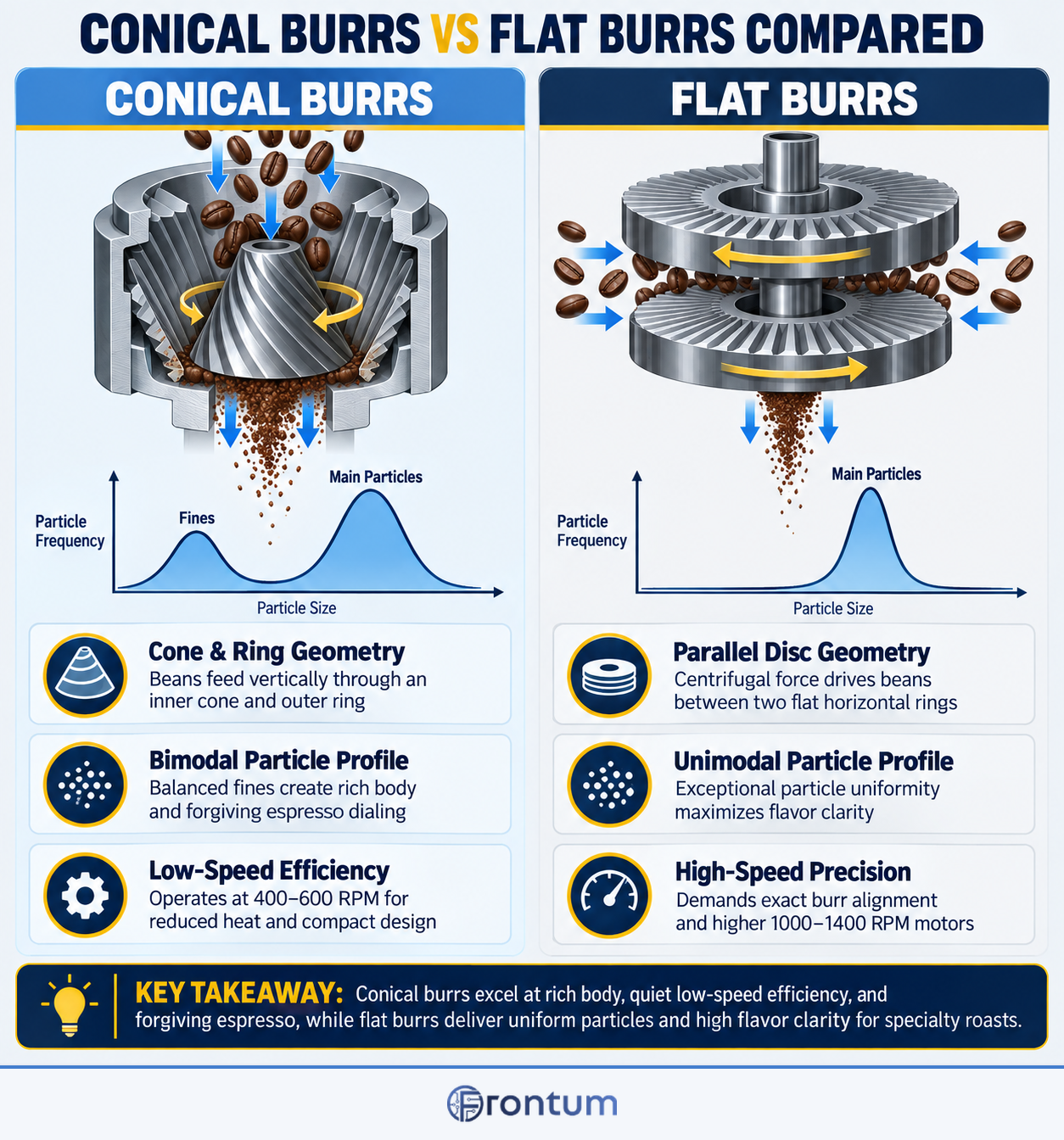
Neither type is better overall: flat burrs give more clarity, and conical burrs give more body and forgiveness. Flat burrs face each other as parallel rings and cut beans in a narrow band. That creates a tight spread of particle sizes, which suits light-roast espresso and filter. Conical burrs set a cone inside a ring and leave more fines, which adds body to dark-roast espresso.
Practical differences matter as much as taste. Conical burrs often turn at 400–500 rpm and fit compact grinders such as the MiiCoffee DC63. Flat burrs usually spin at 1,000–1,400 rpm and need more space and sound damping, as in the Eureka Mignon Silenzio 55. Pick conical for dark roasts and a cool, quiet grind, and flat for bright light roasts.
How does burr size affect a burr coffee grinder?
Larger burrs grind faster, run cooler and keep particle size steadier across a dose. Cutting surface grows with diameter, so a 64 mm flat set has far more working area than a 38 mm conical set. More area means fewer revolutions per gram. Café grinders with 83 mm flat burrs finish a double shot in about 3–5 seconds.
Size also changes the cup, though less than marketing claims. Bigger flat burrs tend to produce fewer fines at the same setting, which gives a cleaner taste in light roasts. Alignment and burr geometry matter just as much: a well-aligned 54 mm set beats a poorly aligned 64 mm one.
For home use, 50–64 mm flat or 40–60 mm conical burrs cover espresso and filter well. Sets of 75 mm and up pay off in cafés pulling 100 or more shots a day. Bigger burrs also need a stronger motor and a heavier body, which adds cost, weight and counter space.