Scored using Tablets Methodology v3.0
Tablets Methodology v3.0
Mathematical & Unbiased Scoring
Products in this category are scored under Frontum Tablets Methodology v3.0: the technical score from the specifications is the base, and independent expert and video reviews (up to ±0.5 points), owner opinions (up to ±0.3) and best-of lists (up to +0.3) move it up or down.
Explore Tablets Methodology v3.0

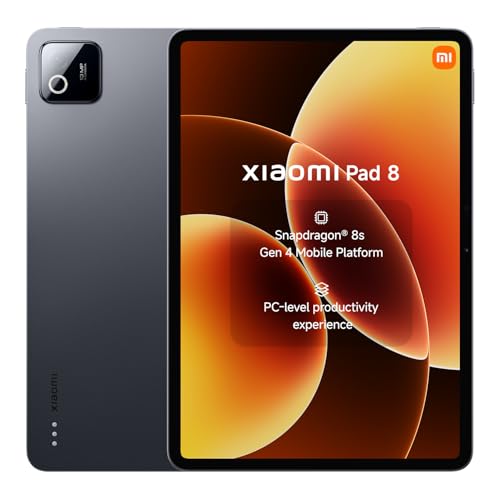
Xiaomi Pad 8 review: 168 specs compared

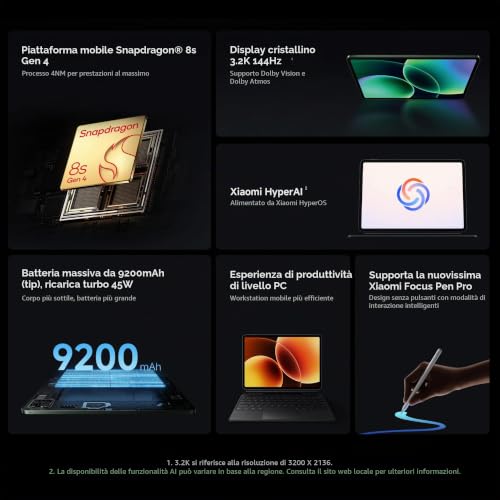
Avg. price:~£390RAM capacity:8 GBInternal storage:128 GBScreen size:11.2 inchesChipset:?

Xiaomi Pad 8 Review: Compare 168 technical specifications, 44 expert and video reviews and 24 best-of lists to see how this product ranks in the Tablets category and whether it is worth buying.
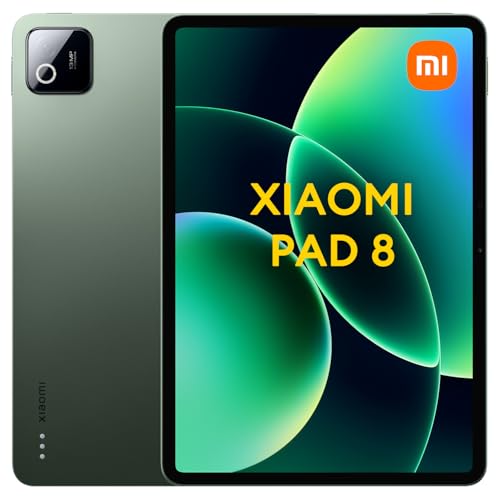
Xiaomi Pad 8
8.5/10

Overall score

Score
8.5/ 10
✕
What it is
Our main score for this model, 1–10. It combines specs, best-of lists, expert reviews and owners.
How we count it
Parts: Technical score 35%, List score 30%, Reviews score 25%, Sentiment score 10%
Marks: Each part gets a mark out of 10. For reviews, lists and owners, a typical model in this category gets about 8 and the best one gets 10.
No data yet: A part with no data shows "?". It counts as the mark of a weaker model in this category (4 in 5 models with data score higher). This way, models with reviews, lists and owners usually come out ahead.
Score distribution
▼
<55-66-77-88-99-10
Score components

35%

8.5

Technical score

30%

9.0

List score

25%

8.6

Reviews score

10%

?

Sentiment scoreNot enough data yet, so we use 6.9, the mark of a weaker model in this category

★Better than 99% of tablets
8.5

Value for money

Value for money
8.5/ 10
✕
What it is
An indicator that combines the tablet's overall rating with its cost.
When it matters
When you are looking for a tablet with a good balance between quality and price.
Score distribution
▼
<55-66-77-88-99-10
Score components

70%

8.5

Overall score

30%

8.5

Price

★Better than 98%
8.5

Technical score

Technical score
8.5/ 10
✕
What it is
How good the specs are compared with the other models in this category, 1–10.
How we count it
Areas: We rate the specs in each area against the other models in this category.
Weighting: The areas that matter most to buyers count more. The shares are shown under Score components.
Share: The technical score is 35% of the overall score.
Score distribution
▼
<55-66-77-88-99-10
Score components

22%

8.3

Performance

20%

8.8

Display

16%

9.1

Camera

14%

8.7

Battery

12%

7.2

Connectivity

8%

9.5

Software

5%

7.6

Design

3%

8.0

Audio

★Better than 92%
8.6

Reviews score

Reviews score
8.6/ 10
✕
What it is
Average grade from independent test sites, magazines and video reviewers, 1–10.
How we count it
Grades: Each review's own score is converted to 1–10; without one, we grade the review ourselves. Big test sites count more, short reviews half as much as full tests. A video review counts half.
Score: The average grade is 80% of the review mark; the number of reviews is the other 20% (1 review = 5, the typical number in this category = 8, the most-reviewed model = 10).
Enough data: With few reviews, the average grade is pulled toward the typical grade of this category. No reviews yet: 7.4 for now.
Share: Reviews count 25% of the overall score.
Score distribution
▼
<55-66-77-88-99-10

80%

8.5

Average grade

20%

9.1

Popularity

Grades by review (44)
14 reviews: 6 with a printed score, 8 estimated from the review. 30 video reviews, each counting half as much as a written test. Reviews count 25% of the overall score.
User ratings collected online are not part of this score.
★Better than 95%
9.0

List score

List score
9.0/ 10
✕
What it is
How often independent test sites, magazines and video reviewers put this model in their best-of lists for this category.
How we count it
Points: The model in the most lists of this category gets 10; the others get 8 to 10 in proportion. In no list yet: 7.5. Lists count 30% of the overall score.
Enough data: Every list counts, even a single one. With fewer than 5 best-of lists in the category, this part is left out.
Lists with this model (24)
List score: in 24 of 136 lists (18%)
★Better than 99%
  • xiaomi-pad-8
  • xiaomi-pad-8
  • xiaomi-pad-8
  • xiaomi-pad-8
  • xiaomi-pad-8
  • xiaomi-pad-8
  • xiaomi-pad-8
  • xiaomi-pad-8
xiaomi-pad-8
xiaomi-pad-8
xiaomi-pad-8
xiaomi-pad-8
xiaomi-pad-8
xiaomi-pad-8
xiaomi-pad-8
xiaomi-pad-8
Where to buy
*As an Amazon Associate, we earn from qualifying purchases.
Best rankings
Available: ranking among products currently available (including other versions of this product).All: ranking among all products in the database.

What reviewers say about the Xiaomi Pad 8

Based on 14 · 39

Reviewers praise the fast performance and premium build, but complain about missing secure unlocking and limited storage and memory.
Praised
Mixed views
Criticised
Pick a topic to see who said what
Loading...
Loading category ranking...

Technical Specifications of tablet Xiaomi Pad 8

Technical score
Technical score
8.5/ 10
✕
What it is
How good the specs are compared with the other models in this category, 1–10.
How we count it
Areas: We rate the specs in each area against the other models in this category.
Weighting: The areas that matter most to buyers count more. The shares are shown under Score components.
Share: The technical score is 35% of the overall score.
Score distribution
▼
<55-66-77-88-99-10
Score components:

22%

8.3

Performance

20%

8.8

Display

16%

9.1

Camera

14%

8.7

Battery

12%

7.2

Connectivity

8%

9.5

Software

5%

7.6

Design

3%

8.0

Audio

8.5
Reviews score
8.6
List score
9.0
Value for money
Value for money
8.5/ 10
✕
What it is
An indicator that combines the tablet's overall rating with its cost.
When it matters
When you are looking for a tablet with a good balance between quality and price.
Score distribution
▼
<55-66-77-88-99-10
Score components:

70%

8.5

Overall score

30%

8.5

Price

8.5
RAM capacity
8 GB
This tablet has 8 GB of RAM, which is more than 72.1% of tablets and equal to 17.9% of tablets.
Process node
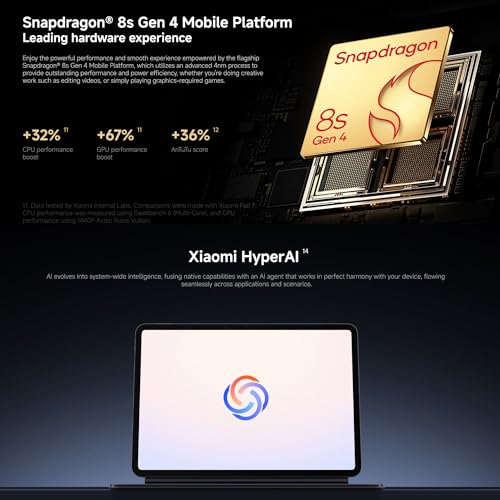
4 nm
This tablet is built on a 4 nm process, which is smaller than 88.1% of tablets and equal to 8.5% of tablets.
Internal storage
128 GB
This tablet has 128 GB of internal storage, which is more than 56.2% of tablets and equal to 20% of tablets.
Geekbench 6 single-core score
?
Chipset
?
Show more
What reviewers say
Screen resolution
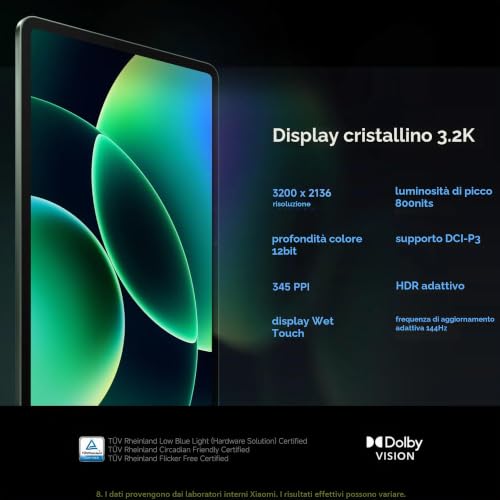
3200×2136
This tablet has a 3200×2136 screen, which is sharper than 98.5% of tablets and equal to 1.1% of tablets.
Refresh rate
144 Hz
This tablet has a 144 Hz screen, which is smoother than 91.2% of tablets and equal to 7.4% of tablets.
Display type
IPS LCD
This tablet uses a IPS LCD display type. 17% of tablets use this display technology.
Pixel density
344 ppi
This tablet has a pixel density of 344 ppi, which is higher than 97.7% of tablets.
Display glass type
?
Show more
What reviewers say
Optical image stabilization
no
This tablet does not support optical stabilisation. 0.4% of tablets offer this.
Main camera megapixels
13 MP
This tablet has a rear camera with 13 MP resolution, which is higher than 73.9% of tablets and equal to 21.7% of tablets.
Front camera megapixels
8 MP
This tablet has a front camera with 8 MP resolution, which is higher than 69.6% of tablets and equal to 19.5% of tablets.
Main camera aperture
f/2.2
This tablet has a main camera aperture of f/2.2, which is wider than 30.1% of tablets and equal to 27.3% of tablets.
Optical zoom
?
Show more
Battery capacity
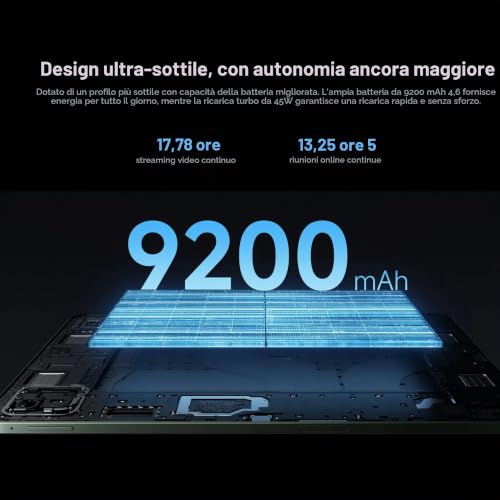
9,200 mAh
This tablet has 9,200 mAh battery capacity, which is larger than 84% of tablets and equal to 0.3% of tablets.
Charging speed
45 W
This tablet charges at 45 W, which is faster than 83.8% of tablets and equal to 6.7% of tablets.
Battery life
?
Wireless charging
no
This tablet does not support wireless charging. 1.5% of tablets offer this.
Fast charging
yes
This tablet supports fast charging. 43.2% of tablets offer this.
Show more
What reviewers say
LTE support
no
This tablet does not have built-in LTE. 42.9% of tablets offer this.
Wi-Fi connectivity
yes
This tablet connects to Wi-Fi. 0.2% of tablets offer this.
GPS
?
5G connectivity
no
This tablet does not support 5G. 8.1% of tablets offer this.
NFC
no
This tablet does not include NFC. 10.8% of tablets offer this.
Show more
What reviewers say
Operating system
?
Update support duration
long
This tablet offers long update support, which is longer than the support period of 80% of tablets and equal to that of 20% of tablets.
Direct OS updates
yes
This tablet supports direct OS updates. 20.3% of tablets offer this.
On-device AI
yes
This tablet supports on-device AI. 71.7% of tablets support this capability.
App tracking protection
?
Show more
IP rating
not rated
This tablet's IP rating is not rated, which is less protected than 16.5% of tablets and the same as 83.6% of tablets.
Weight
?
Backlit keyboard
?
Keyboard accessory
yes
This tablet supports a keyboard accessory. 15.8% of tablets support this option.
Pen latency
?
Show more
What reviewers say
Number of microphones
4
This tablet has a microphone array of 4, which is more than 93.1% of tablets and equal to 4.4% of tablets.
aptX Adaptive
no
This tablet does not support aptX Adaptive. 6.9% of tablets offer this.
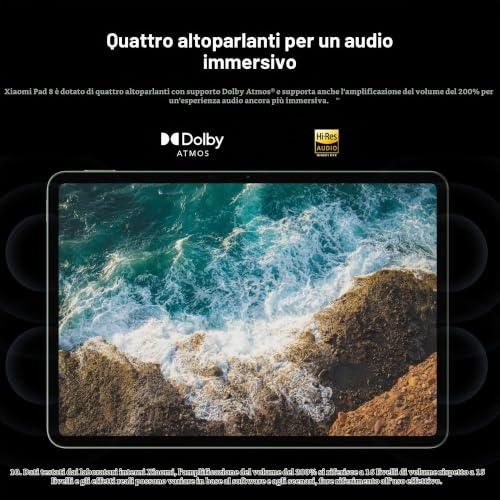
Dolby Atmos support
yes
This tablet supports Dolby Atmos. 68.7% of tablets support Dolby Atmos.
N. of speakers
4
This tablet includes 4 speakers, which is more than in 70.8% of tablets and equal to the number in 22.9% of tablets.
FM radio
no
This tablet does not include an FM radio. 19% of tablets offer this.
Show more
What reviewers say

Xiaomi Pad 8 vs the average tablet

246810TotalPerformanceDisplayCameraBatteryConnectivitySoftwareDesignAudio
  • 2.4x faster refresh rate
    This tablet has a faster refresh rate than the average tablet (144 Hz vs 60 Hz). The average tablet has a 60 Hz refresh rate.
    144 Hz vs 60 Hz
  • Sharper display
    This tablet has a sharper screen than the average tablet (3200×2136 vs 1920×1200).
    3,200×2,136 vs 1,920×1,200
  • 399 nits brighter screen
    This tablet is brighter than the average tablet (800 nits vs 401 nits). The average tablet reaches 401 nits.
    800 nits vs 401 nits
  • Faster storage type
    This tablet uses UFS storage, while the average tablet uses eMMC. Storage technology still varies widely across tablets.
    UFS vs eMMC
  • 2.5x faster charging
    This tablet charges faster than the average tablet (45 W vs 18 W). The average tablet charges at 18 W.
    45 W vs 18 W
  • Better main-camera video
    This tablet supports better main-camera video recording than the average tablet (2160x30 fps vs 1080x30 fps). The average tablet supports 1080x30 fps main-camera video recording.
    2160x30 fps vs 1080x30 fps
  • 55.7% sharper screen detail
    This tablet has sharper screen detail than the average tablet (344 ppi vs 221 ppi). The average tablet has a pixel density of 221 ppi.
    344 ppi vs 221 ppi
  • 5 MP higher rear resolution
    This tablet has a higher-resolution rear camera than the average tablet (13 MP vs 8 MP). The average tablet has a rear camera of 8 MP.
    13 MP vs 8 MP
  • 22.9% higher review score
    Reviews score
    8.6/ 10
    ✕
    What it is
    Average grade from independent test sites, magazines and video reviewers, 1–10.
    How we count it
    Grades: Each review's own score is converted to 1–10; without one, we grade the review ourselves. Big test sites count more, short reviews half as much as full tests. A video review counts half.
    Score: The average grade is 80% of the review mark; the number of reviews is the other 20% (1 review = 5, the typical number in this category = 8, the most-reviewed model = 10).
    Enough data: With few reviews, the average grade is pulled toward the typical grade of this category. No reviews yet: 7.4 for now.
    Share: Reviews count 25% of the overall score.
    Score distribution
    ▼
    <55-66-77-88-99-10

    80%

    8.5

    Average grade

    20%

    9.1

    Popularity

    Grades by review (44)
    14 reviews: 6 with a printed score, 8 estimated from the review. 30 video reviews, each counting half as much as a written test. Reviews count 25% of the overall score.
    User ratings collected online are not part of this score.
    8.6 vs 7.0
  • 13.9% higher list score
    List score
    9.0/ 10
    ✕
    What it is
    How often independent test sites, magazines and video reviewers put this model in their best-of lists for this category.
    How we count it
    Points: The model in the most lists of this category gets 10; the others get 8 to 10 in proportion. In no list yet: 7.5. Lists count 30% of the overall score.
    Enough data: Every list counts, even a single one. With fewer than 5 best-of lists in the category, this part is left out.
    Lists with this model (24)
    List score: in 24 of 136 lists (18%)
    9.0 vs 7.9
  • 12.8% better value for money
    Xiaomi Pad 8 has better value for money than the average tablet (8.52 vs 7.6).
    8.52 vs 7.55
  • Faster storage type
    This tablet uses UFS storage, while the average tablet uses eMMC. Storage technology still varies widely across tablets.
    UFS vs eMMC
  • 4 GB more RAM
    This tablet has more RAM than the average tablet (8 GB vs 4 GB). The average tablet has 4 GB of RAM.
    8 GB vs 4 GB
  • 71.4% smaller process node
    This tablet has a smaller process node than the average tablet (4 nm vs 14 nm). The average tablet is built on 14 nm.
    4 nm vs 14 nm
  • 2x more internal storage
    This tablet has more internal storage than the average tablet (128 GB vs 64 GB). The average tablet has 64 GB of internal storage.
    128 GB vs 64 GB
  • Includes neural engine
    This tablet includes a neural engine, the average tablet does not. 25.6% of tablets include a neural engine.
  • 2.4x faster refresh rate
    This tablet has a faster refresh rate than the average tablet (144 Hz vs 60 Hz). The average tablet has a 60 Hz refresh rate.
    144 Hz vs 60 Hz
  • Sharper display
    This tablet has a sharper screen than the average tablet (3200×2136 vs 1920×1200).
    3,200×2,136 vs 1,920×1,200
  • 399 nits brighter screen
    This tablet is brighter than the average tablet (800 nits vs 401 nits). The average tablet reaches 401 nits.
    800 nits vs 401 nits
  • 55.7% sharper screen detail
    This tablet has sharper screen detail than the average tablet (344 ppi vs 221 ppi). The average tablet has a pixel density of 221 ppi.
    344 ppi vs 221 ppi
  • Supports adaptive refresh rate
    This tablet has adaptive refresh rate, the average tablet does not. 17.7% of tablets support adaptive refresh rate.
  • Wider color gamut
    This tablet supports a wider color gamut than the average tablet (DCI-P3 vs sRGB). The average tablet covers sRGB color gamut.
    DCI-P3 vs sRGB
  • 1.1 inches larger screen
    This tablet has a larger screen than the average tablet (11.2 inches vs 10.1 inches). The average tablet measures 10.1 inches.
    11.2 inches vs 10.1 inches
  • Supports HDR10
    This tablet supports HDR10, while the average tablet does not. 21.7% of tablets support HDR10.
  • 3x faster touch response
    This tablet samples touch faster than the average tablet (360 Hz vs 120 Hz). The average tablet samples touch at 120 Hz.
    360 Hz vs 120 Hz
  • Better main-camera video
    This tablet supports better main-camera video recording than the average tablet (2160x30 fps vs 1080x30 fps). The average tablet supports 1080x30 fps main-camera video recording.
    2160x30 fps vs 1080x30 fps
  • 5 MP higher rear resolution
    This tablet has a higher-resolution rear camera than the average tablet (13 MP vs 8 MP). The average tablet has a rear camera of 8 MP.
    13 MP vs 8 MP
  • 3 MP higher front resolution
    This tablet has a higher-resolution front camera than the average tablet (8 MP vs 5 MP). The average tablet has a front camera of 5 MP.
    8 MP vs 5 MP
  • Supports PDAF
    This tablet supports PDAF, the average tablet does not. 28% of tablets support PDAF.
  • Supports manual shutter speed
    This tablet supports manual shutter speed, while the average tablet does not. 21.8% of tablets support manual shutter speed.
  • Manual focus control
    This tablet supports manual focus, while the average tablet does not. 36.9% of tablets support manual focus.
  • Supports manual ISO
    This tablet supports manual ISO, while the average tablet does not. 45.9% of tablets support manual ISO.
  • Built-in camera flash
    This tablet has a camera flash, while the average tablet does not. 45.5% of tablets have one.
  • 2.5x faster charging
    This tablet charges faster than the average tablet (45 W vs 18 W). The average tablet charges at 18 W.
    45 W vs 18 W
  • 39.4% larger battery capacity
    This tablet has a larger battery capacity than the average tablet (9,200 mAh vs 6,600 mAh). The average tablet offers 6,600 mAh of battery capacity.
    9,200 mAh vs 6,600 mAh
  • Supports DisplayPort over USB-C
    This tablet supports DisplayPort over USB-C, the average tablet does not. 21.3% of tablets support DisplayPort over USB-C.
  • Newer Bluetooth version
    This tablet has a newer Bluetooth version than the average tablet (5.4 vs 5).
    5.4 vs 5.0
  • Faster USB ports
    This tablet has faster USB ports than the average tablet (USB 3.2 Gen 1 vs USB 2).
    USB 3.2 Gen 1 vs USB 2.0
  • Longer update support
    This tablet offers longer update support than the average tablet (long vs medium). The average tablet gets medium of update support.
    long vs medium
  • Includes on-device AI
    This tablet includes on-device AI, the average tablet does not. 28.3% of tablets include on-device AI.
  • Supports live text recognition
    This tablet supports live text recognition, while the average tablet does not. 35.1% of tablets offer this.
  • Supports dynamic themes
    This tablet supports dynamic themes, while the average tablet does not. 29.5% of tablets offer this.
  • Supports extra dim mode
    This tablet supports extra dim mode, while the average tablet does not. 35.9% of tablets offer this.
  • Includes clipboard warnings
    This tablet has clipboard warnings, the average tablet does not. 40.3% of tablets include clipboard warnings.
  • Supports drawing
    This tablet is suitable for drawing, while the average tablet is not. 40% of tablets are suitable for drawing.
  • 2 more speakers
    This tablet has more speakers than the average tablet (4 vs 2). The average tablet has 2 speakers.
    4 vs 2
  • 3 more microphones
    This tablet has more microphones than the average tablet (4 vs 1). The average tablet's microphone count is 1.
    4 vs 1
  • Supports Dolby Atmos
    This tablet supports Dolby Atmos, the average tablet does not. 31.3% of tablets support Dolby Atmos.
  • Supports LDAC
    This tablet supports LDAC, the average tablet does not. 25.3% of tablets support LDAC.
  • No headphone jack
    This tablet does not include a 3.5 mm headphone jack, while the average tablet does. 72.8% of tablets offer this.
  • 51.22 mm taller
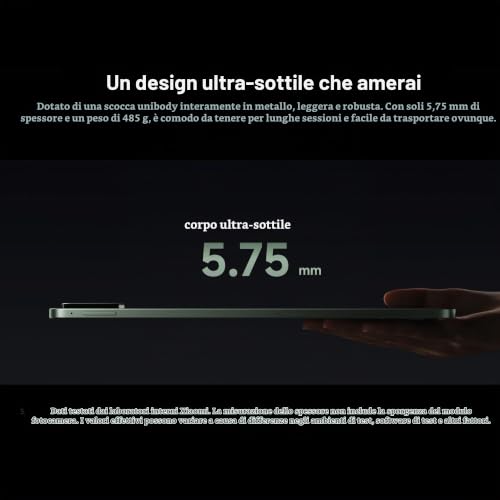
    This tablet is taller than the average tablet (251.2 mm vs 200 mm). The average tablet is 200 mm tall.
    251.22 mm vs 200 mm
  • 50% more expensive
    Xiaomi Pad 8 is more expensive than the average tablet (£390 vs £260).
    £390 vs £260
  • 50% more expensive
    Xiaomi Pad 8 is more expensive than the average tablet (£390 vs £260).
    £390 vs £260
  • 51.22 mm taller
    This tablet is taller than the average tablet (251.2 mm vs 200 mm). The average tablet is 200 mm tall.
    251.22 mm vs 200 mm
  • No headphone jack
    This tablet does not include a 3.5 mm headphone jack, while the average tablet does. 72.8% of tablets offer this.

Video reviews

Hands-on testing, unboxing, and real-world video evaluations

9.0
Sai Tech Guru
≈ estimated
19/10/2026
Long-term test · about 175 days of use
Verdict
Xiaomi Pad 8 has a strong screen, battery and performance, though heat and speaker volume are the main drawbacks.
7.0
Tech & Gears
≈ estimated
04/10/2026
Long-term review · daily use and battery tests
Verdict
Xiaomi Pad 8 is worth considering if you want a slim tablet, but battery and speakers are its weak points.
9.0
Sai Tech Guru
≈ estimated
26/09/2026
Long-term test · 150 days of use
Verdict
Xiaomi Pad 8 has excellent performance and an excellent camera, but battery and heat are its only real drawbacks after months.
8.0
Sai Tech Guru
≈ estimated
28/07/2026
Long-term review · about 100 days of use
Verdict
Xiaomi Pad 8 is a good tablet for gaming and video editing, though it runs warm.
7.0
Renzo Claros - Tech & Cameras
≈ estimated
04/07/2026
Gaming test · base model with 8 GB RAM and 128 GB
Verdict
Xiaomi Pad 8 is fine for casual gaming and as a bigger screen, but not recommended for demanding Android games.
9.0
Sai Tech Guru
≈ estimated
25/06/2026
Long-term review · 75 days of use
Verdict
Xiaomi Pad 8 is a pretty good tablet for gaming and video editing, with weak battery life and noticeable heating.
9.0
Eufracio López 502
≈ estimated
16/06/2026
Hands-on review · gaming tests and battery
Verdict
Xiaomi Pad 8 is recommended, with the lack of bypass charging as its main weakness.
8.0
Sai Tech Guru
≈ estimated
04/05/2026
Long-term test · 45 days of daily use
Verdict
Xiaomi Pad 8 has a solid build and good battery life, but weak speakers, and it lacks a fingerprint scanner, microSD and 5G.
8.0
Mr Techpedia
≈ estimated
04/05/2026
Hands-on review · keyboard, pen, camera and design
Verdict
Xiaomi Pad 8 is a good tablet, just a little expensive, and best suited to heavy users.
8.0
Techy Pathshala
≈ estimated
28/04/2026
Full review · battery, display and gaming tests
Verdict
Xiaomi Pad 8 is a good option worth considering, though its 144Hz display claim does not hold up.
7.0
Venom's Tech
≈ estimated
22/04/2026
Hands-on review · performance, cameras and value comparison
Verdict
Xiaomi Pad 8 is only a small step up from the Pad 7, best for performance-focused buyers who accept a short update window.
9.0
Now & Then Tech
≈ estimated
18/04/2026
Hands-on review · performance, battery and camera tests
Verdict
Xiaomi Pad 8 has few flaws and is a strong choice for budget buyers.
More graded video reviews (21)
creator’s own scoreestimated by us

Expert reviews

In-depth analysis and verdict from leading tech publications

8.2
techpp.com
✓ explicit
12/03/2026
Hands-on review · Tablet with keyboard
Verdict
The Xiaomi Pad 8 has a fast chip and bright 144Hz screen, but it is only a handy short-term notebook alternative.
8.7
notebookcheck.net
✓ explicit
05/12/2025
Lab test · Battery and sound
Verdict
The Xiaomi Pad 8 is well equipped for its price, with narrow bezels, a flicker-free screen and enough power for most tasks.
9.5
androidcentral.com
≈ estimated
20/03/2026
Month-long review · Mid-range tablet
Verdict
The Xiaomi Pad 8 is a solid mid-range Android tablet with a long-lasting battery and a good Focus Keyboard, though its LCD can't match an iPad Pro.
8.0
digitalcameraworld.com
✓ explicit
09/03/2026
Hands-on review · Productivity tablet
Verdict
The Xiaomi Pad 8 is a light, reasonably priced tablet for entertainment and basic creative work, but it can't replace a laptop.
9.0
digit.in
≈ estimated
13/06/2026
Long-term review · Mid-range tablet
Verdict
The Xiaomi Pad 8 is a slimmer, longer-lasting update of the Pad 7 and an easy pick for students and professionals.
9.0
techadvisor.com
✓ explicit
13/03/2026
Hands-on review · Value tablet
Verdict
The Xiaomi Pad 8 is the best value Android tablet to beat, with a strong chip and compact build, though software sees few improvements.
10
stuff.tv
✓ explicit
28/02/2026
Hands-on review · Work and play
Verdict
The Xiaomi Pad 8 is a travel-sized Android all-rounder that the Focus Keyboard and Focus Pen can turn into a capable work tablet.
8.0
yugatech.com
≈ estimated
02/03/2026
Hands-on review · Gaming and work
Verdict
The Xiaomi Pad 8 is fast and bright enough for work and games, but its battery drains quicker than expected and its speakers lack volume.
9.0
unbox.ph
≈ estimated
28/02/2026
Hands-on review · Daily driver
Verdict
The Xiaomi Pad 8 is a light, premium midrange Android tablet that can stand in for a laptop most of the time, though you have to supply your own charger.
8.0
thehindu.com
≈ estimated
31/03/2026
Hands-on review · Pen and productivity
Verdict
The Xiaomi Pad 8 is a sharp, long-lasting tablet whose Focus Pen Pro and floating keyboard suit note-taking, though switching between windows still needs work.
9.0
smartzone.de
≈ estimated
14/04/2026
Lab test · Performance and battery
Verdict
The Xiaomi Pad 8 is a very fast, stable mid-range tablet with a long battery and loud Dolby Atmos speakers, but without a fingerprint sensor or 5G.
8.0
nextpit.de
≈ estimated
06/03/2026
Hands-on test · iPad-style tablet
Verdict
The Xiaomi Pad 8 feels close to an iPad and works as a laptop stand-in, but its LCD has no matte coating and no 5G or LTE.
8.5
charlestech.fr
✓ explicit
09/10/2026
Full review · Mid-range tablet
Verdict
The Xiaomi Pad 8 is one of the best Android tablets in its class, with a processor that punches above its price, but system apps show ads.
9.0
roxmir.it
≈ estimated
20/09/2026
Hands-on test · Screen and battery
Verdict
The Xiaomi Pad 8 suits reading and streaming with its 3:2 screen and long battery, but lacks a fingerprint sensor and water resistance.

Third-party reviews

What customers like about Xiaomi Pad 8

  • The 144 Hz refresh rate makes scrolling and animation look fluid.
  • Peak brightness of 800 nits keeps the screen visible in strong sunlight.
  • The 9200 mAh battery is big enough for long viewing sessions.
  • 45 W charging brings the battery back to a useful level quickly.
  • Dolby Vision and HDR10 support make films look richer in apps that use them.
  • Long update support means the tablet keeps getting new software for years.

What customers don't like about Xiaomi Pad 8

  • There is no 3.5 mm headphone jack, so wired headphones need an adapter.
  • The 128 GB of storage cannot be expanded, since there is no memory card slot.
  • The tablet connects through Wi-Fi only, with no 5G or LTE.
  • There is no optical image stabilization, so handheld video can look shaky.
  • At 251.22 mm tall, it is long to hold up for reading.

Verdict

A 144 Hz screen is the first thing you notice on the Xiaomi Pad 8, an 11.2 inch tablet for people who watch films and play fast games. The IPS panel is sharp at 3200×2136 and reaches 800 nits at its peak, and the DCI-P3 colour range gives images a rich look. Four microphones pick up voices clearly. The 9200 mAh battery pairs with a 45 W charger, so a nearly empty tablet regains a useful charge fast. Eight GB of RAM handles several apps at once. The trade-offs are the 128 GB of storage, which cannot be expanded, and the lack of a 3.5 mm headphone jack. It suits a buyer who wants a bright, smooth screen for films and games and does not need 5G or a memory card.

Compare Xiaomi Pad 8 with other tablets

1Product to compare no. 1
VS
2Product to compare no. 2
VS
3Product to compare no. 3 (optional)

Graphic comparison of Xiaomi Pad 8 and other tablets

No results found