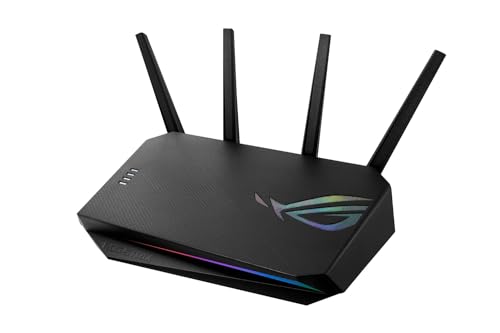
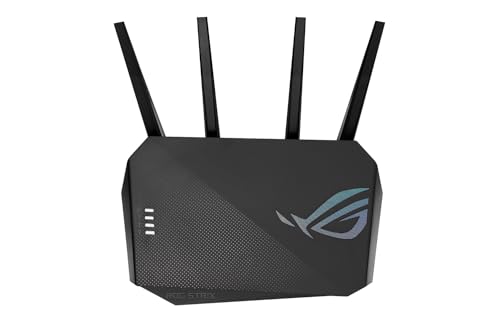
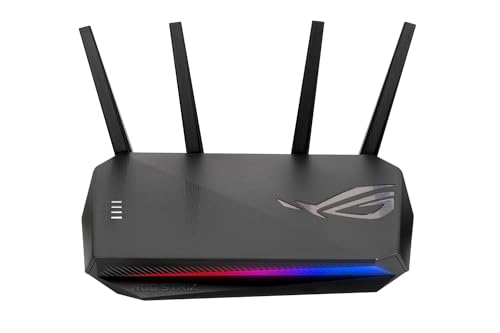
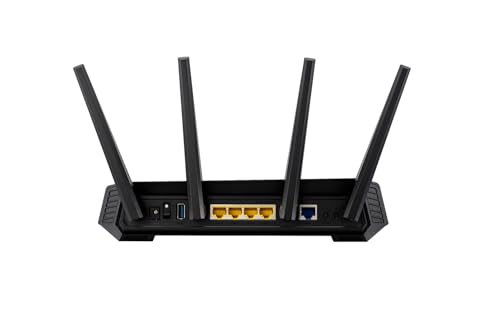
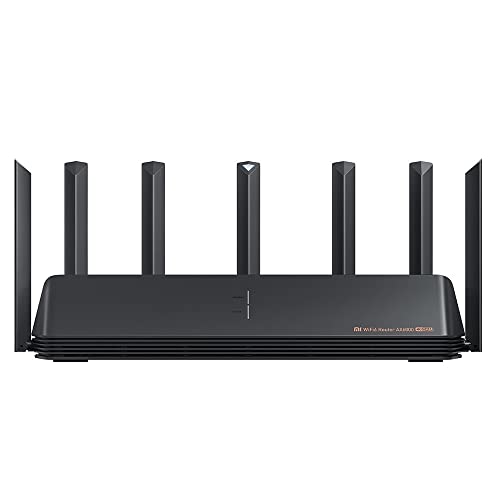
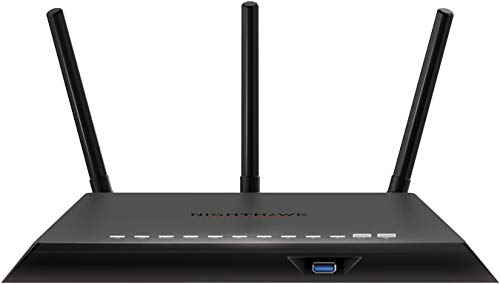
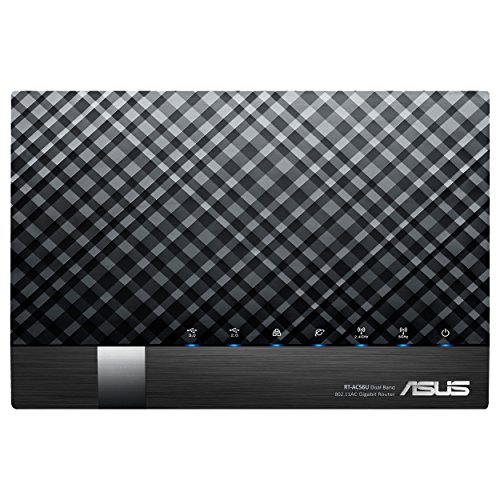
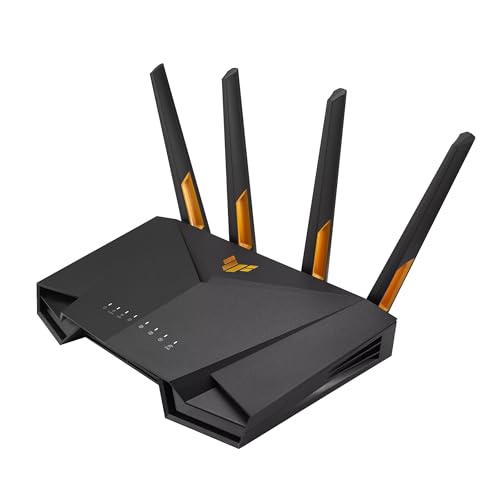
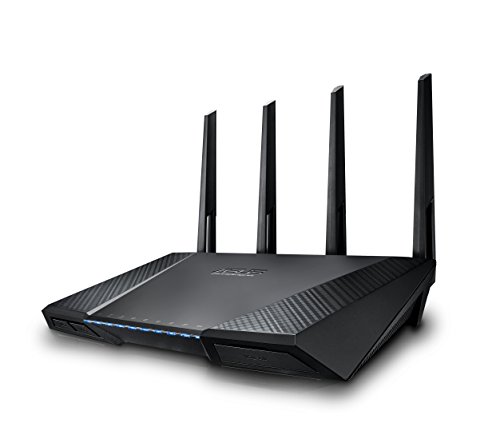
ASUS ROG Strix GS AX3000 Review | 77 Data compared

Avg. price:~£130Wi-Fi version:Wi-Fi 6 (802.11ax)Wi-Fi speed:3000 MbpsLAN port speeds:1 GbpsMesh Wi-Fi:yes

ASUS ROG Strix GS AX3000 Review: Compare 77 technical specifications and user reviews to see how this product ranks in the Routers category and whether it is worth buying.

7.9

Overall score

Score
7.9/ 10
✕
What it is
An overall evaluation of the router's quality, based on technical analyses and user reviews.
When it matters
When you need a quick reference to identify the best routers on the market.
Score distribution
â–¼
<55-66-77-88-99-10
Score components

90%

7.9

Technical Score

10%

8.3

User score

â–²Better than 81% of routers
7.9

Technical Score

Technical score
7.9/ 10
✕
What it is
An assessment of the router's technical performance, covering key areas such as Wi-Fi performance, wired connectivity, security, software features, coverage, and design.
When it matters
When you want to compare routers based on technical performance and available features.
Score distribution
â–¼
<55-66-77-88-99-10
Score components

26%

7.2

Wireless

20%

6.2

Ports

18%

9.0

Networking

14%

10

Security

12%

7.8

Hardware

10%

8.3

Management

â–²Better than 81% of routers
8.3

User score

User score
8.3/ 10
✕
What it is
A rating that combines user reviews and the total number of reviews received by the router.
When it matters
When you want to know how a router performs in daily use and how reliable it is for speed, coverage, and stability according to user feedback.
Score distribution
â–¼
<55-66-77-88-99-10
Score components

70%

8.9

User reviews

30%

7.0

Popularity

User score:
United Kingdom
amazon
4.4
(263)
amazon
4.6
(119)
amazon
4.4
(47)
United States
Amazon_logo.png
4.4
(275)
Amazon_logo.png
4.4
(116)

(Reviews last updated: May 2026)

â–²Better than 73% of routers
  • asus-rog-strix-gs-ax3000
  • asus-rog-strix-gs-ax3000
  • asus-rog-strix-gs-ax3000
  • asus-rog-strix-gs-ax3000
asus-rog-strix-gs-ax3000

Best rankings

Available: ranking among products currently available (including other versions of this product).All: ranking among all products in the database.
Loading...
Loading category ranking...

Verdict

The ASUS ROG Strix GS-AX3000 is a high-performance dual-band WiFi 6 gaming router offering aggregate speeds up to 3000 Mbps (2402 Mbps on 5GHz and 574 Mbps on 2.4GHz) powered by a 1.5 GHz tri-core processor, 512MB RAM, and 256MB flash memory. Key characteristics include 160 MHz channel support, a dedicated Gaming Port for hardware prioritisation, and ASUS Aura RGB lighting, while its primary pros are robust features like VPN Fusion for simultaneous VPN and standard connections, AiProtection Pro for lifetime security, and AiMesh compatibility for whole-home coverage. However, notable cons include the lack of multi-gigabit LAN/WAN ports, antennas that are non-removable, and its relatively large footprint compared to more compact mesh alternatives.

Technical Specifications of router ASUS ROG Strix GS AX3000

Technical Score
Technical score
7.9/ 10
✕
What it is
An assessment of the router's technical performance, covering key areas such as Wi-Fi performance, wired connectivity, security, software features, coverage, and design.
When it matters
When you want to compare routers based on technical performance and available features.
Score distribution
â–¼
<55-66-77-88-99-10
Score components:

26%

7.2

Wireless

20%

6.2

Ports

18%

9.0

Networking

14%

10

Security

12%

7.8

Hardware

10%

8.3

Management

7.9
ASUS ROG Strix GS AX3000 has a technical score of 7.9 points, which is higher than that of 81.4% of products in this category.
User score
User score
8.3/ 10
✕
What it is
A rating that combines user reviews and the total number of reviews received by the router.
When it matters
When you want to know how a router performs in daily use and how reliable it is for speed, coverage, and stability according to user feedback.
Score distribution
â–¼
<55-66-77-88-99-10
Score components

70%

8.9

User reviews

30%

7.0

Popularity

User score:
United Kingdom
amazon
4.4
(263)
amazon
4.6
(119)
amazon
4.4
(47)
United States
Amazon_logo.png
4.4
(275)
Amazon_logo.png
4.4
(116)

(Reviews last updated: May 2026)

8.3
ASUS ROG Strix GS AX3000 has a user score of 8.34 points, which is higher than that of 72.6% of products in this category.
Popularity
Popularity
7.0/ 10
✕
What it is
An indicator based on the number of reviews received by the router.
When it matters
When you prefer to choose a router reviewed and selected by many other buyers.
Score distribution
â–¼
<55-66-77-88-99-10
Popularity:
ASUS ROG Strix GS AX3000 has a popularity score of 7 points, which is higher than that of 53.4% of products in this category.
7.0
ASUS ROG Strix GS AX3000 has a popularity score of 7 points, which is higher than that of 53.4% of products in this category.
Ratio quality/price
Value for money
8.5/ 10
✕
What it is
An indicator that combines the router's overall rating with its cost.
When it matters
When you are looking for a router with a good balance between network performance, features, and price.
Score distribution
â–¼
<55-66-77-88-99-10
Score components:

60%

7.9

Overall score

40%

9.8

Price

8.5
ASUS ROG Strix GS AX3000 has a value-for-money score of 8.5 points, which is higher than that of 86% of products in this category.
Brand name
Asus
Wi-Fi version
Wi-Fi 6 (802.11ax)
Wi-Fi version
Wi-Fi 6 (802.11ax)
This router uses Wi-Fi Wi-Fi 6 (802.11ax), which is more advanced than 65% of routers and equal to 26.7% of routers.
Wi-Fi bands
2.4 GHz + 5 GHz
Wi-Fi bands
2.4 GHz + 5 GHz
This router supports 2.4 GHz + 5 GHz Wi-Fi bands, which are more versatile than 24.8% of routers and equal to 68.1% of routers.
Wi-Fi speed
3,000 Mbps
Wi-Fi speed
3,000 Mbps
This router delivers 3,000 Mbps Wi-Fi speed, which is higher than 72.7% of routers and equal to 4.8% of routers.
Channel widths supported
20 MHz + 40 MHz + 80 MHz + 160 MHz
Channel widths supported
20 MHz + 40 MHz + 80 MHz + 160 MHz
This router supports 20 MHz + 40 MHz + 80 MHz + 160 MHz channel width options, which is more than 72.8% of routers and the same as 24.8% of routers.
Show more
Wi-Fi security protocols
WPA3, WPA2, WPA
Wi-Fi security protocols
WPA3, WPA2, WPA
This router supports WPA3, WPA2, WPA Wi-Fi security protocols, which are more advanced than 87% of routers and equal to 13.1% of routers.
DoS protection
yes
DoS protection
yes
This router includes DoS protection. 12.8% of routers include DoS protection.
SPI intrusion protection
yes
SPI intrusion protection
yes
This router includes SPI-based intrusion protection. 6.1% of routers include SPI-based intrusion protection.
MAC address filtering
yes
MAC address filtering
yes
This router supports MAC address filtering. 2.2% of routers include MAC address filtering.
URL filter
yes
URL filter
yes
This router supports URL filtering. 3.4% of routers include URL filtering.
Show more
IPv6 support
yes
IPv6 support
yes
This router supports IPv6. 11.5% of routers are IPv6-ready.
Dynamic routing
yes
Dynamic routing
yes
This router supports dynamic routing. 47.8% of routers support dynamic routing.
Inter-VLAN routing
no
Inter-VLAN routing
no
This router does not support inter-VLAN routing. 23.5% of routers support inter-VLAN routing.
VLAN tagging
no
VLAN tagging
no
This router does not support VLAN tagging. 62% of routers include VLAN tagging.
QoS
yes
QoS
yes
This router includes QoS controls. 3.2% of routers include QoS controls.
Show more
N. of LAN ports
4
N. of LAN ports
4
This router has 4 LAN ports, which is more than 23.7% of routers and the same as 69.2% of routers.
LAN port speeds
1 Gbps
LAN port speeds
1 Gbps
This router offers 1 Gbps on its LAN ports, which is faster than 27.1% of routers and on par with 59.9% of routers.
N. of WAN ports
1
N. of WAN ports
1
This router has 1 WAN ports, which is more than 1% of routers and the same as 90.1% of routers.
N. of USB ports
1
N. of USB ports
1
This router has 1 USB ports, which is more than 39.5% of routers and the same as 39.5% of routers.
Power over Ethernet (PoE)
no
Power over Ethernet (PoE)
no
This router does not support Power over Ethernet (PoE). 0.5% of routers can be powered over Ethernet.
Show more
Management interface
Web UI, App
Management interface
Web UI, App
This router uses Web UI, App for management, which is more advanced than 33.4% of routers and equal to 57% of routers.
Firmware upgrade method
Web UI, App, Automatic
Firmware upgrade method
Web UI, App, Automatic
This router supports Web UI, App, Automatic firmware update methods, which are more convenient than 78.9% of routers and equal to 19.9% of routers.
Traffic monitoring
yes
Traffic monitoring
yes
This router includes traffic monitoring. 18.1% of routers include traffic monitoring.
Guest Wi-Fi network
yes
Guest Wi-Fi network
yes
This router offers a guest Wi‑Fi network. 8.6% of routers offer a guest Wi‑Fi network.
Captive portal
yes
Captive portal
yes
This router offers captive portal features. 76.7% of routers offer captive portal features.
Show more
CPU clock speed
3x 1.5 GHz
CPU clock speed
3x 1.5 GHz
This router runs at 3x1.5 GHz, which is faster than 72.3% of routers and on par with 3.8% of routers.
RAM capacity
512 MB
RAM capacity
512 MB
This router has 512 MB of RAM, which is more than 64.4% of routers and the same as 22.8% of routers.
Internal storage
0.25 GB
Internal storage
0.25 GB
This router has 0.25 GB of internal storage, which is more than 68.2% of routers and the same as 16.1% of routers.
Hardware acceleration
yes
Hardware acceleration
yes
This router offers hardware acceleration. 31.4% of routers offer hardware acceleration.
N. of external antennas
4
N. of external antennas
4
This router has 4 external antennas, which is more than 71.9% of routers and the same as 17.5% of routers.
Show more

ASUS ROG Strix GS AX3000 vs the average router

246810TotalWirelessSecurityNetworkingPortsManagementHardware
  • Stronger Wi-Fi security
    Wi-Fi security protocols
    WPA3, WPA2, WPA
    This router supports the Wi-Fi security protocols WPA3, WPA2, WPA, while the average router supports WPA2, WPA, WEP, WPS.
    WPA3, WPA2, WPA vs WPA2, WPA, WEP, WPS
  • Supports mesh Wi-Fi
    Mesh Wi-Fi
    yes
    This router supports mesh Wi-Fi, while the average router does not. 36.4% of routers support mesh Wi-Fi.
  • Supports automatic failover
    Automatic failover
    yes
    This router offers automatic failover, while the average router does not. 24.9% of routers offer automatic failover.
  • Supports OFDMA
    OFDMA support
    yes
    This router supports OFDMA, while the average router does not. 35% of routers support OFDMA.
  • 985,012 more NAT sessions
    NAT concurrent sessions
    1,000,000
    This router has more concurrent NAT sessions than the average router (1,000,000 vs 14,988). The average router supports 14,988 concurrent NAT sessions.
    1,000,000 vs 14,988
  • Newer Wi-Fi version
    Wi-Fi version
    Wi-Fi 6 (802.11ax)
    This router supports a newer Wi-Fi version than the average router (Wi-Fi 6 (802.11ax) vs Wi-Fi 5 (802.11ac)). The average router uses Wi-Fi Wi-Fi 5 (802.11ac).
    Wi-Fi 6 (802.11ax) vs Wi-Fi 5 (802.11ac)
  • 2.03x faster Wi-Fi speed
    Wi-Fi speed
    3,000 Mbps
    This router has a higher Wi-Fi speed than the average router (3000 Mbps vs 1475 Mbps). The average router reaches Wi-Fi speed of 1475 Mbps.
    3,000 Mbps vs 1,475 Mbps
  • Supports link aggregation (LACP)
    Link aggregation (LACP)
    yes
    This router supports link aggregation (LACP), while the average router does not. 14.7% of routers support link aggregation (LACP).
  • 8.9% better value for money
    ASUS ROG Strix GS AX3000 has better value for money than the average router (8.52 vs 7.8).
    8.52 vs 7.82
  • 4.2% higher user score
    User score
    8.3/ 10
    ✕
    What it is
    A rating that combines user reviews and the total number of reviews received by the router.
    When it matters
    When you want to know how a router performs in daily use and how reliable it is for speed, coverage, and stability according to user feedback.
    Score distribution
    â–¼
    â–¼
    <55-66-77-88-99-10
    ASUS ROG Strix GS AX3000
    the average router
    ASUS ROG Strix GS AX3000 has a higher user score than the average router (8.34 vs 8.000).
    8.34 vs 8
  • Supports mesh Wi-Fi
    Mesh Wi-Fi
    yes
    This router supports mesh Wi-Fi, while the average router does not. 36.4% of routers support mesh Wi-Fi.
  • Supports OFDMA
    OFDMA support
    yes
    This router supports OFDMA, while the average router does not. 35% of routers support OFDMA.
  • Newer Wi-Fi version
    Wi-Fi version
    Wi-Fi 6 (802.11ax)
    This router supports a newer Wi-Fi version than the average router (Wi-Fi 6 (802.11ax) vs Wi-Fi 5 (802.11ac)). The average router uses Wi-Fi Wi-Fi 5 (802.11ac).
    Wi-Fi 6 (802.11ax) vs Wi-Fi 5 (802.11ac)
  • 2.03x faster Wi-Fi speed
    Wi-Fi speed
    3,000 Mbps
    This router has a higher Wi-Fi speed than the average router (3000 Mbps vs 1475 Mbps). The average router reaches Wi-Fi speed of 1475 Mbps.
    3,000 Mbps vs 1,475 Mbps
  • Supports MU-MIMO
    MU-MIMO
    yes
    This router supports MU-MIMO, while the average router does not. 47.7% of routers support MU-MIMO.
  • Wider channel widths
    Channel widths supported
    20 MHz + 40 MHz + 80 MHz + 160 MHz
    This router has a higher supported channel width than the average router (20 MHz + 40 MHz + 80 MHz + 160 MHz vs 20 MHz + 40 MHz + 80 MHz). The average router supports channel width of 20 MHz + 40 MHz + 80 MHz.
    20 MHz + 40 MHz + 80 MHz + 160 MHz vs 20 MHz + 40 MHz + 80 MHz
  • Supports TWT
    Target Wake Time (TWT) support
    yes
    This router supports Target Wake Time (TWT), while the average router does not. 36.4% of routers support Target Wake Time (TWT).
  • Stronger Wi-Fi security
    Wi-Fi security protocols
    WPA3, WPA2, WPA
    This router supports the Wi-Fi security protocols WPA3, WPA2, WPA, while the average router supports WPA2, WPA, WEP, WPS.
    WPA3, WPA2, WPA vs WPA2, WPA, WEP, WPS
  • Supports automatic failover
    Automatic failover
    yes
    This router offers automatic failover, while the average router does not. 24.9% of routers offer automatic failover.
  • 985,012 more NAT sessions
    NAT concurrent sessions
    1,000,000
    This router has more concurrent NAT sessions than the average router (1,000,000 vs 14,988). The average router supports 14,988 concurrent NAT sessions.
    1,000,000 vs 14,988
  • Supports link aggregation (LACP)
    Link aggregation (LACP)
    yes
    This router supports link aggregation (LACP), while the average router does not. 14.7% of routers support link aggregation (LACP).
  • Supports captive portal
    Captive portal
    yes
    This router supports captive portal, while the average router does not. 23.5% of routers support captive portal.
  • 2x more RAM
    RAM capacity
    512 MB
    This router has more RAM than the average router (512 MB vs 256 MB). The average router has 256 MB of RAM.
    512 MB vs 256 MB
  • Suitable for gaming
    Suitable for gaming
    yes
    This router is designed for gaming, while the average router is not. 36.9% of routers are designed for gaming.
  • Higher CPU clock speed
    CPU clock speed
    3 x 1.5 GHz
    This router has a higher CPU clock speed than the average router (3x1.5 GHz vs 2x0.5 GHz). The average router has a CPU clock speed of 2x0.5 GHz.
    3x1.5 GHz vs 2x0.5 GHz
  • 2x more internal storage
    Internal storage
    0.25 GB
    This router has more internal storage than the average router (0.3 GB vs 0.1 GB). The average router offers 0.125 GB of internal storage.
    0.25 GB vs 0.125 GB
  • 2 more external antennas
    N. of external antennas
    4
    This router has more external antennas than the average router (4 vs 2). The average router has 2 external antennas.
    4 vs 2
  • 6 newer release date
    Release date
    2021
    This router was released more recently than the average router (2021 vs 2015). The average router release year is 2015.
    June 2021
    2021 vs 2015
  • No VLAN tagging
    VLAN tagging
    no
    This router does not support VLAN tagging, while the average router does. 61.9% of routers support VLAN tagging.
  • Less capable NAS services
    Built-in NAS services
    none
    This router includes none NAS services, while the average router includes SMB, FTP, time machine, NFS, web access.
    none vs SMB, FTP, time machine, NFS, web access
  • 9.9 W higher power consumption
    Power consumption
    18 W
    This router uses more power than the average router (18 W vs 8.1 W). The average router uses 8.1 W power.
    18 W vs 8.1 W
  • 35.5% narrower wireless coverage
    Wireless coverage
    120 m²
    This router has narrower wireless coverage than the average router (120 m² vs 186 m²). The average router offers wireless coverage of 186 m².
    120 m² vs 186 m²
  • 1 fewer spatial streams
    N. of spatial streams
    2
    This router has fewer spatial streams than the average router (2 vs 3). The average router has 3 spatial streams.
    2 vs 3
  • 121 mm thicker design
    Thickness
    166 mm
    This router is thicker than the average router (166 mm vs 45 mm). The average router is 45 mm thick.
    166 mm vs 45 mm
  • 66 mm wider width
    Width
    268 mm
    This router is wider than the average router (268 mm vs 202 mm). The average router is 202 mm wide.
    268 mm vs 202 mm
  • 44.4% more expensive
    ASUS ROG Strix GS AX3000 is more expensive than the average router (£130 vs £90).
    £130 vs £90
  • 44.4% more expensive
    ASUS ROG Strix GS AX3000 is more expensive than the average router (£130 vs £90).
    £130 vs £90
  • 35.5% narrower wireless coverage
    Wireless coverage
    120 m²
    This router has narrower wireless coverage than the average router (120 m² vs 186 m²). The average router offers wireless coverage of 186 m².
    120 m² vs 186 m²
  • 1 fewer spatial streams
    N. of spatial streams
    2
    This router has fewer spatial streams than the average router (2 vs 3). The average router has 3 spatial streams.
    2 vs 3
  • No VLAN tagging
    VLAN tagging
    no
    This router does not support VLAN tagging, while the average router does. 61.9% of routers support VLAN tagging.
  • Less capable NAS services
    Built-in NAS services
    none
    This router includes none NAS services, while the average router includes SMB, FTP, time machine, NFS, web access.
    none vs SMB, FTP, time machine, NFS, web access
  • 9.9 W higher power consumption
    Power consumption
    18 W
    This router uses more power than the average router (18 W vs 8.1 W). The average router uses 8.1 W power.
    18 W vs 8.1 W
  • 121 mm thicker design
    Thickness
    166 mm
    This router is thicker than the average router (166 mm vs 45 mm). The average router is 45 mm thick.
    166 mm vs 45 mm
  • 66 mm wider width
    Width
    268 mm
    This router is wider than the average router (268 mm vs 202 mm). The average router is 202 mm wide.
    268 mm vs 202 mm
  • 59.4% heavier weight
    Weight
    701.3 g
    This router is heavier than the average router (701.3 g vs 440 g). The average router weighs 440 g.
    701.3 g vs 440 g

Graphic comparison of ASUS ROG Strix GS AX3000 and other routers

No results found

Third-party reviews

(Reviews last updated: May 2026)

What customers like about ASUS ROG Strix GS AX3000?

  • Excellent overall wireless performance and reliable WiFi 6 speeds
  • Comprehensive feature set including robust AiMesh 2.0 support and system-wide guest networks
  • Free-for-life network security via AiProtection powered by Trend Micro
  • User-friendly web interface and highly functional ASUS Router mobile app
  • Dedicated gaming features like Gear Accelerator, VPN Fusion, and customizable AURA RGB lighting
  • Quick and intuitive setup process suitable for both beginners and enthusiasts

What customers dislike about ASUS ROG Strix GS AX3000?

  • Lacks a Multi-Gig (2.5Gbps or higher) Ethernet port for ultra-high-speed wired connections
  • No built-in Gamer VPN (such as WTFast) included, unlike some higher-tier ROG models
  • Performance as a Network Attached Storage (NAS) server is relatively underwhelming
  • Aesthetics may feel 'boring' to some as the main ROG logo does not illuminate
  • The 2.4GHz band can be significantly slower compared to the high-performing 5GHz band
  • Advanced parental controls can be rigid and somewhat vague in category definitions

Expert reviews

In-depth analysis and verdict from leading tech publications

D
dongknows.com
15/09/2021
Summary of the review
D
dongknows.com
03/09/2021
Summary of the review

Video reviews

Hands-on testing, unboxing, and real-world video evaluations

Compare ASUS ROG Strix GS AX3000 with other routers

1Product to compare no. 1
VS
2Product to compare no. 2
VS
3Product to compare no. 3 (optional)