Scored using Routers Methodology v3.0
Routers Methodology v3.0
Mathematical & Unbiased Scoring
Products in this category are scored under Frontum Routers Methodology v3.0: the technical score from the specifications is the base, and independent expert and video reviews (up to ±0.5 points), owner opinions (up to ±0.3) and best-of lists (up to +0.3) move it up or down.
Explore Routers Methodology v3.0

ASUS RT-AC68U review: 77 specs compared

Avg. price:~£140Wi-Fi version:Wi-Fi 5 (802.11ac)Wi-Fi speed:1900 MbpsLAN port speeds:1 GbpsMesh Wi-Fi:yes

ASUS RT-AC68U Review: Compare 77 technical specifications and 28 expert and video reviews to see how this product ranks in the Routers category and whether it is worth buying.
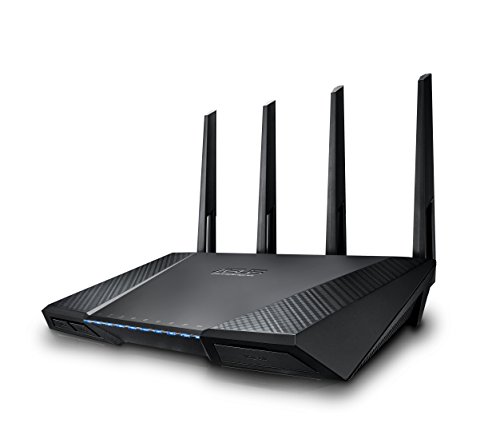
ASUS RT-AC68U
8.0/10

Overall score

Score
8.0/ 10
✕
What it is
Our main score for this model, 1–10. It combines specs, expert reviews, best-of lists and owners.
How we count it
Parts: Technical score 40%, Reviews score 25%, List score 25%, Sentiment score 10%
Marks: Each part gets a mark out of 10. For reviews, lists and owners, a typical model in this category gets about 8 and the best one gets 10.
No data yet: A part with no data shows "?". It counts as the mark of a weaker model in this category (4 in 5 models with data score higher). This way, models with reviews, lists and owners usually come out ahead.
Score distribution
â–¼
<55-66-77-88-99-10
Score components

40%

7.5

Technical score

25%

9.0

Reviews score

25%

?

List scoreNot enough data yet, so we use 7.5, the mark of a weaker model in this category

10%

9.1

Sentiment score

â–²Better than 83% of routers
8.6

Value for money

Value for money
8.6/ 10
✕
What it is
An indicator that combines the router's overall rating with its cost.
When it matters
When you are looking for a router with a good balance between network performance, features, and price.
Score distribution
â–¼
<55-66-77-88-99-10
Score components

70%

8.0

Overall score

30%

9.8

Price

â–²Better than 89%
7.5

Technical score

Technical score
7.5/ 10
✕
What it is
How good the specs are compared with the other models in this category, 1–10.
How we count it
Areas: We rate the specs in each area against the other models in this category.
Weighting: The areas that matter most to buyers count more. The shares are shown under Score components.
Share: The technical score is 40% of the overall score.
Score distribution
â–¼
<55-66-77-88-99-10
Score components

26%

6.2

Wireless

20%

6.3

Ports

18%

9.8

Networking

14%

9.1

Security

12%

6.8

Hardware

10%

8.2

Management

â–²Better than 64%
9.0

Reviews score

Reviews score
9.0/ 10
✕
What it is
Average grade from independent test sites, magazines and video reviewers, 1–10.
How we count it
Grades: Each review's own score is converted to 1–10; without one, we grade the review ourselves. Big test sites count more, short reviews half as much as full tests. A video review counts half.
Score: The average grade is 80% of the review mark; the number of reviews is the other 20% (1 review = 5, the typical number in this category = 8, the most-reviewed model = 10).
Enough data: With few reviews, the average grade is pulled toward the typical grade of this category. No reviews yet: 7.7 for now.
Share: Reviews count 25% of the overall score.
Score distribution
â–¼
<55-66-77-88-99-10

80%

8.9

Average grade

20%

9.5

Popularity

Grades by review (28)
16 reviews: 12 with a printed score, 4 estimated from the review. 12 video reviews, each counting half as much as a written test. Reviews count 25% of the overall score.
User ratings collected online are not part of this score.
★Better than 100%
?

List score

List score
7.5/ 10
✕
What it is
How often independent test sites, magazines and video reviewers put this model in their best-of lists for this category.
How we count it
Points: The model in the most lists of this category gets 10; the others get 8 to 10 in proportion. In no list yet: 7.5. Lists count 25% of the overall score.
Enough data: Every list counts, even a single one. With fewer than 5 best-of lists in the category, this part is left out.
Lists with this model (0)
Not in any best-of list yet, so this part counts as 7.5. Models in a list get 8 to 10.
Not in any best-of list yet
  • asus-rt-ac68u
  • asus-rt-ac68u
asus-rt-ac68u
asus-rt-ac68u
Where to buy
*As an Amazon Associate, we earn from qualifying purchases.
Best rankings
Available: ranking among products currently available (including other versions of this product).All: ranking among all products in the database.

What reviewers say about the ASUS RT-AC68U

Based on 10 · 12

Reviewers praise the polished firmware, strong speed and good range, but criticise the design and build, with reliability opinions split.
Praised
Mixed views
Criticised
Pick a topic to see who said what

What owners say about the ASUS RT-AC68U

Based on 191 owners sharing their experience in online comments

38%positive15%mixed47%negative

Owners value its long life, range, and features, but recurring wireless and firmware problems make reliability inconsistent.

What owners dislike

  • WiFi speeds fall or swing sharply, sometimes after about 20 GB of heavy transfers; a soft reboot does not help, but a full power-off restores speed.19
  • Failover often fails to switch when the modem loses internet while the cable stays connected, and load balancing causes slow pages and dropped connections.13
  • AiMesh nodes drop connections every hour or two, and devices stall when moving between nodes or after a node is moved away.11
  • Devices lose WiFi at random, sometimes needing a reboot, and some units stopped accepting WiFi connections on one band after a failed WAN port.9
  • The 2.4 GHz radio sometimes cuts out for seconds to minutes each day, or stops broadcasting while 5 GHz keeps working.9
  • Some owners cannot connect remotely: the OpenVPN client config file never finishes exporting, or the VPN times out and works only on the home network.8
  • Some newer Asus firmware versions made WiFi unstable, and 5 GHz sometimes stopped broadcasting; updates also fail to install, even when uploaded manually.8
  • Some homes get spotty signal on one side or upstairs, and signal can drop around 40 feet, so owners added extra units or mesh.8
  • The 5 GHz band sometimes stops broadcasting or disconnects devices, including after an update; a few reboots or restoring an old backup helped.5
  • USB tethering from Android phones often shows WAN not connected, and 4G dongles or modems fail to connect as a backup link.5

Points mentioned by at least 3 owners, most mentioned first.

Loading...
Loading category ranking...

Routers model ranking

Ranked #70 of 524 models in Routers (Overall score)

Technical Specifications of router ASUS RT-AC68U

Technical score
Technical score
7.5/ 10
✕
What it is
How good the specs are compared with the other models in this category, 1–10.
How we count it
Areas: We rate the specs in each area against the other models in this category.
Weighting: The areas that matter most to buyers count more. The shares are shown under Score components.
Share: The technical score is 40% of the overall score.
Score distribution
â–¼
<55-66-77-88-99-10
Score components:

26%

6.2

Wireless

20%

6.3

Ports

18%

9.8

Networking

14%

9.1

Security

12%

6.8

Hardware

10%

8.2

Management

7.5
Reviews score
9.0
List score
?
Value for money
Value for money
8.6/ 10
✕
What it is
An indicator that combines the router's overall rating with its cost.
When it matters
When you are looking for a router with a good balance between network performance, features, and price.
Score distribution
â–¼
<55-66-77-88-99-10
Score components:

70%

8.0

Overall score

30%

9.8

Price

8.6
Brand name
ASUS
Wi-Fi version
Wi-Fi 5 (802.11ac)
This router uses Wi-Fi 5 (802.11ac), which is more advanced than 35.2% of routers and equal to 23.1% of routers.
Wi-Fi bands
2.4 GHz + 5 GHz
This router supports 2.4 GHz + 5 GHz Wi-Fi bands, which are more versatile than 24.2% of routers and equal to 65.6% of routers.
Wi-Fi speed
1900 Mbps
This router delivers 1900 Mbps Wi-Fi speed, which is higher than 58.1% of routers and equal to 1.7% of routers.
Channel widths supported
20 MHz + 40 MHz + 80 MHz
This router supports 20 MHz + 40 MHz + 80 MHz channel width options, which is more than 36.5% of routers and the same as 29.9% of routers.
Show more
What reviewers say
Wi-Fi security protocols
WPA2, WPA, WEP, WPS
This router supports WPA2, WPA, WEP, WPS Wi-Fi security protocols, which are less advanced than 69.1% of routers and equal to 9.4% of routers.
DoS protection
yes
This router includes DoS protection. 9.8% of routers include DoS protection.
SPI intrusion protection
yes
This router includes SPI-based intrusion protection. 4.7% of routers include SPI-based intrusion protection.
MAC address filtering
yes
This router supports MAC address filtering. 1.7% of routers include MAC address filtering.
URL filter
yes
This router supports URL filtering. 2.6% of routers include URL filtering.
Show more
IPv6 support
yes
This router supports IPv6. 8.8% of routers are IPv6-ready.
Dynamic routing
yes
This router supports dynamic routing. 54% of routers support dynamic routing.
Inter-VLAN routing
no
This router does not support inter-VLAN routing. 24.5% of routers support inter-VLAN routing.
VLAN tagging
yes
This router supports VLAN tagging. 33.6% of routers include VLAN tagging.
QoS
yes
This router includes QoS controls. 2.4% of routers include QoS controls.
Show more
N. of LAN ports
4
This router has 4 LAN ports, which is more than 34.2% of routers and the same as 59.3% of routers.
LAN port speeds
1 Gbps
This router offers 1 Gbps on its LAN ports, which is faster than 25.7% of routers and on par with 56.1% of routers.
N. of WAN ports
1
This router has 1 WAN ports, which is more than 0.8% of routers and the same as 89.4% of routers.
N. of USB ports
2
This router has 2 USB ports, which is more than 81.9% of routers and the same as 17.9% of routers.
Power over Ethernet (PoE)
no
This router does not support Power over Ethernet (PoE). 1.7% of routers can be powered over Ethernet.
Show more
What reviewers say
Management interface
Web UI, App, CLI
This router uses Web UI, App, CLI for management, which is more advanced than 96.4% of routers and equal to 1.1% of routers.
ASUS Router app
Firmware upgrade method
Web UI, Automatic
This router supports Web UI, Automatic firmware update methods, which are more convenient than 30.2% of routers and equal to 31.9% of routers.
Traffic monitoring
yes
This router includes traffic monitoring. 13.9% of routers include traffic monitoring.
Guest Wi-Fi network
yes
This router offers a guest Wi‑Fi network. 7.3% of routers offer a guest Wi‑Fi network.
Captive portal
no
This router does not offer captive portal features. 22.4% of routers offer captive portal features.
Show more
What reviewers say
CPU clock speed
2x 1 GHz
This router runs at 2x1 GHz, which is faster than 49.1% of routers and on par with 7.3% of routers.
RAM capacity
256 MB
This router has 256 MB of RAM, which is more than 46.3% of routers and the same as 14.9% of routers.
Internal storage
0.125 GB
This router has 0.125 GB of internal storage, which is more than 47.9% of routers and the same as 23.8% of routers.
Hardware acceleration
yes
This router offers hardware acceleration. 24.9% of routers offer hardware acceleration.
N. of external antennas
3
This router has 3 external antennas, which is more than 57.9% of routers and the same as 11.8% of routers.
Show more
What reviewers say

ASUS RT-AC68U vs the average router

246810TotalWirelessSecurityNetworkingPortsManagementHardware
  • Supports mesh Wi-Fi
    This router supports mesh Wi-Fi, while the average router does not. 45.2% of routers support mesh Wi-Fi.
  • Supports automatic failover
    This router offers automatic failover, while the average router does not. 31.2% of routers offer automatic failover.
  • Better management tools
    This router uses the management interface Web UI, App, CLI, while the average router uses Web UI, App.
    ASUS Router app
    Web UI, App, CLI vs Web UI, App
  • 285,000 more NAT sessions
    This router has more concurrent NAT sessions than the average router (300,000 vs 15,000). The average router supports 15,000 concurrent NAT sessions.
    300,000 vs 15,000
  • 1 more USB ports
    This router has more USB ports than the average router (2 vs 1). The average router has 1 USB ports.
    2 vs 1
  • Supports dynamic routing
    This router supports dynamic routing, while the average router does not. 46.1% of routers support dynamic routing.
  • Suitable for gaming
    This router is designed for gaming, while the average router is not. 37.9% of routers are designed for gaming.
  • 16.9% higher review score
    Reviews score
    9.0/ 10
    ✕
    What it is
    Average grade from independent test sites, magazines and video reviewers, 1–10.
    How we count it
    Grades: Each review's own score is converted to 1–10; without one, we grade the review ourselves. Big test sites count more, short reviews half as much as full tests. A video review counts half.
    Score: The average grade is 80% of the review mark; the number of reviews is the other 20% (1 review = 5, the typical number in this category = 8, the most-reviewed model = 10).
    Enough data: With few reviews, the average grade is pulled toward the typical grade of this category. No reviews yet: 7.7 for now.
    Share: Reviews count 25% of the overall score.
    Score distribution
    â–¼
    <55-66-77-88-99-10

    80%

    8.9

    Average grade

    20%

    9.5

    Popularity

    Grades by review (28)
    16 reviews: 12 with a printed score, 4 estimated from the review. 12 video reviews, each counting half as much as a written test. Reviews count 25% of the overall score.
    User ratings collected online are not part of this score.
    9.0 vs 7.7
  • 16.7% higher sentiment score
    9.1 vs 7.8
  • 6.1% better value for money
    ASUS RT-AC68U has better value for money than the average router (8.57 vs 8.1).
    8.57 vs 8.08
  • Supports mesh Wi-Fi
    This router supports mesh Wi-Fi, while the average router does not. 45.2% of routers support mesh Wi-Fi.
  • 8.6% faster Wi-Fi speed
    This router has a higher Wi-Fi speed than the average router (1900 Mbps vs 1,750 Mbps). The average router reaches Wi-Fi speed of 1,750 Mbps.
    1,900 Mbps vs 1,750 Mbps
  • Stronger Wi-Fi security
    This router supports the Wi-Fi security protocols WPA2, WPA, WEP, WPS, while the average router supports WPA2, WPA/WPA2, WEP.
    WPA2, WPA, WEP, WPS vs WPA2, WPA/WPA2, WEP
  • Supports automatic failover
    This router offers automatic failover, while the average router does not. 31.2% of routers offer automatic failover.
  • 285,000 more NAT sessions
    This router has more concurrent NAT sessions than the average router (300,000 vs 15,000). The average router supports 15,000 concurrent NAT sessions.
    300,000 vs 15,000
  • Supports dynamic routing
    This router supports dynamic routing, while the average router does not. 46.1% of routers support dynamic routing.
  • 1 more USB ports
    This router has more USB ports than the average router (2 vs 1). The average router has 1 USB ports.
    2 vs 1
  • Better management tools
    This router uses the management interface Web UI, App, CLI, while the average router uses Web UI, App.
    ASUS Router app
    Web UI, App, CLI vs Web UI, App
  • More capable NAS services
    This router includes SMB, FTP, time machine, NFS NAS services, while the average router includes SMB, media server.
    SMB, FTP, time machine, NFS vs SMB, media server
  • Suitable for gaming
    This router is designed for gaming, while the average router is not. 37.9% of routers are designed for gaming.
  • Removable antennas
    This router has removable antennas, while the average router does not. 27.8% of routers have removable antennas.
  • 1 more external antennas
    This router has more external antennas than the average router (3 vs 2). The average router has 2 external antennas.
    3 vs 2
  • Limited firmware updates
    This router supports the firmware update methods Web UI, Automatic, while the average router supports Web UI, App, Automatic.
    Web UI, Automatic vs Web UI, App, Automatic
  • No MU-MIMO
    This router does not support MU-MIMO, while the average router does. 54% of routers support MU-MIMO.
  • 1.9 W higher power consumption
    This router uses more power than the average router (10 W vs 8.1 W). The average router uses 8.1 W power.
    10 W vs 8.1 W
  • 10.2% narrower wireless coverage
    This router has narrower wireless coverage than the average router (167 m² vs 186 m²). The average router offers wireless coverage of 186 m².
    167 m² vs 186 m²
  • 6 years older release date
    This router is an older model than the average router (2013 vs 2019). The average router release year is 2019.
    October 2013
    2013 vs 2019
  • 108.6 mm higher height
    This router is taller than the average router (160 mm vs 51.4 mm). The average router is 51.4 mm tall.
    160 mm vs 51.4 mm
  • 47.4% more expensive
    ASUS RT-AC68U is more expensive than the average router (£140 vs £95).
    £140 vs £95
  • 29.3 mm thicker design
    This router is thicker than the average router (83.3 mm vs 54 mm). The average router is 54 mm thick.
    83.3 mm vs 54 mm
  • 47.4% more expensive
    ASUS RT-AC68U is more expensive than the average router (£140 vs £95).
    £140 vs £95
  • No MU-MIMO
    This router does not support MU-MIMO, while the average router does. 54% of routers support MU-MIMO.
  • 10.2% narrower wireless coverage
    This router has narrower wireless coverage than the average router (167 m² vs 186 m²). The average router offers wireless coverage of 186 m².
    167 m² vs 186 m²
  • Limited firmware updates
    This router supports the firmware update methods Web UI, Automatic, while the average router supports Web UI, App, Automatic.
    Web UI, Automatic vs Web UI, App, Automatic
  • 1.9 W higher power consumption
    This router uses more power than the average router (10 W vs 8.1 W). The average router uses 8.1 W power.
    10 W vs 8.1 W
  • 6 years older release date
    This router is an older model than the average router (2013 vs 2019). The average router release year is 2019.
    October 2013
    2013 vs 2019
  • 108.6 mm higher height
    This router is taller than the average router (160 mm vs 51.4 mm). The average router is 51.4 mm tall.
    160 mm vs 51.4 mm
  • 29.3 mm thicker design
    This router is thicker than the average router (83.3 mm vs 54 mm). The average router is 54 mm thick.
    83.3 mm vs 54 mm

Video reviews

Hands-on testing, unboxing, and real-world video evaluations

9.5
Owl In Tech
≈ estimated
30/07/2020
Long-term test · six years of daily use
Verdict
ASUS RT AC68U is still highly recommended after six years of daily use, with reliable performance and solid router software.
8.0
NWH Productions
≈ estimated
11/07/2016
Hands-on review · unboxing and speed tests before and after
Verdict
ASUS RT AC68U is clearly faster and steadier than the old router, though results varied during testing.
9.0
Wanderer001 Reviews
≈ estimated
04/10/2015
Hands-on review · range, speed and interface tests
Verdict
ASUS RT AC68U is easy to set up and navigate, with deep advanced options, making it a good upgrade despite its higher price.
9.0
GECID Benchmarks
≈ estimated
31/07/2015
Hands-on review · wireless and LAN speed tests
Verdict
ASUS RT AC68U is recommended for home, office, school or small business use at its price.
9.0
Amoeba Man
≈ estimated
29/06/2015
Hands-on review · unboxing, web interface and Wi-Fi speed tests
Verdict
ASUS RT AC68U offers fast, stable Wi-Fi and a well-organised web interface, a clear upgrade over an older router.
9.0
Babbling Boolean
≈ estimated
01/03/2015
In-depth review · real-world performance, range and software features
Verdict
ASUS RT AC68U is very responsive with far-reaching coverage and is worth buying if you can afford the high price.
9.5
Lon.TV
≈ estimated
23/01/2015
Hands-on review · wireless, file sharing and feature tests
Verdict
ASUS RT AC68U is a high-performing, reasonably priced router that handles most families and small offices well.
9.0
PC419
≈ estimated
09/10/2019
Hands-on review · AiMesh setup and app tests
Verdict
ASUS RT AC68U is very easy to expand with mesh nodes and to manage through its app.
9.0
Sloppy's Pc Gaming & Benchmarks
≈ estimated
28/09/2014
First look · unboxing and first-day impressions
Verdict
ASUS RT AC68U impressed on day one with fast speeds and good reception, and the reviewer already recommends it.
9.5
RickTEG
≈ estimated
11/05/2014
Short review · technical overview and first look
Verdict
ASUS RT AC68U is a top-end router buyers should not regret, despite not being wall-mountable.
Not graded yet
Not graded yet

Third-party reviews

What customers like about ASUS RT-AC68U

  • Superior wireless performance and high throughput speeds on the 5GHz band
  • Extremely easy and intuitive setup process that can be completed in minutes
  • Highly functional and polished ASUSWRT user interface for both novices and power users
  • Robust feature set including AiMesh support, built-in VPN server/client, and Dual-WAN capability
  • Excellent reliability and long-term stability with minimal need for reboots
  • Strong build quality and an iconic, svelte physical design

What customers don't like about ASUS RT-AC68U

  • High price point relative to its age and some modern competitors
  • Integrated vertical stand is non-removable, which prevents wall-mounting
  • Middling 2.4GHz band performance that can trail behind some rival models
  • Hardware can run hot during intensive use
  • Lack of automatic firmware update notifications in earlier software versions
  • Limited to older Wi-Fi 5 (802.11ac) standards, missing out on the latest Wi-Fi 6/7 features

Verdict

The ASUS RT-AC68U is an AC1900 dual-band Wi-Fi 5 router that delivers combined data rates of up to 1900 Mbps, utilizing Broadcom TurboQAM technology to reach 600 Mbps on the 2.4 GHz band and 1300 Mbps on the 5 GHz band. Driven by a 1GHz dual-core processor and 256MB of RAM, it features three external detachable antennas, five Gigabit Ethernet ports (1 WAN, 4 LAN), and dual USB ports (1 x USB 3.0, 1 x USB 2.0). Main pros include its robust ASUSWRT interface, AiMesh support for mesh networking, and comprehensive security via AiProtection. However, notable cons include its non-removable vertical stand, lack of wall-mounting options, and aging hardware that may struggle with gigabit-speed ISP throughput or high-density modern smart home environments.

Compare ASUS RT-AC68U with other routers

1Product to compare no. 1
VS
2Product to compare no. 2
VS
3Product to compare no. 3 (optional)

Graphic comparison of ASUS RT-AC68U and other routers

No results found