Scored using Projectors Methodology v3.0
Projectors Methodology v3.0
Mathematical & Unbiased Scoring
Products in this category are scored under Frontum Projectors Methodology v3.0: the technical score from the specifications is the base, and independent expert and video reviews (up to ±0.5 points), owner opinions (up to ±0.3) and best-of lists (up to +0.3) move it up or down.
Explore Projectors Methodology v3.0

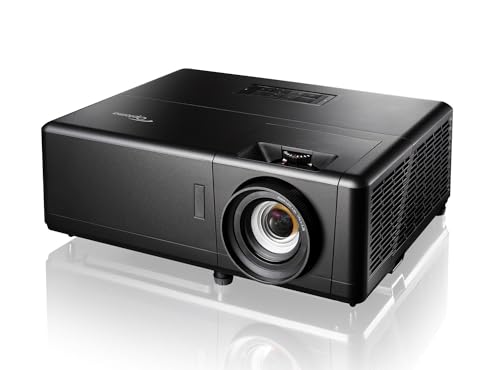
Optoma UHD35STx review: 86 specs compared

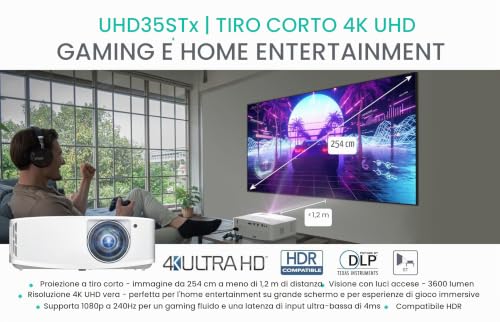
Avg. price:~£1,280Native panel resolution:3840x2160ANSI lumens:3600Throw ratio:0.5:1Lamp life:4000 hours

Optoma UHD35STx Review: Compare 86 technical specifications, 2 expert and video reviews and 1 best-of list to see how this product ranks in the Projectors category and whether it is worth buying.
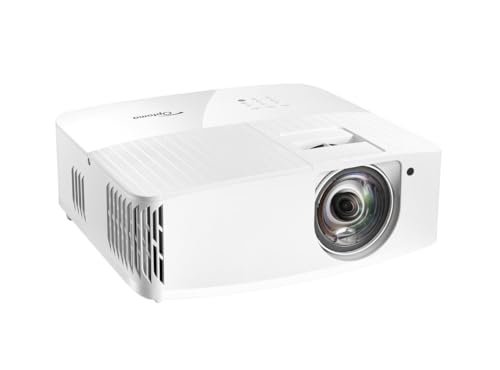
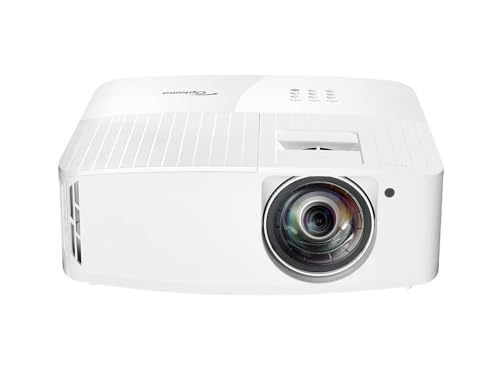
Optoma UHD35STx
7.4/10

Overall score

Score
7.4/ 10
✕
What it is
Our main score for this model, 1–10. It combines specs, best-of lists, expert reviews and owners.
How we count it
Parts: Technical score 35%, List score 30%, Reviews score 25%, Sentiment score 10%
Marks: Each part gets a mark out of 10. For reviews, lists and owners, a typical model in this category gets about 8 and the best one gets 10.
No data yet: A part with no data shows "?". It counts as the mark of a weaker model in this category (4 in 5 models with data score higher). This way, models with reviews, lists and owners usually come out ahead.
Score distribution
▼
<55-66-77-88-99-10
Score components

35%

7.5

Technical score

30%

7.5

List score

25%

7.5

Reviews score

10%

?

Sentiment scoreNot enough data yet, so we use 6.8, the mark of a weaker model in this category

▲Better than 70% of projectors
6.3

Value for money

Value for money
6.3/ 10
✕
What it is
An indicator that combines the projector's overall rating with its cost.
When it matters
When you are looking for a projector with a good balance between quality and price.
Score distribution
▼
<55-66-77-88-99-10
Score components

70%

7.4

Overall score

30%

3.8

Price

▼Worse than 71%
7.5

Technical score

Technical score
7.5/ 10
✕
What it is
How good the specs are compared with the other models in this category, 1–10.
How we count it
Areas: We rate the specs in each area against the other models in this category.
Weighting: The areas that matter most to buyers count more. The shares are shown under Score components.
Share: The technical score is 35% of the overall score.
Score distribution
▼
<55-66-77-88-99-10
Score components

42%

8.7

Image Quality

22%

7.5

Projection & Lens

12%

7.1

HDMI & Gaming

10%

5.6

Audio & Features

8%

5.6

Connectivity

6%

5.6

Design & Power

▲Better than 84%
7.5

Reviews score

Reviews score
7.5/ 10
✕
What it is
Average grade from independent test sites, magazines and video reviewers, 1–10.
How we count it
Grades: Each review's own score is converted to 1–10; without one, we grade the review ourselves. Big test sites count more, short reviews half as much as full tests. A video review counts half.
Score: The average grade is 80% of the review mark; the number of reviews is the other 20% (1 review = 5, the typical number in this category = 8, the most-reviewed model = 10).
Enough data: With few reviews, the average grade is pulled toward the typical grade of this category. No reviews yet: 7.8 for now.
Share: Reviews count 25% of the overall score.
Score distribution
▼
<55-66-77-88-99-10

7.5

Mark 8.1 is below the typical mark 8.2 of this category, so it cannot lift the score above the technical score

80%

8.6

Average grade

20%

6.1

Popularity

Grades by review (2)
1 review, its grade estimated from the review text. 1 video review, counting half as much as a written test. Reviews count 25% of the overall score.
User ratings collected online are not part of this score.
▼Worse than 55%
7.5

List score

List score
7.5/ 10
✕
What it is
How often independent test sites, magazines and video reviewers put this model in their best-of lists for this category.
How we count it
Points: The model in the most lists of this category gets 10; the others get 8 to 10 in proportion. In no list yet: 7.5. Lists count 30% of the overall score.
Enough data: Every list counts, even a single one. With fewer than 5 best-of lists in the category, this part is left out.
Lists with this model (1)
List score: in 1 of 107 lists (1%)
▲Better than 76%
  • optoma-uhd35stx
  • optoma-uhd35stx
  • optoma-uhd35stx
  • optoma-uhd35stx
  • optoma-uhd35stx
  • optoma-uhd35stx
  • optoma-uhd35stx
  • optoma-uhd35stx
  • optoma-uhd35stx
  • optoma-uhd35stx
  • optoma-uhd35stx
  • optoma-uhd35stx
optoma-uhd35stx
optoma-uhd35stx
optoma-uhd35stx
optoma-uhd35stx
optoma-uhd35stx
optoma-uhd35stx
optoma-uhd35stx
optoma-uhd35stx
optoma-uhd35stx
optoma-uhd35stx
optoma-uhd35stx
optoma-uhd35stx
Where to buy
*As an Amazon Associate, we earn from qualifying purchases.
Best rankings
Available: ranking among products currently available (including other versions of this product).All: ranking among all products in the database.
Loading...
Loading category ranking...

Technical Specifications of projector Optoma UHD35STx

Technical score
Technical score
7.5/ 10
✕
What it is
How good the specs are compared with the other models in this category, 1–10.
How we count it
Areas: We rate the specs in each area against the other models in this category.
Weighting: The areas that matter most to buyers count more. The shares are shown under Score components.
Share: The technical score is 35% of the overall score.
Score distribution
▼
<55-66-77-88-99-10
Score components:

42%

8.7

Image Quality

22%

7.5

Projection & Lens

12%

7.1

HDMI & Gaming

10%

5.6

Audio & Features

8%

5.6

Connectivity

6%

5.6

Design & Power

7.5
Reviews score
7.5
List score
7.5
Value for money
Value for money
6.3/ 10
✕
What it is
An indicator that combines the projector's overall rating with its cost.
When it matters
When you are looking for a projector with a good balance between quality and price.
Score distribution
▼
<55-66-77-88-99-10
Score components:

70%

7.4

Overall score

30%

3.8

Price

6.3
ANSI lumens
3,600
This projector reaches 3,600 ANSI lumens, brighter than 79.9% of projectors and equal to 2% of projectors.
Contrast ratio
1,000,000:1
This projector has a contrast ratio of 1000000:1, higher than 85.5% of projectors and equal to 1.9% of projectors.
Native panel resolution
3840x2160
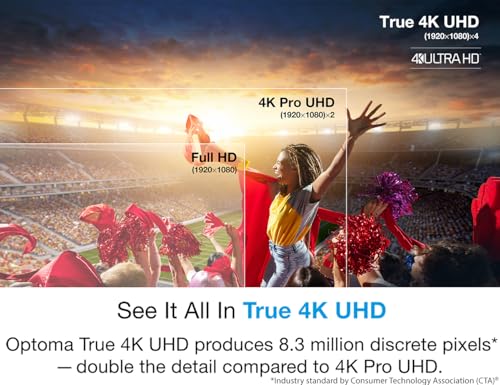
This projector uses a native resolution of 3840x2160, higher than 91.1% of projectors and equal to 4.7% of projectors.
Output resolution
3840x2160
This projector supports output resolution up to 3840x2160, higher than 71.2% of projectors and equal to 24.6% of projectors.
Projection technology
DLP
Show more
Throw ratio
0.5:1
Min throw distance
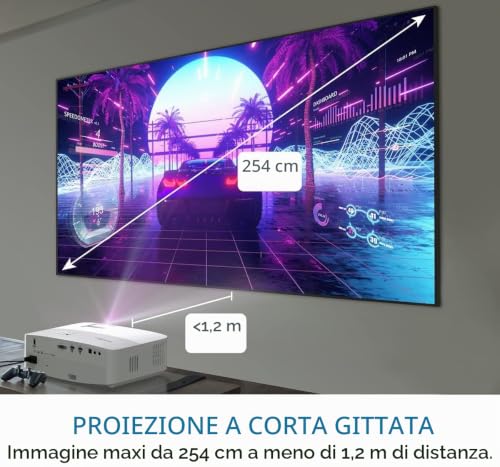
0.4 m
This projector needs a minimum throw distance of 0.4 m, shorter than 92.3% of projectors and equal to 1.1% of projectors.
Max projection size
300.53 inch
This projector supports projection sizes up to 300.53 inch, larger than 89.6% of projectors.
Zoom ratio
N/A
Motorized zoom
no
This projector does not have motorised zoom. 14.8% of projectors offer this.
Show more
Input lag
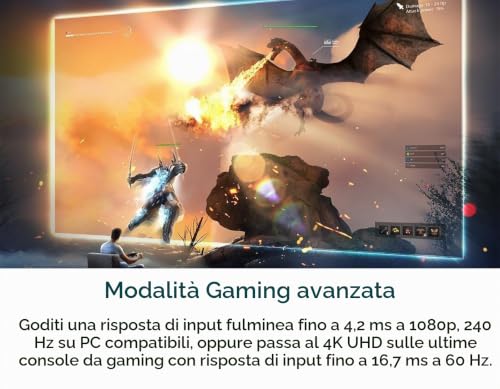
4.2 ms
This projector has input lag of 4.2 ms, lower than 92.2% of projectors and equal to 4.9% of projectors.
Auto low latency mode (ALLM)
no
This projector does not switch to low-latency mode automatically. 16.1% of projectors offer this.
Variable refresh rate (VRR)
no
This projector does not support variable refresh rate. 1.8% of projectors offer this.
HDMI version
2
This projector supports HDMI 2, more modern than 46.1% of projectors and equal to 35.9% of projectors.
Max HDMI bandwidth
18 Gbps
This projector supports HDMI bandwidth up to 18 Gbps, higher than 48.9% of projectors and equal to 39.7% of projectors.
Show more
N. of HDMI ports
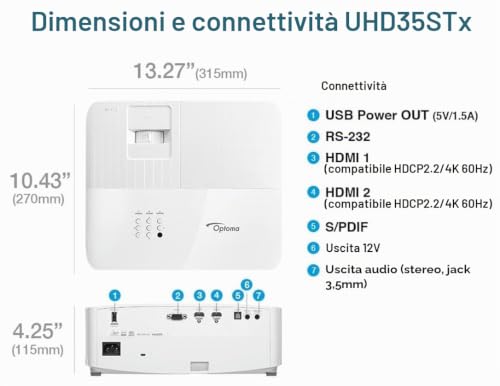
2
This projector has 2 HDMI port/s, more than 45.9% of projectors and equal to 47.3% of projectors.
Wi-Fi connectivity
no
This projector does not connect to Wi-Fi networks. 53.4% of projectors offer this.
Wi-Fi version
N/A
Bluetooth connectivity
no
This projector does not support Bluetooth. 50.7% of projectors offer this.
Bluetooth version
N/A
Show more
Smart TV features
no
This projector does not have built-in smart TV features. 43.9% of projectors offer this.
Operating system
none
Android OS
no
This projector does not run Android OS. 19.1% of projectors run Android OS.
Dedicated smartphone app
no
This projector does not come with a dedicated smartphone app. 36.8% of projectors come with a dedicated smartphone app.
Remote control
yes
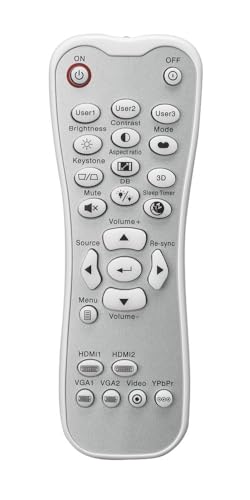
This projector includes a remote control. 1.5% of projectors offer this.
Show more
Light source type
lamp
This projector uses lamp light source technology, less advanced than 66.5% of projectors and equal to 33.5% of projectors.
Laser light source
no
This projector does not have a laser light source. 26.8% of projectors offer this.
Lamp life
4,000 hours
This projector offers lamp life of 4,000 hours, longer than 78.8% of projectors and equal to 9.6% of projectors.
Lamp life (eco mode)
10,000 hours
This projector offers eco-mode lamp life of 10,000 hours, longer than 64.8% of projectors and equal to 9.7% of projectors.
Operating power consumption
220 W
This projector uses 220 W of power, less than 50.8% of projectors and equal to 1.1% of projectors.
Show more

Optoma UHD35STx vs the average projector

246810TotalImage QualityProjection & LensHDMI & GamingConnectivityAudio & FeaturesDesign & Power
  • 63.6% brighter image
    This projector has higher ANSI lumens than the average projector (3,600 vs 2,200). The average projector has 2,200 ANSI lumens.
    3,600 vs 2,200
  • Higher contrast ratio
    This projector has a higher contrast ratio than the average projector (1000000:1 vs 10000:1). The average projector has 10000:1 of contrast ratio.
    1,000,000:1 vs 10,000:1
  • High native resolution
    This projector has a higher native panel resolution than the average projector (3840x2160 vs 1920x1080). The average projector has a native panel resolution of 1920x1080.
    3840x2160 vs 1920x1080
  • Higher output resolution
    This projector supports a higher output resolution than the average projector (3840x2160 vs 1920x1080). The average projector outputs at 1920x1080 resolution.
    3840x2160 vs 1920x1080
  • Supports curved-surface correction
    This projector corrects warping on curved surfaces, while the average projector does not. 5.5% of projectors offer this.
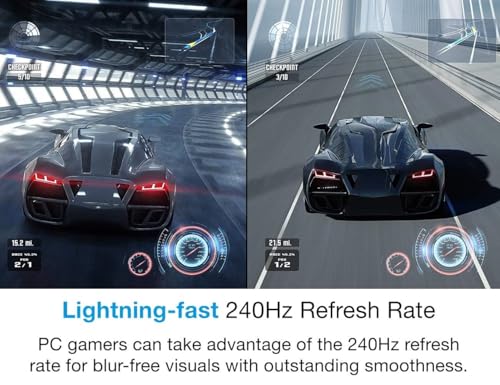
  • 2.82x higher refresh rate
    This projector has a higher refresh rate than the average projector (240 Hz vs 85 Hz). The average projector has 85 Hz of refresh rate.
    240 Hz vs 85 Hz
  • 50.53 inch larger image size
    This projector has a higher projection size than the average projector (300.5 inch vs 250 inch). The average projector has 250 inch of projection size.
    300.53 inch vs 250 inch
  • Supports pixel shifting
    This projector supports pixel shifting, while the average projector does not. 26.6% of projectors support pixel shifting.
  • 63.6% brighter image
    This projector has higher ANSI lumens than the average projector (3,600 vs 2,200). The average projector has 2,200 ANSI lumens.
    3,600 vs 2,200
  • Higher contrast ratio
    This projector has a higher contrast ratio than the average projector (1000000:1 vs 10000:1). The average projector has 10000:1 of contrast ratio.
    1,000,000:1 vs 10,000:1
  • High native resolution
    This projector has a higher native panel resolution than the average projector (3840x2160 vs 1920x1080). The average projector has a native panel resolution of 1920x1080.
    3840x2160 vs 1920x1080
  • Higher output resolution
    This projector supports a higher output resolution than the average projector (3840x2160 vs 1920x1080). The average projector outputs at 1920x1080 resolution.
    3840x2160 vs 1920x1080
  • 2.82x higher refresh rate
    This projector has a higher refresh rate than the average projector (240 Hz vs 85 Hz). The average projector has 85 Hz of refresh rate.
    240 Hz vs 85 Hz
  • Supports pixel shifting
    This projector supports pixel shifting, while the average projector does not. 26.6% of projectors support pixel shifting.
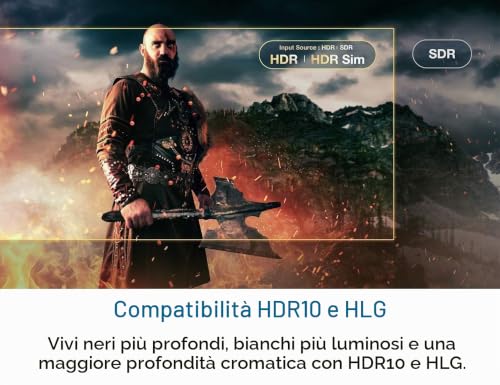
  • Supports HLG
    This projector supports HLG, while the average projector does not. 41.2% of projectors support HLG.
  • Supports curved-surface correction
    This projector corrects warping on curved surfaces, while the average projector does not. 5.5% of projectors offer this.
  • 50.53 inch larger image size
    This projector has a higher projection size than the average projector (300.5 inch vs 250 inch). The average projector has 250 inch of projection size.
    300.53 inch vs 250 inch
  • 0.61 m shorter throw distance
    This projector has a lower throw distance than the average projector (0.4 m vs 1 m). The average projector has 1.0055 m of throw distance.
    0.4 m vs 1.0055 m
  • 10 degrees more vertical correction
    This projector offers more vertical keystone correction than the average projector (40 degrees vs 30 degrees). The average projector offers vertical keystone correction of 30 degrees.
    40 degrees vs 30 degrees
  • 10 degrees more horizontal correction
    This projector offers more horizontal keystone correction than the average projector (40 degrees vs 30 degrees). The average projector offers horizontal keystone correction of 30 degrees.
    40 degrees vs 30 degrees
  • 22.8 ms lower input lag
    This projector has a lower input lag than the average projector (4.2 ms vs 27 ms). The average projector has 27 ms of input lag.
    4.2 ms vs 27 ms
  • Has S/PDIF output
    This projector supports S/PDIF output, while the average projector does not. 16.6% of projectors support S/PDIF output.
  • 7 dB quieter operation
    This projector has a lower audible noise than the average projector (24 dB vs 31 dB). The average projector has 31 dB of audible noise.
    24 dB vs 31 dB
  • 4 dB quieter eco mode
    This projector has a lower audible noise in eco mode than the average projector (24 dB vs 28 dB). The average projector has 28 dB of audible noise in eco mode.
    24 dB vs 28 dB
  • Basic light source
    This projector has Basic light source than the average projector (lamp vs laser). The average projector uses a laser light source.
    lamp vs laser
  • 2 bit lower color depth
    This projector has a lower color depth than the average projector (8 bit vs 10 bit). The average projector has 10 bit of color depth.
    8 bit vs 10 bit
  • Limited HDMI format
    This projector supports a less capable max HDMI input format than the average projector (1080p/240Hz vs 4K/120Hz). The average projector supports a max HDMI input format of 4K/120Hz.
    1080p/240Hz vs 4K/120Hz
  • No Wi-Fi connectivity
    This projector does not connect to Wi-Fi networks, while the average projector does. 53.4% of projectors offer this.
  • No Bluetooth connectivity
    This projector does not support Bluetooth, while the average projector does. 50.6% of projectors offer this.
  • 16,000 hours shorter lamp life
    This projector has a lower lamp life than the average projector (4,000 hours vs 20,000 hours). The average projector has 20,000 hours of lamp life.
    4,000 hours vs 20,000 hours
  • 10,000 hours shorter eco lamp life
    This projector has a lower lamp life in eco mode than the average projector (10,000 hours vs 20,000 hours). The average projector has 20,000 hours of lamp life in eco mode.
    10,000 hours vs 20,000 hours
  • 93.9% more expensive
    Optoma UHD35STx is more expensive than the average projector (£1,280 vs £660).
    £1,280 vs £660
  • 93.9% more expensive
    Optoma UHD35STx is more expensive than the average projector (£1,280 vs £660).
    £1,280 vs £660
  • 10.2% worse value for money
    Optoma UHD35STx has a lower value-for-money score than the average projector (6.31 vs 6.9).
    6.31 vs 6.95
  • 2 bit lower color depth
    This projector has a lower color depth than the average projector (8 bit vs 10 bit). The average projector has 10 bit of color depth.
    8 bit vs 10 bit
  • Limited HDMI format
    This projector supports a less capable max HDMI input format than the average projector (1080p/240Hz vs 4K/120Hz). The average projector supports a max HDMI input format of 4K/120Hz.
    1080p/240Hz vs 4K/120Hz
  • No Wi-Fi connectivity
    This projector does not connect to Wi-Fi networks, while the average projector does. 53.4% of projectors offer this.
  • No Bluetooth connectivity
    This projector does not support Bluetooth, while the average projector does. 50.6% of projectors offer this.
  • Basic light source
    This projector has Basic light source than the average projector (lamp vs laser). The average projector uses a laser light source.
    lamp vs laser
  • 16,000 hours shorter lamp life
    This projector has a lower lamp life than the average projector (4,000 hours vs 20,000 hours). The average projector has 20,000 hours of lamp life.
    4,000 hours vs 20,000 hours
  • 10,000 hours shorter eco lamp life
    This projector has a lower lamp life in eco mode than the average projector (10,000 hours vs 20,000 hours). The average projector has 20,000 hours of lamp life in eco mode.
    10,000 hours vs 20,000 hours

Video reviews

Hands-on testing, unboxing, and real-world video evaluations

9.0
Technotin
≈ estimated
21/03/2023
Hands-on review · unboxing, brightness and gaming tests
Verdict
Optoma UHD35STx is excellent for gaming and very bright, a clear recommendation, though its built-in speakers are weak.
Overview video
Overview video

Expert reviews

In-depth analysis and verdict from leading tech publications

9.0
goods.observer
≈ estimated
Not Dated
Hands-on test · Short-throw projector
Verdict
The Optoma UHD35STx is a short-throw 4K projector that fills 100 inches from about three feet away, which suits small rooms and console gaming.

Third-party reviews

What customers like about Optoma UHD35STx

  • A picture up to 300.53 inch fills a big wall.
  • 3600 ANSI lumens keeps the picture bright in a room with some light.
  • A 240 Hz refresh rate and 4.2 ms input lag make fast action smooth.
  • The fan is quiet at 24 dB, even in eco mode.
  • The native 3840x2160 panel gives true 4K detail.
  • Two HDMI ports let you connect a console and a player at the same time.

What customers don't like about Optoma UHD35STx

  • The lamp is rated for 4000 hours, so replacement comes sooner.
  • The 240 Hz refresh works with 1080p input, not 4K.
  • There is no Dolby Vision support, so only HDR10 is available.
  • There is no Wi-Fi and no smart TV apps.
  • Sound comes from one built-in 10 W speaker, with no stereo pair.

Verdict

Gamers who want a fast, large 4K picture will like the Optoma UHD35STx. It throws up to 300.53 inch with 3600 ANSI lumens, and a minimum throw of 0.4 m lets it sit close to the wall. A 240 Hz refresh rate and 4.2 ms of input lag keep fast action smooth and responsive. The fan runs at 24 dB, and eco mode is just as quiet. Pixel shifting and geometric warping are uncommon extras that help with picture quality and alignment. HDR10 is supported, but Dolby Vision is not. The lamp is rated for 4000 hours, so plan for a replacement after a few years of heavy use. It suits a home cinema fan or a serious gamer in a dark room who does not need smart TV apps or Wi-Fi.

Compare Optoma UHD35STx with other products in the Projectors category

1Product to compare no. 1
VS
2Product to compare no. 2
VS
3Product to compare no. 3 (optional)

Graphic comparison of Optoma UHD35STx and other products in the Projectors category

No results found