Which brands make the best gaming projectors?
The best gaming projector brands are as follows.
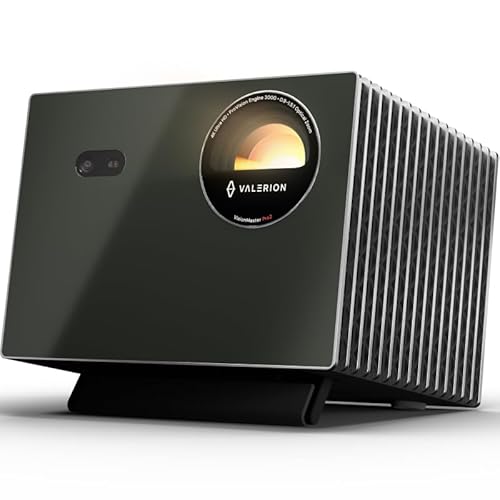
- Valerion (Average overall score: 8.7)
- XGIMI (Average overall score: 8.5)
- Leica (Average overall score: 8.5)
The chart below compares gaming projector brands by average overall score.
[horizontal-chart-08527592039467330078028442001077769303031370895544]
What makes a gaming projector suitable for gaming?
A gaming projector is suitable for gaming when it combines the following features:
- Low input lag: Fast response matters more than headline resolution if you want controls to feel clean and immediate.
- 120 Hz or 240 Hz support: Higher refresh rates help motion feel smoother, especially for competitive or fast-paced games.
- Sharp 1080p or 4K output: Good gaming projectors still need enough image detail for modern consoles and PC play on a large screen.
- Useful HDMI support: Reliable HDMI handling matters for consoles, PCs, HDR signals, and higher-refresh 1080p modes.
- Enough real brightness: A projector that is too dim becomes less enjoyable for everyday gaming, particularly outside of a fully dark room.
The best gaming projectors usually keep input lag around 4 to 16 ms, which is quick enough to feel responsive even for more demanding play. Once lag stays below about 20 ms, most players will consider it very good, while figures above roughly 30 ms start to feel more casual and less precise.
The exact number still depends on the resolution and refresh mode you use. Some projectors are fastest at 1080p and slower at 4K, so the most useful way to judge gaming speed is to look at the actual mode you plan to play in.
What refresh rates do gaming projectors support?
Gaming projectors usually start at 60 Hz, but the better ones often support 120 Hz at 1080p and some stronger models can push to 240 Hz for especially smooth motion. That is where gaming-focused models separate themselves from ordinary home-cinema projectors, which are more likely to prioritise film performance than fast refresh.
At 4K, 60 Hz is still the more common ceiling. So if high refresh matters more to you than absolute pixel count, a strong 1080p or pixel-shifted gaming mode can be the smarter choice than chasing 4K on paper alone.
What connections matter on a gaming projector?
The connections that matter most on a gaming projector are as follows:
- HDMI: This is the main connection for consoles and PCs, and better projectors handle higher-bandwidth 1080p or 4K gaming modes more cleanly.
- Audio output: A 3.5 mm jack, optical output, or HDMI ARC support matters if you want a headset, soundbar, or speaker setup with better sound than the built-in speakers.
- USB power or service ports: These can be useful for streaming sticks, accessories, or firmware tasks even though they are not the core gaming path.
- More than one input: Two HDMI ports make life much easier if you want a console and a streaming box connected at the same time.
How bright are gaming projectors?
Gaming projectors are usually bright enough for flexible everyday use, with many strong models landing around 2,000 to 3,500 ANSI lumens. That works well because gaming often happens in rooms that are not perfectly dark, and a big image quickly starts to look flat if the projector is too dim.
Still, brightness is only one part of gaming quality. A bright projector with high lag will feel worse than a slightly dimmer one with fast response, so the best gaming models balance output with speed rather than focusing on lumens alone.
How much do gaming projectors cost?
Gaming projectors usually begin around £600 and the cheaper end can still work well for straightforward 1080p play. The trade-off is that contrast, HDR quality, and installation flexibility are often weaker, so they are better for casual gaming than for a full cinema-plus-gaming setup.
\n
The most practical range for many buyers is around £860 to £1,700. This is where lower input lag, higher refresh rate support, and better HDMI handling become more common, which matters much more for responsive gaming than headline brightness alone.
\n
Above about £1,700 the extra money usually goes more into image quality than pure gaming advantage. You may get better blacks, cleaner 4K detail, and a more cinematic picture, but the jump in gameplay responsiveness is often smaller than the jump in price.