Which brands make the best mini portable vacuum cleaners?
The best mini portable vacuum cleaner brands by average overall score are as follows:
- URAQT (Average overall score: 7.8)
- Brigii (Average overall score: 7.5)
- Cecotec (Average overall score: 7.4)
The chart below compares the best mini portable vacuum cleaner brands by average overall score.
[horizontal-chart-16835835057538659423094908061222112127591971504161]
What weight and dimensions define a practical mini vacuum cleaner?
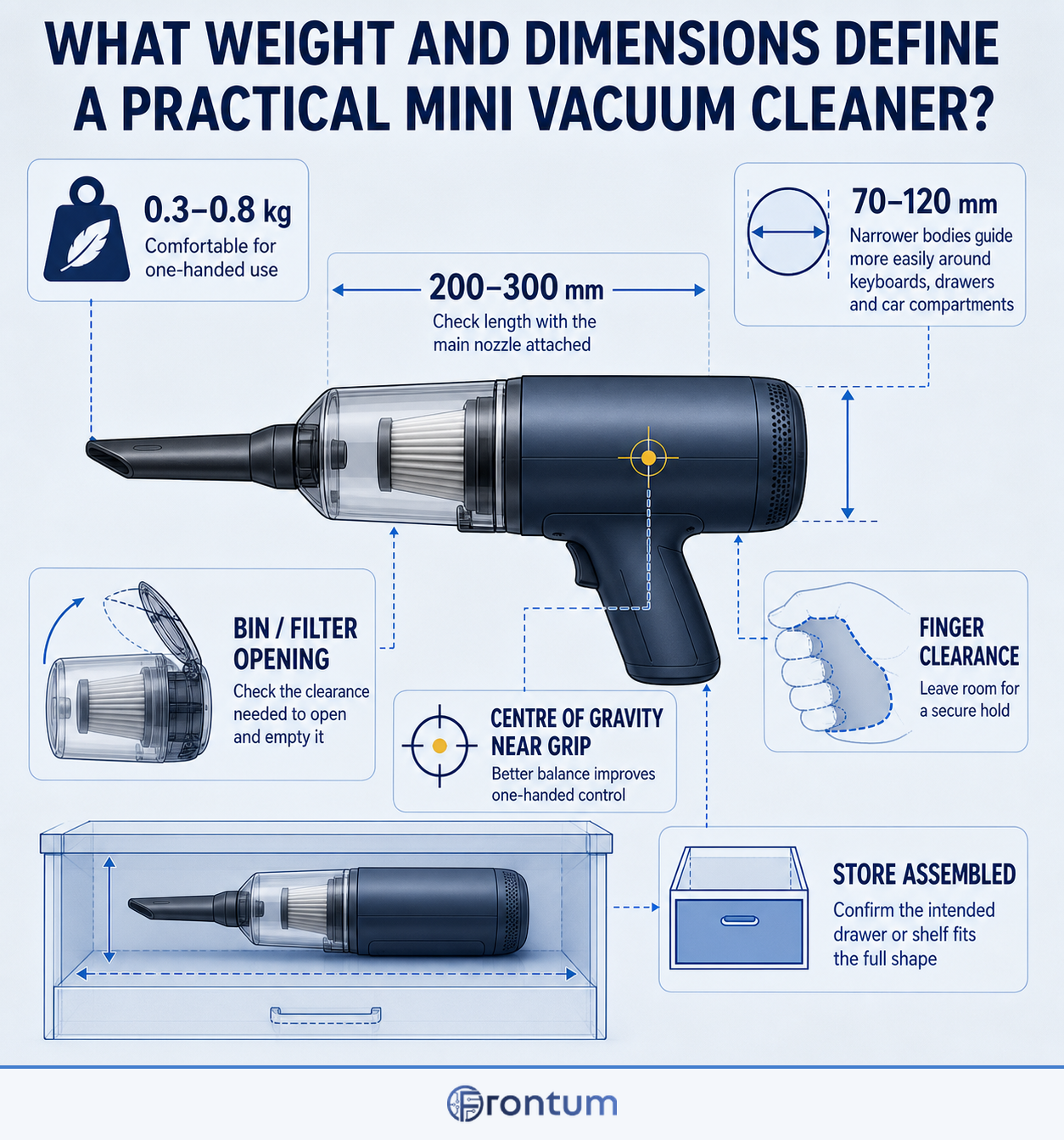
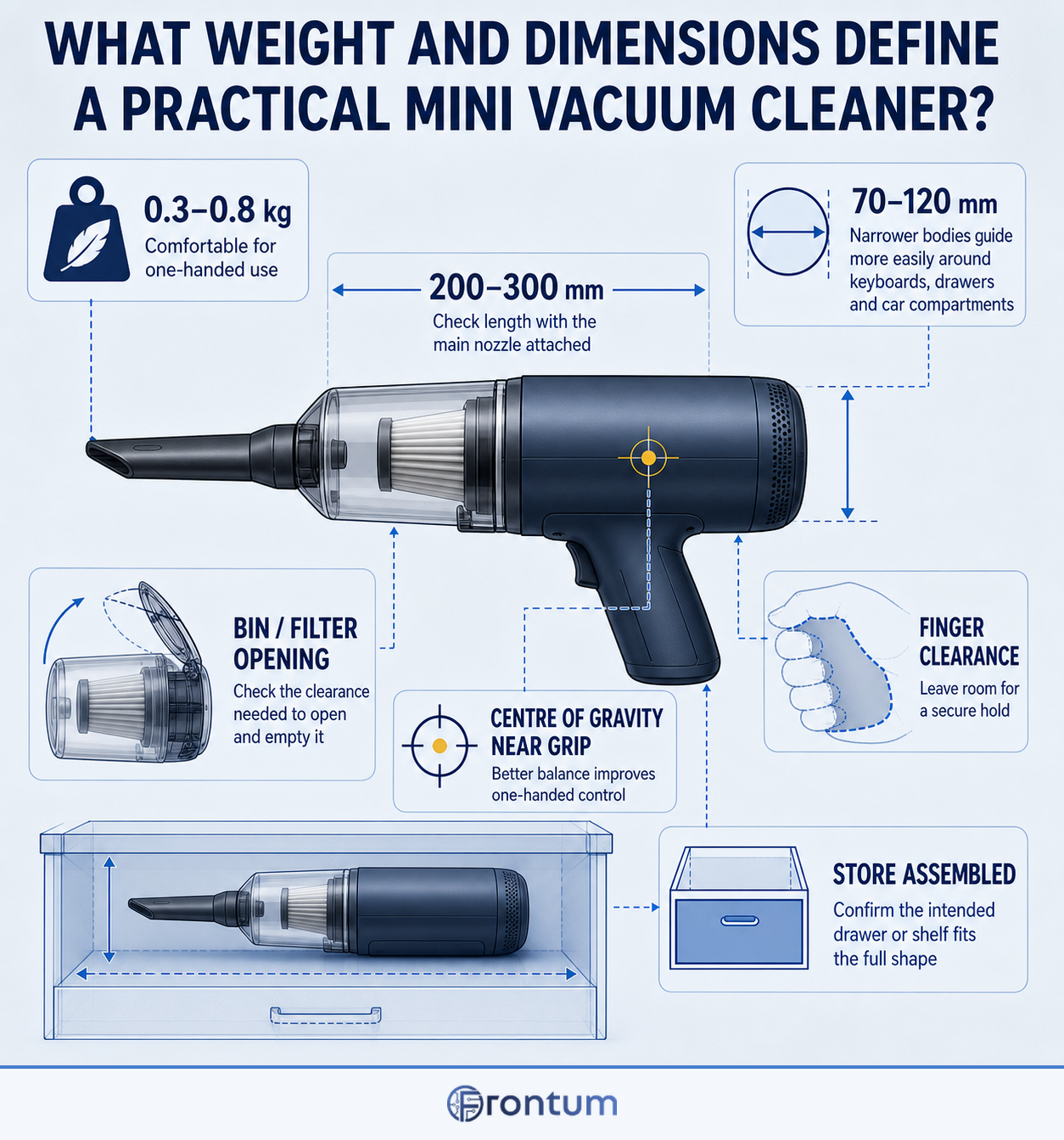
A practical mini vacuum cleaner weighs about 0.3–0.8 kg and is roughly 200–300 mm long, with a body narrow enough for one-handed use and small storage spaces. Dimensions should be checked with the main nozzle attached if the vacuum is stored assembled.
Cross-sections near 70–120 mm are easier to guide around keyboards, drawers and car compartments than a wide motor housing. A slightly longer body can still be convenient when it improves balance or places the exhaust away from loose dust.
Shape matters alongside measurements. The handle should leave room for the fingers, the centre of gravity should sit close to the grip, and the bin or filter must open without requiring clearance that the intended drawer or shelf cannot provide.
The chart below shows the weight distribution of mini portable vacuum cleaners.
[vertical-chart-01140938908965175344183533222183547544153144543655]
What dust capacity should a good mini vacuum cleaner have?
A good mini vacuum cleaner should hold about 0.1–0.3 L of dust. Around 0.1 L suits keyboard debris and a quick desk clean, while 0.2–0.3 L reduces interruptions during car, stair or upholstery work without making the body unnecessarily bulky.
Usable volume is limited by the maximum-fill line and filter position, not only the advertised shell capacity. A transparent bin and one-touch release help, but the mechanism should keep the filter attached and prevent fine dust from spilling onto the hand.
Does a smaller body reduce suction or runtime?
A smaller body can reduce suction or runtime because it leaves less room for the fan, battery, airflow path and cooling, but compact size does not automatically mean weak performance. Efficient motors and short sealed airways can preserve useful pickup in a small enclosure.
Battery volume creates the clearest compromise. A mini cordless vacuum commonly runs for about 15–25 minutes in a normal mode, while continuous maximum power may reduce that sharply; compare energy in Wh when available rather than voltage alone.
The dust path also becomes tighter. A small bin fills sooner, a compact pleated filter can clog quickly, and sharp turns in the airway increase resistance, so accessible cleaning and a visible fill line are essential.
Choose the smallest body that still meets the real job. Desks and crumbs need little capacity, whereas sand, pet hair and multiple car footwells justify a slightly larger vacuum with better cooling, longer runtime and a wider bin.
How much do mini portable vacuum cleaners cost?
Mini portable vacuum cleaners generally cost about £20-£130, with many useful desk and spot-cleaning models between roughly £30 and £70. Very cheap units can collect loose crumbs, but battery durability, filter availability and the fit of small plastic nozzles deserve close inspection.
Around £50-£100 can bring stronger sustained suction, better seals and a more convenient dock or USB charging system. Above roughly £100, expect a real advantage such as a replaceable battery, notably quieter operation or a powered upholstery tool rather than size alone.
The chart below shows the price distribution of mini portable vacuum cleaners.
[vertical-chart-10077634214053197810024181269002024211350466231655]
What should you consider while choosing a mini portable vacuum cleaner?
Before buying a mini portable vacuum cleaner, consider the following factors:
- Weight and complete dimensions: Aim for roughly 0.3–0.8 kg and check the length, width and depth with any nozzle left attached for storage. The grip, exhaust and bin release still need enough clearance in the intended drawer, shelf or car compartment.
- Suction and airflow: About 8–15 kPa is a useful starting range for light debris when methods are comparable. A well-sealed airway and suitable nozzle matter more than motor watts, and the smallest opening may not provide enough airflow for upholstery.
- Runtime and charging: Prefer at least 15–25 minutes in normal use and a recharge time near four hours or less. Confirm whether USB charging supports a common cable and adequate power rather than relying on a slow proprietary connection.
- Bin capacity and emptying: Around 0.1–0.3 L is practical for a genuinely compact vacuum. Choose transparent walls, a visible fill line and a release that keeps the filter secure while preventing debris from falling back out.
- Filtration and cleaning: A washable pre-filter lowers running cost, but compact filters often clog quickly and must dry fully after washing. The filter and airway should be removable without small screws or fragile clips.
- Useful attachments: A crevice nozzle and soft brush cover desks, vents, drawers and light car cleaning. Add an upholstery tool only if the vacuum has enough airflow, and avoid bundles whose adapters make the assembled machine larger than necessary.
- Battery and replacement support: Battery energy in Wh is more informative than voltage alone when it is published. Check whether filters, charging cables and batteries are sold separately, because a tiny vacuum is poor value if one worn part cannot be replaced.