Are Dyson portable vacuum cleaners good?
Dyson portable vacuum cleaners are very good for strong car, stair and upholstery pickup, especially when a powered mini tool is needed for pet hair, but they are less attractive if low weight, fast charging or a removable battery is the priority.
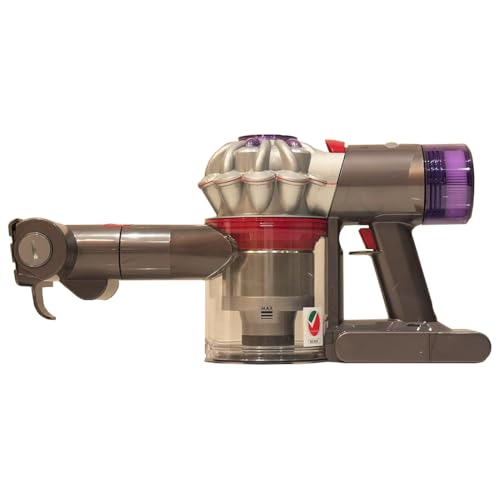
Dyson portable vacuum cleaners use the V8 digital-motor and cyclone platform to combine roughly 115 AW of maximum suction with sealed fine-particle filtration and a 0.54 L hygienic bin. The broad accessory interface and motorized tool give the system more cleaning depth than a basic suction-only hand vacuum.
Dyson portable vacuum cleaners are relatively heavy at about 1.9 kg, take roughly five hours to charge and provide only a short maximum-power session. Choose them for concentrated high-performance work; a lighter Shark WANDVAC or cheaper conventional handheld is easier for frequent crumbs and brief daily touch-ups.
What are the main advantages of Dyson portable vacuum cleaners?
The main advantages of Dyson portable vacuum cleaners are the following:
- Strong maximum pickup: The V8 handheld platform reaches about 115 AW and is rated around 21 kPa under its stated high-power conditions. That gives it unusual headroom for sand, carpet fibres and embedded debris compared with many compact hand vacuums.
- Effective powered tools: A mini motorized brush agitates car seats, stairs, pet beds and upholstery instead of relying on suction alone. The crevice, combination and soft-brush tools extend the same body to narrow gaps and delicate surfaces.
- Useful low-power runtime: Up to roughly 50 minutes is available in the least demanding configuration. That is enough for several spot-cleaning tasks when maximum mode is reserved for stubborn areas.
- Cyclonic separation and filtration: The multi-stage cyclone and sealed filter path help keep fine dust away from the exhaust. Washable filters reduce consumable cost, provided they are cleaned on schedule and dried completely.
- Large handheld bin and clean release: A 0.54 L transparent bin holds substantially more than many slim handhelds. The one-action dirt release limits contact with compacted debris and makes the fill level easy to monitor.
What are the main disadvantages of Dyson portable vacuum cleaners?
The main disadvantages of Dyson portable vacuum cleaners are the following:
- High working weight: The V8 Car+Boat body is about 1.9 kg before the user accounts for prolonged one-handed leverage. It is powerful but much heavier than slim handhelds around 0.6–0.8 kg.
- Short maximum-power runtime: Continuous high-output operation is only about five minutes. The much longer headline runtime applies to a lower-demand configuration, so boost cannot be treated as the normal mode.
- Slow charging: A full recharge takes roughly five hours. That is less convenient than handhelds that restore a shorter battery in two to four hours, especially when several demanding jobs occur on the same day.
- Fixed battery and no dock: The battery is not designed for quick user swapping, and the handheld package does not include a wall-mounted charging dock. Owners cannot simply insert a second pack to extend a session and must plan storage separately.
- Premium price: A typical price near £220 is high for a portable vacuum. The value depends on using the powered tool, strong suction and filtration; buyers needing only crumbs or desk dust can spend much less.
Who makes Dyson portable vacuum cleaners?
Dyson portable vacuum cleaners are made by Dyson, the technology company founded by British engineer James Dyson. The business grew from his work on cyclonic bagless vacuum cleaning and launched the DC01 in 1993, establishing the motor, airflow and dust-separation focus that still shapes its cordless products.
Dyson is headquartered globally at St James Power Station in Singapore and retains major engineering and research operations in the United Kingdom and Asia. Its digital motors are closely tied to Singapore manufacturing, while the company develops machines through engineering teams spanning motors, batteries, filtration, acoustics and fluid dynamics.
Dyson portable vacuum cleaners therefore use a platform designed within Dyson’s broader cordless-vacuum system rather than a generic private-label handheld. The V8-based Car+Boat shares genuine tools and service parts with parts of the wider V8 family, although buyers must still confirm compatibility for the exact machine and region.
How much do Dyson portable vacuum cleaners cost?
Dyson portable vacuum cleaners generally sit around £200-£300, with the current V8-based handheld near £220. That is a premium position beside many conventional handhelds, reflecting the stronger motor, sealed filtration, larger bin and powered mini tool rather than compactness alone.
The purchase makes most sense when upholstery, pet hair and car carpet justify those capabilities. Also budget for genuine filters, tools or a future service battery, and compare the exact package because a missing dock, storage bag or specialized nozzle can affect the real value.
How do Dyson portable vacuum cleaners compare with Shark models?
Dyson portable vacuum cleaners generally outperform Shark handhelds in peak suction, bin capacity and long low-power runtime, while Shark models are usually lighter, quicker to charge and substantially cheaper. The better choice depends on whether deep fabric pickup or everyday convenience matters more.
Dyson’s V8 Car+Boat provides about 115 AW, a 0.54 L bin, up to 50 minutes in its lowest-demand configuration and a motorized upholstery tool, but weighs roughly 1.9 kg and takes about five hours to charge. It suits pet hair, sand and larger car-cleaning jobs where strong pickup justifies the weight.
Shark WANDVAC models can weigh around 0.6–0.7 kg, charge in roughly three hours and store neatly, but their small 0.1 L bins and shorter high-output sessions demand more interruptions. Shark’s larger CH950-type handhelds add a 0.45 L bin and pet tool at a lower price; choose Dyson for maximum cleaning depth and Shark for lighter, faster spot cleaning.
What should you check before buying a Dyson portable vacuum cleaner?
Before buying a Dyson portable vacuum cleaner, check the following factors:
- Exact model and tool package: Confirm that the machine is the V8-based Car+Boat handheld and inspect the included mini motorized, crevice, combination and soft-brush tools. Retail bundles vary, and the powered tool is central to the value for pet hair and upholstery.
- Suction mode and test basis: The roughly 115 AW maximum figure applies to the high-output condition, not every setting. Compare equivalent AW claims and expect the strongest mode to consume the battery much faster.
- Runtime by mode: Up to about 50 minutes describes the least demanding configuration, while continuous maximum power is closer to five minutes. Judge whether the normal mode can complete the job and reserve maximum output for stubborn patches.
- Weight and handling: The body weighs about 1.9 kg, so test wrist comfort and reach around seats or stairs. A flexible hose can improve access, but it does not reduce the weight carried between areas.
- Charging and battery service: A full recharge takes roughly five hours and the pack is not designed for quick swapping. Check battery-service cost, local availability and warranty terms before treating the machine as a long-term purchase.
- Bin and filtration: The 0.54 L transparent bin is generous for a handheld, and sealed washable filtration suits fine dust. Empty at the fill line and allow both filters to dry completely after their recommended monthly wash.
- Storage, parts and compatibility: The handheld package lacks a wall dock, so plan a stable charging place for the body and tools. Use the exact serial or model reference when ordering V8 parts because not every accessory or charger fits every regional variant.