Scored using Motherboards Methodology v3.0
Motherboards Methodology v3.0
Mathematical & Unbiased Scoring
Products in this category are scored under Frontum Motherboards Methodology v3.0: the technical score from the specifications is the base, and independent expert and video reviews (up to ±0.5 points), owner opinions (up to ±0.3) and best-of lists (up to +0.3) move it up or down.
Explore Motherboards Methodology v3.0

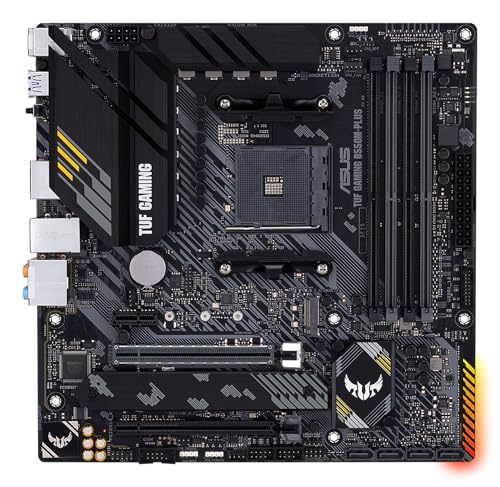
ASUS TUF Gaming B550M-Plus review: 109 specs compared

Avg. price:~£110CPU socket:AM4Chipset:AMD B550Form factor:microATX

ASUS TUF Gaming B550M-Plus Review: Compare 109 technical specifications, 12 expert and video reviews and 3 best-of lists to see how this product ranks in the Motherboards category and whether it is worth buying.
ASUS TUF Gaming B550M-Plus
7.9/10

Overall score

Score
7.9/ 10
✕
What it is
Our main score for this model, 1–10. It combines specs, expert reviews, best-of lists, owners and ratings from across the web.
How we count it
Parts: Technical score 40%, Reviews score 20%, List score 20%, Sentiment score 10%, User score 10%
Marks: Each part gets a mark out of 10. For reviews, lists and owners, a typical model in this category gets about 8 and the best one gets 10.
No data yet: A part with no data shows "?". It counts as the mark of a weaker model in this category (4 in 5 models with data score higher). This way, models with reviews, lists and owners usually come out ahead.
Score distribution
▼
<55-66-77-88-99-10
Score components

40%

6.5

Technical score

20%

8.5

Reviews score

20%

8.7

List score

10%

9.4

Sentiment score

10%

9.5

User score

▲Better than 84% of motherboards
8.5

Value for money

Value for money
8.5/ 10
✕
What it is
An indicator that combines the motherboard's overall rating with its cost.
When it matters
When you are looking for a motherboard that offers a strong balance of features, performance, and price.
Score distribution
▼
<55-66-77-88-99-10
Score components

70%

7.9

Overall score

30%

9.9

Price

★Better than 93%
6.5

Technical score

Technical score
6.5/ 10
✕
What it is
How good the specs are compared with the other models in this category, 1–10.
How we count it
Areas: We rate the specs in each area against the other models in this category.
Weighting: The areas that matter most to buyers count more. The shares are shown under Score components.
Share: The technical score is 40% of the overall score.
Score distribution
▼
<55-66-77-88-99-10
Score components

19%

6.9

Memory

16%

7.9

Platform

16%

5.4

Storage

15%

8.0

Network

13%

4.8

Ports

8%

4.5

Expansion

8%

6.1

Power & Cooling

5%

7.7

Audio

▲Better than 57%
8.5

Reviews score

Reviews score
8.5/ 10
✕
What it is
Average grade from independent test sites, magazines and video reviewers, 1–10.
How we count it
Grades: Each review's own score is converted to 1–10; without one, we grade the review ourselves. Big test sites count more, short reviews half as much as full tests. A video review counts half.
Score: The average grade is 80% of the review mark; the number of reviews is the other 20% (1 review = 5, the typical number in this category = 8, the most-reviewed model = 10).
Enough data: With few reviews, the average grade is pulled toward the typical grade of this category. No reviews yet: 7.8 for now.
Share: Reviews count 20% of the overall score.
Score distribution
▼
<55-66-77-88-99-10

80%

8.2

Average grade

20%

9.3

Popularity

Grades by review (12)
6 reviews: 3 with a printed score, 3 estimated from the review. 6 video reviews, each counting half as much as a written test. Reviews count 20% of the overall score.
Ratings from across the web count in the User score, not in this score.
▲Better than 68%
9.5

User score

User score
9.5/ 10
✕
What it is
How happy buyers are with this model, based on ratings from across the web.
How we count it
Enough data: A model needs at least 1 rating from across the web. Without one, it counts as 7.9, the mark of a weaker rated model in this category.
Share: User score counts 10% of the overall score.
Score distribution
▼
<55-66-77-88-99-10

70%

9.3

Rating

30%

10

Popularity

★Better than 99%
8.7

List score

List score
8.7/ 10
✕
What it is
How often independent test sites, magazines and video reviewers put this model in their best-of lists for this category.
How we count it
Points: The model in the most lists of this category gets 10; the others get 8 to 10 in proportion. In no list yet: 7.5. Lists count 20% of the overall score.
Enough data: Every list counts, even a single one. With fewer than 5 best-of lists in the category, this part is left out.
Lists with this model (3)
List score: in 3 of 65 lists (5%)
★Better than 98%
  • asus-tuf-gaming-b550m-plus
  • asus-tuf-gaming-b550m-plus
  • asus-tuf-gaming-b550m-plus
  • asus-tuf-gaming-b550m-plus
  • asus-tuf-gaming-b550m-plus
  • asus-tuf-gaming-b550m-plus
asus-tuf-gaming-b550m-plus
Where to buy
*As an Amazon Associate, we earn from qualifying purchases.

What reviewers say about the ASUS TUF Gaming B550M-Plus

Based on 6 · 6

Reviewers like the networking and performance, but criticise the BIOS, ports, build and audio, and split on cooling.
Praised
Mixed views
Criticised
Pick a topic to see who said what
Loading...
Loading category ranking...

Technical Specifications of motherboard ASUS TUF Gaming B550M-Plus

Technical score
Technical score
6.5/ 10
✕
What it is
How good the specs are compared with the other models in this category, 1–10.
How we count it
Areas: We rate the specs in each area against the other models in this category.
Weighting: The areas that matter most to buyers count more. The shares are shown under Score components.
Share: The technical score is 40% of the overall score.
Score distribution
▼
<55-66-77-88-99-10
Score components:

19%

6.9

Memory

16%

7.9

Platform

16%

5.4

Storage

15%

8.0

Network

13%

4.8

Ports

8%

4.5

Expansion

8%

6.1

Power & Cooling

5%

7.7

Audio

6.5
Reviews score
8.5
User score
9.5
List score
8.7
Value for money
Value for money
8.5/ 10
✕
What it is
An indicator that combines the motherboard's overall rating with its cost.
When it matters
When you are looking for a motherboard that offers a strong balance of features, performance, and price.
Score distribution
▼
<55-66-77-88-99-10
Score components:

70%

7.9

Overall score

30%

9.9

Price

8.5
CPU socket
AM4
This motherboard uses AM4, which is more up-to-date than 38.2% of Motherboards and the same as 13.3% of Motherboards.
CPU platform
AMD
Chipset
AMD B550
This motherboard uses AMD B550, which is more capable than 49.9% of Motherboards and as capable as 4.8% of Motherboards.
Form factor
microATX
Integrated graphics support
yes
This motherboard supports integrated graphics. 10.2% of motherboards support this feature.
Show more
What reviewers say
DDR memory version
DDR4
This motherboard uses DDR4, which is more modern than 13.4% of Motherboards and the same as 50.4% of Motherboards.
Memory slots
4
This motherboard has 4 Memory slots, which is more than 21.9% of motherboards and equal to 72% of motherboards.
Maximum memory capacity
128 GB
This motherboard supports up to 128 GB of memory, which is more than 40.1% of motherboards and equal to 31.9% of motherboards.
Memory channels
2
Maximum RAM speed
3,200 MT/s
This motherboard supports memory speeds up to 3,200 MT/s, which is lower than that of 63.1% of motherboards and equal to that of 11.2% of motherboards.
Show more
N. of M.2 sockets
2
This motherboard has 2 M.2 sockets, which is more than 30.5% of motherboards and equal to 34.5% of motherboards.
M.2 slot interface per slot
1x PCIe 4.0 x4/SATA, 1x PCIe 3.0 x4/SATA
This motherboard offers M.2 slots: 1x PCIe 4.0x4/SATA, 1x PCIe 3.0x4/SATA, which is slower than 51% of Motherboards and the same as 1.3% of Motherboards.
N. of SATA 3 connectors
4
This motherboard has 4 SATA 3 connectors, which is more than 6.1% of motherboards and equal to 46.8% of motherboards.
Supported RAID levels
0/1/10
This motherboard RAID support: 0/1/10, which is less flexible than 67.6% of Motherboards and the same as 23.6% of Motherboards.
NVMe RAID support
yes
This motherboard supports NVMe RAID. 40.2% of motherboards support this feature.
Show more
N. of PCIe 5.0 x16 slots
0
This motherboard has 0 PCIe 5.0x16 slots, which is fewer than 31.6% of motherboards and equal to 68.4% of motherboards.
N. of PCIe 4.0 x16 slots
1
This motherboard has 1 PCIe 4.0x16 slots, which is more than 55.2% of motherboards and equal to 35.7% of motherboards.
N. of PCIe 3.0 x16 slots
1
This motherboard has 1 PCIe 3.0x16 slots, which is more than 40.5% of motherboards and equal to 26.8% of motherboards.
runs at x4 mode
PCIe slot electrical configuration
x16/x0/x4
This motherboard splits its PCIe lanes as x16/x0/x4, which is more generous than 51% of Motherboards and the same as 9.6% of Motherboards.
PCIe bifurcation support
yes
This motherboard supports PCIe bifurcation. 40.3% of motherboards support this feature.
Show more
Total USB ports (rear I/O)
8
This motherboard has 8 USB ports (rear I/O), which is more than 40.6% of motherboards and equal to 30.3% of motherboards.
Total USB ports (including headers)
14
This motherboard has 14 USB ports (including headers), which is fewer than 52.3% of motherboards and equal to 12.4% of motherboards.
Total USB-C ports (rear I/O)
1
This motherboard has 1 USB-C ports (rear I/O), which is more than 35.8% of motherboards and equal to 48.3% of motherboards.
Total USB-C ports (including headers)
1
This motherboard has 1 USB-C ports (including headers), which is more than 30.5% of motherboards and equal to 21.1% of motherboards.
N. of USB 3.2 Gen2x2 ports (USB-C)
0
This motherboard has 0 USB 3.2 Gen2x2 ports (USB-C), which is fewer than 18% of motherboards and equal to 82% of motherboards.
Show more
What reviewers say
LAN speed
2.5 Gbps
This motherboard supports LAN speeds up to 2.5 Gbps, which is higher than that of 49% of motherboards and equal to that of 41.4% of motherboards.
LAN controller
Realtek RTL8125B
This motherboard has a Realtek RTL8125B LAN controller, which is faster than 70.4% of Motherboards and equal to 12.2% of Motherboards.
N. of RJ45 ports
1
This motherboard has 1 RJ45 ports, which is fewer than 14.4% of motherboards and equal to 85.6% of motherboards.
Wi-Fi connectivity
yes
This motherboard supports Wi-Fi connectivity. 50% of motherboards support this feature.
Wi-Fi version
Wi-Fi 6 (802.11ax)
This motherboard uses Wi-Fi 6 (802.11ax), which is newer than 60.3% of Motherboards and the same as 11.2% of Motherboards.
Show more
What reviewers say
Audio codec
Realtek S1200A
This motherboard uses Realtek S1200A, which is higher-end than 62.1% of Motherboards and the same as 0.9% of Motherboards.
Audio channels
7.1
This motherboard offers 7.1 audio channels, which is more than 4.7% of motherboards and equal to 95.3% of motherboards.
Audio SNR
108 dB
This motherboard has an audio SNR of 108 dB, which is lower than that of 60.2% of motherboards and equal to that of 2% of motherboards.
Headphone amp support
no
This motherboard does not support a headphone amp. 58.8% of motherboards support this feature.
N. of 3.5mm audio jacks
5
This motherboard has 5 3.5mm audio jacks, which is more than 50.6% of motherboards and equal to 36.3% of motherboards.
Show more
What reviewers say
VRM phases
8+2
This motherboard has 8+2 VRM phases, which is fewer than 57.4% of motherboards and equal to 4.4% of motherboards.
N. of CPU power connectors
1
This motherboard has 1 CPU power connectors, which is fewer than 45.2% of motherboards and equal to 54.9% of motherboards.
N. of fan headers
4
This motherboard has 4 fan headers, which is fewer than 64.7% of motherboards and equal to 12.4% of motherboards.
Pump header
yes
This motherboard has a pump header. 22.1% of motherboards include this feature.
Pump header max current
0 A
This motherboard supports up to 0 A on the pump header, which is lower than that of 76.2% of motherboards and equal to that of 23.8% of motherboards.
Show more
What reviewers say

ASUS TUF Gaming B550M-Plus vs the average motherboard

246810TotalPlatformMemoryStorageExpansionPortsNetworkAudioPower & Cooling
  • More capable LAN controller
    This motherboard has a faster LAN controller than the average motherboard (Realtek RTL8125B vs Killer + Intel + Realtek).
    Realtek RTL8125B vs Killer + Intel + Realtek
  • 1 more USB 3.2 Gen2 USB-C ports
    This motherboard has more USB 3.2 Gen2 USB-C ports than the average motherboard (1 vs 0). The average motherboard has 0 USB 3.2 Gen2 USB-C port/s.
    1 vs 0
  • 1 more PCIe 4.0x16 slots
    This motherboard has more PCIe 4.0x16 slots than the average motherboard (1 vs 0). The average motherboard has 0 PCIe 4.0x16 slot/s.
    1 vs 0
  • More up-to-date socket
    This motherboard uses a more up-to-date socket than the average motherboard (AM4 vs LGA 1151).
    AM4 vs LGA 1,151
  • More capable onboard audio
    This motherboard has a higher-end audio codec than the average motherboard (Realtek S1200A vs Realtek ALC897).
    Realtek S1200A vs Realtek ALC897
  • Supports ECC memory
    This motherboard supports ECC memory, while the average motherboard does not. 20.9% of motherboards support ECC memory.
    ECC requires compatible CPU.
  • 16.4% higher review score
    Reviews score
    8.5/ 10
    ✕
    What it is
    Average grade from independent test sites, magazines and video reviewers, 1–10.
    How we count it
    Grades: Each review's own score is converted to 1–10; without one, we grade the review ourselves. Big test sites count more, short reviews half as much as full tests. A video review counts half.
    Score: The average grade is 80% of the review mark; the number of reviews is the other 20% (1 review = 5, the typical number in this category = 8, the most-reviewed model = 10).
    Enough data: With few reviews, the average grade is pulled toward the typical grade of this category. No reviews yet: 7.8 for now.
    Share: Reviews count 20% of the overall score.
    Score distribution
    ▼
    <55-66-77-88-99-10

    80%

    8.2

    Average grade

    20%

    9.3

    Popularity

    Grades by review (12)
    6 reviews: 3 with a printed score, 3 estimated from the review. 6 video reviews, each counting half as much as a written test. Reviews count 20% of the overall score.
    Ratings from across the web count in the User score, not in this score.
    8.5 vs 7.3
  • 1 more USB4 or Thunderbolt headers
    This motherboard has more USB4 or Thunderbolt headers than the average motherboard (1 vs 0). The average motherboard has 0 USB4 or Thunderbolt header/s.
    1 vs 0
  • 16.4% higher review score
    Reviews score
    8.5/ 10
    ✕
    What it is
    Average grade from independent test sites, magazines and video reviewers, 1–10.
    How we count it
    Grades: Each review's own score is converted to 1–10; without one, we grade the review ourselves. Big test sites count more, short reviews half as much as full tests. A video review counts half.
    Score: The average grade is 80% of the review mark; the number of reviews is the other 20% (1 review = 5, the typical number in this category = 8, the most-reviewed model = 10).
    Enough data: With few reviews, the average grade is pulled toward the typical grade of this category. No reviews yet: 7.8 for now.
    Share: Reviews count 20% of the overall score.
    Score distribution
    ▼
    <55-66-77-88-99-10

    80%

    8.2

    Average grade

    20%

    9.3

    Popularity

    Grades by review (12)
    6 reviews: 3 with a printed score, 3 estimated from the review. 6 video reviews, each counting half as much as a written test. Reviews count 20% of the overall score.
    Ratings from across the web count in the User score, not in this score.
    8.5 vs 7.3
  • 28.4% higher user score
    User score
    9.5/ 10
    ✕
    What it is
    How happy buyers are with this model, based on ratings from across the web.
    How we count it
    Enough data: A model needs at least 1 rating from across the web. Without one, it counts as 7.9, the mark of a weaker rated model in this category.
    Share: User score counts 10% of the overall score.
    Score distribution
    ▼
    <55-66-77-88-99-10

    70%

    9.3

    Rating

    30%

    10

    Popularity

    9.5 vs 7.4
  • 25.3% higher sentiment score
    9.4 vs 7.5
  • 11.5% higher list score
    List score
    8.7/ 10
    ✕
    What it is
    How often independent test sites, magazines and video reviewers put this model in their best-of lists for this category.
    How we count it
    Points: The model in the most lists of this category gets 10; the others get 8 to 10 in proportion. In no list yet: 7.5. Lists count 20% of the overall score.
    Enough data: Every list counts, even a single one. With fewer than 5 best-of lists in the category, this part is left out.
    Lists with this model (3)
    List score: in 3 of 65 lists (5%)
    8.7 vs 7.8
  • 10.6% better value for money
    ASUS TUF Gaming B550M-Plus has better value for money than the average motherboard (8.51 vs 7.7).
    8.51 vs 7.7
  • More up-to-date socket
    This motherboard uses a more up-to-date socket than the average motherboard (AM4 vs LGA 1151).
    AM4 vs LGA 1,151
  • Supports ECC memory
    This motherboard supports ECC memory, while the average motherboard does not. 20.9% of motherboards support ECC memory.
    ECC requires compatible CPU.
  • 1 more PCIe 4.0x16 slots
    This motherboard has more PCIe 4.0x16 slots than the average motherboard (1 vs 0). The average motherboard has 0 PCIe 4.0x16 slot/s.
    1 vs 0
  • 1 more USB 3.2 Gen2 USB-C ports
    This motherboard has more USB 3.2 Gen2 USB-C ports than the average motherboard (1 vs 0). The average motherboard has 0 USB 3.2 Gen2 USB-C port/s.
    1 vs 0
  • 1 more USB4 or Thunderbolt headers
    This motherboard has more USB4 or Thunderbolt headers than the average motherboard (1 vs 0). The average motherboard has 0 USB4 or Thunderbolt header/s.
    1 vs 0
  • More capable LAN controller
    This motherboard has a faster LAN controller than the average motherboard (Realtek RTL8125B vs Killer + Intel + Realtek).
    Realtek RTL8125B vs Killer + Intel + Realtek
  • Supports Bluetooth
    This motherboard supports Bluetooth, while the average motherboard does not. 49% of motherboards support Bluetooth.
  • More recent Wi-Fi standard
    This motherboard has a more recent Wi-Fi standard than the average motherboard (Wi-Fi 6 (802.11ax) vs Wi-Fi 5 (802.11ac)).
    Wi-Fi 6 (802.11ax) vs Wi-Fi 5 (802.11ac)
  • More capable onboard audio
    This motherboard has a higher-end audio codec than the average motherboard (Realtek S1200A vs Realtek ALC897).
    Realtek S1200A vs Realtek ALC897
  • 2 more 3.5mm audio jacks
    This motherboard has more 3.5mm audio jacks than the average motherboard (5 vs 3). The average motherboard has 3 3.5mm audio jacks.
    5 vs 3
  • 1 more RGB headers
    This motherboard has more RGB headers than the average motherboard (2 vs 1). The average motherboard has 1 RGB header/s.
    2 vs 1
  • Includes onboard RGB lighting
    This motherboard has onboard RGB lighting, while the average motherboard does not. 50% of motherboards include onboard RGB lighting.
  • More basic chipset
    This motherboard uses a more basic chipset than the average motherboard (AMD B550 vs Intel B860).
    AMD B550 vs Intel B860
  • Slower NVMe storage slots
    This motherboard has slower M.2 slots than the average motherboard (1x PCIe 4x4/SATA, 1x PCIe 3x4/SATA vs 1x PCIe 5x4, 2x PCIe 4x4).
    1x PCIe 4.0x4/SATA, 1x PCIe 3.0x4/SATA vs 1x PCIe 5.0x4, 2x PCIe 4.0x4
  • Fewer RAID options
    This motherboard offers fewer RAID levels than the average motherboard (0/1/10 vs 0/1/5/10).
    0/1/10 vs 0/1/5/10
  • No headphone amp support
    This motherboard does not support a headphone amp, while the average motherboard does. 58.8% of motherboards support a headphone amp.
  • 1.5 fewer fan headers
    This motherboard has fewer fan headers than the average motherboard (4 vs 5.5). The average motherboard has 5.5 fan header/s.
    4 vs 5.5
  • 31.9% lower maximum RAM speed
    This motherboard has a lower maximum RAM speed than the average motherboard (3,200 MT/s vs 4,699.5 MT/s). The average motherboard supports RAM speed of 4,699.5 MT/s.
    3,200 MT/s vs 4,699.5 MT/s
  • 1 fewer total USB connections
    This motherboard has fewer total USB connections than the average motherboard (14 vs 15). The average motherboard has 15 total USB connections.
    14 vs 15
  • 7 dB lower audio SNR
    This motherboard has a lower audio SNR than the average motherboard (108 dB vs 115 dB). The average motherboard has audio SNR of 115 dB.
    108 dB vs 115 dB
  • More basic chipset
    This motherboard uses a more basic chipset than the average motherboard (AMD B550 vs Intel B860).
    AMD B550 vs Intel B860
  • 31.9% lower maximum RAM speed
    This motherboard has a lower maximum RAM speed than the average motherboard (3,200 MT/s vs 4,699.5 MT/s). The average motherboard supports RAM speed of 4,699.5 MT/s.
    3,200 MT/s vs 4,699.5 MT/s
  • Slower NVMe storage slots
    This motherboard has slower M.2 slots than the average motherboard (1x PCIe 4x4/SATA, 1x PCIe 3x4/SATA vs 1x PCIe 5x4, 2x PCIe 4x4).
    1x PCIe 4.0x4/SATA, 1x PCIe 3.0x4/SATA vs 1x PCIe 5.0x4, 2x PCIe 4.0x4
  • Fewer RAID options
    This motherboard offers fewer RAID levels than the average motherboard (0/1/10 vs 0/1/5/10).
    0/1/10 vs 0/1/5/10
  • Less generous lane split
    This motherboard splits its PCIe lanes less generously than the average motherboard (x16/x0/x4 vs x16/x0/x4, x8/x8/x4).
    x16/x0/x4 vs x16/x0/x4, x8/x8/x4
  • 1 fewer total USB connections
    This motherboard has fewer total USB connections than the average motherboard (14 vs 15). The average motherboard has 15 total USB connections.
    14 vs 15
  • Less recent Bluetooth version
    This motherboard has a less recent Bluetooth version than the average motherboard (5.1 vs 5.4).
    5.1 vs 5.4
  • No headphone amp support
    This motherboard does not support a headphone amp, while the average motherboard does. 58.8% of motherboards support a headphone amp.
  • 7 dB lower audio SNR
    This motherboard has a lower audio SNR than the average motherboard (108 dB vs 115 dB). The average motherboard has audio SNR of 115 dB.
    108 dB vs 115 dB
  • 1.5 fewer fan headers
    This motherboard has fewer fan headers than the average motherboard (4 vs 5.5). The average motherboard has 5.5 fan header/s.
    4 vs 5.5
  • 2 A lower pump header current limit
    This motherboard has a lower pump header current than the average motherboard (0 A vs 2 A). The average motherboard provides pump header current of 2 A.
    0 A vs 2 A
  • 1 fewer ARGB headers
    This motherboard has fewer ARGB headers than the average motherboard (1 vs 2). The average motherboard has 2 ARGB header/s.
    1 vs 2

Video reviews

Hands-on testing, unboxing, and real-world video evaluations

9.0
TheTanelChannel
✓ explicit
26/08/2020
Hands-on review · design, cooling and connectivity
Verdict
The ASUS TUF Gaming B550M-Plus is a decent board with built-in Wi-Fi 6 at its price, best for little or no overclocking.
8.0
KitGuruTech
≈ estimated
12/08/2020
Hands-on review · performance, VRM and overclocking tests
Verdict
The ASUS TUF Gaming B550M-Plus performs well, but it looks overpriced and lacks a few features.
8.0
Dipscovery
≈ estimated
27/06/2021
First look · unboxing and build in a case
Verdict
The ASUS TUF Gaming B550M-Plus looks good and was easy to build into a case, with a useful Wi-Fi antenna.
8.0
A2K
≈ estimated
10/06/2020
First look · unboxing and spec overview
Verdict
The ASUS TUF Gaming B550M-Plus looks very promising on paper, with full testing still to come.
Not graded
Shop video

Expert reviews

In-depth analysis and verdict from leading tech publications

9.0
windowscentral.com
≈ estimated
04/11/2020
Lab test · Micro-ATX B550 board
Verdict
The ASUS TUF Gaming B550M-Plus is a well-equipped micro-ATX board with PCIe 4.0 and 2.5Gb LAN, though its audio is unremarkable and it has only four SATA ports.
7.0
overclock3d.net
≈ estimated
16/06/2020
Hands-on test · Budget mATX board
Verdict
The TUF B550M-Plus WiFi is a strong pick for a budget Ryzen gaming build, but its plain look, limited connectivity and hidden VRM temperatures hold it back.
8.0
au.pcmag.com
✓ explicit
18/08/2020
Hands-on test · MicroATX board
Verdict
The TUF B550M-Plus Wi-Fi is a stable, well-connected MicroATX board for Ryzen builders, though its pushy bundled software is the main drawback and it is not the cheapest option.
8.0
tomshardware.com
✓ explicit
08/09/2020
Lab test · Wi-Fi 6 MicroATX board
Verdict
The TUF B550M-Plus Wi-Fi is a sound MicroATX board for Ryzen 3000 builds, with Wi-Fi 6, two M.2 slots and USB-C, but its styling may not suit everyone.
7.0
hexus.net
≈ estimated
23/06/2020
Review · Micro-ATX B550 board
Verdict
The TUF B550M-Plus WiFi is a fair micro-ATX choice for Ryzen 3000, with Intel Wi-Fi and a noise-cancelling mic, but its B550 price sits close to X570 boards.
8.0
techgaming.nl
✓ explicit
06/10/2020
Hands-on test · Micro-ATX B550 board
Verdict
The ASUS TUF Gaming B550M-PLUS WIFI is a small, well-cooled board with built-in WiFi 6, but it has only two fan headers and four SATA ports.

Third-party reviews

What customers like about ASUS TUF Gaming B550M-Plus

  • Robust power delivery (8+2 DrMOS power stages) that handles high-end Ryzen CPUs effectively
  • Excellent networking with 2.5Gb Ethernet and Wi-Fi 6 (on Wi-Fi model)
  • Strong cooling features including sizeable VRM heatsinks and fanless chipset cooling
  • PCIe 4.0 support for high-speed Gen4 SSDs and modern GPUs
  • Easy installation and compact micro-ATX size that fits well in smaller cases
  • Convenient BIOS FlashBack button for updating firmware without a CPU
  • Comprehensive rear I/O with multiple USB 3.2 Gen 2 ports (Type-A and Type-C)

What customers don't like about ASUS TUF Gaming B550M-Plus

  • Higher price point compared to some other budget-oriented B550 micro-ATX competitors
  • Lacks a pre-installed I/O shield, which can be tedious for builders
  • Only four SATA ports, fewer than some competing boards
  • Limited M.2 heatsinks; typically only one of the two slots is covered
  • BIOS interface can be cluttered and less intuitive for first-time users
  • Some users reported issues with 'bloatware' or gratuitous software utilities like Armoury Crate
  • Occasional reports of SATA drive detection 'bugs' or inconsistent connection speeds

Verdict

The ASUS TUF Gaming B550M-Plus is a micro-ATX motherboard featuring the AMD AM4 socket, an 8+2 DrMOS power stage design, and PCIe 4.0 support for high-speed GPUs and M.2 SSDs. It includes 2.5 Gb Ethernet, BIOS FlashBack, and USB 3.2 Gen 2 connectivity, alongside military-grade TUF components for enhanced durability. Main pros include its robust VRM cooling, excellent price-to-performance ratio, and reliable power delivery for Ryzen processors. However, it lacks an integrated I/O shield and has limited expansion slots due to its compact form factor.

Compare ASUS TUF Gaming B550M-Plus with other products in the Motherboards category

1Product to compare no. 1
VS
2Product to compare no. 2
VS
3Product to compare no. 3 (optional)

Graphic comparison of ASUS TUF Gaming B550M-Plus and other products in the Motherboards category

No results found