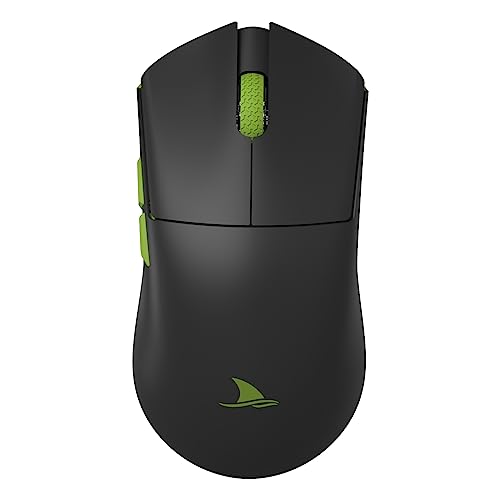
Redragon M916 Pro 4K Review | 78 Data compared

Avg. price:~£45Connectivity:wireless+wiredMaximum polling rate:4000 HzMaximum DPI:26000 DPIWeight:49 g

Redragon M916 Pro 4K Review: Compare 78 technical specifications and user reviews to see how this product ranks in the Mice category and whether it is worth buying.

8.3

Overall score

Score
8.3/ 10
✕
What it is
An overall evaluation of the mouse's quality, based on technical analyses and user reviews.
When it matters
When you need a quick reference to identify the best mice on the market.
Score distribution
â–¼
<55-66-77-88-99-10
Score components

80%

8.3

Technical Score

20%

8.3

User score

â–²Better than 89% of mice
8.3

Technical Score

Technical score
8.3/ 10
✕
What it is
An assessment of technical performance for products in the Mice category across these key areas: Performance & Sensor, Connectivity, Battery & Charging, Controls, Design, Features.
When it matters
When you want to compare mice based on technical performance and available features.
Score distribution
â–¼
<55-66-77-88-99-10
Score components

36%

10

Performance & Sensor

22%

6.1

Controls

16%

9.4

Design

14%

6.1

Features

7%

10

Connectivity

5%

5.7

Battery & Charging

â–²Better than 88% of mice
8.3

User score

User score
8.3/ 10
✕
What it is
A rating that combines user reviews and the total number of reviews received by the mouse.
When it matters
When you want to understand how a mouse performs in daily use or gaming and how reliable it is in terms of comfort, button feel, tracking accuracy, and long-term durability.
Score distribution
â–¼
<55-66-77-88-99-10
Score components

70%

8.8

User ratings

30%

7.2

Number of reviews

Based on 1,599 buyer reviews from online shops.
How we calculate this
User ratings – average star rating across all shop listings, weighted by how many reviews each has, on a 1–10 scale.
Number of reviews – how many buyer reviews the product has, on a logarithmic scale; the 8% most-reviewed models in the category get 10.
â–²Better than 65% of mice
  • redragon-m916-pro-4k
  • redragon-m916-pro-4k
  • redragon-m916-pro-4k
  • redragon-m916-pro-4k
  • redragon-m916-pro-4k
  • redragon-m916-pro-4k
  • redragon-m916-pro-4k
  • redragon-m916-pro-4k
redragon-m916-pro-4k

Best prices

*As an Amazon Associate, we earn from qualifying purchases.

Best rankings

Available: ranking among products currently available (including other versions of this product).All: ranking among all products in the database.
Loading...
Loading category ranking...

Verdict

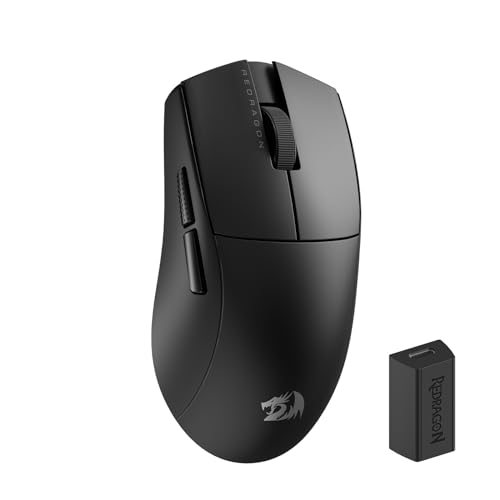
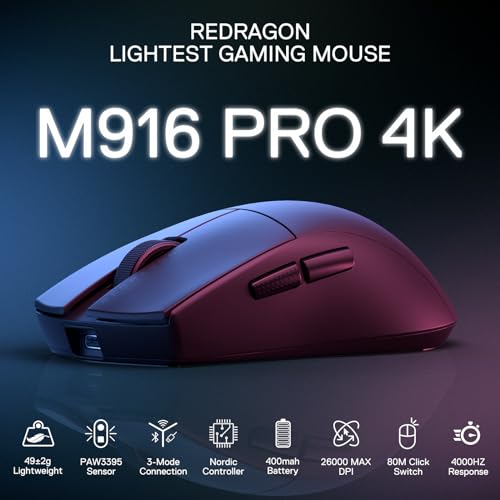
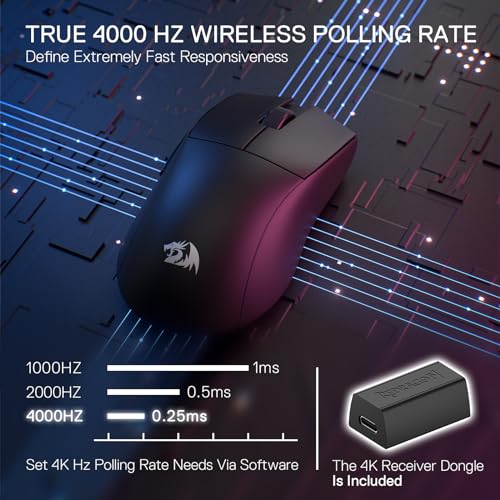
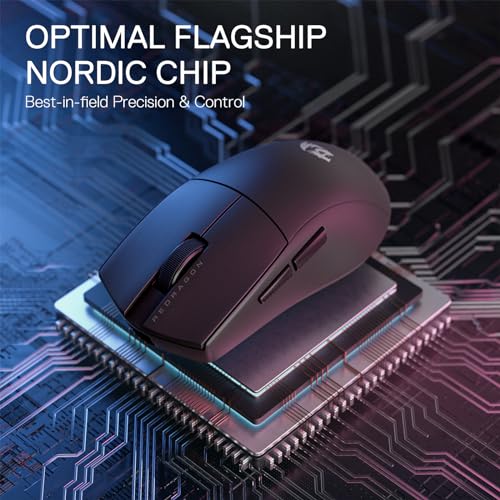
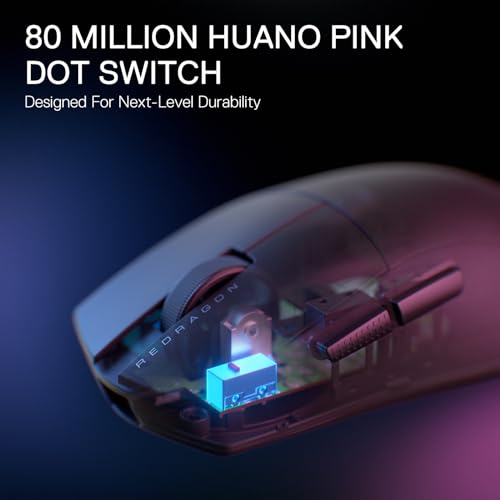
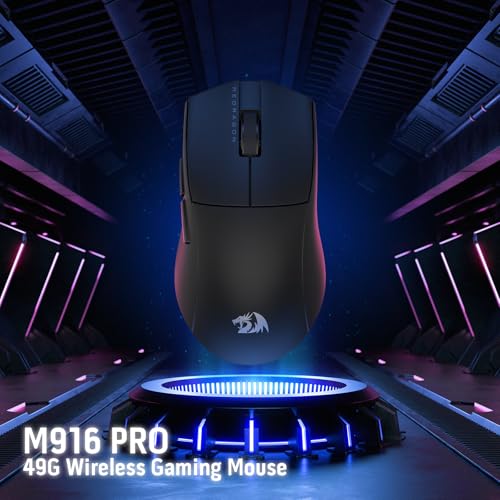
The Redragon M916 Pro 4K is an ultra-lightweight gaming mouse weighing just 49g, featuring a PixArt PAW3395 optical sensor with a maximum sensitivity of 26,000 DPI and a 4,000Hz wireless polling rate via a Nordic flagship chip. It offers tri-mode connectivity (2.4GHz wireless, Bluetooth, and USB-C wired), Huano blue shell pink dot micro switches rated for 80 million clicks, and a symmetrical, ergonomic design. Main pros include its exceptional budget value, high-end tracking performance, and extremely low weight that reduces fatigue. However, notable cons include an arguably 'cheap' plastic feel, potentially unstable 4K performance on certain firmware versions, and thin stock PTFE feet that may require replacement for better glide.

Technical Specifications of mouse Redragon M916 Pro 4K

Technical Score
Technical score
8.3/ 10
✕
What it is
An assessment of technical performance for products in the Mice category across these key areas: Performance & Sensor, Connectivity, Battery & Charging, Controls, Design, Features.
When it matters
When you want to compare mice based on technical performance and available features.
Score distribution
â–¼
<55-66-77-88-99-10
Score components:

36%

10

Performance & Sensor

22%

6.1

Controls

16%

9.4

Design

14%

6.1

Features

7%

10

Connectivity

5%

5.7

Battery & Charging

8.3
Redragon M916 Pro 4K has a technical score of 8.3 points, which is higher than that of 87.6% of products in this category.
User score
User score
8.3/ 10
✕
What it is
A rating that combines user reviews and the total number of reviews received by the mouse.
When it matters
When you want to understand how a mouse performs in daily use or gaming and how reliable it is in terms of comfort, button feel, tracking accuracy, and long-term durability.
Score distribution
â–¼
<55-66-77-88-99-10
Score components

70%

8.8

User ratings

30%

7.2

Number of reviews

Based on 1,599 buyer reviews from online shops.
How we calculate this
User ratings – average star rating across all shop listings, weighted by how many reviews each has, on a 1–10 scale.
Number of reviews – how many buyer reviews the product has, on a logarithmic scale; the 8% most-reviewed models in the category get 10.
8.3
Redragon M916 Pro 4K has a user score of 8.33 points, which is higher than that of 64.6% of products in this category.
Popularity
Popularity
7.2/ 10
✕
What it is
An indicator based on the number of reviews received by the mouse.
When it matters
When you prefer a mouse that has already been chosen and reviewed by many other users.
Score distribution
â–¼
<55-66-77-88-99-10
Popularity:
Redragon M916 Pro 4K has a popularity score of 7.2 points, which is higher than that of 61.4% of products in this category.
7.2
Redragon M916 Pro 4K has a popularity score of 7.2 points, which is higher than that of 61.4% of products in this category.
Ratio quality/price
Value for money
8.8/ 10
✕
What it is
An indicator that combines the mouse's overall rating with its cost.
When it matters
When you are looking for a mouse that offers a strong balance of performance, features, and price.
Score distribution
â–¼
<55-66-77-88-99-10
Score components:

60%

8.3

Overall score

40%

10

Price

8.8
Redragon M916 Pro 4K has a value-for-money score of 8.8 points, which is higher than that of 88.8% of products in this category.
Brand name
Redragon
Maximum polling rate
4,000 Hz
Maximum polling rate
4,000 Hz
This mouse has a maximum polling rate of 4,000 Hz, which is higher than 85.2% of mice and equal to 3% of mice.
Wired polling rate
4,000 Hz
Wired polling rate
4,000 Hz
This mouse has a wired polling rate of 4,000 Hz, which is higher than 92.7% of mice and equal to 0.4% of mice.
2.4 GHz polling rate
4,000 Hz
2.4 GHz polling rate
4,000 Hz
This mouse has a 2.4 GHz polling rate of 4,000 Hz, which is higher than 81.7% of mice and equal to 7.4% of mice.
Bluetooth polling rate
125 Hz
Bluetooth polling rate
125 Hz
This mouse has a Bluetooth polling rate of 125 Hz, which is higher than 67.8% of mice and equal to 30.7% of mice.
Show more
Connectivity
wireless+wired
Connectivity
wireless+wired
This mouse supports wireless+wired connectivity, which is more versatile than 56.8% of mice and equal to 43.3% of mice.
connection modes: wired / Bluetooth / 2.4 GHz.
Bluetooth support
yes
Bluetooth support
yes
This mouse supports Bluetooth. 64.5% of mice support Bluetooth.
Bluetooth version
5
Bluetooth version
5
This mouse uses Bluetooth 5, which is newer than 73.9% of mice and equal to 12.3% of mice.
Proprietary 2.4 GHz support
yes
Proprietary 2.4 GHz support
yes
This mouse supports proprietary 2.4 GHz wireless. 38.8% of mice support proprietary 2.4 GHz wireless.
Receiver included
yes
Receiver included
yes
This mouse includes a receiver. 37.8% of mice include a receiver.
Show more
Battery life
150 hours
Battery life
150 hours
This mouse lasts 150 hours on a charge, which is longer than 77.6% of mice and equal to 3.5% of mice.
Battery capacity
400 mAh
Battery capacity
400 mAh
This mouse has a battery capacity of 400 mAh, which is smaller than 57.8% of mice and equal to 6% of mice.
Battery form factor
integrated
Rechargeable battery
yes
Rechargeable battery
yes
This mouse uses a rechargeable battery. 54.2% of mice use a rechargeable battery.
Removable battery
no
Removable battery
no
This mouse does not use a removable battery. 22.3% of mice use a removable battery.
Show more
N. of buttons
5
N. of buttons
5
This mouse has 5 buttons, which is less than 76.9% of mice and equal to 9.6% of mice.
N. of side buttons
2
N. of side buttons
2
This mouse has 2 side buttons, which is more than 15% of mice and equal to 68.6% of mice.
N. of programmable buttons
5
N. of programmable buttons
5
This mouse has 5 programmable buttons, which is less than 64.5% of mice and equal to 13.4% of mice.
DPI switching button
yes
DPI switching button
yes
This mouse includes a DPI switching button. 14.7% of mice include a DPI switching button.
Profile switching button
no
Profile switching button
no
This mouse does not include a profile switching button. 16% of mice include a profile switching button.
Show more
Orientation
right-handed
Weight
49 g
Weight
49 g
This mouse weighs 49 g, which makes it lighter than 92.9% of mice and equal to 1.8% of mice.
Extra weights
0 g
Extra weights
0 g
This mouse comes with 0 g extra weights, which is less than 4.6% of mice and equal to 95.4% of mice.
Cable length
1.5 m
Cable length
1.5 m
This mouse has a cable length of 1.5 m, which is less than 87.2% of mice and equal to 8.3% of mice.
Cable type
braided
Show more
Onboard memory profiles
1
Onboard memory profiles
1
This mouse stores 1 onboard profiles, which is more than 48% of mice and equal to 20% of mice.
Onboard memory size
?
Software name
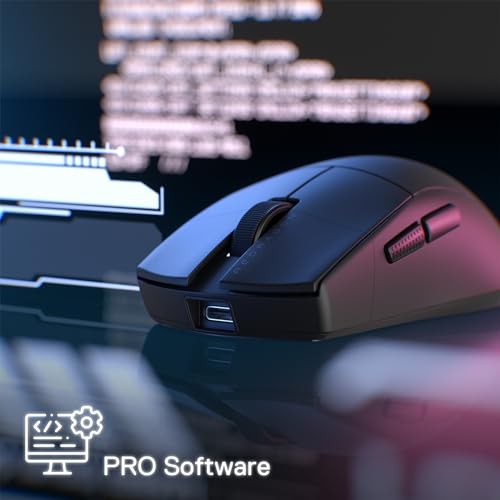
Redragon Gaming Mouse Software
Firmware upgradable
yes
Firmware upgradable
yes
This mouse supports firmware updates. 22.5% of mice support firmware updates.
Suitable for gaming
yes
Suitable for gaming
yes
This mouse is suitable for gaming. 23.9% of mice are suitable for gaming.

Redragon M916 Pro 4K vs the average mouse

246810TotalPerformance & SensorConnectivityBattery & ChargingControlsDesignFeatures
  • 4x higher maximum polling rate
    Maximum polling rate
    4,000 Hz
    This mouse has a maximum polling rate of 4000 Hz, while the average mouse has a maximum polling rate of 1000 Hz.
    4,000 Hz vs 1,000 Hz
  • 40.2% lower mouse weight
    Weight
    49 g
    This mouse weighs 49 g, while the average mouse weighs 82 g.
    49 g vs 82 g
  • 2.6x higher maximum DPI
    Maximum DPI
    26,000 DPI
    This mouse has a maximum DPI of 26000 DPI, while the average mouse has a maximum DPI of 10000 DPI.
    26,000 DPI vs 10,000 DPI
  • 4x higher 2.4 GHz polling rate
    2.4 GHz polling rate
    4,000 Hz
    This mouse has a 2.4 GHz polling rate of 4000 Hz, while the average mouse has a 2.4 GHz polling rate of 1000 Hz.
    4,000 Hz vs 1,000 Hz
  • 4x higher wired polling rate
    Wired polling rate
    4,000 Hz
    This mouse has a wired polling rate of 4000 Hz, while the average mouse has a wired polling rate of 1000 Hz.
    4,000 Hz vs 1,000 Hz
  • Adjustable lift-off distance
    Lift-off distance adjustable
    yes
    This mouse supports adjustable lift-off distance, while the average mouse does not. 46.5% of mice support adjustable lift-off distance.
  • 62.5% higher tracking speed
    Maximum tracking speed
    650 IPS
    This mouse offers a maximum tracking speed of 650 IPS, while the average mouse offers a maximum tracking speed of 400 IPS.
    650 IPS vs 400 IPS
  • 65 hours longer battery life
    Battery life
    150 hours
    This mouse lasts 150 hours on a charge, while the average mouse lasts 85 hours on a charge.
    150 hours vs 85 hours
  • 20.4% better value for money
    Redragon M916 Pro 4K has better value for money than the average mouse (8.81 vs 7.3).
    8.81 vs 7.31
  • 4x higher maximum polling rate
    Maximum polling rate
    4,000 Hz
    This mouse has a maximum polling rate of 4000 Hz, while the average mouse has a maximum polling rate of 1000 Hz.
    4,000 Hz vs 1,000 Hz
  • 2.6x higher maximum DPI
    Maximum DPI
    26,000 DPI
    This mouse has a maximum DPI of 26000 DPI, while the average mouse has a maximum DPI of 10000 DPI.
    26,000 DPI vs 10,000 DPI
  • 4x higher 2.4 GHz polling rate
    2.4 GHz polling rate
    4,000 Hz
    This mouse has a 2.4 GHz polling rate of 4000 Hz, while the average mouse has a 2.4 GHz polling rate of 1000 Hz.
    4,000 Hz vs 1,000 Hz
  • 4x higher wired polling rate
    Wired polling rate
    4,000 Hz
    This mouse has a wired polling rate of 4000 Hz, while the average mouse has a wired polling rate of 1000 Hz.
    4,000 Hz vs 1,000 Hz
  • Adjustable lift-off distance
    Lift-off distance adjustable
    yes
    This mouse supports adjustable lift-off distance, while the average mouse does not. 46.5% of mice support adjustable lift-off distance.
  • 62.5% higher tracking speed
    Maximum tracking speed
    650 IPS
    This mouse offers a maximum tracking speed of 650 IPS, while the average mouse offers a maximum tracking speed of 400 IPS.
    650 IPS vs 400 IPS
  • 150 DPI lower minimum setting
    Minimum DPI
    50 DPI
    This mouse goes as low as 50 DPI, while the average mouse goes as low as 200 DPI.
    50 DPI vs 200 DPI
  • 25% higher maximum acceleration
    Maximum acceleration
    50 G
    This mouse has a maximum acceleration of 50 G, while the average mouse has a maximum acceleration of 40 G.
    50 G vs 40 G
  • Multi-device pairing
    Multi-device pairing
    yes
    This mouse supports multi-device pairing, while the average mouse does not. 20.3% of mice support multi-device pairing.
  • Versatile connectivity
    Connectivity
    wireless+wired
    This mouse supports wireless+wired connectivity, while the average mouse supports wireless connectivity.
    connection modes: wired / Bluetooth / 2.4 GHz.
    wireless+wired vs wireless
  • Bluetooth support
    Bluetooth support
    yes
    This mouse supports Bluetooth, while the average mouse does not. 35.5% of mice support Bluetooth.
  • 65 hours longer battery life
    Battery life
    150 hours
    This mouse lasts 150 hours on a charge, while the average mouse lasts 85 hours on a charge.
    150 hours vs 85 hours
  • Usable while charging
    Use while charging
    yes
    This mouse can be used while charging, while the average mouse cannot. 47.5% of mice can be used while charging.
  • Rechargeable battery
    Rechargeable battery
    yes
    This mouse uses a rechargeable battery, while the average mouse does not. 45.9% of mice use a rechargeable battery.
  • 20 million clicks longer switch lifespan
    Switch durability
    50 million clicks
    This mouse offers switch durability of 50 million clicks, while the average mouse offers switch durability of 30 million clicks.
    50 million clicks vs 30 million clicks
  • 40.2% lower mouse weight
    Weight
    49 g
    This mouse weighs 49 g, while the average mouse weighs 82 g.
    49 g vs 82 g
  • Detachable cable
    Detachable cable
    yes
    This mouse comes with a detachable cable, while the average mouse does not. 43% of mice come with a detachable cable.
  • 2 hours longer full charge time
    Full charge time
    4 hours
    This mouse reaches a full charge in 4 hours, while the average mouse reaches a full charge in 2 hours.
    4 hours vs 2 hours
  • 1 fewer programmable buttons
    N. of programmable buttons
    5
    This mouse has 5 programmable buttons, while the average mouse has 6 programmable buttons.
    5 vs 6
  • No RGB lighting
    RGB lighting
    no
    This mouse does not have RGB lighting, while the average mouse does. 56.3% of mice have RGB lighting.
  • 0.3 m shorter cable
    Cable length
    1.5 m
    This mouse has a cable length of 1.5 m, while the average mouse has a cable length of 1.8 m.
    1.5 m vs 1.8 m
  • Thin glide feet
    Feet thickness
    0.75 mm
    This mouse uses 0.8 mm thick mouse feet, while the average mouse uses 0.8 mm thick mouse feet.
    0.75 mm vs 0.8 mm
  • 2 hours longer full charge time
    Full charge time
    4 hours
    This mouse reaches a full charge in 4 hours, while the average mouse reaches a full charge in 2 hours.
    4 hours vs 2 hours
  • 1 fewer programmable buttons
    N. of programmable buttons
    5
    This mouse has 5 programmable buttons, while the average mouse has 6 programmable buttons.
    5 vs 6
  • No RGB lighting
    RGB lighting
    no
    This mouse does not have RGB lighting, while the average mouse does. 56.3% of mice have RGB lighting.
  • 0.3 m shorter cable
    Cable length
    1.5 m
    This mouse has a cable length of 1.5 m, while the average mouse has a cable length of 1.8 m.
    1.5 m vs 1.8 m
  • Thin glide feet
    Feet thickness
    0.75 mm
    This mouse uses 0.8 mm thick mouse feet, while the average mouse uses 0.8 mm thick mouse feet.
    0.75 mm vs 0.8 mm

Graphic comparison of Redragon M916 Pro 4K and other products in the Mice category

No results found

Third-party reviews

Based on 1,599 buyer reviews from online shops.
Reviews last updated: May 2026 · How we calculate this

What customers like about Redragon M916 Pro 4K?

  • Excellent value for money, offering high-end specs (PAW 3395 sensor, 4K polling) at a budget price point.
  • Extremely lightweight at approximately 49g, making it ideal for fast-paced competitive gaming.
  • Crisp and responsive main clicks using tactile Huano switches.
  • Versatile tri-mode connectivity supporting 2.4GHz wireless, Bluetooth, and wired USB-C modes.
  • Reliable tracking and low latency performance, especially when using the 4K polling rate.
  • Sturdy internal build quality with many users reporting no creaking or flexing despite the light weight.

What customers dislike about Redragon M916 Pro 4K?

  • Materials can feel cheap or 'plasticky,' lacking the premium finish of more expensive competitors.
  • Stock PTFE feet are often described as thin or low-quality, sometimes requiring replacement for better glide.
  • The 4K polling rate significantly reduces battery life compared to standard 1,000Hz usage.
  • Small, compact shape and specific hump design may be uncomfortable for users with large hands or those who prefer a palm grip.
  • The scroll wheel is sometimes noted for having light tactility or feeling a bit spongy.
  • Some users reported a high Lift-Off Distance (LOD) that can be distracting during intense gaming.

Video reviews

Hands-on testing, unboxing, and real-world video evaluations

Compare Redragon M916 Pro 4K with other products in the Mice category

1Product to compare no. 1
VS
2Product to compare no. 2
VS
3Product to compare no. 3 (optional)