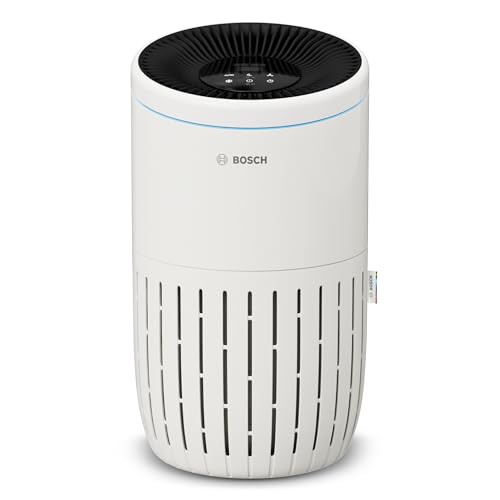
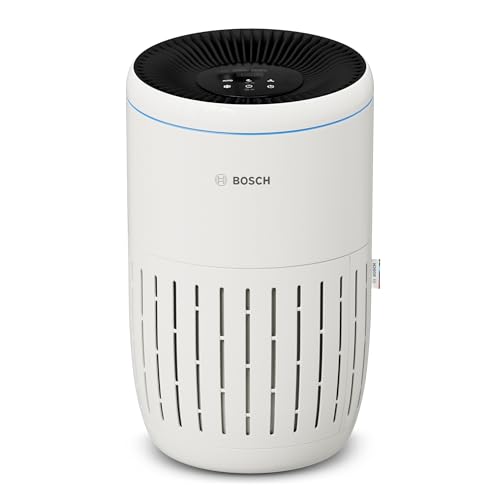
Are Bosch air purifiers good?
Bosch air purifiers are good straightforward choices when you want HEPA H13 and activated-carbon filtration with automatic and quiet modes. Air 2000 targets modest rooms at about 180 m³/h, while Air 4000 raises output to about 300 m³/h; both remain conventional purifiers without a fan-heater premium.
The range represented here is too small for a reliable brand-wide ranking, and its limited connectivity and model variety will not suit every buyer. Treat Bosch as a focused two-size proposition: choose it when the correct model meets your room-volume target and genuine replacement filters are easy to obtain.
What are the main advantages of Bosch air purifiers?
The main advantages of Bosch air purifiers are as follows:
- Clear two-size choice: Air 2000 and Air 4000 provide a simple step from roughly 180 to 300 m³/h. Buyers can match the room volume without decoding a long series catalogue.
- Three-stage filter: The Bosch replacement system combines a prefilter, HEPA H13 layer, and activated carbon. It therefore addresses fine particles as well as ordinary household odours, while the display tracks filter status.
- Automatic PM2.5 response: A particle sensor reports conditions through the display and light ring, and Auto mode adjusts fan speed. This makes day-to-day operation easier than choosing a fixed speed whenever air quality changes.
- Quiet and timed modes: Quiet mode reduces fan speed and dims the lights, while the timer supports scheduled shut-off. These are practical bedroom features even without an app.
- Conventional appliance design: Bosch focuses on purification rather than adding heating, humidifying, or high-volume fan claims. That keeps purchase decisions centred on airflow, filters, and noise.
What are the main disadvantages of Bosch air purifiers?
The main disadvantages of Bosch air purifiers are as follows:
- Narrow model range: Air 2000 and Air 4000 cover only two meaningful output levels. Bosch offers no compact personal unit, high-CADR flagship, purifier-heater, or formaldehyde-focused alternative within these two families.
- No Wi‑Fi on these models: Air 2000 and Air 4000 rely on their control panels, so remote schedules and app-based air-quality history are absent. That simplicity is a benefit only if connected control is unimportant.
- Limited large-room headroom: Air 4000 reaches about 300 m³/h, which can be insufficient for a large open-plan room at four or five air changes per hour. Buyers may need a higher-output rival rather than accepting a low turnover rate.
- Proprietary filter dependence: The three-in-one cartridge is convenient, but the full assembly needs replacement when its service life ends. Check the exact Bosch part number, price, and local stock before buying the purifier.
- Few pollutant-specific choices: The carbon layer is useful for ordinary odours, but Bosch does not publish a broad selection of smoke, pet, toxin, or formaldehyde filter variants for these models. Specialist needs may be better served elsewhere.
Who makes Bosch air purifiers?
Bosch-branded home appliances are produced through BSH Hausgeräte GmbH, the Bosch Group company responsible for the consumer-goods appliance business. BSH is headquartered in Munich, Germany, while the wider Bosch Group is based near Stuttgart.
BSH develops appliances under the Bosch name and combines its own engineering, supplier network and regional factories rather than presenting every product as made in one country. In air treatment, the range is comparatively focused: Bosch Air 2000 and Air 4000 models extend the group’s home-appliance portfolio instead of forming a separate specialist purifier company.
How do Bosch air purifier models differ?
The Bosch air purifier models differ as follows:
- Air 2000: This is the compact option, delivering about 180 m³/h and targeting rooms up to roughly 37.5 m² under Bosch’s stated test assumptions. It suits bedrooms, offices, and smaller living spaces where quiet operation and a modest footprint matter.
- Air 4000: This model increases CADR to about 300 m³/h and the stated room figure to roughly 62.5 m². It is the better Bosch choice for a larger room or for buyers who want airflow headroom so the purifier need not stay at maximum speed.
How much do Bosch air purifiers cost?
Bosch air purifiers generally cost about £100-£200. Air 2000 occupies the lower end, while Air 4000 costs more for its higher 300 m³/h clean-air delivery.
The price gap is small enough that room volume should decide the model: buy Air 2000 only when 180 m³/h is sufficient. Add the replacement-cartridge price to the calculation, because filter availability and annual cost can outweigh a modest difference at checkout.
How do Bosch air purifiers compare with other brands?
Bosch competes through simplicity rather than breadth. Against LEVOIT or Rowenta, the Air 2000 and Air 4000 offer fewer sizes, no app control in this set, and fewer specialist variants, but their HEPA H13, carbon, PM2.5 display, and conventional controls are easy to understand.
Dyson adds premium fan, heating, and sensor options at a much higher price, while Daikin’s MC55W offers stronger airflow and a long-life electrostatic HEPA proposition. Bosch is the pragmatic choice when one of its two CADR levels fits and local replacement-filter support is stronger than the alternatives.
What should you consider while choosing the best Bosch air purifier?
Before choosing a Bosch air purifier, consider the following factors:
- Air 2000 or Air 4000: Calculate room volume before choosing between 180 and 300 m³/h. At four air changes per hour, those outputs cover about 45 and 75 m³ respectively; add headroom if quiet operation is important.
- Filter part number: Confirm that the correct three-in-one Bosch cartridge is stocked locally and includes the expected HEPA H13 and carbon stages. Replacement price and interval are part of the ownership cost.
- Particle versus odour priority: HEPA H13 addresses fine particles, while the carbon layer helps with normal household smells. For heavy smoke or persistent gases, compare carbon quantity rather than assuming every carbon filter performs equally.
- Controls without an app: These models provide Auto, manual, Quiet, and Timer modes at the purifier. Choose Bosch if that is enough; select a connected rival when remote schedules or air-quality history are essential.
- Bedroom operation: Quiet mode dims the display and lowers speed, but its clean-air output is also reduced. Size the purifier with enough reserve to clean effectively without relying on the loudest setting overnight.
- Placement and service: Keep the intake and top outlet clear, and allow room to remove the bottom filter cover. Check warranty terms, filter-status reset instructions, and authorised spare-parts access in your market.