
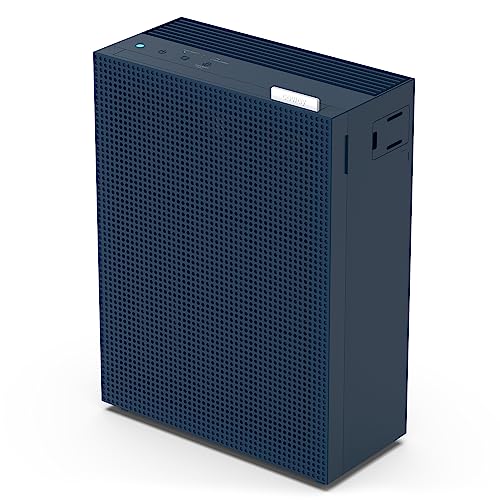


Are Daikin air purifiers good?
Daikin air purifiers are a good fit when filtration performance, low-pressure electrostatic HEPA design, and quiet running matter more than smart-home features. MC55WVM offers about 320 m³/h CADR, automatic modes, and a compact vertical body; Daikin also states that its main filter may not need replacement for up to ten years under its conditions.
The decision is less flexible than with LEVOIT, Rowenta, or Dyson because this comparison contains one Daikin model and no Wi‑Fi version. It is a focused, premium purchase for a larger living area, not a complete range for every room size or budget.
What are the main advantages of Daikin air purifiers?
The main advantages of Daikin air purifiers are as follows:
- Flash Streamer treatment: Daikin uses a plasma-discharge process to break down selected allergens and odour compounds after they are captured. It complements, rather than replaces, the mechanical filter and should not be treated as a general medical sterilisation claim.
- Electrostatic HEPA collection: The high-performance electrostatic HEPA filter is designed to collect fine particles while resisting rapid clogging and pressure loss. That supports strong airflow without making the fan work as hard.
- Strong, quiet airflow: MC55WVM reaches about 320 m³/h CADR and offers silent operation around 19 dBA, with turbo around 53 dBA. Buyers can therefore choose between unobtrusive bedroom use and faster room turnover.
- Long-life main filter: Daikin states that the filter can last up to ten years in its specified conditions. That can reduce consumable cost, although prefilter cleaning and local service parts still matter.
- Automatic particle and odour sensing: Auto fan mode responds to the unit’s sensors, while the display shows dust, odour, and PM2.5 information. It is a useful control system for a purifier that does not rely on a phone app.
What are the main disadvantages of Daikin air purifiers?
The main disadvantages of Daikin air purifiers are as follows:
- Limited model choice: MC55WVM does not provide a small-room, smart, or high-capacity family choice. Buyers who need a compact desk purifier or a different feature mix must compare another brand.
- No Wi‑Fi control: The unit uses onboard buttons, sensors, indicators, and a remote rather than an app. That is dependable for local use but limits scheduling and remote air-quality checks.
- Premium purchase price: At around £300-£340, Daikin costs more than many compact HEPA towers. The long-life filter can offset some running cost, but only when the unit’s airflow is actually needed.
- Streamer maintenance is still real: The main filter may be long-lived, but the prefilter needs cleaning and the Streamer unit can require attention in dusty, oily, or humid environments. Read the maintenance schedule before assuming it is maintenance-free.
- No heating or humidifying: MC55WVM is a purifier only. It does not replace a heater, fan, or humidifier, and its combination with an HVAC system may be unnecessary in a small room.