D-Link DIR 505L Review | 77 Data compared

double-arrow
  • Avg. price in UK: ~£60
  • Avg. price in US: ~$70
  • Wi-Fi version: Wi-Fi 4 (802.11n)
  • Wi-Fi speed: 54 Mbps
  • LAN port speeds: 100 Mbps
  • Wireless coverage: ?

D-Link DIR 505L review. Compare 77 technical specifications and user reviews to see how it ranks among routers and if it is worth buying.

5.0

Overall score

What it is: An overall evaluation of the router's quality, based on technical analyses and user reviews.

When it matters: When you need a quick reference to identify the best routers on the market.

Score components:

90.0%

5.0

Technical Score

10.0%

?

User score

Good
5.0

Technical Score

What it is: An assessment of the router's technical performance, covering key areas such as Wi-Fi performance, wired connectivity, security, software features, coverage, and design.

When it matters: When you want to compare routers based on technical performance and available features.

Score components:

26.0%

3.8

Wireless

20.0%

4.1

Ports

18.0%

5.3

Networking

14.0%

9.0

Security

12.0%

3.5

Hardware

10.0%

5.6

Management

Good
?

User score

What it is: A rating that combines user reviews and the total number of reviews received by the router.

When it matters: When you want to know how a router performs in daily use and how reliable it is for speed, coverage, and stability according to user feedback.

Score components:

70.0%

?

User reviews

30.0%

?

Popularity

  • 2.3
    Gaming

    Score components:

    33.0%

    1.0

    Wi-Fi speed

    28.0%

    5.0

    CPU clock speed

    22.0%

    1.9

    RAM capacity

    17.0%

    1.1

    Maximum connected devices

  • 5.2
    Travel

    Score components:

    40.0%

    10

    Weight

    30.0%

    1.0

    Wi-Fi speed

    20.0%

    4.0

    Cellular modem type

    10.0%

    1.0

    SIM slot

  • d-link-dir-505l
  • d-link-dir-505l
  • d-link-dir-505l
  • d-link-dir-505l
  • d-link-dir-505l
  • d-link-dir-505l
  • d-link-dir-505l
  • d-link-dir-505l
d-link-dir-505l
d-link-dir-505l
d-link-dir-505l
d-link-dir-505l
d-link-dir-505l
d-link-dir-505l
d-link-dir-505l
d-link-dir-505l

Best prices in UK

    N/A~ £60

Best rankings

?

Available: ranking among products currently available (including other versions of this product).
All: ranking among all products in the database.

Verdict

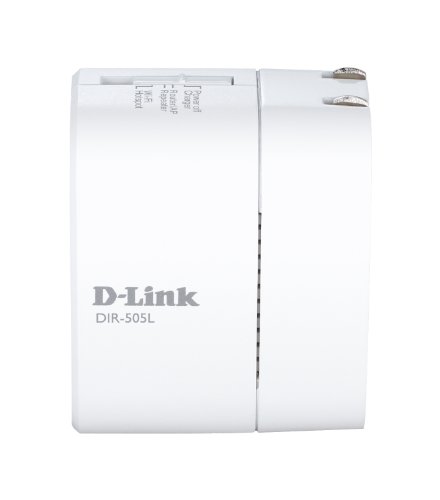
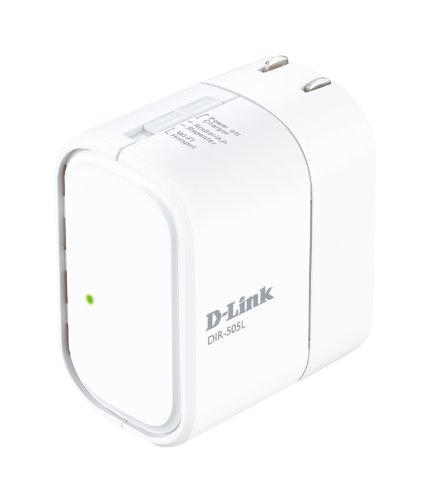
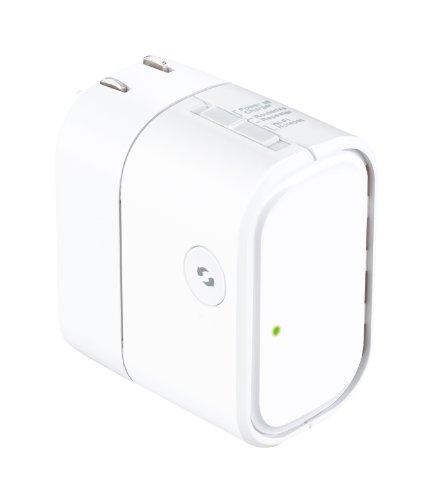
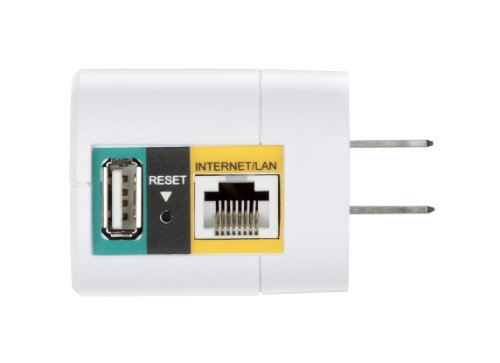
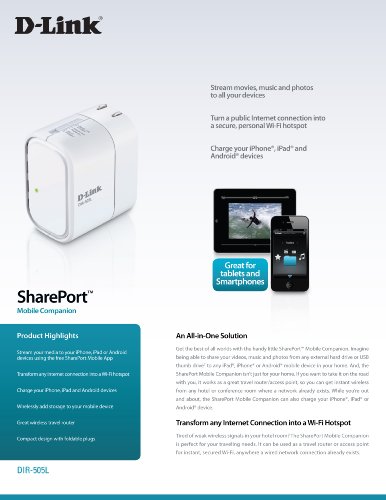
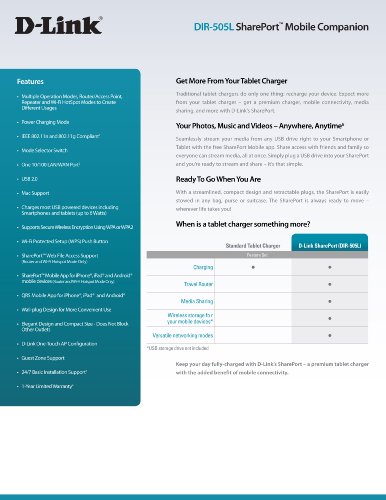
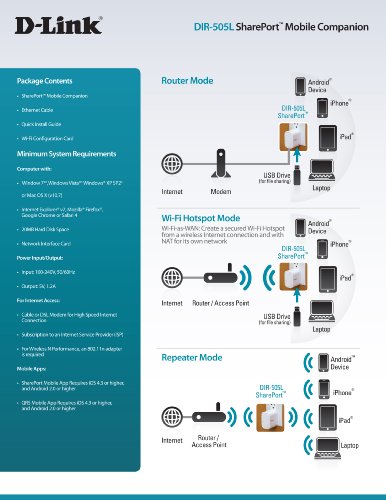
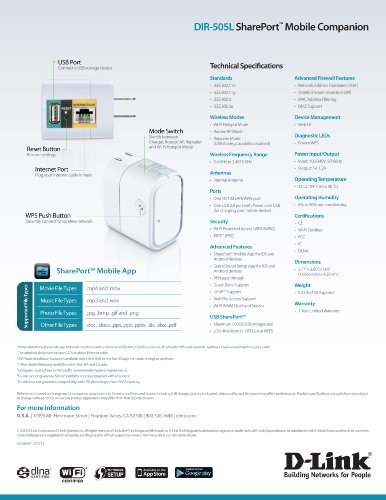
The D-Link DIR-505L is a compact Wireless N150 travel router and mobile companion featuring a single 10/100 Ethernet WAN/LAN port, a USB 2.0 port for file sharing via SharePort Mobile, and a convenient wall-plug design. It operates in multiple modes, including Router/Access Point, Repeater, and Wi-Fi Hotspot, and supports internal omni-directional antennas with 64MB of RAM. Its main pros include extreme portability, the ability to charge mobile devices via USB, and simple setup through the QRS Mobile app or WPS. However, its primary cons are limited wireless speeds of up to 150 Mbps on the 2.4GHz band only, a lack of modern Wi-Fi 5/6 standards, and having only one physical Ethernet port.

Technical Specifications of router D-Link DIR 505L

Technical Score

What it is: An assessment of the router's technical performance, covering key areas such as Wi-Fi performance, wired connectivity, security, software features, coverage, and design.

When it matters: When you want to compare routers based on technical performance and available features.

Score components:

26.0%

?

Wireless

20.0%

?

Ports

18.0%

?

Networking

14.0%

?

Security

12.0%

?

Hardware

10.0%

?

Management

5.0
D-Link DIR 505L has a technical score of 5 points, which is lower than that of 96.6% of products in this category.
User score

What it is: A rating that combines user reviews and the total number of reviews received by the router.

When it matters: When you want to know how a router performs in daily use and how reliable it is for speed, coverage, and stability according to user feedback.

Score components:

70.0%

0.0

User reviews

30.0%

1.0

Popularity

?
Popularity
What it is: An indicator based on the number of reviews received by the router.
When it matters: When you prefer to choose a router reviewed and selected by many other buyers.
1.0
D-Link DIR 505L has a popularity of 1 points, which is lower than 71.1% of products in this category.
Ratio quality/price

What it is: An indicator that combines the router's overall rating with its cost.

When it matters: When you are looking for a router with a good balance between network performance, features, and price.

Score components:

60.0%

5.0

Overall score

40.0%

10

Price

6.5
D-Link DIR 505L has a quality-to-price ratio of 6.5 points, which is lower than 96.8% of products in this category.
Brand name
What it is: The manufacturer or brand of the product.
When it matters: When you prefer a specific ecosystem, support network, or design philosophy.

Importance: MEDIUM

D-Link
Wi-Fi version
What it is: Identifies the Wi-Fi generation the router supports, such as Wi-Fi 5, 6, 6E, or 7.
When it matters: When newer phones, laptops, and consoles need the latest Wi-Fi efficiency and speed features.

Importance: HIGH

Good value: Wi-Fi 6 (802.11ax)

Wi-Fi 4 (802.11n)
D-Link DIR 505L uses Wi-Fi Wi-Fi 4 (802.11n), which is less advanced than 60.8% of routers and equal to 37.2% of routers.
Wi-Fi bands
What it is: Lists which wireless frequency bands the router can use, such as 2.4 GHz, 5 GHz, or 6 GHz.
When it matters: When you need to balance range, speed, and congestion across different types of client devices.

Importance: HIGH

Good value: 2.4 GHz + 5 GHz

2.4 GHz
D-Link DIR 505L supports 2.4 GHz Wi-Fi bands, which are less versatile than 75.3% of routers and equal to 22.3% of routers.
Wi-Fi speed
What it is: The advertised maximum wireless throughput rating of the router under supported conditions.
When it matters: When several users stream, download, and game at once and you want more wireless headroom.

Importance: HIGH

Good value: >2700 Mbps

54 Mbps
D-Link DIR 505L delivers 54 Mbps Wi-Fi speed, which is lower than 99.8% of routers and equal to 0.3% of routers.
Channel widths supported
What it is: Lists the Wi-Fi channel widths the router can use, such as 20, 40, 80, or 160 MHz.
When it matters: When you want the option to trade peak speed against stability in crowded wireless environments.

Importance: MEDIUM

Good value: 20 MHz + 40 MHz + 80 MHz

20 MHz + 40 MHz
D-Link DIR 505L supports 20 MHz + 40 MHz channel width options, which is fewer than 59.9% of routers and the same as 34.8% of routers.
Show more
Wi-Fi security protocols
What it is: Lists the wireless security standards the router supports, such as WPA2 or WPA3.
When it matters: When you want stronger wireless protection without locking out older devices that still need compatibility.

Importance: HIGH

WPA2, WPA, WEP
D-Link DIR 505L supports WPA2, WPA, WEP Wi-Fi security protocols, which are more advanced than 41% of routers and equal to 17.7% of routers.
DoS protection
What it is: Provides defenses intended to reduce the impact of denial-of-service traffic against the router or network.
When it matters: When exposed services or remote access make resilience against traffic floods more important.

Importance: HIGH

?
SPI intrusion protection
What it is: Uses stateful packet inspection to track sessions and block suspicious unsolicited traffic more accurately.
When it matters: When the router needs a stronger first line of filtering on an internet-facing connection.

Importance: HIGH

yes
D-Link DIR 505L includes SPI-based intrusion protection. 3.6% of routers include SPI-based intrusion protection.
MAC address filtering
What it is: Lets the router allow or block devices based on their MAC addresses.
When it matters: When you want an extra device-level access rule beyond passwords and network names.

Importance: MEDIUM

yes
D-Link DIR 505L supports MAC address filtering. 1% of routers include MAC address filtering.
URL filter
What it is: Allows the router to block or allow access based on website addresses or domain rules.
When it matters: When you need to restrict specific sites for children, guests, or work-policy reasons.

Importance: MEDIUM

yes
D-Link DIR 505L supports URL filtering. 1.8% of routers include URL filtering.
Show more
IPv6 support
What it is: Support for the newer IPv6 internet addressing standard alongside the older IPv4 system.
When it matters: When your internet provider or network already uses IPv6, or you want the router to stay compatible as IPv6 use becomes more common.

Importance: HIGH

no
D-Link DIR 505L does not support IPv6. 89.3% of routers are IPv6-ready.
Dynamic routing
What it is: Supports routing protocols or dynamic route updates instead of relying only on static route entries.
When it matters: When the router sits in a more complex network with changing paths between multiple subnets.

Importance: MEDIUM

yes
D-Link DIR 505L supports dynamic routing. 46.8% of routers support dynamic routing.
Inter-VLAN routing
What it is: Allows the router to pass traffic between separate VLANs under controlled rules.
When it matters: When you need segmented networks to communicate selectively instead of staying fully isolated.

Importance: MEDIUM

no
D-Link DIR 505L does not support inter-VLAN routing. 22.2% of routers support inter-VLAN routing.
VLAN tagging
What it is: Lets the router mark traffic with VLAN tags for segmented or ISP-specific network setups.
When it matters: When you separate guest, office, IoT, or ISP-required traffic into different network segments.

Importance: MEDIUM

no
D-Link DIR 505L does not support VLAN tagging. 63% of routers include VLAN tagging.
QoS
What it is: Provides quality-of-service controls that prioritize some traffic over less important traffic.
When it matters: When calls, gaming, and downloads compete and you want latency-sensitive traffic protected.

Importance: HIGH

yes
D-Link DIR 505L includes QoS controls. 2.7% of routers include QoS controls.
Show more
N. of LAN ports
What it is: Measures how many LAN ports the router includes. A higher count expands direct connectivity for matching devices.
When it matters: When you run a home office with NAS, TV boxes, and desktops, having more LAN ports avoids extra switches and keeps latency lower on wired links.

Importance: HIGH

Good value: 4 ports

1
D-Link DIR 505L has 1 LAN ports, which is fewer than 95.3% of routers and the same as 4.2% of routers.
LAN port speeds
What it is: Lists the Ethernet speeds available on the router’s LAN ports, such as Gigabit or multi-gig.
When it matters: When wired transfers to NAS, desktops, or access points need more than basic Ethernet speeds.

Importance: HIGH

Good value: 1 Gbps

100 Mbps
D-Link DIR 505L offers 100 Mbps on its LAN ports, which is slower than 73.1% of routers and on par with 26.4% of routers.
N. of WAN ports
What it is: Shows how many separate WAN uplink ports the router provides for internet connections.
When it matters: When you use dual internet lines, backup WAN, or load balancing between multiple external links.

Importance: HIGH

Good value: 1 WAN port

1
D-Link DIR 505L has 1 WAN ports, which is more than 1% of routers and the same as 90.1% of routers.
N. of USB ports
What it is: Shows how many USB ports the router includes for storage, printers, or modem accessories.
When it matters: When you plan to share storage, attach a printer, or use USB-based network extras.

Importance: MEDIUM

Good value: 1 USB port

1
D-Link DIR 505L has 1 USB ports, which is more than 39.2% of routers and the same as 39.9% of routers.
Power over Ethernet (PoE)
What it is: Power over Ethernet support, meaning the router can receive power, deliver it, or be part of a PoE-based installation.
When it matters: When you want cleaner installation with fewer separate power cables, especially in ceilings, walls, racks, or remote locations.

Importance: MEDIUM

no
D-Link DIR 505L does not support Power over Ethernet (PoE). 0.5% of routers can be powered over Ethernet.
Show more
Management interface
What it is: Shows how the router is configured and monitored, such as web UI, app, or command-line tools.
When it matters: When setup depth and day-to-day admin convenience are part of the buying decision.

Importance: HIGH

Web UI, App
D-Link DIR 505L uses Web UI, App for management, which is more advanced than 33.4% of routers and equal to 57% of routers.
QRS Mobile app
Firmware upgrade method
What it is: Describes how router firmware updates are installed, such as automatic OTA, web UI, or manual upload.
When it matters: When you want security fixes and new features applied with less maintenance friction.

Importance: HIGH

Web UI, Automatic
D-Link DIR 505L supports Web UI, Automatic firmware update methods, which are more convenient than 35.4% of routers and equal to 37.8% of routers.
Traffic monitoring
What it is: Lets the router track bandwidth usage by device, app category, or time period.
When it matters: When you need to find which devices or activities are causing slowdowns or high data use.

Importance: MEDIUM

no
D-Link DIR 505L does not include traffic monitoring. 82.8% of routers include traffic monitoring.
Guest Wi-Fi network
What it is: Lets the router create a separate wireless network for visitors or less-trusted devices.
When it matters: When guests need internet access without reaching private devices on the main network.

Importance: HIGH

yes
D-Link DIR 505L offers a guest Wi‑Fi network. 8.6% of routers offer a guest Wi‑Fi network.
Captive portal
What it is: Supports a login or acceptance page that users must pass before getting internet access.
When it matters: When guest networks, rentals, cafes, or managed access points need a sign-in page.

Importance: MEDIUM

no
D-Link DIR 505L does not offer captive portal features. 23.9% of routers offer captive portal features.
Show more
CPU clock speed
What it is: Shows the operating frequency of the router processor, often listed per core.
When it matters: When routing, encryption, QoS, and many active clients can put heavier load on the CPU.

Importance: HIGH

0.4 GHz
D-Link DIR 505L runs at 0.4 GHz, which is slower than 84.7% of routers and on par with 3.5% of routers.
RAM capacity
What it is: The amount of working memory available for sessions, routing tables, and running router services.
When it matters: When many devices, VPN tunnels, or advanced features need the router to stay responsive under load.

Importance: HIGH

Good value: >=512 MB

64 MB
D-Link DIR 505L has 64 MB of RAM, which is less than 66.9% of routers and the same as 15.2% of routers.
Internal storage
What it is: The built-in storage available for logs, apps, shared files, or other local router functions.
When it matters: When the router runs extra services and needs space for logs, packages, or shared content.

Importance: MEDIUM

Good value: >=8 GB

0.007812 GB
D-Link DIR 505L has 0.007812 GB of internal storage, which is less than 73.1% of routers and the same as 20.3% of routers.
Hardware acceleration
What it is: Uses dedicated hardware paths to offload routing, NAT, encryption, or switching tasks from the main CPU.
When it matters: When heavy routing or security features would otherwise reduce throughput on the processor alone.

Importance: HIGH

no
D-Link DIR 505L does not offer hardware acceleration. 81% of routers offer hardware acceleration.
N. of external antennas
What it is: Shows how many antennas are mounted externally on the router.
When it matters: When you want stronger adjustable coverage or plan to aim antennas for difficult room layouts.

Importance: MEDIUM

Good value: 3 antennas

0
D-Link DIR 505L has 0 external antennas, which is fewer than 59.7% of routers and the same as 40.3% of routers.
Show more

D-Link DIR 505L vs the average router

  • Stronger Wi-Fi security
    D-Link DIR 505L supports the Wi-Fi security protocols WPA2, WPA, WEP, while the average router supports WPA2, WPA, WEP, WPS.
    What it is: Lists the wireless security standards the router supports, such as WPA2 or WPA3.
    When it matters: When you want stronger wireless protection without locking out older devices that still need compatibility.

    Importance: HIGH

    D-Link DIR 505L supports the Wi-Fi security protocols WPA2, WPA, WEP, while the average router supports WPA2, WPA, WEP, WPS.WPA2, WPA, WEP vs WPA2, WPA, WEP, WPS
  • 6.6 W lower power consumption
    D-Link DIR 505L uses less power than the average router (1.5 W vs 8.1 W). The average router uses 8.1 W power.
    What it is: The amount of electrical power the router draws during normal operation, usually measured in watts.
    When it matters: When the router stays on all day and you care about heat output and long-term electricity cost.

    Importance: MEDIUM

    Good value: <6 W

    D-Link DIR 505L uses less power than the average router (1.5 W vs 8.1 W). The average router uses 8.1 W power.1.5 W vs 8.1 W
  • Stronger Wi-Fi security
    D-Link DIR 505L supports the Wi-Fi security protocols WPA2, WPA, WEP, while the average router supports WPA2, WPA, WEP, WPS.
  • 6.6 W lower power consumption
    D-Link DIR 505L uses less power than the average router (1.5 W vs 8.1 W). The average router uses 8.1 W power.
  • Fewer Wi-Fi bands
    D-Link DIR 505L supports fewer Wi-Fi bands than the average router (2.4 GHz vs 2.4 GHz + 5 GHz). The average router supports 2.4 GHz + 5 GHz Wi-Fi bands.
  • 96.3% slower Wi-Fi speed
    D-Link DIR 505L has a lower Wi-Fi speed than the average router (54 Mbps vs 1,450 Mbps). The average router reaches Wi-Fi speed of 1,450 Mbps.
  • Narrower channel widths
    D-Link DIR 505L has a lower supported channel width than the average router (20 MHz + 40 MHz vs 20 MHz + 40 MHz + 80 MHz). The average router supports channel width of 20 MHz + 40 MHz + 80 MHz.
  • No band steering
    D-Link DIR 505L does not support band steering, while the average router does. 52.6% of routers support band steering.
  • No beamforming
    D-Link DIR 505L does not support beamforming, while the average router does. 59.6% of routers support beamforming.
  • 49 fewer connected devices
    D-Link DIR 505L supports fewer connected devices than the average router (15 vs 64). The average router supports 64 connected devices.
  • 1 fewer spatial streams
    D-Link DIR 505L has fewer spatial streams than the average router (1 vs 2). The average router has 2 spatial streams.
  • No L2TP passthrough
    D-Link DIR 505L does not support L2TP pass-through, while the average router does. 96.3% of routers support L2TP pass-through.
  • No VLAN tagging
    D-Link DIR 505L does not support VLAN tagging, while the average router does. 62.8% of routers support VLAN tagging.
  • No IPv6 support
    D-Link DIR 505L does not support IPv6, while the average router does. 89.1% of routers support IPv6.
  • 3 fewer LAN ports
    D-Link DIR 505L has fewer LAN ports than the average router (1 vs 4). The average router has 4 LAN ports.
  • Slower LAN ports
    D-Link DIR 505L has a lower LAN port speed than the average router (100 Mbps vs 1 Gbps). The average router has a LAN port speed of 1 Gbps.
  • Limited firmware updates
    D-Link DIR 505L supports the firmware update methods Web UI, Automatic, while the average router supports Web UI, App, Automatic.
  • No traffic monitoring
    D-Link DIR 505L does not offer traffic monitoring, while the average router does. 82.6% of routers offer traffic monitoring.
  • Less capable NAS services
    D-Link DIR 505L includes media server, web access NAS services, while the average router includes SMB, FTP, time machine, NFS, web access.
  • No hardware acceleration
    D-Link DIR 505L does not offer hardware acceleration, while the average router does. 80.7% of routers offer hardware acceleration.
  • Lower CPU clock speed
    D-Link DIR 505L has a lower CPU clock speed than the average router (0.4 GHz vs 2x0.5 GHz). The average router has a CPU clock speed of 2x0.5 GHz.
  • 50% GB less RAM
    D-Link DIR 505L has less RAM than the average router (64 MB vs 128 MB). The average router has 128 MB of RAM.
  • 2 fewer external antennas
    D-Link DIR 505L has fewer external antennas than the average router (0 vs 2). The average router has 2 external antennas.
  • Fewer Wi-Fi bands
    D-Link DIR 505L supports fewer Wi-Fi bands than the average router (2.4 GHz vs 2.4 GHz + 5 GHz). The average router supports 2.4 GHz + 5 GHz Wi-Fi bands.
    What it is: Lists which wireless frequency bands the router can use, such as 2.4 GHz, 5 GHz, or 6 GHz.
    When it matters: When you need to balance range, speed, and congestion across different types of client devices.

    Importance: HIGH

    Good value: 2.4 GHz + 5 GHz

    D-Link DIR 505L supports fewer Wi-Fi bands than the average router (2.4 GHz vs 2.4 GHz + 5 GHz). The average router supports 2.4 GHz + 5 GHz Wi-Fi bands.2.4 GHz vs 2.4 GHz + 5 GHz
  • 96.3% slower Wi-Fi speed
    D-Link DIR 505L has a lower Wi-Fi speed than the average router (54 Mbps vs 1,450 Mbps). The average router reaches Wi-Fi speed of 1,450 Mbps.
    What it is: The advertised maximum wireless throughput rating of the router under supported conditions.
    When it matters: When several users stream, download, and game at once and you want more wireless headroom.

    Importance: HIGH

    Good value: >2700 Mbps

    D-Link DIR 505L has a lower Wi-Fi speed than the average router (54 Mbps vs 1,450 Mbps). The average router reaches Wi-Fi speed of 1,450 Mbps.54 Mbps vs 1450 Mbps
  • Slower LAN ports
    D-Link DIR 505L has a lower LAN port speed than the average router (100 Mbps vs 1 Gbps). The average router has a LAN port speed of 1 Gbps.
    What it is: Lists the Ethernet speeds available on the router’s LAN ports, such as Gigabit or multi-gig.
    When it matters: When wired transfers to NAS, desktops, or access points need more than basic Ethernet speeds.

    Importance: HIGH

    Good value: 1 Gbps

    D-Link DIR 505L has a lower LAN port speed than the average router (100 Mbps vs 1 Gbps). The average router has a LAN port speed of 1 Gbps.100 Mbps vs 1 Gbps
  • No VLAN tagging
    D-Link DIR 505L does not support VLAN tagging, while the average router does. 62.8% of routers support VLAN tagging.
    What it is: Lets the router mark traffic with VLAN tags for segmented or ISP-specific network setups.
    When it matters: When you separate guest, office, IoT, or ISP-required traffic into different network segments.

    Importance: MEDIUM

    D-Link DIR 505L does not support VLAN tagging, while the average router does. 62.8% of routers support VLAN tagging.
  • 3 fewer LAN ports
    D-Link DIR 505L has fewer LAN ports than the average router (1 vs 4). The average router has 4 LAN ports.
    What it is: Measures how many LAN ports the router includes. A higher count expands direct connectivity for matching devices.
    When it matters: When you run a home office with NAS, TV boxes, and desktops, having more LAN ports avoids extra switches and keeps latency lower on wired links.

    Importance: HIGH

    Good value: 4 ports

    D-Link DIR 505L has fewer LAN ports than the average router (1 vs 4). The average router has 4 LAN ports.1 vs 4
  • No IPv6 support
    D-Link DIR 505L does not support IPv6, while the average router does. 89.1% of routers support IPv6.
    What it is: Support for the newer IPv6 internet addressing standard alongside the older IPv4 system.
    When it matters: When your internet provider or network already uses IPv6, or you want the router to stay compatible as IPv6 use becomes more common.

    Importance: HIGH

    D-Link DIR 505L does not support IPv6, while the average router does. 89.1% of routers support IPv6.
  • No hardware acceleration
    D-Link DIR 505L does not offer hardware acceleration, while the average router does. 80.7% of routers offer hardware acceleration.
    What it is: Uses dedicated hardware paths to offload routing, NAT, encryption, or switching tasks from the main CPU.
    When it matters: When heavy routing or security features would otherwise reduce throughput on the processor alone.

    Importance: HIGH

    D-Link DIR 505L does not offer hardware acceleration, while the average router does. 80.7% of routers offer hardware acceleration.
  • Limited firmware updates
    D-Link DIR 505L supports the firmware update methods Web UI, Automatic, while the average router supports Web UI, App, Automatic.
    What it is: Describes how router firmware updates are installed, such as automatic OTA, web UI, or manual upload.
    When it matters: When you want security fixes and new features applied with less maintenance friction.

    Importance: HIGH

    D-Link DIR 505L supports the firmware update methods Web UI, Automatic, while the average router supports Web UI, App, Automatic.Web UI, Automatic vs Web UI, App, Automatic

Graphic comparison of D-Link DIR 505L and other routers

Attribute category
Attribute
No results found

Third-party reviews

What customers like about D-Link DIR 505L?

  • Extremely compact and lightweight 'wall-wart' design making it highly portable for travel
  • Versatile functionality with four operation modes: Router, Access Point, Repeater, and Wi-Fi Hotspot
  • Simple one-touch setup using the WPS button
  • Features a built-in USB port for charging mobile devices or sharing files from a USB drive
  • Budget-friendly price point providing good value for travelers
  • Integrated power plug eliminates the need for carrying extra cables

What customers dislike about D-Link DIR 505L?

  • Limited Wi-Fi range that often struggles to cover more than one room or penetrate walls
  • Connection speeds are relatively slow, maxing out at Wi-Fi 4 (802.11n) standards
  • The 10/100 Mbps Ethernet port limits wired speeds compared to Gigabit alternatives
  • Mixed reliability when used specifically in Repeater mode, with some users reporting weak signals
  • Potential firmware bugs and occasional setup errors mentioned by some long-term users
  • The placement of the WPS button can lead to accidental presses while plugging or unplugging the device

Video reviews

Compare D-Link DIR 505L with other routers

VS
VS

Compare