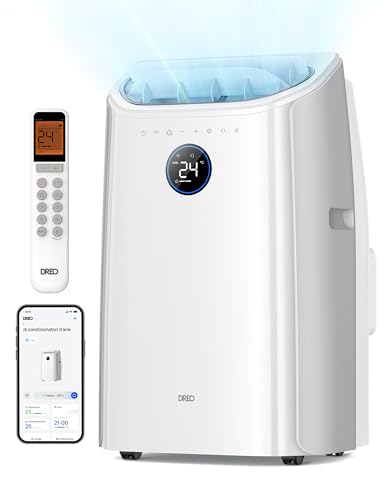
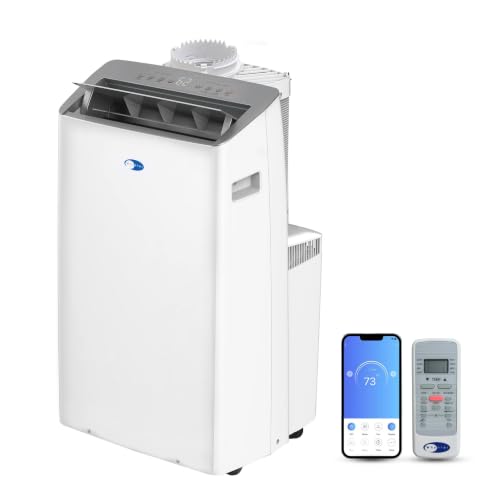
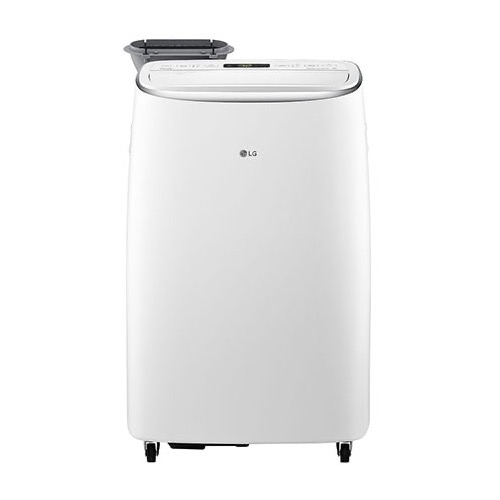
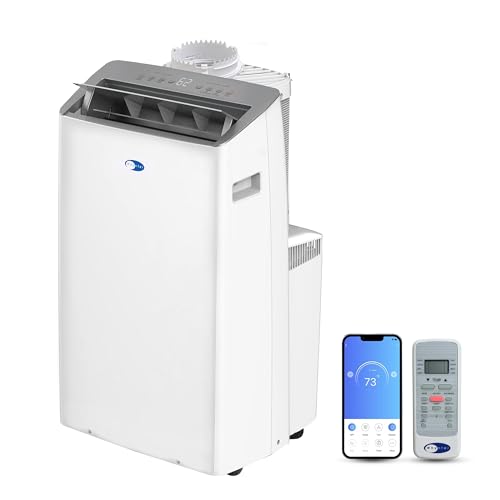
Which brands make the best quiet portable air conditioners?
The best quiet portable air conditioner brands are ranked below:
- [shortcode-05955974146652018410072466258625945020593173234963] (Average overall score: [shortcode-04178003084908462148134210153641926428161242147909])
- [shortcode-10832891833579365417031241513299317267271242611283] (Average overall score: [shortcode-11723302255614422666082596112701442754781418660389])
The chart below ranks quiet portable air conditioner brands by average overall score.
[horizontal-chart-15818965153899661283047832860023782717410243506241]
What decibel level counts as quiet for a portable air conditioner?
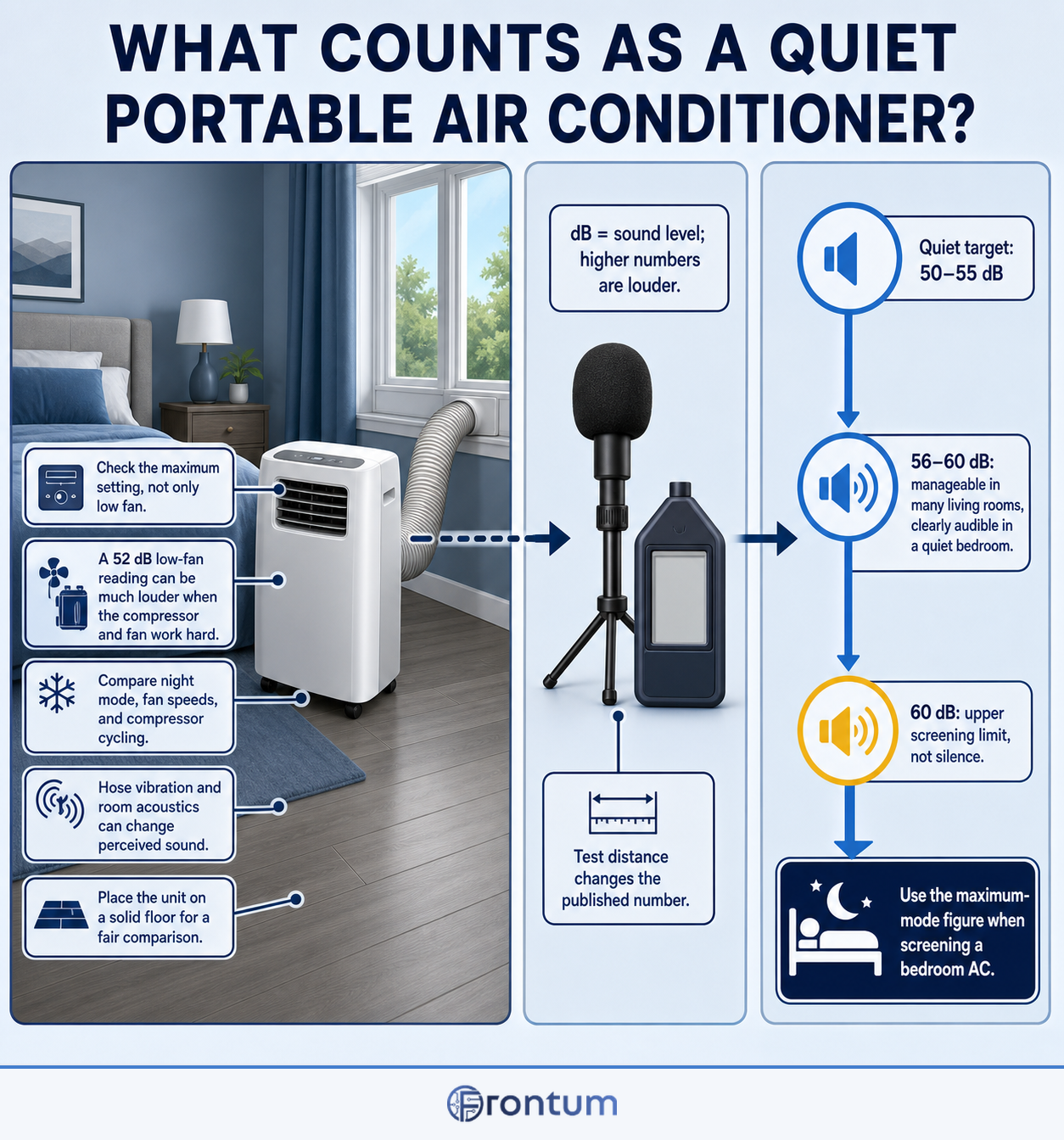
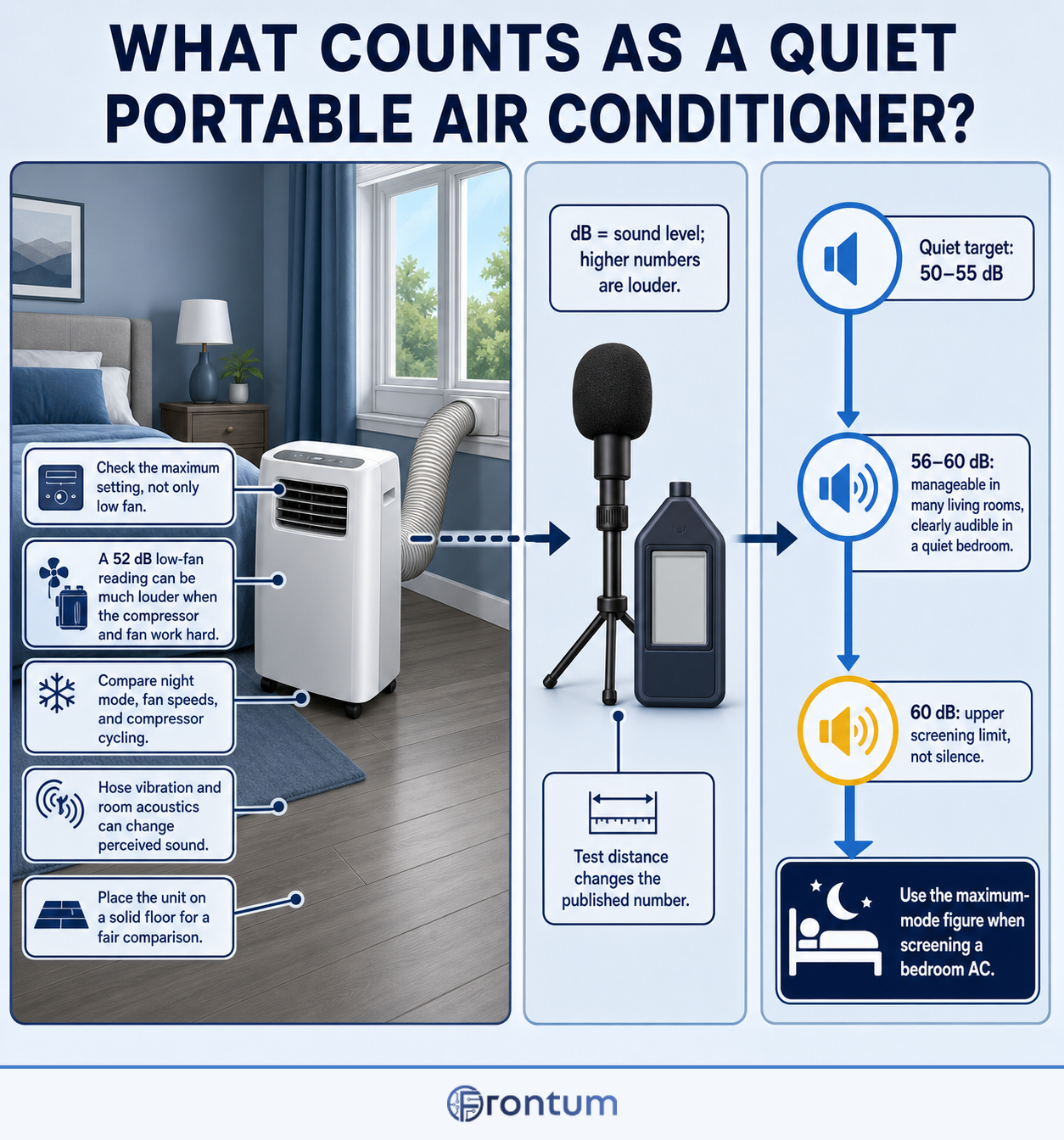
A quiet portable air conditioner typically has a maximum noise rating around 50–55 dB; 56–60 dB is still manageable for many living rooms but clearly audible in a quiet bedroom. Treat 60 dB as an upper screening limit rather than a promise of silence.
Check whether the number is measured at the maximum setting, because a unit that reaches 52 dB on low fan may be much louder when the compressor and fan are working hard. Also compare night-mode behavior, fan-speed control, compressor cycling, and the distance used for the manufacturer’s test.
Why can two portable air conditioners with the same noise rating sound different?
Two portable air conditioners with the same dB rating can sound different because the number does not describe the full sound spectrum or the operating condition. One may produce a smooth low compressor hum, while another adds a sharper fan tone, vibration, or periodic compressor starts that are more noticeable at night.
Room acoustics also matter: hard walls, a window recess, and a hose touching furniture can reflect or transmit sound. Compare ratings at the same mode, place the unit on a level solid floor, isolate the hose from walls, and read independent listening impressions when sleep comfort is the priority.
A unit that is quiet at low fan may still become louder when it must remove a large heat load. Correct sizing and a good window seal help it reach the set temperature without running continuously at maximum output.
Quieter operation does not inherently reduce cooling, but a quiet or sleep mode often lowers fan speed and compressor output, so the room may cool more slowly. That trade-off is useful at night when holding a stable temperature matters more than rapid pull-down.
Inverter compressors can maintain cooling at a lower steady speed, while fixed-speed units may alternate between louder full output and silence. Choose the capacity for the room, seal the window kit, and check whether the advertised quiet figure applies while the compressor is actually cooling rather than only to fan-only operation.
What BTU capacity is best for a quiet bedroom or home office?
For a quiet bedroom or home office, about 7,000–9,000 BTU/h is usually a sensible starting point for roughly 15–25 m², while 10,000–12,000 BTU/h suits a larger or sunnier room around 25–35 m². The exact choice depends on insulation, windows, ceiling height, and outdoor heat.

Avoid oversizing simply to finish faster: a large unit may cycle abruptly, raise peak noise, and remove less moisture. A correctly sized model can run at a lower fan setting for longer, which is often more comfortable for sleep and calls.
If the room is open to a hall or receives strong afternoon sun, size for the extra heat or cool a smaller closed zone. Verify the manufacturer’s room-size guidance and use a good window seal before concluding that more BTU is needed.
Which settings help a portable air conditioner stay quiet at night?
The most useful settings for keeping a portable air conditioner quiet at night are as follows:
- Sleep or night mode: Use the mode that reduces fan speed or adjusts the set point gradually, then confirm that it still maintains enough cooling for the room.
- Low or automatic fan: Start with low fan once the room is comfortable; automatic control can raise airflow briefly when heat returns instead of running loudly all night.
- Timer: Set a switch-off or delayed-start time around your sleep schedule, and use a restart function only when the unit and socket support it safely.
- Moderate set temperature: A realistic target avoids constant maximum cooling. Setting the thermostat several degrees below the room temperature often adds noise without improving sleep.
- Eco or inverter control: These can reduce compressor cycling and hold a steadier temperature, provided the unit is correctly sized for the room.
- Airflow and placement: Aim the louvres away from the bed, keep the hose straight, and leave clearance around the intake so vibration and fan speed do not rise unnecessarily.
How much do quiet portable air conditioners cost?
Quiet portable air conditioners usually cost about £220-£860. Entry quiet models around £220-£300 generally provide 7,000–9,000 BTU/h, basic timers, and a 55–60 dB maximum rating.
Mid-range choices around £300-£500 are more likely to combine stronger cooling with several fan speeds, sleep controls, inverter operation, or better sealing and remote control. Premium models near £800-£900 can add compact designs, heating, smart control, or especially refined sound behavior, but check the actual cooling-mode rating before paying for features.
The chart below shows the price distribution of quiet portable air conditioners rated at 60 dB or less.
[vertical-chart-16299279189775411605038348009368813997453903515518]