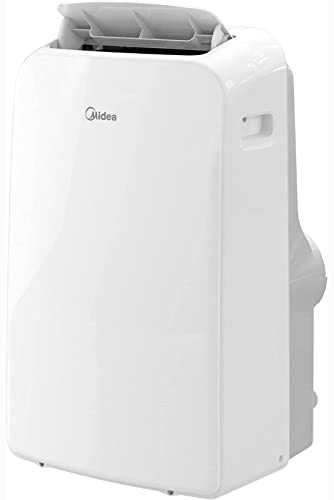

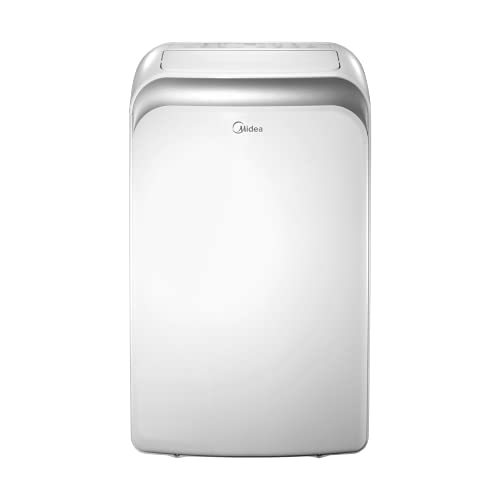
Are Midea portable air conditioners good?
Midea portable air conditioners are a practical mid-range choice when you want broad room coverage and useful controls, but the line is not uniformly quiet or smart.
Midea portable air conditioners cover 8,500–12,000 BTU/h and 23–44 m². The MAP06S1JWT-B is the lightest at 22.6 kg and adds Wi‑Fi and voice control with 42–52 dB operation; the 12,000-BTU MPD and MPPDZ units cover 41–44 m² but reach 63 dB. The 9,000-BTU MPPDA sits between them at 29.5 kg and up to 62 dB.
Midea portable air conditioners are less suitable if you need an inverter compressor, built-in heating, or consistently low noise. All four models are non-inverter and have no heating function, while the largest 38 kg MPPDZ is much less convenient to move; check the exact regional listing for condensate and hose details because configurations are not identical.
What are the main advantages of Midea portable air conditioners?
The main advantages of Midea portable air conditioners are as follows:
- Capacity ladder: Midea covers 8,500–12,000 BTU/h and published room claims from 23 to 44 m², so the MAP06 compact unit and the two 12,000-BTU cabinets serve different room loads.
- Connected compact option: MAP06S1JWT-B combines Wi‑Fi, voice control and MSmartHome with a 22.6 kg cabinet and 42–52 dB published noise, giving the line its clearest smart and portable option.
- Automatic comfort controls: The larger MPD, MPPDA and MPPDZ models offer three speeds, automatic airflow, fan-only mode, remote control and 24-hour timers; verify the exact model because MAP06 speed data are not published.
- Flexible moisture handling: MAP06, MPPDA and MPPDZ list self-evaporating, continuous-drain and tank options, which can reduce routine emptying while still allowing a hose drain in humid conditions.
- Accessible pricing: Prices run from £230 to £420, so buyers can enter with a connected compact model or spend more for 9,000–12,000 BTU coverage without moving into premium-brand pricing.
What are the main disadvantages of Midea portable air conditioners?
The main disadvantages of Midea portable air conditioners are as follows:
- Fixed-speed cooling: All four models list no inverter compressor, so output cycles rather than modulates continuously; this can be less even and less efficient than an inverter design.
- Noise gap: Published maximum noise ranges from 52 dB on MAP06 to 62–63 dB on the larger models, and MPD starts at 50.4 dB; check cooling-mode ratings for bedroom use.
- Heavy large cabinets: Weight rises from 22.6 kg MAP06 to 29.5, 33 and 38 kg, while MPPDZ stands 87.5 cm tall and 51 cm wide; stairs and storage need planning.
- Inconsistent features: MPPDZ lacks night and dehumidification modes in the listing, while MPD includes an ionizer and MAP06 adds smart control; do not assume one Midea model has another’s feature set.
- Installation details need checking: Regional listings do not consistently state hose configuration or drain arrangements, so confirm the window kit, exhaust hose and continuous-drain route before purchase.
Who makes Midea portable air conditioners?
Midea portable air conditioners are made by Midea Group, a publicly listed appliance company founded in 1968 and headquartered in Foshan, Guangdong, China. Midea describes the group as a Fortune Global 500 business with more than 190,000 employees and operations in over 200 countries and regions.
Midea Group’s air-treatment business covers residential cooling and related climate products, backed by broad engineering and research operations. That scale supports both straightforward fixed-speed units such as the MPD and connected MSmartHome models such as MAP06S1JWT-B, while regional partners and importers can determine the warranty and service route.
What are the main Midea portable air conditioner series?
The main Midea portable air conditioner model lines are as follows:
- MAP06S1JWT-B: This compact 8,500-BTU model claims 23 m² coverage and weighs 22.6 kg. It is the connected option, with Wi‑Fi, voice control and MSmartHome, plus a 42–52 dB published noise range.
- MPPDA-09CRN7-QB7G1: The 9,000-BTU line claims 33 m² and weighs 29.5 kg. It has three speeds, 24-hour timing and 51.2–62 dB noise ratings, making it a middle-size fixed-speed choice.
- MPD-12CRN7: This 12,000-BTU model claims 41 m² and weighs 33 kg. It adds three speeds, automatic airflow and 355–420 m³/h airflow figures, but its maximum noise is 63 dB and it has no Wi‑Fi.
- MPPDZ-12CRN7-QB6A: The largest cabinet in the set also claims 12,000 BTU, reaching 44 m² at 38 kg. It retains three speeds and a 24-hour timer, but lacks night and dehumidification modes in the listing and reaches 63 dB.
How much do Midea portable air conditioners cost?
Midea portable air conditioners in this range cost about £230-£420. The MAP06S1JWT-B is the entry-priced model at £230, while the 12,000-BTU MPPDZ is £340, MPD is £400, and 9,000-BTU MPPDA is £420.
At £230, MAP06 buys compact 8,500-BTU cooling for a claimed 23 m² with Wi‑Fi and voice control. Spending £340-£420 moves to 9,000–12,000 BTU and 33–44 m², but the cabinets weigh 29.5–38 kg and publish up to 62–63 dB, so the extra cost buys coverage rather than consistently quieter operation.
What should you consider while choosing the best Midea portable air conditioner?
When choosing the best Midea portable air conditioner, compare the following model-specific factors:
- Capacity and room size: MAP06S1JWT-B is 8,500 BTU/h for a claimed 23 m²; MPPDA is 9,000 BTU/h for 33 m²; MPD and MPPDZ are 12,000 BTU/h for 41–44 m². Match the delivered rating to heat load, insulation and open doors rather than choosing by BTU label alone.
- Noise and sleeping: MAP06 publishes 42–52 dB, MPPDA 51.2–62 dB, MPD 50.4–63 dB and MPPDZ 63 dB. Prefer the lower figures for bedrooms, but check test mode and hose vibration because maximum ratings are not directly identical across sellers.
- Weight and footprint: Weights run from 22.6 kg MAP06 to 29.5 kg MPPDA, 33 kg MPD and 38 kg MPPDZ; widths range about 29.5–51 cm and heights 70–87.5 cm. Measure doorways, storage and window clearance before selecting a 12,000-BTU cabinet.
- Connected control: Only MAP06 lists Wi‑Fi, voice control and MSmartHome; the other three list no Wi‑Fi or voice control but provide remote or touch controls. Choose the smart option only if app control matters and regional support is available.
- Modes and timing: MPD, MPPDA and MPPDZ list three speeds and 24-hour timers; MPPDZ does not list night or dehumidification, while MAP06 lists night and dehumidification but not a speed count. Confirm the exact mode set rather than assuming all Midea controls match.
- Drainage and installation: MAP06, MPPDA and MPPDZ list self-evaporating, continuous-drain and tank handling; hose configuration is not consistently stated, and the MPD listing does not specify condensate handling. Confirm the supplied window kit, exhaust hose and continuous-drain route before installation.
- Compressor and refrigerant: All four models list no inverter compressor; MAP06 uses R32 and the larger models use R290. Expect fixed-speed cycling and verify the local energy label or rated input, especially because only MAP06 has a published 870 W input in the current listing.