


Are Cuisinart immersion blenders good?
Cuisinart immersion blenders have an average overall score of 6.3, ranking #49 among all immersion blender brands, and an average review score of 8.1, placing them at #10 among brands graded by independent reviewers.
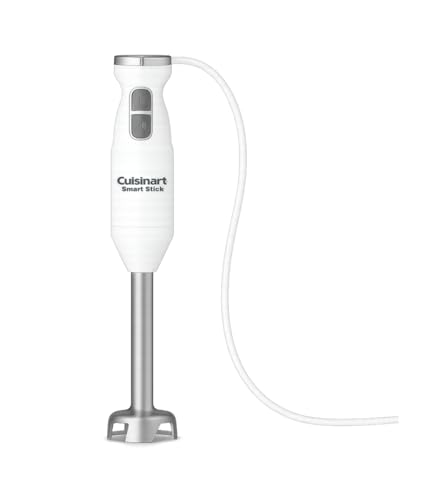
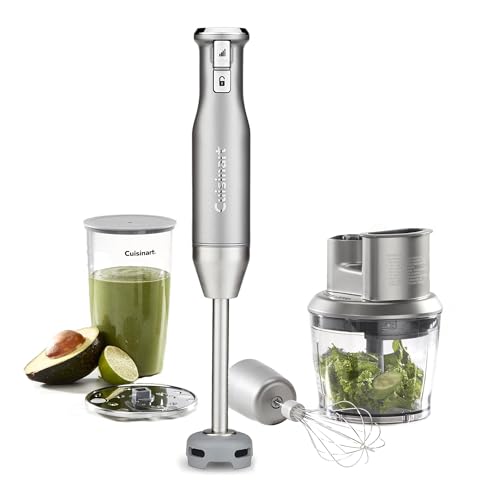
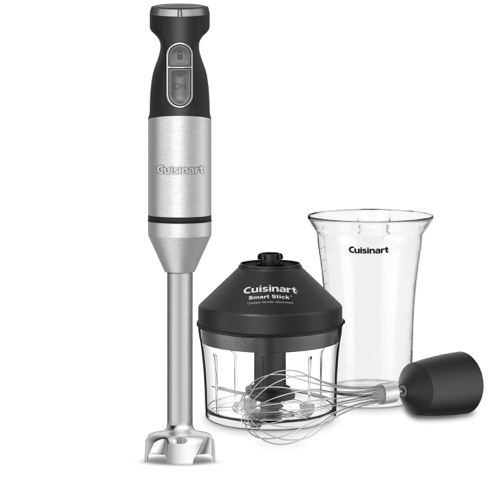
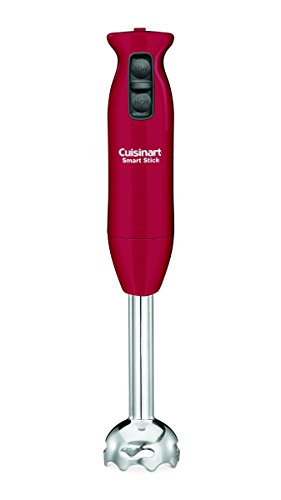
Cuisinart is best known for its Smart Stick hand blenders, a compact design from the American brand that made the food processor popular in home kitchens. The CSB-75 and CSB-179P1 belong to that family, with 200–300 W motors, a stainless steel shaft and one-touch buttons. The CSB-750H steps up to 750 W for thicker purées.
The main weakness is power. Most models sit well below the 1000 W common at other brands and use a two-point blade. Fibrous mixtures such as raw kale or frozen berries take longer and leave more bits. Spare parts and accessories are also harder to find in Europe than parts for European brands.
(Note: A total of 61 brands were evaluated in the comparison in the first paragraph. Only those with at least 3 immersion blender models in our database were included.)
The chart below ranks immersion blender brands by average overall score.
[horizontal-chart-01236393224515583485153992884091065572451810322944]What are the main advantages of Cuisinart immersion blenders?
The main advantages of Cuisinart immersion blenders are the following:
- Light and compact: The CSB-75 and CSB-175 are slim sticks that fit a drawer. They suit quick jobs such as a smoothie or a cup of soup.
- Speed choice: The CSB-179P1, CSB300 and Power Blend 400W offer 5 speeds. You start low in a tall cup and step up gradually, which cuts splashing.
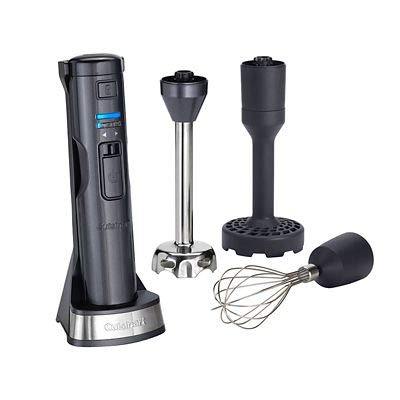
- Cordless option: The RHB-100 runs without a cord at 13,800 rpm. You blend at the stove or the table without hunting for a socket.
- Low entry price: The CSB-75 costs £30 with two speeds and a 13,000 rpm blade. That is enough for soups and shakes for very little money.
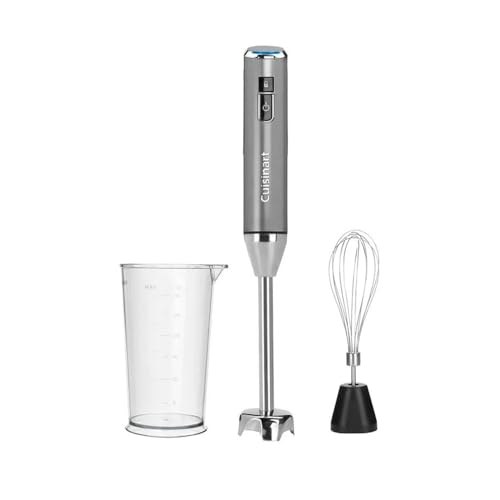
- Useful kits: The CSB-179P1 and CSB-750H come with 3 accessories, typically a whisk, a chopper and a beaker. You cover most small kitchen jobs from one box.
What are the main disadvantages of Cuisinart immersion blenders?
The main disadvantages of Cuisinart immersion blenders are as follows:
- Low power: The CSB-33R has 135 W and the CSB-75 200 W. Frozen fruit and raw root vegetables slow these motors down noticeably.
- Two-point blades: Most models, including the CSB-175RP1 and Power Blend 400W, use a two-point blade. It cuts less per turn than the four-point foot on the CSB-175.
- Basic cheap kits: The CSB-75 and CSB-175RP1 come with 1 accessory, usually a beaker. A chopper means buying extra or stepping up to the CSB-179P1.
- Modest specs at the top: The CSB300 costs £150 with a 300 W motor. Similar money buys far more power from other brands.
- Patchy availability: Models such as the CSB-750H and RHB-100 appear at fewer European retailers. Spare shafts and chopper lids are harder to source.