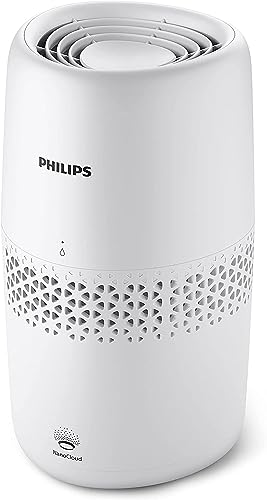
Are Philips humidifiers good?
Philips humidifiers have an average overall score of 6.5, ranking #5 among comparable humidifier brands, and a user rating of 8.2, placing them at #4 based on user reviews.
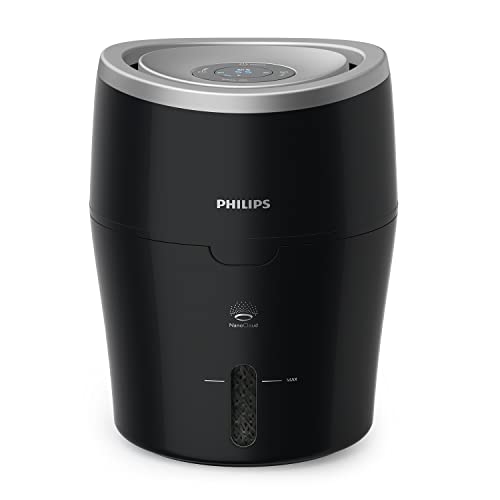
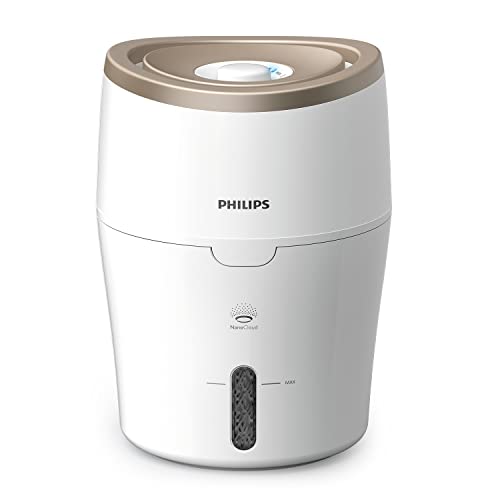
Philips humidifiers are a strong choice for buyers who want evaporative NanoCloud operation, low mineral-aerosol risk, and a clear progression from compact 2000 Series models to the larger 3000 Series. Automatic shut-off, optional hygrostats, and quiet night settings support bedroom and living-room use.
Philips humidifiers are less suitable when you need hot mist, app control, or a very large tank. Most models use 2–3 L reservoirs and the evaporative filter needs regular attention, while the exact HU model determines noise, runtime, room rating, and whether a washable filter is included.
The chart below compares Philips with other humidifier brands by average overall score.
[horizontal-chart-02668668939914719101041846797898946685933330701769]
What are the main advantages of Philips humidifiers?
The main advantages of Philips humidifiers are as follows:
- NanoCloud evaporative output: The evaporative process adds moisture without projecting a visible mineral mist, which is useful around furniture, electronics, and bedrooms.
- Quiet everyday operation: Published maximum noise levels range from about 23 dB on the quietest 2000 Series model to roughly 33–34 dB on the higher-output units, with lower settings quieter still.
- Straightforward sizing: The 2000 Series covers about 25–40 m² with 190–275 ml/h output, while the 3000 Series reaches about 45 m² and 300 ml/h.
- Useful control features: Many HU models include a hygrostat, automatic low-water shut-off, water-level indication, and multiple output levels.
- Low electrical demand: Listed power draw is around 11–25 W, so continuous humidification uses much less electricity than a heated warm-mist appliance.
What are the main disadvantages of Philips humidifiers?
The main disadvantages of Philips humidifiers are as follows:
- Limited tank size: Most models use 2 L reservoirs and the 3000 Series uses 3 L, so maximum-output operation can require more frequent refills than a 5–10 L large-room unit.
- Filter ownership: Evaporative models need a wick or filter to be inspected, cleaned, or replaced. A clogged filter reduces output and can add cost even though it lowers mineral aerosol.
- No app ecosystem: The Philips humidifier range is focused on buttons, dials, indicators, and automatic sensing rather than Wi-Fi, scheduling from a phone, or voice control.
- Model-code variation: HU2510/10, HU2716/10, HU480x, HU481x, and HU391x models differ in hygrostat, washable-filter, noise, runtime, and room-area details, so the series name alone is not enough.
- Narrow technology choice: Philips humidifiers in this range are evaporative; buyers wanting warm mist or a visible ultrasonic plume need to consider another technology or brand.
Who makes Philips humidifiers?
Philips humidifiers are made and marketed under the Philips consumer brand by Versuni, the Netherlands-headquartered home-appliance company that took over Philips Domestic Appliances in 2021. Royal Philips remains the wider Philips brand owner, while Versuni manages the domestic humidifier portfolio and regional support.
The current range is organized around Philips 2000 and 3000 Series NanoCloud evaporative appliances, with model codes such as HU2510/10, HU2716/10, HU4803/01, HU4814/10, and HU3918/10 identifying different room ratings, output, sensors, and filters. Manufacturing can vary by model and market, so the complete HU code and local warranty terms matter.
This structure explains why Philips humidifiers share the same core evaporative approach but differ in hygrostat, noise, runtime, washable-filter, and tank details. Buyers should use the exact model specification rather than assuming that every Philips humidifier has the same controls or maintenance requirements.
What are the main Philips humidifier series?
The main Philips humidifier series are as follows:
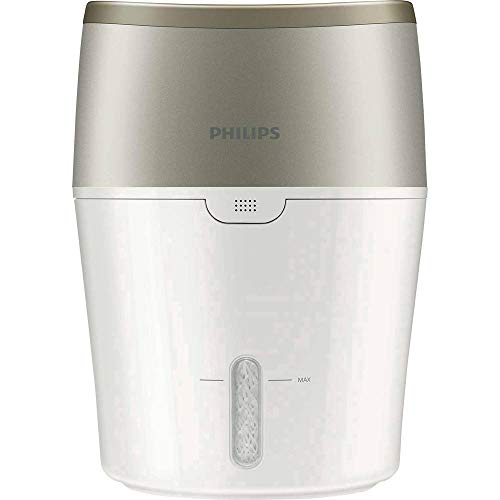
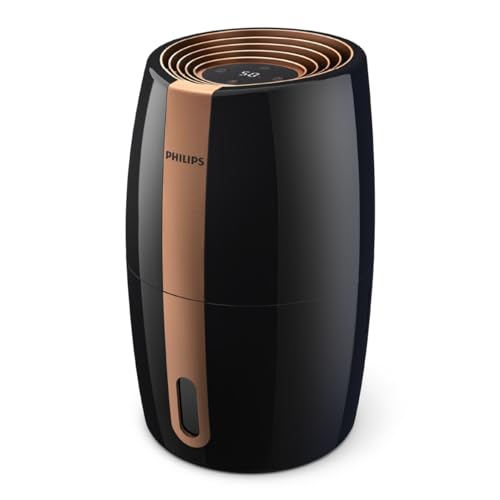
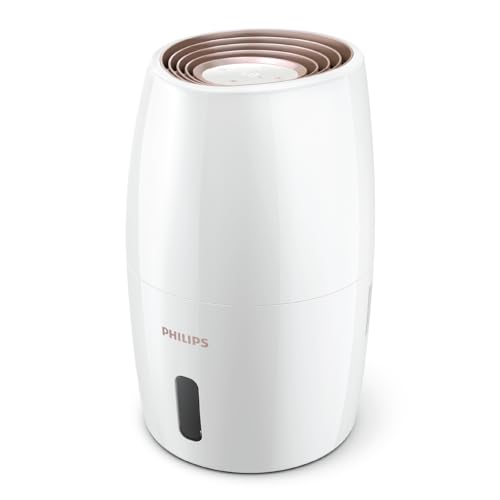
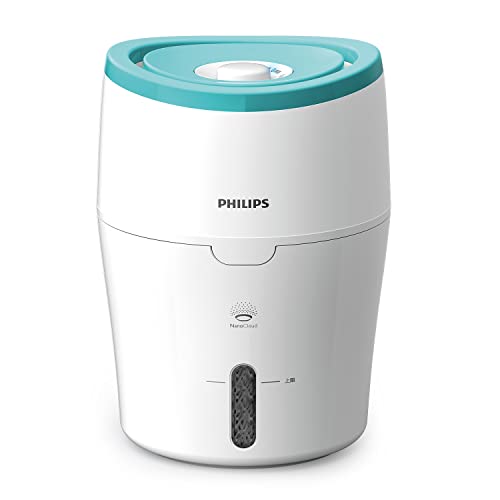
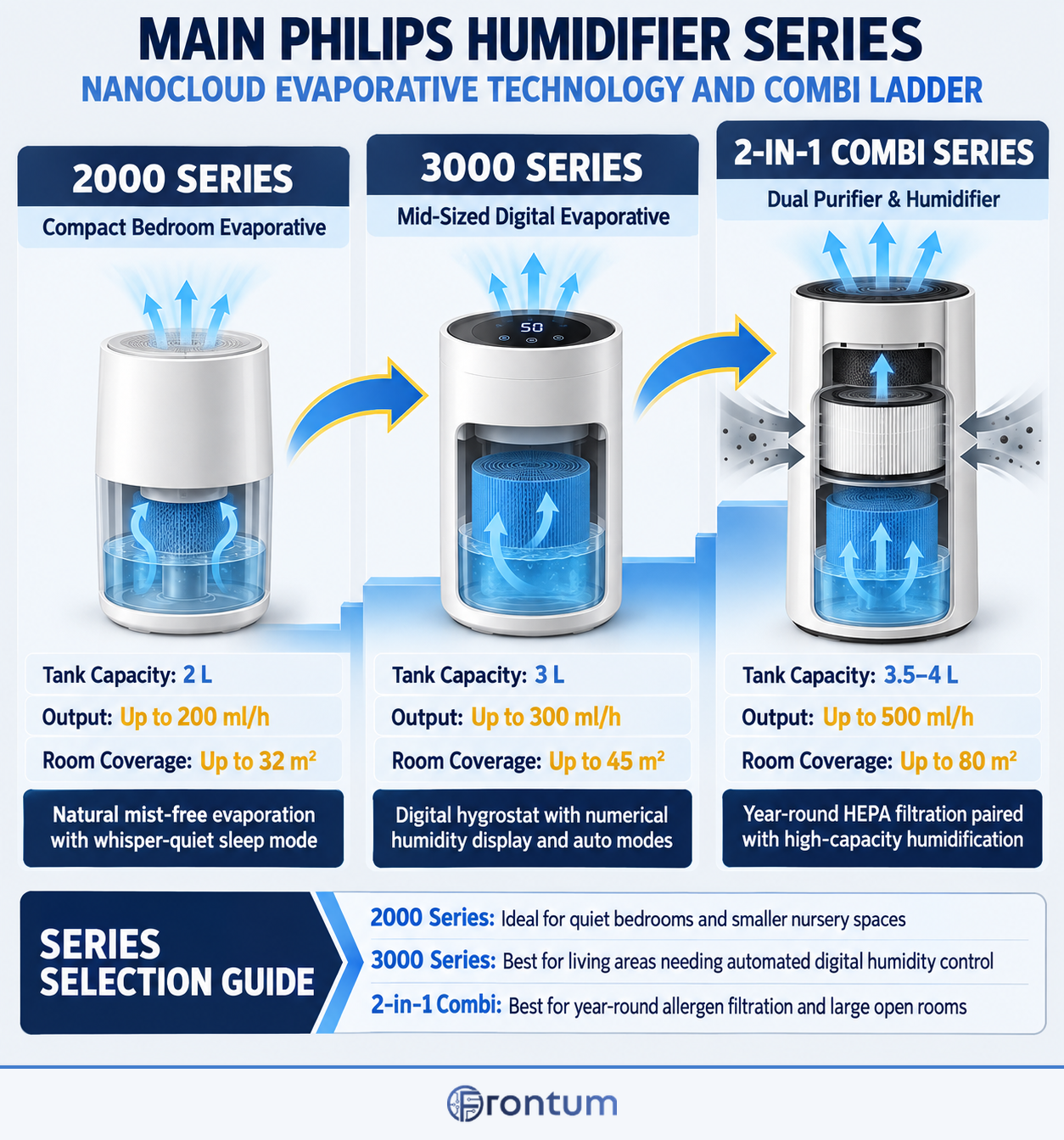
- 2000 Series: This is the compact family, with 2 L tanks, roughly 190–275 ml/h output, and room ratings from about 25 to 40 m². HU2510/10 is the quiet, simpler entry model, while HU2716/10, HU4803/01, HU4811/10, HU4814/10, and HU2718/10 add different hygrostat, output, runtime, or filter combinations.
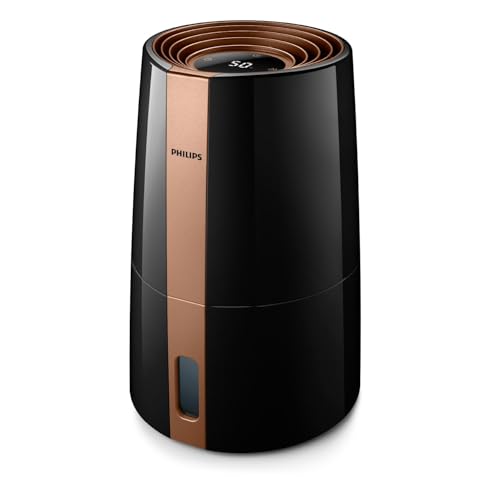
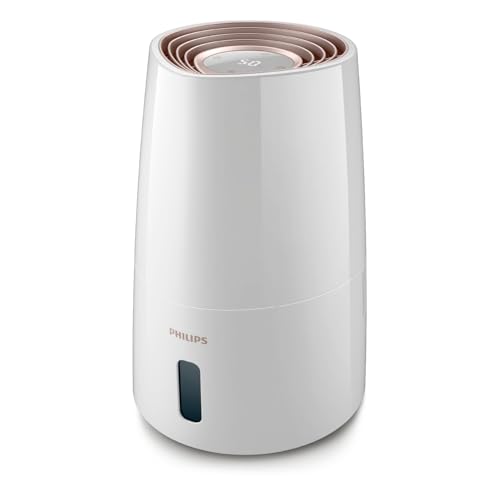
- 3000 Series: HU3916/10 and HU3918/10 raise the room rating to about 45 m², output to 300 ml/h, tank capacity to 3 L, and maximum runtime to about 20 hours. They suit a larger bedroom or living room but remain evaporative rather than smart or warm-mist appliances.
- NanoCloud platform: NanoCloud is the shared evaporative technology across these families, not a separate tank size or control tier. Compare the full HU code for noise, washable-filter support, humidity sensing, and low-water behaviour.
How much do Philips humidifiers cost?
Philips humidifiers generally cost about £50-£130, with compact 2000 Series models near £50-£100 and the higher-output 2000 and 3000 Series versions around £90-£130.
At the lower end, HU2510/10 and HU2716/10 provide 2 L tanks, evaporative output around 190–200 ml/h, and room ratings near 31–32 m². Around £70-£100, models such as HU4801/01, HU4811/10, and HU2718/10 add higher output, a hygrostat, or a larger rated room depending on the exact code.
At £120-£130, HU4803/01, HU4814/10, and the 3000 Series models offer stronger output or broader room coverage. The premium is mainly for 220–300 ml/h output, 40–45 m² ratings, a 3 L tank, or more complete sensing; check filter replacement and the exact HU specification before paying more.
How do Philips humidifiers compare with other brands?
Philips humidifiers are strongest when you want a quiet evaporative appliance with a recognizable support and filter ecosystem. Compared with ultrasonic brands such as LEVOIT or Dreo, Philips NanoCloud models produce no visible mineral mist and are more forgiving of ordinary tap-water residue, but they use a wick or filter that must be maintained.
Philips also offers less smart-home choice than many newer competitors. Most models rely on local controls and humidity sensing rather than Wi-Fi, voice commands, or app schedules, so they suit buyers who prefer a simple appliance.
The range sits in a mid-market price band of roughly £50-£130. LEVOIT and Dreo extend further into 5–10 L tanks, high output, and connected control, while Philips focuses on compact 25–45 m² rooms, low power draw, and predictable evaporative operation. Match the technology and exact room rating before comparing brand names alone.
What should you consider while choosing a Philips humidifier?
Before choosing a Philips humidifier, consider the following factors:
- Room rating and output: Match the stated 25–45 m² coverage and roughly 190–300 ml/h output to the room. Choose the 3000 Series for a larger living room, while a 2000 Series model is easier to place in a bedroom or office.
- Tank and runtime: A 2 L 2000 Series tank normally supports about 10–15 hours, while the 3 L 3000 Series reaches about 20 hours under its published conditions. A larger tank reduces refills but adds carrying weight.
- Humidity control: Prefer a model with a hygrostat when you want it to stop near a target instead of running continuously. HU2510/10 and HU4801/01 lack a hygrostat, while many HU2716, HU4803, HU4811, HU4814, HU2718, and HU391x versions include one.
- Noise and placement: Published maximum noise ranges from about 23 dB to 44 dB. Check the exact model and use the lower setting for sleep; leave clearance around the air inlet and keep water away from sockets.
- Filter care: Confirm whether the filter is washable and whether replacement wicks are available locally. The HU4811/10 and HU2718/10 list washable filters, while other models require replacement or manual-specific care.
- Technology fit: Philips humidifiers are evaporative and cool-mist. Choose another product if you specifically need warm mist, visible ultrasonic output, app control, or aromatherapy.
- Price and support: Normal prices run about £50-£130. Compare the exact HU code, filter cost, warranty, and local parts support rather than paying more for a higher series number alone.