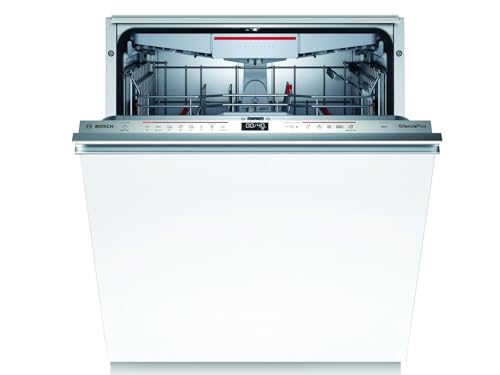

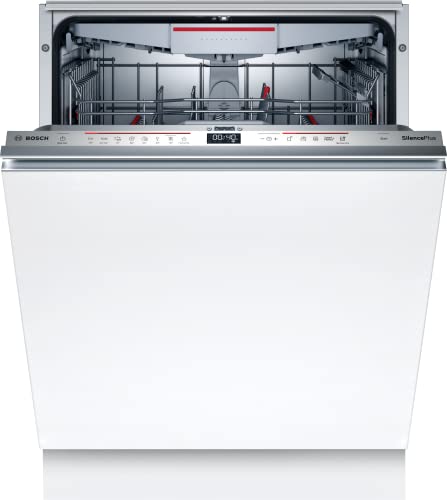
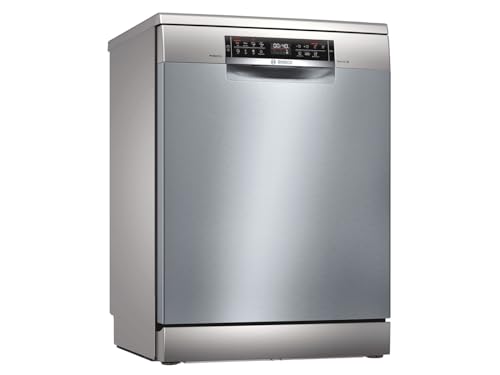
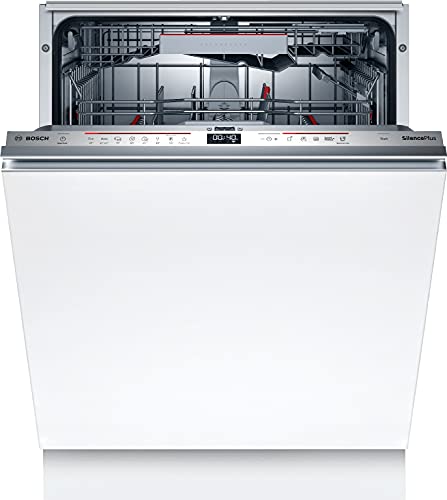
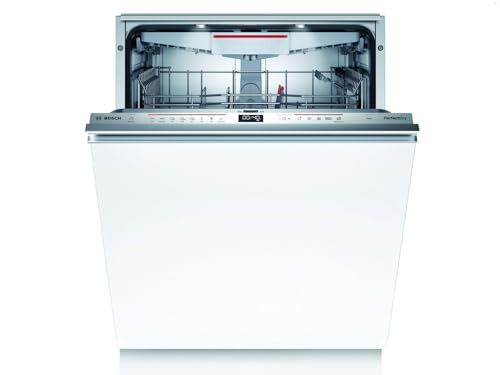
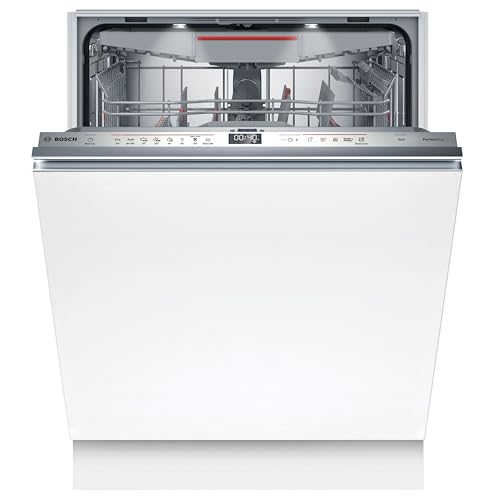
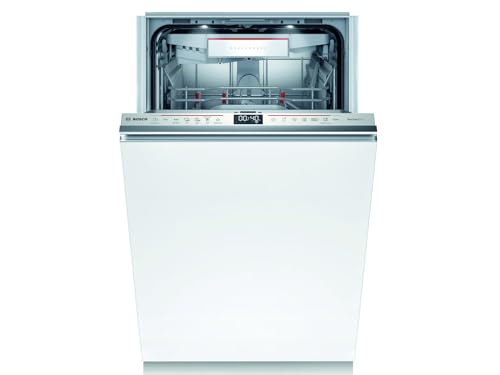
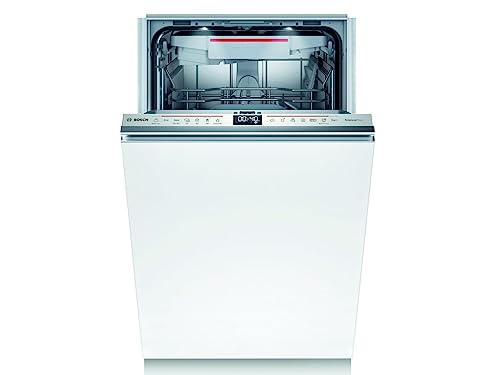
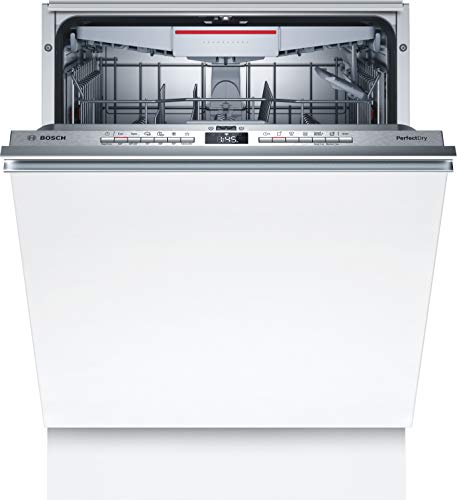
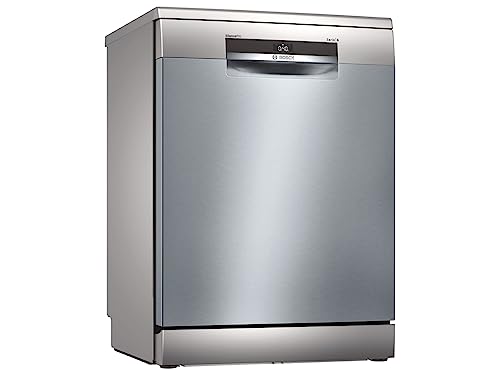
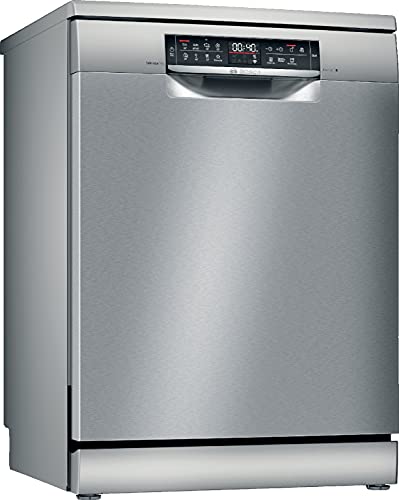
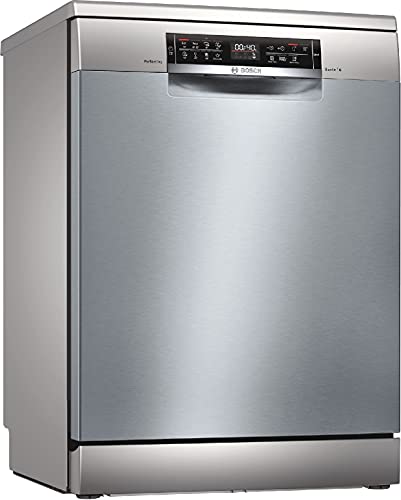
What features define Bosch Series 6 dishwashers?
The following features most clearly define Bosch Series 6 dishwashers:
- Range position and formats: Series 6 is an upper-mid-range family available in 60 cm freestanding and integrated designs plus selected 45 cm integrated models. Full-size capacity is usually 13–14 place settings, whereas slim versions commonly hold 10, so width affects both loading flexibility and energy used per item.
- Rack and loading systems: Max Flex or VarioFlex baskets, Rackmatic three-level upper-basket adjustment, folding supports, VarioDrawer or third-rack storage, and Extra Clean Zone may be included. Check the exact layout because a nominal 14-place capacity does not show whether tall plates, wine glasses, pans, and cutlery can fit together.
- Drying technology: EfficientDry opens the door near the end of the cycle to release moisture, while PerfectDry uses Zeolith minerals to absorb moisture and release heat. PerfectDry is normally the stronger choice for plastics, but it can increase purchase price and does not remove the need to load concave items correctly.
- Wash control: Auto programs, AquaSensor load sensing, SpeedPerfect Plus, Intensive Zone, Machine Care, and favorite-program storage are common differentiators. A higher program count is less important than having sensor-controlled daily washing, a genuinely intensive option, and suitable spray coverage.
- Noise and efficiency: Representative Series 6 models span roughly 38–44 dB, which ranges from very quiet to clearly suitable for most open-plan kitchens. Eco consumption varies substantially—approximately 0.59–1.05 kWh among typical configurations—so compare the energy label, place settings, Eco duration, and water use rather than assuming every Series 6 is equally efficient.
- Connectivity and status: Home Connect can provide remote start, notifications, program assistance, and downloadable functions, while integrated models may use InfoLight or TimeLight to show cycle status. Verify whether remote start must be enabled at the machine after each cycle and whether the chosen status display remains visible with the kitchen layout.

How does Bosch Series 6 compare with Series 4 and Series 8?
Bosch Series 6 is generally the best balance for buyers who want more flexible racks, quieter operation, connected functions, and a choice of advanced drying without automatically paying Series 8 prices. Series 4 remains the stronger value option when standard condensation or automatic-door drying, simpler baskets, and roughly mid-range noise are sufficient.
Compared with Series 4, Series 6 more often offers Max Flex baskets, stronger third-rack arrangements, Extra Clean Zone, lower-noise variants, TimeLight, and a wider choice between EfficientDry and PerfectDry with Zeolith. The improvement is practical when the dishwasher regularly handles plastics, mixed cookware, delicate glasses, or evening loads near a living area; it is less valuable if the machine is used mainly for straightforward full loads.
Series 8 sits above Series 6 and is aimed at buyers seeking Bosch’s most complete basket, lighting, control, and drying packages. Its incremental benefit can be small when a Series 6 model already provides 14 settings, approximately 40–43 dB operation, Home Connect, Max Flex racks, and PerfectDry, so compare exact model codes rather than paying for the series number alone.
How much do Bosch Series 6 dishwashers cost?
Bosch Series 6 dishwashers generally cost about £560-£820, although unusually discounted or highly specified models can fall outside this range. Width, freestanding versus integrated construction, rack system, noise, energy class, and EfficientDry versus PerfectDry explain most of the difference.
At roughly £560-£650, expect selected 45 cm or simpler full-size models, usually with Home Connect and competent rack adjustment but potentially fewer premium loading or display features. Around £650-£730, the range is broader and can include 13–14-place full-size models, quieter operation, Max Flex equipment, automatic-door drying, TimeLight, or better energy performance.
Above about £730, models more often add PerfectDry with Zeolith, premium baskets, interior lighting, lower noise, stronger status projection, or specialized integrated hardware. A price above £860 should be justified by a specific installation requirement or a combination of drying, efficiency, racks, and noise—not the Series 6 badge by itself.
The chart below shows the price distribution of Bosch Series 6 dishwashers.
[vertical-chart-17792587561068904302069502432702771365761441284366]
What should you consider when choosing a Bosch Series 6 dishwasher?
Before buying a Bosch Series 6 dishwasher, consider the following factors:
- Exact model code: Series 6 is a range position, not a fixed specification. Decode the complete model because width, installation format, hinge, baskets, drying, controls, lighting, energy class, and noise can differ even between similarly priced machines.
- Installation and dimensions: Confirm 45 or 60 cm width, niche height and depth, furniture-panel weight, fixed or sliding hinge, plinth clearance, hose routing, ventilation, and open-door projection. A fully integrated model also needs a suitable visible status system such as InfoLight, TimeLight, or app notification.
- Capacity and rack geometry: Full-size Series 6 models with 13–14 place settings generally suit 3–5 people and slim models with about 10 settings suit 1–3 people, but the basket layout determines usable capacity. Test plate diameter, stemware supports, pan height, Rackmatic adjustment, folding tines, cutlery storage, and whether Extra Clean Zone occupies useful loading space.
- Drying system: Choose EfficientDry when automatic opening and good everyday efficiency are sufficient; choose PerfectDry with Zeolith when plastics and mixed loads are frequent. Check Eco-cycle duration, steam release near worktops, door clearance, and whether the price premium solves a real drying problem.
- Noise and efficiency: For Bosch Series 6, 40–44 dB, about 0.59–0.75 kWh, and 9–10 L per Eco cycle is a strong target; 45 dB or more, above 0.90 kWh, or above 11 L is relatively weak for the premium. A 0.20 kWh difference equals about 56 kWh over 280 annual cycles.
- Programs and controls: Priority should go to Auto, Eco, Intensive, SpeedPerfect Plus, Machine Care, and any required hygiene or quiet function instead of counting programs. Check whether Home Connect adds functions you will use and whether remote start needs to be re-enabled at the appliance.
- Protection and ownership costs: Verify AquaStop or equivalent inlet-hose and base-tray protection, warranty terms, service access, replacement rack parts, and water-softener adjustment. Compare the dishwasher, installation kit, furniture work, energy, detergent, salt, and rinse aid as one ownership cost.