Netgear EX7500 Review | 63 Data compared

double-arrow
  • Avg. price in UK: ~£110
  • Avg. price in US: ~$160
  • Wi-Fi version: Wi-Fi 5 (802.11ac)
  • Wi-Fi speed: 2200 Mbps
  • Coverage area: 214

Netgear EX7500 review. Compare 63 technical specifications and user reviews to see how it ranks among wi-fi extenders and if it is worth buying.

6.8

Overall score

What it is: An overall evaluation of the Wi-Fi extender's quality, based on technical analyses and user reviews.

When it matters: When you need a quick reference to spot the best Wi‑Fi extenders overall.

Score components:

80.0%

6.4

Technical Score

20.0%

8.2

User score

Good
6.4

Technical Score

What it is: An assessment of the Wi-Fi extender's technical performance, covering eight key areas: speed, coverage, signal stability, connectivity, Ethernet features, mesh support, ease of setup, and design.

When it matters: When you want to compare Wi‑Fi extenders based on speed, coverage, ports, and wireless features.

Score components:

40.0%

6.9

Wi-Fi Performance

30.0%

5.4

Network & Security

12.0%

8.7

Setup & Management

10.0%

5.6

Hardware & Deployment

8.0%

5.5

Ports

Good
8.2

User score

What it is: A rating that combines user reviews and the total number of reviews received by the Wi-Fi extender.

When it matters: When you want to know how a Wi‑Fi extender performs in daily use and how reliably it maintains a stable connection over time according to user feedback.

Score components:

70.0%

7.4

User reviews

30.0%

10

Popularity

User score:
United Kingdom
amazon
3.7
(4234)
United States
Amazon_logo.png
3.7
(4699)

(Reviews last updated: June 2026)

Excellent
  • 5.9
    Gaming

    Score components:

    35.0%

    7.3

    Wi-Fi speed

    30.0%

    10

    QoS support

    20.0%

    1.0

    Ethernet backhaul

    15.0%

    1.0

    N. of LAN ports

  • 7.8
    Travel

    Score components:

    45.0%

    7.9

    Weight

    30.0%

    10

    Portable design

    15.0%

    7.3

    Wi-Fi speed

    10.0%

    1.0

    Access Point mode

  • netgear-ex7500
  • netgear-ex7500
  • netgear-ex7500
  • netgear-ex7500
netgear-ex7500
netgear-ex7500
netgear-ex7500
netgear-ex7500

Best prices in UK

Best rankings

?

Available: ranking among products currently available (including other versions of this product).
All: ranking among all products in the database.

Verdict

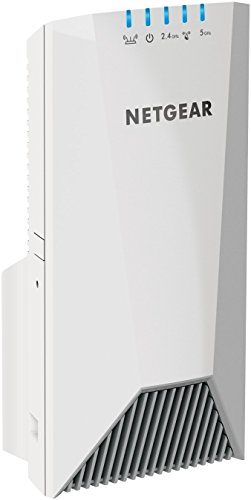
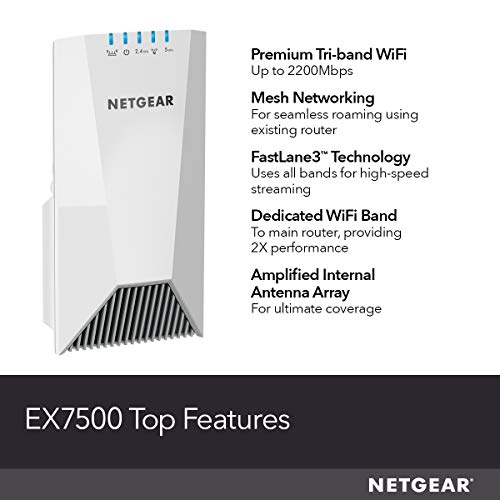
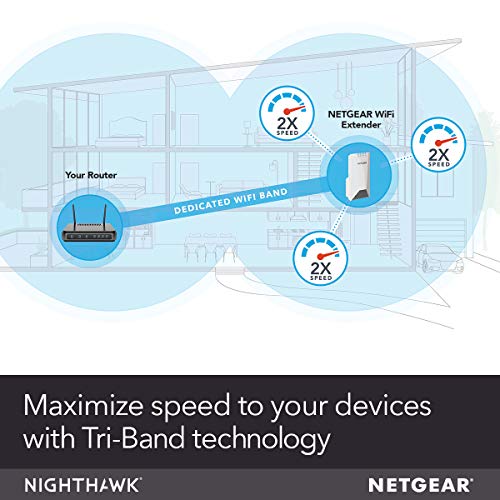
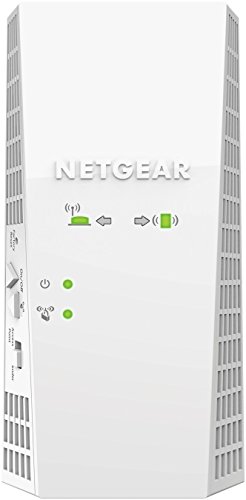
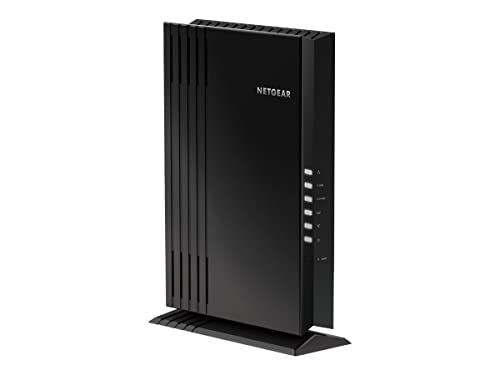
The Netgear Nighthawk X4S EX7500 is a wall-plug AC2200 tri-band WiFi mesh extender that provides combined speeds of up to 2.2Gbps and covers up to 2,300 square feet for 45 devices. Its main characteristic is FastLane3 technology, which uses a dedicated 5GHz wireless backhaul to maintain high bandwidth between the extender and router, while Smart Roaming allows for a single network name (SSID) across the home. Key pros include seamless 4K streaming, easy one-button WPS setup, and universal compatibility with any standard router. However, notable cons include the lack of any physical Ethernet ports for wired devices, a bulky design that often blocks adjacent power outlets, and mixed reports regarding long-term connection stability.

Technical Specifications of Netgear EX7500

Technical Score

What it is: An assessment of the Wi-Fi extender's technical performance, covering eight key areas: speed, coverage, signal stability, connectivity, Ethernet features, mesh support, ease of setup, and design.

When it matters: When you want to compare Wi‑Fi extenders based on speed, coverage, ports, and wireless features.

Score components:

40.0%

6.9

Wi-Fi Performance

30.0%

5.4

Network & Security

12.0%

8.7

Setup & Management

10.0%

5.6

Hardware & Deployment

8.0%

5.5

Ports

6.4
Netgear EX7500 has a technical score of 6.43 points, which is lower than 65.7% of Wi-Fi extenders.
User score

What it is: A rating that combines user reviews and the total number of reviews received by the Wi-Fi extender.

When it matters: When you want to know how a Wi‑Fi extender performs in daily use and how reliably it maintains a stable connection over time according to user feedback.

Score components:

70.0%

7.4

User reviews

30.0%

10

Popularity

User score:
United Kingdom
amazon
3.7
(4234)
United States
Amazon_logo.png
3.7
(4699)

(Reviews last updated: June 2026)

8.2
Netgear EX7500 has a user score of 8.18 points, which is higher than 49% of Wi-Fi extenders.
Popularity
What it is: An indicator based on the number of reviews received by the Wi-Fi extender.
When it matters: When you prefer to buy a Wi‑Fi extender that has already been chosen and reviewed by many other users.
10
Netgear EX7500 has a popularity of 10 points, which is higher than 49% of products in this category.
Ratio quality/price

What it is: An indicator that combines the Wi-Fi extender's overall rating with its cost.

When it matters: When you are looking for a Wi‑Fi extender with a good balance between performance and price.

Score components:

60.0%

6.8

Overall score

40.0%

9.9

Price

7.7
Netgear EX7500 has a quality-to-price ratio of 7.7 points, which is lower than 64.7% of products in this category.
Wi-Fi version
What it is: The Wi‑Fi generation the extender supports, such as Wi‑Fi 5, Wi‑Fi 6, or Wi‑Fi 6E.
When it matters: When you want the extender to work well with newer routers and support modern wireless features.

Importance: HIGH

Wi-Fi 5 (802.11ac)
Netgear EX7500 supports Wi-Fi 5 (802.11ac), more advanced than 9.8% of Wi-Fi extenders and equal to 44.1% of Wi-Fi extenders.
Wi-Fi bands
What it is: The wireless frequency bands the extender can use.
When it matters: When your router and devices depend on support for the right Wi‑Fi bands.

Importance: HIGH

Tri-band
Netgear EX7500 supports Tri-band, more versatile than 86.3% of Wi-Fi extenders and equal to 13.7% of Wi-Fi extenders.
Bands: 2.4 GHz + 5 GHz + 5 GHz.
6 GHz band support
What it is: Whether the extender can operate on the 6 GHz band.
When it matters: When you want the extender to work well with newer routers and support modern wireless features.

Importance: LOW

no
Netgear EX7500 does not support the 6 GHz band. 5.9% of Wi-Fi extenders support the 6 GHz band.
Wi-Fi speed
What it is: The combined theoretical maximum wireless speed across the supported bands.
When it matters: When you need better speed and signal strength in rooms that are harder to reach.

Importance: HIGH

2,200 Mbps
Netgear EX7500 reaches 2200 Mbps Wi-Fi speed, faster than 68.6% of Wi-Fi extenders and equal to 2% of Wi-Fi extenders.
Max speed 2.4 GHz
What it is: The maximum supported wireless speed on the 2.4 GHz band.
When it matters: When you need better speed and signal strength in rooms that are harder to reach.

Importance: MEDIUM

400 Mbps
Netgear EX7500 reaches 400 Mbps on 2.4 GHz, slower than 52% of Wi-Fi extenders and equal to 8.8% of Wi-Fi extenders.
Show more
Ethernet backhaul
What it is: Whether the extender supports Ethernet backhaul through a wired network connection.
When it matters: When you want a more stable link over Ethernet instead of relying only on wireless repeating.

Importance: MEDIUM

no
Netgear EX7500 does not support Ethernet backhaul. 52.2% of Wi-Fi extenders support Ethernet backhaul.
Mesh compatibility
What it is: The mesh systems or ecosystems the extender can work with.
When it matters: When you want smoother roaming and more consistent coverage across your home.

Importance: LOW

N/A
Mesh standard
What it is: The mesh standard or ecosystem the extender uses.
When it matters: When you want smoother roaming and more consistent coverage across your home.

Importance: LOW

proprietary mesh
Roaming feature
What it is: Whether the extender supports seamless roaming between network nodes.
When it matters: When you want smoother roaming and more consistent coverage across your home.

Importance: MEDIUM

yes
Netgear EX7500 supports roaming. 17.7% of Wi-Fi extenders support roaming.
Via Smart Roaming.
802.11k support
What it is: Whether the extender supports 802.11k for better roaming information between access points.
When it matters: When you want smoother roaming and more consistent coverage across your home.

Importance: LOW

yes
Netgear EX7500 supports 802.11k. 27.1% of Wi-Fi extenders support 802.11k.
Show more
N. of LAN ports
What it is: The number of wired LAN ports on the extender.
When it matters: When you need to connect wired devices such as TVs, consoles, PCs, or switches.

Importance: MEDIUM

0
Netgear EX7500 has 0 LAN port/s, fewer than 92.9% of Wi-Fi extenders and equal to 7.1% of Wi-Fi extenders.
Wireless only.
Ethernet port speed
What it is: The maximum Ethernet speed supported by the wired ports.
When it matters: When you connect wired devices and want them to run at full local network speed.

Importance: MEDIUM

1 Gbps
Netgear EX7500 offers 1 Gbps Ethernet speed, faster than 25.7% of Wi-Fi extenders and equal to 64.4% of Wi-Fi extenders.
N. of USB ports
What it is: The number of USB ports on the extender.
When it matters: When you need to connect wired devices such as TVs, consoles, PCs, or switches.

Importance: LOW

0
Netgear EX7500 has 0 USB port/s, equal to 97.1% of Wi-Fi extenders.
PoE standard
What it is: The Power over Ethernet standard the extender supports, if any.
When it matters: When you want to power the extender over Ethernet instead of using a separate power adapter.

Importance: LOW

N/A
Dedicated smartphone app
What it is: Whether the extender can be managed through a dedicated smartphone app.
When it matters: When you want easier setup, monitoring, and control from your phone.

Importance: MEDIUM

yes
Netgear EX7500 comes with a dedicated smartphone app. 15.2% of Wi-Fi extenders come with a dedicated smartphone app.
Nighthawk app.
Web UI management
What it is: Whether the extender offers a web-based interface for setup and management.
When it matters: When you prefer advanced setup and control from a web browser.

Importance: MEDIUM

yes
Netgear EX7500 has a web management interface. 2% of Wi-Fi extenders have a web management interface.
Web UI at mywifiext.net.
Automatic firmware updates
What it is: Whether the extender can install firmware updates automatically.
When it matters: When you want security and stability updates without having to manage them manually.

Importance: LOW

no
Netgear EX7500 does not have automatic firmware updates. 48% of Wi-Fi extenders have automatic firmware updates.
LED control
What it is: Whether the extender’s LED indicators can be adjusted or turned off.
When it matters: When the extender sits in a bedroom or another space where bright status lights can be annoying.

Importance: LOW

yes
Netgear EX7500 has LED control. 12.1% of Wi-Fi extenders have LED control.
LED control setting available.
Buttons present
What it is: The physical buttons available on the extender, such as reset, power, or WPS.
When it matters: When you prefer direct physical controls instead of relying only on software menus.

Importance: LOW

wps, reset, power
Show more
Mounting type
What it is: The mounting style the extender uses, such as wall-plug or desktop placement.
When it matters: When the extender needs to fit neatly into a tight space, behind furniture, or near an outlet.

Importance: LOW

wall-plug
Portable design
What it is: Whether the extender has a travel-friendly portable design, usually a compact plug-in form factor rather than a larger desktop or fixed-installation unit.
When it matters: When you want an extender that is easy to pack, move between locations, or use temporarily while travelling.

Importance: LOW

yes
Netgear EX7500 has a portable design. 34.3% of Wi-Fi extenders have a portable design.
Derived from compact plug-in form factor.
Height
What it is: The height of the extender body.
When it matters: When the extender needs to fit neatly into a tight space, behind furniture, or near an outlet.

Importance: LOW

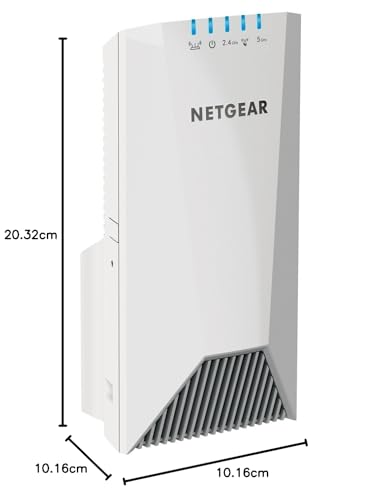
161.04 mm
Netgear EX7500 is 161.04 mm tall, taller than 80.4% of Wi-Fi extenders.
Width
What it is: The width of the extender body.
When it matters: When the extender needs to fit neatly into a tight space, behind furniture, or near an outlet.

Importance: LOW

83.82 mm
Netgear EX7500 is 83.82 mm wide, wider than 52.9% of Wi-Fi extenders.
Thickness
What it is: The depth or thickness of the extender body.
When it matters: When the extender needs to fit neatly into a tight space, behind furniture, or near an outlet.

Importance: LOW

76.2 mm
Netgear EX7500 is 76.2 mm thick, thicker than 90.2% of Wi-Fi extenders.
Show more

Netgear EX7500 vs the average wi-fi extender

  • 2 more antennas
    Netgear EX7500 has more antennas than the average wi-fi extender (4 vs 2). The average Wi-Fi extender has 2 antennas.
    What it is: The number of antennas built into or attached to the extender.
    When it matters: When you need better speed and signal strength in rooms that are harder to reach.

    Importance: LOW

    Netgear EX7500 has more antennas than the average wi-fi extender (4 vs 2). The average Wi-Fi extender has 2 antennas.4 vs 2
  • 47.6% larger coverage area
    Netgear EX7500 covers a larger area than the average wi-fi extender (214 m² vs 145 m²). The average Wi-Fi extender covers 145 m².
    What it is: The estimated area the extender is designed to cover.
    When it matters: When you need better speed and signal strength in rooms that are harder to reach.

    Importance: HIGH

    Netgear EX7500 covers a larger area than the average wi-fi extender (214 m² vs 145 m²). The average Wi-Fi extender covers 145 m².214 m² vs 145 m²
  • 23.9% faster Wi-Fi speed
    Netgear EX7500 reaches faster Wi-Fi speed than the average wi-fi extender (2,200 Mbps vs 1,775 Mbps). The average Wi-Fi extender reaches 1,775 Mbps Wi-Fi speed.
    What it is: The combined theoretical maximum wireless speed across the supported bands.
    When it matters: When you need better speed and signal strength in rooms that are harder to reach.

    Importance: HIGH

    Netgear EX7500 reaches faster Wi-Fi speed than the average wi-fi extender (2,200 Mbps vs 1,775 Mbps). The average Wi-Fi extender reaches 1,775 Mbps Wi-Fi speed.2200 Mbps vs 1775 Mbps
  • 8x more flash storage
    Netgear EX7500 has more flash storage than the average wi-fi extender (128 MB vs 16 MB). The average Wi-Fi extender has 16 MB of flash storage.
    What it is: The amount of built-in flash storage used for firmware and saved settings.
    When it matters: When you want the extender to stay responsive and capable over the long term.

    Importance: LOW

    Netgear EX7500 has more flash storage than the average wi-fi extender (128 MB vs 16 MB). The average Wi-Fi extender has 16 MB of flash storage.128 MB vs 16 MB
  • Supports DFS
    Netgear EX7500 supports DFS, while the average wi-fi extender does not. 44.7% of Wi-Fi extenders support DFS.
    What it is: Whether the extender supports DFS channels for access to additional wireless spectrum.
    When it matters: When your home or office has many nearby networks that can cause interference and congestion.

    Importance: LOW

    Netgear EX7500 supports DFS, while the average wi-fi extender does not. 44.7% of Wi-Fi extenders support DFS.
  • 14 more connected devices
    Netgear EX7500 supports more connected devices than the average wi-fi extender (45 vs 31). The average Wi-Fi extender supports up to 31 connected devices.
    What it is: The maximum number of client devices the extender is designed to handle at once.
    When it matters: When many phones, laptops, TVs, and smart-home devices are online at the same time.

    Importance: MEDIUM

    Netgear EX7500 supports more connected devices than the average wi-fi extender (45 vs 31). The average Wi-Fi extender supports up to 31 connected devices.45 vs 31
  • 2 more antennas
    Netgear EX7500 has more antennas than the average wi-fi extender (4 vs 2). The average Wi-Fi extender has 2 antennas.
  • 47.6% larger coverage area
    Netgear EX7500 covers a larger area than the average wi-fi extender (214 m² vs 145 m²). The average Wi-Fi extender covers 145 m².
  • 23.9% faster Wi-Fi speed
    Netgear EX7500 reaches faster Wi-Fi speed than the average wi-fi extender (2,200 Mbps vs 1,775 Mbps). The average Wi-Fi extender reaches 1,775 Mbps Wi-Fi speed.
  • Supports DFS
    Netgear EX7500 supports DFS, while the average wi-fi extender does not. 44.7% of Wi-Fi extenders support DFS.
  • 14 more connected devices
    Netgear EX7500 supports more connected devices than the average wi-fi extender (45 vs 31). The average Wi-Fi extender supports up to 31 connected devices.
  • 8x more flash storage
    Netgear EX7500 has more flash storage than the average wi-fi extender (128 MB vs 16 MB). The average Wi-Fi extender has 16 MB of flash storage.
  • 3 dBm weaker transmit power
    Netgear EX7500 has lower transmit power than the average wi-fi extender (20 dBm vs 23 dBm). The average Wi-Fi extender has 23 dBm of transmit power.
  • 50 Mbps slower 2.4 GHz speed
    Netgear EX7500 reaches a slower 2.4 GHz speed than the average wi-fi extender (400 Mbps vs 450 Mbps). The average Wi-Fi extender reaches 450 Mbps on 2.4 GHz.
  • No Ethernet backhaul
    Netgear EX7500 does not support Ethernet backhaul, while the average wi-fi extender does. 51.6% of Wi-Fi extenders support Ethernet backhaul.
  • No WPA3 support
    Netgear EX7500 does not support WPA3, while the average wi-fi extender does. 56.7% of Wi-Fi extenders support WPA3.
  • No Access Point mode
    Netgear EX7500 does not have Access Point mode, while the average wi-fi extender does. 91.3% of Wi-Fi extenders have Access Point mode.
  • 1 fewer LAN ports
    Netgear EX7500 has fewer LAN ports than the average wi-fi extender (0 vs 1). The average Wi-Fi extender has 1 LAN port/s.
    Wireless only.
  • 30.2 mm thicker
    Netgear EX7500 is thicker than the average wi-fi extender (76.2 mm vs 46 mm). The average Wi-Fi extender has a thickness of 46 mm.
  • 39.04 mm taller
    Netgear EX7500 is taller than the average wi-fi extender (161 mm vs 122 mm). The average Wi-Fi extender has a height of 122 mm.
  • 8.6% heavier
    Netgear EX7500 is heavier than the average wi-fi extender (304 g vs 280 g). The average Wi-Fi extender weighs 280 g.
  • 0.5 W higher power consumption
    Netgear EX7500 uses more power than the average wi-fi extender (10 W vs 9.5 W). The average Wi-Fi extender uses 9.5 W of power.
  • 3 older release date
    Netgear EX7500 was released earlier than the average wi-fi extender (2,017 vs 2,020). The average Wi-Fi extender was released in 2,020.
    October 2017
  • No Ethernet backhaul
    Netgear EX7500 does not support Ethernet backhaul, while the average wi-fi extender does. 51.6% of Wi-Fi extenders support Ethernet backhaul.
    What it is: Whether the extender supports Ethernet backhaul through a wired network connection.
    When it matters: When you want a more stable link over Ethernet instead of relying only on wireless repeating.

    Importance: MEDIUM

    Netgear EX7500 does not support Ethernet backhaul, while the average wi-fi extender does. 51.6% of Wi-Fi extenders support Ethernet backhaul.
  • No WPA3 support
    Netgear EX7500 does not support WPA3, while the average wi-fi extender does. 56.7% of Wi-Fi extenders support WPA3.
    What it is: Whether the extender supports WPA3 wireless security.
    When it matters: When you want stronger protection for your network and connected devices.

    Importance: MEDIUM

    Netgear EX7500 does not support WPA3, while the average wi-fi extender does. 56.7% of Wi-Fi extenders support WPA3.
  • No Access Point mode
    Netgear EX7500 does not have Access Point mode, while the average wi-fi extender does. 91.3% of Wi-Fi extenders have Access Point mode.
    What it is: Whether the extender can work in access point mode instead of only as a repeater.
    When it matters: When the extender needs to fit cleanly into a more advanced network setup.

    Importance: MEDIUM

    Netgear EX7500 does not have Access Point mode, while the average wi-fi extender does. 91.3% of Wi-Fi extenders have Access Point mode.
  • 1 fewer LAN ports
    Netgear EX7500 has fewer LAN ports than the average wi-fi extender (0 vs 1). The average Wi-Fi extender has 1 LAN port/s.
    Wireless only.
    What it is: The number of wired LAN ports on the extender.
    When it matters: When you need to connect wired devices such as TVs, consoles, PCs, or switches.

    Importance: MEDIUM

    Netgear EX7500 has fewer LAN ports than the average wi-fi extender (0 vs 1). The average Wi-Fi extender has 1 LAN port/s.0 vs 1
  • 3 dBm weaker transmit power
    Netgear EX7500 has lower transmit power than the average wi-fi extender (20 dBm vs 23 dBm). The average Wi-Fi extender has 23 dBm of transmit power.
    What it is: The maximum wireless transmit power of the extender.
    When it matters: When you need better speed and signal strength in rooms that are harder to reach.

    Importance: MEDIUM

    Netgear EX7500 has lower transmit power than the average wi-fi extender (20 dBm vs 23 dBm). The average Wi-Fi extender has 23 dBm of transmit power.20 dBm vs 23 dBm
  • 30.2 mm thicker
    Netgear EX7500 is thicker than the average wi-fi extender (76.2 mm vs 46 mm). The average Wi-Fi extender has a thickness of 46 mm.
    What it is: The depth or thickness of the extender body.
    When it matters: When the extender needs to fit neatly into a tight space, behind furniture, or near an outlet.

    Importance: LOW

    Netgear EX7500 is thicker than the average wi-fi extender (76.2 mm vs 46 mm). The average Wi-Fi extender has a thickness of 46 mm.76.2 mm vs 46 mm
  • 50 Mbps slower 2.4 GHz speed
    Netgear EX7500 reaches a slower 2.4 GHz speed than the average wi-fi extender (400 Mbps vs 450 Mbps). The average Wi-Fi extender reaches 450 Mbps on 2.4 GHz.
    What it is: The maximum supported wireless speed on the 2.4 GHz band.
    When it matters: When you need better speed and signal strength in rooms that are harder to reach.

    Importance: MEDIUM

    Netgear EX7500 reaches a slower 2.4 GHz speed than the average wi-fi extender (400 Mbps vs 450 Mbps). The average Wi-Fi extender reaches 450 Mbps on 2.4 GHz.400 Mbps vs 450 Mbps
  • 39.04 mm taller
    Netgear EX7500 is taller than the average wi-fi extender (161 mm vs 122 mm). The average Wi-Fi extender has a height of 122 mm.
    What it is: The height of the extender body.
    When it matters: When the extender needs to fit neatly into a tight space, behind furniture, or near an outlet.

    Importance: LOW

    Netgear EX7500 is taller than the average wi-fi extender (161 mm vs 122 mm). The average Wi-Fi extender has a height of 122 mm.161.04 mm vs 122 mm

Graphic comparison of Netgear EX7500 and

Attribute category
Attribute
No results found

Third-party reviews

United Kingdom
United States

(Reviews last updated: June 2026)

What customers like about Netgear EX7500?

  • Tri-band technology provides a dedicated backhaul to maintain high speeds without halving bandwidth
  • One WiFi Name feature allows for seamless roaming without manually switching networks
  • Effective at eliminating 'dead zones' in large homes and even outdoor areas like gardens
  • Compatible with any standard WiFi router, regardless of brand
  • Sleek wall-plug design that doesn't require extra desk space

What customers dislike about Netgear EX7500?

  • Bulky physical size can block access to adjacent electrical outlets
  • Lacks physical Ethernet ports for wired device connections
  • Setup process is often reported as tricky, fiddly, or requiring multiple attempts
  • Higher price point compared to many other standard range extenders
  • Limited to WiFi 5 technology, making it less future-proof than newer WiFi 6/7 models

Expert reviews

H
hothardware.com
23/02/2018

The Netgear Nighthawk X6S (EX8000) tri-band extender effectively eliminates Wi-Fi dead zones, utilizing a single SSID for seamless, mesh-like roaming without replacing an existing router. Key benefits include exceptional speed, strong performance, and four Gigabit Ethernet ports for wired devices, providing a "set-it-and-forget-it" experience. However, the $199 USD price point is...Read more

R
reviewed.com
17/05/2023

The Linksys RE9000 stands out as the best overall Wi-Fi extender for extending fast, high-performing networks over long distances. Operating on the fast AC3000 standard, this tri-band device features four external antennas and four Ethernet ports, making it highly versatile for heavy-use areas like home offices or garages. During testing, it effortlessly sustained multiple 4K video...Read more

S
senses.se
09/07/2018

The Netgear Nighthawk EX7500 X4S Tri-band WiFi Range Extender offers excellent performance and reliable mesh coverage once fully functional, but it suffers from a remarkably frustrating setup process. Reviewers highlighted the device's sleek, wall-plug design and its ability to seamlessly mirror an existing network identity without adding annoying suffixes. Thanks to its tri-band...Read more

T
techguide.com.au
15/02/2018

The Netgear Nighthawk X4S (EX7500) is a tri-band wall plug Wi-Fi range extender that uses FastLane3 mesh technology to eliminate internet black spots in the home. It provides up to a 100 per cent performance improvement over standard extenders by utilizing a dedicated wireless link, achieving a link rate of 270Mbps during testing when paired with routers like the Netgear X10 or...Read more

E
expertreviews.co.uk
04/04/2019

The Expert Reviews evaluation of the Netgear Nighthawk X4S wireless repeater highlights its ability to maximize throughput through a tri-band radio array, delivering it within a compact, wall-mounted design. The pros of this device include its respectable overall performance—retaining about 68% of the speed of its larger sibling, the X6S—which makes it faster than most main...Read more

T
trustedreviews.com
24/11/2020

The Netgear Nighthawk X4S (EX7500) is a high-performing, expensive Wi-Fi extender that utilizes tri-band architecture to eliminate the bandwidth degradation common in traditional repeaters. It delivers exceptional speed and integrates easily, offering a strong, unified network for existing routers. Conversely, the unit is bulky, lacks Ethernet ports and a pass-through socket, and is...Read more

D
dongknows.com
12/05/2018

The NETGEAR EX7500 Nighthawk Mesh X4S is a compact, tri-band wall-plug Wi-Fi extender designed to easily create a fast mesh network without replacing your existing router. It utilizes a dedicated AC2200 5GHz backhaul band to communicate with the main router, mimicking the efficient signal loss reduction seen in NETGEAR's Orbi systems. During testing, the extender demonstrated...Read more

M
modding.fr
25/03/2018

The Modding.fr review of the Netgear Nighthawk X4S (EX7500) identifies the device as a high-end, tri-band (AC2200) range extender, offering a unified SSID for seamless roaming and FastLane3 technology for efficient backhaul. While providing impressive speeds and a sleek wall-plug design with, the unit lacks physical Ethernet ports and features a bulky design that often blocks...Read more

Z
zeden.net
11/02/2018

The French hardware publication ZeDen published an in-depth review of the Netgear Nighthawk X4S (EX7500) Wi-Fi range extender, examining its AC2200 tri-band performance under real-world home conditions. Tested within a house plagued by signal-blocking obstacles like cinderblock walls, plasterboard partitions, and reinforced concrete pillars, the review focuses heavily on the...Read more

L
lesnumeriques.com
11/04/2026

The Netgear Orbi 970 is a premium Wi-Fi 7 mesh system consisting of one router and two satellites, designed to provide long-term, high-performance home networking. It excels with exceptional internet speeds and features a highly versatile multi-Gigabit wired connectivity setup that easily accommodates demanding network needs. Additionally, the system offers simple yet comprehensive...Read more

C
cloriou.fr
24/09/2019

This review evaluates the Netgear Nighthawk X4S (EX7500) Wi-Fi repeater, a high-end tri-band AC2200 MU-MIMO model designed to eliminate internet dead zones and extend wireless coverage throughout a home. The device is physically substantial, weighing 303 grams and measuring 84.3mm x 67.3mm x 166mm, and it operates with a powerful quad-core processor to handle multiple connections...Read more

J
journaldugeek.com
19/09/2019

The Netgear EX7500 X4S, reviewed by Journal du Geek, is a tri-band AC2200 wall-plug extender that utilizes Mesh technology and FastLane3 to create a unified network with dedicated backhaul, eliminating Wi-Fi dead zones. Its key strengths include seamless, single-SSID roaming, high-speed performance for connected devices, and a distinctive, angular white design. Conversely, the...Read more

P
profesionalreview.com
28/05/2018

The Netgear Nighthawk X4S Tri-Band WiFi Mesh Extender is a high-performance mesh network expander designed to eliminate dead zones by sharing the exact same SSID as the main router, preventing device disconnection during movement. Measuring 8.2 cm x 16.8 cm x 7.1 cm and weighing 0.6 kg, the large white plastic device features multiple ventilation cooling grilles and a built-in...Read more

R
redeszone.net
01/10/2018

The NETGEAR EX7500 Nighthawk X4S is an advanced, wall-plug style AC2200 triple-band Wi-Fi mesh extender designed to eliminate dead zones and deliver high-speed connectivity for 4K streaming and online gaming. Its standout feature is the FastLane3 technology, which utilises a dedicated 5GHz wireless band (up to 867Mbps) exclusively for the backhaul connection to the main router. This...Read more

C
console-tribe.com
15/02/2018

This review outlines the features, performance, and key differences between the Netgear EX7500 and EX8000 mesh Wi-Fi extenders, positioning them as high-end, "Ferrari-level" solutions for eliminating network dead zones without changing your router's brand. Both devices feature Netgear's Fastlane3 technology, which utilizes a dedicated 2.2Gbps wireless band strictly for communicating...Read more

Video reviews

Compare Netgear EX7500 with

VS
VS

Compare