Scored using Graphics cards Methodology v1.0
Graphics cards Methodology v1.0
Mathematical & Unbiased Scoring
Products in this category are scored under Frontum Graphics cards Methodology v1.0: technical specifications plus authentic consumer ratings, with 0% commercial bias.
Explore Graphics cards Methodology v1.0

EVGA GeForce RTX 3070 Ti FTW3 Ultra Gaming Review | 118 Data compared

Avg. price:~£710VRAM:8 GBMemory bus width:256 bitThermal Design Power (TDP):290 W

EVGA GeForce RTX 3070 Ti FTW3 Ultra Gaming Review: Compare 118 technical specifications and user reviews to see how this product ranks in the Graphics cards category and whether it is worth buying.
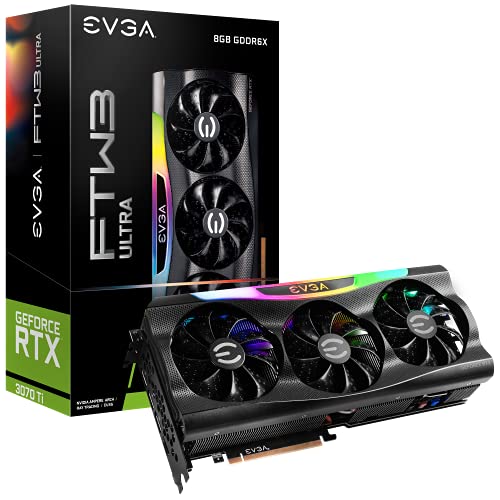
EVGA GeForce RTX 3070 Ti FTW3 Ultra Gaming
7.1/10

Overall score

Score
7.1/ 10
✕
What it is
An overall evaluation of the graphics card's quality, based on technical analyses and user reviews.
When it matters
When you need a quick reference to identify the best graphics cards on the market.
Score distribution
â–¼
<55-66-77-88-99-10
Score components

90%

6.9

Technical score

10%

9.6

User score

â–²Better than 50% of graphics cards
7.0

Value for money

Value for money
7.0/ 10
✕
What it is
An indicator that combines the graphics card's overall rating with its cost.
When it matters
When you are looking for a graphics card that offers a strong balance of performance, features, and price.
Score distribution
â–¼
<55-66-77-88-99-10
Score components

70%

7.1

Overall score

30%

6.8

Price

â–¼Worse than 62%
6.9

Technical score

Technical score
6.9/ 10
✕
What it is
An assessment of technical performance for products in the Graphics cards category across these key areas: Performance, Memory, Platform & Features, Connectivity & Media, Power & Cooling, Design.
When it matters
When you want to compare graphics cards based on technical performance and available features.
Score distribution
â–¼
<55-66-77-88-99-10
Score components

44%

6.1

Performance

24%

6.1

Memory

12%

8.3

Power & Cooling

11%

9.5

Platform & Features

5%

6.6

Design

4%

9.2

Connectivity & Media

â–¼Worse than 52%
9.6

User score

User score
9.6/ 10
✕
What it is
A rating that combines user reviews and the total number of reviews received by the graphics card.
When it matters
When you want to understand how a graphics card performs in real use and how reliable it is in terms of performance, temperatures, noise, stability, and long-term ownership.
Score distribution
â–¼
<55-66-77-88-99-10
Score components

70%

9.4

User ratings

30%

10

Number of reviews

Based on ratings from across the web.
★Better than 99%
  • evga-geforce-rtx-3070-ti-ftw3-ultra-gaming
  • evga-geforce-rtx-3070-ti-ftw3-ultra-gaming
  • evga-geforce-rtx-3070-ti-ftw3-ultra-gaming
  • evga-geforce-rtx-3070-ti-ftw3-ultra-gaming
  • evga-geforce-rtx-3070-ti-ftw3-ultra-gaming
  • evga-geforce-rtx-3070-ti-ftw3-ultra-gaming
  • evga-geforce-rtx-3070-ti-ftw3-ultra-gaming
  • evga-geforce-rtx-3070-ti-ftw3-ultra-gaming
  • evga-geforce-rtx-3070-ti-ftw3-ultra-gaming
  • evga-geforce-rtx-3070-ti-ftw3-ultra-gaming
evga-geforce-rtx-3070-ti-ftw3-ultra-gaming
Best prices
*As an Amazon Associate, we earn from qualifying purchases.
Loading...
Loading category ranking...

Technical Specifications of graphics card EVGA GeForce RTX 3070 Ti FTW3 Ultra Gaming

Technical score
Technical score
6.9/ 10
✕
What it is
An assessment of technical performance for products in the Graphics cards category across these key areas: Performance, Memory, Platform & Features, Connectivity & Media, Power & Cooling, Design.
When it matters
When you want to compare graphics cards based on technical performance and available features.
Score distribution
â–¼
<55-66-77-88-99-10
Score components:

44%

6.1

Performance

24%

6.1

Memory

12%

8.3

Power & Cooling

11%

9.5

Platform & Features

5%

6.6

Design

4%

9.2

Connectivity & Media

6.9
User score
User score
9.6/ 10
✕
What it is
A rating that combines user reviews and the total number of reviews received by the graphics card.
When it matters
When you want to understand how a graphics card performs in real use and how reliable it is in terms of performance, temperatures, noise, stability, and long-term ownership.
Score distribution
â–¼
<55-66-77-88-99-10
Score components

70%

9.4

User ratings

30%

10

Number of reviews

Based on ratings from across the web.
9.6
Popularity
Popularity
10/ 10
✕
What it is
An indicator based on the number of reviews received by the graphics card.
When it matters
When you prefer a graphics card that has already been chosen and reviewed by many other users.
Score distribution
â–¼
<55-66-77-88-99-10
Popularity:
EVGA GeForce RTX 3070 Ti FTW3 Ultra Gaming has a popularity score of 10 points, which is higher than that of 91.9% of products in this category.
10
Value for money
Value for money
7.0/ 10
✕
What it is
An indicator that combines the graphics card's overall rating with its cost.
When it matters
When you are looking for a graphics card that offers a strong balance of performance, features, and price.
Score distribution
â–¼
<55-66-77-88-99-10
Score components:

70%

7.1

Overall score

30%

6.8

Price

7.0
3DMark Time Spy benchmark score
14,600 points
This graphics card scores 14,600 points in 3DMark Time Spy, which is lower than 50.1% of graphics cards and equal to 0.1% of graphics cards.
3DMark Port Royal score
8,800 points
This graphics card scores 8,800 points in 3DMark Port Royal, which is lower than 51.5% of graphics cards and equal to 0.2% of graphics cards.
PassMark (G3D) result
22,492 points
This graphics card scores 22,492 points in PassMark G3D, which is lower than 53.6% of graphics cards and equal to 0.3% of graphics cards.
PassMark (DirectCompute) result
7,611 points
This graphics card scores 7,611 points in PassMark DirectCompute, which is lower than 72.5% of graphics cards and equal to 0.2% of graphics cards.
Floating-point performance
22.86 TFLOPS
This graphics card delivers 22.86 TFLOPS floating-point performance, which is lower than that of 50.2% of graphics cards and equal to that of 0.1% of graphics cards.
Show more
VRAM
8 GB
This graphics card has 8 GB of VRAM, which is less than 57.5% of graphics cards and equal to 25.1% of graphics cards.
Memory type
GDDR6X
GDDR version
GDDR6X
This graphics card uses GDDR6X memory, which is newer than on 56.7% of graphics cards and equal to 22.7% of graphics cards.
Memory bus width
256 bit
This graphics card uses a 256 bit memory bus, which is wider than that of 49.7% of graphics cards and equal to that of 35.9% of graphics cards.
Maximum memory bandwidth
608 GB/s
This graphics card reaches 608 GB/s memory bandwidth, which is higher than that of 63.1% of graphics cards and equal to that of 0.5% of graphics cards.
Show more
PCI Express (PCIe) version
4
This graphics card supports PCIe 4, which is newer than on 22.3% of graphics cards and equal to 52.1% of graphics cards.
PCIe lanes
x16
This graphics card uses x16 PCIe lanes, which is more than 23.4% of graphics cards and equal to 76.6% of graphics cards.
DirectX version
12 Ultimate
This graphics card supports DirectX 12 Ultimate, which is more advanced than on 22.6% of graphics cards and equal to 77.4% of graphics cards.
Vulkan version
1.4
This graphics card supports Vulkan 1.4, which is more advanced than on 20.7% of graphics cards and equal to 79.3% of graphics cards.
OpenGL version
4.6
This graphics card supports OpenGL 4.6, which is more advanced than on 1.9% of graphics cards and equal to 98.1% of graphics cards.
Show more
Max displays supported
4
This graphics card supports up to 4 displays, which is more than 8.3% of graphics cards and equal to 88.9% of graphics cards.
Max digital resolution
7680x4320
This graphics card supports a maximum digital resolution of 7680x4320, which is higher than that of 9% of graphics cards and equal to that of 91% of graphics cards.
DisplayPort outputs
3
This graphics card offers 3 DisplayPort outputs, which is more than 21% of graphics cards and equal to 76.8% of graphics cards.
DisplayPort version
1.4a
This graphics card supports DisplayPort 1.4a, which is more advanced than on 19.5% of graphics cards and equal to 47.1% of graphics cards.
DisplayPort link rates
16.2 Gbps
This graphics card supports DisplayPort link rates up to 16.2 Gbps, which is slower than on 58.4% of graphics cards and equal to 2% of graphics cards.
Show more
Thermal Design Power (TDP)
290 W
This graphics card has a TDP of 290 W, which is higher than that of 70.5% of graphics cards and equal to that of 0.6% of graphics cards.
Power consumption while under peak load
290 W
This graphics card draws 290 W under peak load, which is higher than 68.9% of graphics cards and equal to 0.5% of graphics cards.
Recommended PSU wattage
750 W
This graphics card recommends a 750 W PSU, which is higher than that of 64.5% of graphics cards and equal to that of 17.1% of graphics cards.
Board power limit
310 W
This graphics card has a board power limit of 310 W, which is higher than that of 74% of graphics cards and equal to that of 0.4% of graphics cards.
PCIe power spec
290 W
Show more
Size
300x 137x 2.75 mm
Length
300 mm
This graphics card is 300 mm long, which is longer than 56.5% of graphics cards and equal in length to 2.9% of graphics cards.
Height
136.75 mm
This graphics card is 136.75 mm tall, which is taller than 73.1% of graphics cards and equal in height to 0.4% of graphics cards.
Slot width
2.75 slot/s
This graphics card occupies 2.75 slot/s, which is wider than 67.3% of graphics cards and equal in width to 1.1% of graphics cards.
Weight
522 g
This graphics card weighs 522 g, which is lighter than 90.7% of graphics cards and equal in weight to 0.1% of graphics cards.
Show more

EVGA GeForce RTX 3070 Ti FTW3 Ultra Gaming vs the average graphics card

246810TotalPerformanceMemoryPlatform & FeaturesConnectivity & MediaPower & CoolingDesign
  • 32 more ROPs
    This graphics card has more ROPs than the average graphics card (96 vs 64). The average graphics card has 64 ROPs.
    96 vs 64
  • 35.7% higher memory bandwidth
    This graphics card has a higher memory bandwidth than the average graphics card (608 GB/s vs 448 GB/s). The average graphics card has a memory bandwidth of 448 GB/s.
    608 GB/s vs 448 GB/s
  • 8 more compute units
    This graphics card has more compute units than the average graphics card (48 vs 40). The average graphics card has 40 compute units.
    48 vs 40
  • 19.5% higher user score
    User score
    9.6/ 10
    ✕
    What it is
    A rating that combines user reviews and the total number of reviews received by the graphics card.
    When it matters
    When you want to understand how a graphics card performs in real use and how reliable it is in terms of performance, temperatures, noise, stability, and long-term ownership.
    Score distribution
    â–¼
    â–¼
    <55-66-77-88-99-10
    EVGA GeForce RTX 3070 Ti FTW3 Ultra Gaming
    the average graphics card
    EVGA GeForce RTX 3070 Ti FTW3 Ultra Gaming has a higher user score than the average graphics card (9.56 vs 8.000).
    9.56 vs 8
  • 8 more ray tracing cores
    This graphics card has more ray tracing cores than the average graphics card (48 vs 40). The average graphics card has 40 ray tracing cores.
    48 vs 40
  • 48 more AI cores
    This graphics card has more AI cores than the average graphics card (192 vs 144). The average graphics card has 144 AI cores.
    192 vs 144
  • Includes LHR limiter
    This graphics card includes an LHR limiter, the average graphics card does not.
  • 2.36x more popular
    EVGA GeForce RTX 3070 Ti FTW3 Ultra Gaming is more popular than the average graphics card (9.97 vs 4.2).
    9.97 vs 4.22
  • 19.5% higher user score
    User score
    9.6/ 10
    ✕
    What it is
    A rating that combines user reviews and the total number of reviews received by the graphics card.
    When it matters
    When you want to understand how a graphics card performs in real use and how reliable it is in terms of performance, temperatures, noise, stability, and long-term ownership.
    Score distribution
    â–¼
    â–¼
    <55-66-77-88-99-10
    EVGA GeForce RTX 3070 Ti FTW3 Ultra Gaming
    the average graphics card
    EVGA GeForce RTX 3070 Ti FTW3 Ultra Gaming has a higher user score than the average graphics card (9.56 vs 8.000).
    9.56 vs 8
  • 2.36x more popular
    EVGA GeForce RTX 3070 Ti FTW3 Ultra Gaming is more popular than the average graphics card (9.97 vs 4.2).
    9.97 vs 4.22
  • 32 more ROPs
    This graphics card has more ROPs than the average graphics card (96 vs 64). The average graphics card has 64 ROPs.
    96 vs 64
  • 8 more compute units
    This graphics card has more compute units than the average graphics card (48 vs 40). The average graphics card has 40 compute units.
    48 vs 40
  • 8 more ray tracing cores
    This graphics card has more ray tracing cores than the average graphics card (48 vs 40). The average graphics card has 40 ray tracing cores.
    48 vs 40
  • 48 more AI cores
    This graphics card has more AI cores than the average graphics card (192 vs 144). The average graphics card has 144 AI cores.
    192 vs 144
  • 35.7% higher memory bandwidth
    This graphics card has a higher memory bandwidth than the average graphics card (608 GB/s vs 448 GB/s). The average graphics card has a memory bandwidth of 448 GB/s.
    608 GB/s vs 448 GB/s
  • Includes LHR limiter
    This graphics card includes an LHR limiter, the average graphics card does not.
  • 48.9% lighter card weight
    This graphics card is lighter than the average graphics card (522 g vs 1021 g). The average graphics card weighs 1021 g.
    522 g vs 1,021 g
  • 25.7% lower boost clock speed
    This graphics card has a lower boost GPU clock than the average graphics card (1860 MHz vs 2505 MHz). The average graphics card has a boost GPU clock of 2505 MHz.
    1,860 MHz vs 2,505 MHz
  • 4 GB less VRAM
    This graphics card has fewer VRAM than the average graphics card (8 GB vs 12 GB). The average graphics card has 12 GB VRAM.
    8 GB vs 12 GB
  • 60% larger process node
    This graphics card has a higher process node than the average graphics card (8 nm vs 5 nm). The average graphics card uses a process node of 5 nm.
    8 nm vs 5 nm
  • No AV1 encoding
    This graphics card does not support AV1 encoding, the average graphics card does.
    No vs yes
  • 18% lower base clock speed
    This graphics card has a lower base GPU clock than the average graphics card (1575 MHz vs 1920 MHz). The average graphics card has a base GPU clock of 1920 MHz.
    1,575 MHz vs 1,920 MHz
  • 34.9% higher TDP
    This graphics card has a higher TDP than the average graphics card (290 W vs 215 W). The average graphics card has a TDP of 215 W.
    290 W vs 215 W
  • 32.1% slower VRAM clock
    This graphics card has a lower VRAM clock than the average graphics card (1188 MHz vs 1750 MHz). The average graphics card runs its VRAM at 1750 MHz.
    1,188 MHz vs 1,750 MHz
  • 15.4% higher PSU requirement
    This graphics card has a higher PSU requirement than the average graphics card (750 W vs 650 W). The average graphics card has a PSU requirement of 650 W.
    750 W vs 650 W
  • 34% more expensive
    EVGA GeForce RTX 3070 Ti FTW3 Ultra Gaming is more expensive than the average graphics card (£710 vs £530).
    £710 vs £530
  • 25.7% lower boost clock speed
    This graphics card has a lower boost GPU clock than the average graphics card (1860 MHz vs 2505 MHz). The average graphics card has a boost GPU clock of 2505 MHz.
    1,860 MHz vs 2,505 MHz
  • 18% lower base clock speed
    This graphics card has a lower base GPU clock than the average graphics card (1575 MHz vs 1920 MHz). The average graphics card has a base GPU clock of 1920 MHz.
    1,575 MHz vs 1,920 MHz
  • 6.3% lower texture rate
    This graphics card has a lower texture rate than the average graphics card (357.1 GTexel/s vs 381.2 GTexel/s). The average graphics card has a texture rate of 381.2 GTexel/s.
    357.1 GTexel/s vs 381.2 GTexel/s
  • 4 GB less VRAM
    This graphics card has fewer VRAM than the average graphics card (8 GB vs 12 GB). The average graphics card has 12 GB VRAM.
    8 GB vs 12 GB
  • 32.1% slower VRAM clock
    This graphics card has a lower VRAM clock than the average graphics card (1188 MHz vs 1750 MHz). The average graphics card runs its VRAM at 1750 MHz.
    1,188 MHz vs 1,750 MHz
  • 83.3% smaller L2 cache
    This graphics card has fewer L2 cache than the average graphics card (4 MB vs 24 MB). The average graphics card has 24 MB L2 cache.
    4 MB vs 24 MB
  • 60% larger process node
    This graphics card has a higher process node than the average graphics card (8 nm vs 5 nm). The average graphics card uses a process node of 5 nm.
    8 nm vs 5 nm
  • 2 older
    This graphics card was released earlier than the average graphics card (2021 vs 2023).
    June 2021
    2,021 vs 2,023
  • Older encoder generation
    This graphics card uses an older encoder generation than the average graphics card (7 vs 8). The average graphics card uses encoder generation 8.
    7 vs 8
  • Older FSR version
    This graphics card supports an older FSR version than the average graphics card (1 vs 3.1).
    1.0 vs 3.1
  • 32.9% larger GPU die
    This graphics card has a higher GPU die size than the average graphics card (392 mm² vs 295 mm²). The average graphics card has a GPU die size of 295 mm².
    392 mm² vs 295 mm²
  • No AV1 encoding
    This graphics card does not support AV1 encoding, the average graphics card does.
    No vs yes
  • Narrower decode codec support
    This graphics card supports narrower hardware decode codec support than the average graphics card (H.264/H.265/AV1/VP9 vs H.264/H.265/AV1/VP9/MPEG-2/VC-1).
    H.264/H.265/AV1/VP9 vs H.264/H.265/AV1/VP9/MPEG-2/VC-1
  • 34.9% higher TDP
    This graphics card has a higher TDP than the average graphics card (290 W vs 215 W). The average graphics card has a TDP of 215 W.
    290 W vs 215 W
  • 15.4% higher PSU requirement
    This graphics card has a higher PSU requirement than the average graphics card (750 W vs 650 W). The average graphics card has a PSU requirement of 650 W.
    750 W vs 650 W
  • 37.8% higher board power limit
    This graphics card has a higher board power limit than the average graphics card (310 W vs 225 W). The average graphics card has a board power limit of 225 W.
    310 W vs 225 W
  • 5 °C higher idle temperature
    This graphics card has a higher idle temperature than the average graphics card (42 °C vs 37 °C). The average graphics card has an idle temperature of 37 °C.
    42 °C vs 37 °C
  • 11.75 mm higher card profile
    This graphics card is taller than the average graphics card (136.8 mm vs 125 mm). The average graphics card has a height of 125 mm.
    136.75 mm vs 125 mm
  • 0.25 slot/s wider design
    This graphics card occupies more slots than the average graphics card (2.8 slot/s vs 2.5 slot/s). The average graphics card occupies 2.5 slot/s.
    2.75 slot/s vs 2.5 slot/s
  • 15 mm longer card length
    This graphics card is longer than the average graphics card (300 mm vs 285 mm). The average graphics card has a length of 285 mm.
    300 mm vs 285 mm

Video reviews

Hands-on testing, unboxing, and real-world video evaluations

Expert reviews

In-depth analysis and verdict from leading tech publications

F
funkykit.com
28/06/2021
Summary of the review
T
thefpsreview.com
22/12/2021
Summary of the review
H
hardwarespot.de
01/06/2021
Summary of the review

Third-party reviews

Based on ratings from across the web.
Reviews last updated: June 2026 · How we calculate this

What we like about EVGA GeForce RTX 3070 Ti FTW3 Ultra Gaming

  • Excellent 1440p gaming performance with high frame rates
  • Highly effective iCX3 cooling system that maintains low temperatures even under load
  • Extremely quiet fan operation during demanding tasks
  • Premium build quality with a solid metal backplate
  • Attractive, customizable ARGB lighting
  • User-friendly overclocking features and dual BIOS switch

What we don't like about EVGA GeForce RTX 3070 Ti FTW3 Ultra Gaming

  • Massive physical size (2.75 slots wide and 11.8 inches long), which may not fit in all cases
  • High power requirement, recommending at least a 750W power supply
  • Steep price premium compared to other RTX 3070 Ti models
  • Only 8GB of VRAM, which some users feel is not future-proof for 4K gaming
  • EVGA's exit from the GPU market has raised concerns regarding future RMA and warranty support

Verdict

The EVGA GeForce RTX 3070 Ti FTW3 Ultra Gaming is a high-performance graphics card built on NVIDIA's Ampere architecture, featuring 6,144 CUDA cores and a factory-overclocked boost clock of 1860 MHz. It is equipped with 8GB of ultra-fast GDDR6X memory on a 256-bit bus, delivering a bandwidth of 608 GB/s to excel in 1440p and entry-level 4K gaming. A standout characteristic is the triple-fan iCX3 cooling system, which utilizes nine thermal sensors and asynchronous fans to maintain low temperatures and quiet operation under load. Main pros include its exceptional thermal management, robust build quality with an all-metal backplate, and vibrant customizable ARGB lighting. However, notable cons include its significant 290W power draw requiring a minimum 750W PSU and its large physical footprint, which occupies 2.75 slots and may present clearance issues in smaller cases.

Compare EVGA GeForce RTX 3070 Ti FTW3 Ultra Gaming with other products in the Graphics cards category

1Product to compare no. 1
VS
2Product to compare no. 2
VS
3Product to compare no. 3 (optional)

Graphic comparison of EVGA GeForce RTX 3070 Ti FTW3 Ultra Gaming and other products in the Graphics cards category

No results found